ARM and Interest-Only ARM vs Fixed-Rate Mortgage Calculator
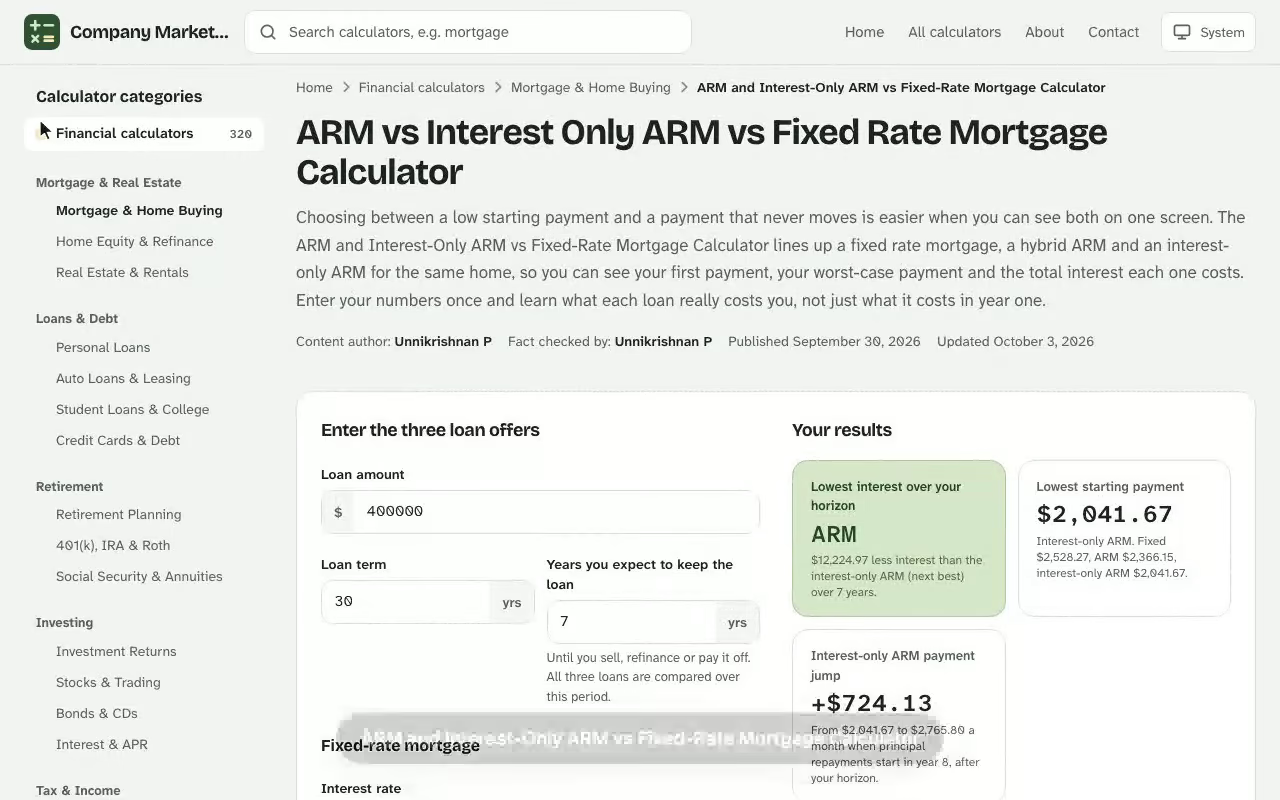
ARM and Interest-Only ARM vs Fixed-Rate Mortgage Calculator. Choosing between a low starting payment and a payment that never moves is easier when you can see both on one screen. The ARM and Interest-Only ARM vs Fixed-Rate Mortgage Calculator lines up a fixed rate mortgage, a hybrid ARM and an interest-only ARM for the same home, so you can see your first payment, your worst-case payment and the total interest each one costs. Enter your numbers once and learn what each loan really costs you, not just what it costs in year one. The amortization calculator uses the same plain-English approach, so you can compare results side by side.
Your results
Lowest interest over your horizon
–
Lowest starting payment
–
Interest-only ARM payment jump
–
Interest-only means no equity from payments
While you pay interest only, the balance does not go down. If home prices fall or you need to sell early, you owe the full amount you borrowed. ARM results depend on the rate path you assume; the worst-case rows show what happens if rates rise as fast as the caps allow.
Side-by-side over your horizon
Payments, interest and the balance you would still owe when you expect to sell or refinance. Interest is the true cost of each loan up to that point; the rest of what you pay goes to principal.
Measure
Fixed rate
ARM
Interest-only ARM
Year-by-year comparison
Rate, monthly payment and balance at the end of each year on the expected rate path. Rows within your horizon are marked with an asterisk.
Year
Fixed payment
ARM rate
ARM payment
IO ARM rate
IO ARM payment
Fixed balance
ARM balance
IO ARM balance
Results are estimates for educational purposes and are not financial, tax or legal advice.
What an ARM vs Fixed Rate Mortgage Calculator Compares
A fixed-rate mortgage holds one rate for the whole loan. An adjustable-rate mortgage starts with a lower rate for a set stretch, then lets the rate move up or down with the market. An interest only ARM adds a twist: for the first few years you pay only the interest, so none of your payment touches the balance. Putting all three beside each other is the quickest way to judge the trade between a cheap start and a predictable finish. Next, open the option arm calculator online and enter your own details to see an estimate in seconds.
The comparison works because every loan is built from the same home price, down payment and 30-year schedule. Only the rate path and the repayment style change, so any gap in cost comes from the loan structure itself.
Mortgage Amount, Starting Interest Rate and Loan Term
Start with the mortgage amount you plan to borrow after your down payment, then the starting interest rate for each product and the loan term in years. ARMs and interest-only loans usually advertise a lower initial interest rate than a fixed loan, because the lender is shifting some future rate risk onto you. Use quotes from the lender rather than a headline rate, since advertised and offered rates often differ.
See how the ARM and Interest-Only ARM vs Fixed-Rate Mortgage Calculator works: change the inputs and the lowest interest over your horizon updates instantly. Enter your own numbers in the calculator above.
Months Between Adjustments and Expected Adjustment
Two inputs describe how your rate behaves after the fixed stretch ends. The months between adjustments field is how often the rate can change; 12 is the usual answer. The expected adjustment is your own forecast of how many percentage points the rate will rise at each change. Nobody knows the market years from now, so try a mild guess and a harsh one and keep both results in view.
Interest Rate Cap and Lifetime Ceiling
Every ARM carries an interest rate cap that stops the rate from climbing without limit. Some loans cap each single change, and a lifetime figure sets a ceiling for the entire loan. The calculator stops your rate at that ceiling, which is what produces the maximum payment you see in the results. Set a rate cap lower than the contract allows and you will understate your risk.
How the Fixed vs ARM Payment Math Works
Every figure comes from the same amortization formula. For a fixed loan, your monthly payment depends on the balance, the monthly rate and the number of payments left. Once you have your inputs, open the amortization schedule to see each month's interest and principal split: The free mortgage tax saving calculator is free to use with no sign-up, and works on desktop and mobile.
$$M = P \times \frac{r(1+r)^{n}}{(1+r)^{n}-1}$$
Here \(P\) is the balance, \(r\) is the annual rate divided by 12, and \(n\) is the number of months remaining. That payment covers principal and interest only. Each month the interest is the balance times \(r\), and the rest of the payment pays down principal.
Starting Monthly Payment for a Fixed-Rate Mortgage
A fixed loan solves the formula once with the full 360 months, so the starting monthly payment is also the final one. That sameness is the stable monthly payment people pay extra for, and it lets you lock in a budget for three decades.
Interest-Only Payments and the Recast
During the interest-only period the payment is simply:
$$M_{io} = P \times r$$
The balance never shrinks, so when that period ends the loan must recast: the lender re-runs the first formula with the new rate and fewer months, so the same balance has to fully amortize over a shorter window. Fewer months and a higher rate are why the payment jumps.
ARM and Interest-Only ARM vs Fixed-Rate Mortgage Calculator Worked Example
Take a $386,400 loan over 30 years. The fixed loan carries 6.55%. The 5/1 ARM opens at 5.35%, and the interest-only ARM opens at 5.60% for five years of interest-only payments. After year five, both adjustable loans rise 1.50 percentage points, then 0.50 points each year, never passing 5.00 points above the start.
Result
Fixed rate
5/1 ARM
5-year interest-only ARM
Initial rate
6.55%
5.35%
5.60%
Monthly payment, years 1-5
$2,455.03
$2,157.71
$1,803.20
Monthly payment, year 6
$2,455.03
$2,486.01
$2,755.69
Maximum monthly payment
$2,455.03
$3,235.95
$3,576.97
Outstanding balance after year 5
$361,920
$356,551
$386,400
Total interest over 30 years
$497,411
$678,356
$756,012
Total payments over 30 years
$883,811
$1,064,756
$1,142,412
The interest-only ARM starts at $1,803.20 a month but can reach $3,576.97 once the rate cap is hit.
Initial Monthly Payment and the Reset Point
For the first 60 months the ARM saves you $297.32 a month and the interest-only loan saves you $651.83 compared with the fixed loan, or $17,839 and $39,110 across five years. The first adjustment lands at the reset point in month 61, and that is where that advantage starts to erode: the ARM payment climbs to $2,486.01, already above the fixed payment, and the interest-only payment leaps by $952.49 in one step.
The payment changes at month 61 and reaches its ceiling around month 145.
Total Interest and Outstanding Balance
The interest-only loan shows the cost of deferring principal. After five years you still owe the entire $386,400, while the fixed loan has dropped to $361,920. Over the full term, the ARM adds $180,945 in interest versus the fixed loan if rates follow this path, and the interest-only ARM adds $258,601. A cheaper start does not mean a cheaper loan.
Principal is identical at $386,400; interest is what separates the three loans.
When the Cheaper Loan Stops Being Cheaper
Add up what you actually pay and the lines converge. By the end of year ten you have paid $294,604 on the fixed loan, $291,828 on the ARM and $287,992 on the interest-only loan. If you sell or refinance before that crossover, the adjustable options come out ahead; if you stay, the stable payment wins.
Year
ARM rate
ARM payment
Interest-only ARM rate
Interest-only ARM payment
6
6.85%
$2,486.01
7.10%
$2,755.69
7
7.35%
$2,597.13
7.60%
$2,877.36
8
7.85%
$2,707.27
8.10%
$2,997.96
9
8.35%
$2,816.23
8.60%
$3,117.27
10
8.85%
$2,923.80
9.10%
$3,235.06
13 and later (ceiling)
10.35%
$3,235.95
10.60%
$3,576.97
Types of Adjustable Rate Mortgage You Can Model
Outside the United States the same product is usually called a variable rate mortgage. The names are shorthand: the first number is how many years the rate stays fixed, and the second is how often it adjusts afterward. A hybrid ARM blends a fixed period with a floating one, and that is what most lenders sell today. The fixed stretch is sometimes called the honeymoon period, because the payment is at its friendliest.
3/1 ARM: three fixed years, then a loan that adjusts once a year for 27 years. It has the lowest teaser rate and the soonest exposure.
5/1 ARM: five fixed years, then yearly changes for 25 years, the most common middle ground.
7/1 ARM: seven fixed years, then 23 years of adjustment, for borrowers who expect to move later.
10/1 ARM: ten fixed years and 20 adjusting years, priced closest to a fixed loan.
Traditional ARM: no long fixed stretch; it resets every year from the start.
Payment-Option ARM and Negative Amortization
A payment-option ARM lets you pick among a full payment, an interest-only payment and a minimum payment. When the minimum falls below the interest owed, the unpaid interest is added to your balance, which is negative amortization. A payment cap limits how fast your payment can rise each year, but it can leave a balloon payment or a forced recast at the end. This calculator assumes no negative amortization.
Testing a Hybrid ARM Against a 30-Year Fixed Before a Relocation
Dana has a job transfer penciled in for roughly six years out and a $318,750 loan to place. One lender quotes a 7/1 ARM at 5.12%; another quotes 6.38% fixed for 30 years. The question is simple: does the lower rate survive a six-year stay, and what happens if the move slips?
Dana enters $318,750, a 360-month term, 6.38% for the fixed loan and 5.12% for the ARM, then sets the first adjustment at +2.00 points to match the common 2/2/5 cap structure on the quote. The calculator returns $1,989.63 a month for the fixed loan against $1,734.57 for the ARM, a gap of $255.06.
Across the 72 months before the move, that gap adds up. The fixed loan costs $143,253 in payments and the ARM $124,889, so the ARM saves $18,364. Of the money paid, $117,463 is interest on the fixed loan versus $93,397 on the ARM, and the balance Dana would pay off at sale is $292,960 versus $287,257.
The risk is the reset. The ARM's rate is fixed for 84 months, so a six-year stay never reaches it. Dana reruns the comparison with the sale pushed to month 108, which forces one adjustment to 7.12% in month 85. The ARM payment rises to $2,072.18, only $82.55 above the fixed payment, and the 108-month total still favors the ARM, $195,436 against $214,880, a $19,444 lead.
That result settles the next step: even a three-year delay does not erase the advantage, so Dana asks the ARM lender for a written 7/1 quote showing the 2/2/5 caps and the margin, and shelves the fixed offer as the fallback if the transfer is cancelled outright.
ARM vs Interest-Only ARM: Where the Risk Sits
An interest-only loan is not simply an ARM with a smaller payment. A plain ARM calculator that treats both loans alike misses this. In a standard ARM each payment already includes some principal, so your balance is falling while your rate is still fixed. With interest-only, the whole balance rides into the adjustment period, and the payment then has to cover more principal in fewer years. Think of it as two stacked risks: rate risk and repayment risk. Lenders sometimes label this product an IO ARM, and a good interest-only adjustable rate mortgage calculator must model the recast, or it will understate your payment.
Standard ARM: payment shock comes only from the rate adjusting.
Interest-only ARM: payment shock comes from the rate adjusting and the recast to a shorter amortizing schedule.
Fixed-rate: neither shock applies, which is why it carries a higher opening payment.
Home equity also behaves differently. Interest-only borrowers build equity only through appreciation or voluntary extra payments, so a flat market leaves nothing to fall back on. If you choose this path, plan to pay down principal in the early years so the recast bites less.
Fixed-Rate Mortgage Strengths and Trade-Offs
A fixed-rate mortgage (often shortened to FRM) is the default for most homebuyers, and for good reason. You know what your payment will be in year one and year thirty, and you can still refinance if rates fall. The 30-year fixed is the most popular term, while the 15-year option costs more each month but charges far less interest.
Pro: a payment that does not change makes budgeting simple.
Pro: you start building equity from the first payment.
Con: the opening rate and payment are higher than an ARM's teaser rate.
Con: if rates drop, you must refinance, and refinancing has its own closing costs.
Costs Beyond Principal and Interest
The calculator compares principal and interest, but a real housing budget has more in it. Property taxes, mortgage insurance (PMI) when your down payment is under 20%, and HOA fees sit on top of every option equally, so they do not change which loan wins; they only raise the true cost of homeownership. They do change whether you can afford any of them.
Points and origination fees are different, because they vary by product. Discount points lower your rate for an upfront price; an origination charge pays the lender for making the loan. Add these to your closing costs and spread them over the years you expect to keep the loan before you decide.
Which Loan the Calculator Results Favor: Adjustable or Fixed
Read the comparison against how long you will keep the loan. If the first-five-year payment gap is large and the local real estate market is strong enough that you expect to sell in four to six years, a 5/1 or 7/1 captures the low introductory period and you leave before the reset. If this is a forever home, the stable payment protects you from an economy you cannot forecast. Interest-only results suit home buyers with irregular or rising income who can make large lump-sum payments, not those stretching to afford the house.
Risk tolerance matters as much as the math. If the maximum payment of $3,235.95 in the table would strain your budget, the lifetime ceiling is a real number for you, not a footnote.
Taking Your Adjustable vs Fixed Results to a Lender
Run the calculator with several scenarios, then take the results to at least two lenders and ask each one to confirm the margin, the index, the cap structure and its current mortgage rates for the same three loan types. A conforming loan is priced against benchmarks such as the Freddie Mac survey, so your credit and down payment drive how close the offer lands to your calculator inputs. You can prequalify online first, then get pre-approved so the rates you model are rates you can actually obtain.
The calculator does not model low doc or no doc loans, which charge a higher rate for the lender's added risk, so keep them out of the comparison. Financing a home is a long commitment, and the lender's Loan Estimate is a consumer disclosure written to let you check the quote against your results.
ARM and Interest-Only ARM vs Fixed-Rate Mortgage Calculator questions
What is the difference between an ARM and an interest-only ARM?
A standard ARM charges principal and interest from the first payment, so the balance falls even while the rate is fixed. An interest-only ARM charges only interest for the initial period, so the balance stays the same, and the loan is then recast to repay the whole balance in the months that remain, usually at a higher rate.
How does the calculator estimate my ARM payment after the rate adjusts?
It applies your expected first adjustment when the fixed period ends, then your expected subsequent adjustment at each interval, never letting the rate rise above the initial rate plus the lifetime cap. At every reset the payment is recalculated on the remaining balance over the months left.
What does the maximum monthly payment mean?
It is the highest principal and interest payment you would owe if the rate climbed by your chosen adjustments up to the lifetime cap. It is a stress-test figure, not a prediction, so use it to check that you could still afford the loan in the worst case.
Do the results include taxes, insurance and PMI?
Yes. The principal and interest payment is shown first, then the all-in payment adds property taxes, homeowner insurance, HOA fees and PMI when your loan is above 80% of the house price. Set those fields to zero to compare principal and interest only.
When does an ARM beat a fixed-rate mortgage?
An ARM usually wins when you sell or refinance before the rate resets, because you keep the lower initial payment and never pay the higher adjusted rate. A fixed-rate mortgage usually wins when you keep the loan long enough for adjustments to push your payment above the fixed payment.
What are discount points and origination points?
Discount points are fees you pay up front to lower your interest rate, and origination points are a fee charged by the lender for making the loan. Enter them as a percentage of the loan or as a dollar amount, and choose whether to finance them into the loan.
Can I model a negative amortization or payment-option ARM?
No. This calculator assumes payments always cover at least the interest owed, so the balance never grows. Payment-option loans that allow smaller payments need a lender's own disclosure to model accurately.