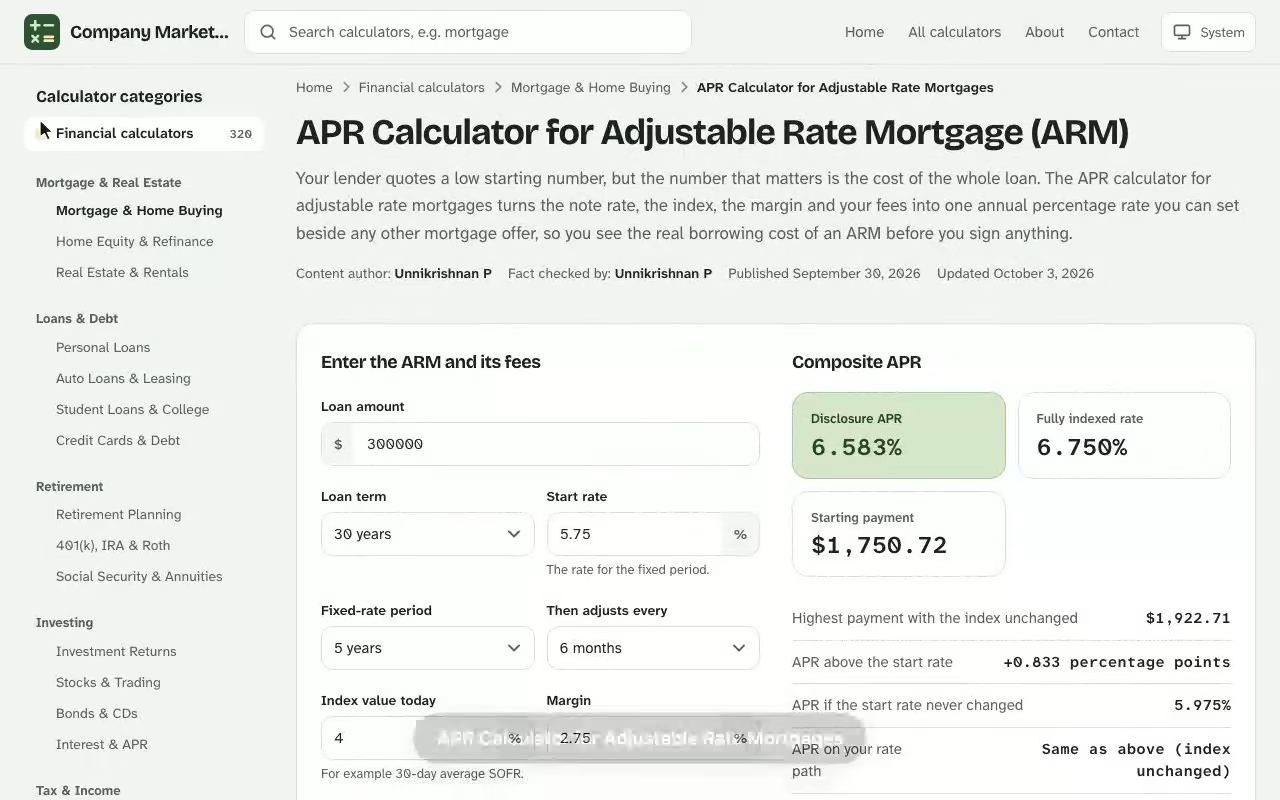
APR Calculator for Adjustable Rate Mortgages. Your lender quotes a low starting number, but the number that matters is the cost of the whole loan. The APR calculator for adjustable rate mortgages turns the note rate, the index, the margin and your fees into one annual percentage rate you can set beside any other mortgage offer, so you see the real borrowing cost of an ARM before you sign anything. The amortization calculator uses the same plain-English approach, so you can compare results side by side.
Composite APR
Disclosure APR
–
Fully indexed rate
–
Starting payment
–
Highest payment with the index unchanged–
APR above the start rate–
APR if the start rate never changed–
APR on your rate path–
Prepaid finance charges–
Amount financed–
Finance charge–
Total of payments–
–
Regulation Z has lenders work out an ARM's APR from the start rate for as long as it lasts, then from the index value at closing plus the margin, limited by the caps (comment 17(c)(1)-10). Because the payments change, the disclosed APR may be off by up to 1/4 point.
Payment schedule behind the APR
The payment levels used for the disclosure APR, with the index held at today's value.
Number of payments
Payment numbers
Rate
Monthly payment
Results are estimates for educational purposes and are not financial, tax or legal advice.
APR Calculator for Adjustable Rate Mortgages: What the Effective Interest Rate Tells You
An adjustable-rate mortgage (ARM) starts with a low introductory rate and then moves with the market, which makes its true price harder to read than a fixed-rate mortgage. The APR folds everything into a single effective interest rate: the interest you pay, plus points, mortgage broker fees and other additional charges that reduce the cash you actually receive. Two lenders can advertise the same interest rate and still differ by a full quarter point once fees are counted, and the APR is the figure that exposes that gap. Try the interest only arm calculator online to run your own numbers — everything is calculated in your browser and nothing you enter is stored or sent anywhere.
What an ARM APR Calculator Needs From You
Every ARM APR calculator asks for the same short list of facts, all printed on your loan estimate and your disclosure form. The table below lists them with the values used in the worked example later on this page.
Input
What it means
Example value
Loan amount
The principal you borrow
$318,400
Loan term
Years to repay the mortgage
30 years
Beginning interest rate
The introductory rate during the initial rate period
5.15%
Initial rate period
Months before the first rate adjustment
60 months
Current index
The published benchmark rate your ARM follows
3.85%
Margin
The fixed amount your lender adds to the index
2.65%
Points and closing costs
Up-front fees paid to the lender and third parties
1 point plus $2,950
Fully Indexed Rate: Index Plus Margin
Nobody can know where the index will sit in five years, so the calculator makes one fair assumption: that the index stays where it is today. Add the margin to the index and you get the fully indexed rate, the rate your loan would carry if it adjusted right now. Regulators ask lenders to use this same logic when they disclose an APR on an ARM, which keeps every quote comparable even though nobody can predict the future.
Adjustable Rate Mortgage Calculator Worked Example
Suppose you borrow $318,400 on a 30-year 5/1 hybrid ARM at a 5.15% beginning rate. Your index reads 3.85% and the margin is 2.65%, so the fully indexed rate is 6.50%. You pay one point ($3,184) and another $2,950 of closing costs, so you actually receive $312,266 even though you owe $318,400. The first-adjustment cap of 2 percentage points would allow up to 7.15%, so the 6.50% fully indexed rate is not limited by the cap. The existing mortgage biweekly calculator online is free to use with no sign-up, and works on desktop and mobile.
The calculator then builds the amortization schedule in two stages. For the first 60 months it uses the 5.15% rate; at the reset point it re-amortizes the remaining balance of $292,999 over the 300 months that are left, using 6.50%.
$$M = P \times \frac{i(1+i)^{n}}{(1+i)^{n}-1}$$
Here \(P\) is the balance, \(i\) is the monthly rate (annual rate divided by 12) and \(n\) is the number of payments left. The APR is then the single rate \(r\) that makes the present value of all those payments equal to the amount you actually received:
The 6.15% APR sits a full percentage point above the 5.15% note rate. That gap is the price of the points, the fees and, more importantly, the jump to 6.50% that begins in month 61.
The monthly payment on the example 5/1 ARM steps up by $240 when the initial rate period ends.
Initial Rate Period and Rate Adjustment Caps
The initial rate period is the stretch of the loan that runs at the starting rate, and a longer one pushes the APR closer to the beginning rate. Every rate adjustment is limited by caps that appear in your paperwork: a cap on the first change, a cap on each later change, and a lifetime ceiling. If your maximum interest rate could be reached, the payment shown in the last row of the results is the one to budget for, not the introductory figure.
Closing Costs, Points and Additional Fees
Because the APR measures cost against the money you receive, fees matter a great deal. In the example above, removing the fees entirely would drop the APR from 6.15% to about 5.98%, and paying no points but keeping the $2,950 would give roughly 6.06%. Include closing costs, points, origination fees and any other additional fees your lender charges for the loan, but leave out costs that would be identical on every mortgage you compare, such as title insurance.
Reading Your Adjustable-Rate Mortgage APR Result
Treat the APR on ARMs as a comparison tool for your next home loan, not a forecast. It assumes the current index never changes, so it can understate the cost if rates rise and overstate it if they fall. Use it to rank offers, then test your payment against a worse case.
Why the APR Sits Above Your Note Rate
Two forces lift the APR above the beginning rate. First, the fees are spread across the loan, so the lender earns more per dollar you actually receive. Second, a fully indexed rate higher than the introductory rate means the calculator assumes you pay more after the reset. If the two are close together, your variable rate loan costs little more than its sticker rate; if they are far apart, you are leaning on a honeymoon period that ends after the first rate adjustment.
Common Hybrid ARM Types Compared
A hybrid ARM fixes the rate for a set number of years and then adjusts, and the hybrid ARMs below are the ones most lenders offer. The names describe the structure: the first number is the years of fixed rate, the second is how often the rate changes afterward. A traditional ARM has no fixed stretch and adjusts from the beginning. Choose the loan type that matches how long you expect to keep the home you are buying.
Loan type
Initial rate period
First rate adjustment
Subsequent adjustments
Maximum interest rate
3/1 ARM
3 years
After month 36
Every 12 months
Set by your lifetime cap
5/1 ARM
5 years
After month 60
Every 12 months
Set by your lifetime cap
7/1 ARM
7 years
After month 84
Every 12 months
Set by your lifetime cap
10/1 ARM
10 years
After month 120
Every 12 months
Set by your lifetime cap
The longer the fixed stretch, the higher the starting rate tends to be, because the bank takes on more of the risk of rising rates. Many of these loans also let you refinance before the first adjustment, though that depends on your equity and the market at that time.
Testing a 7/1 ARM Loan Quote with an ARM APR Calculator
A schoolteacher with two Loan Estimates on the desk needs to know which one actually costs less. The first is a 30-year fixed offer showing a 6.25% APR. The second is a 7/1 ARM for $241,750 at a 5.45% starting rate, with a half point ($1,209) and $3,420 of other closing costs. Its disclosure form lists a 3.60% index, a 2.50% margin and a 2-point cap on the first adjustment.
She enters those figures into the calculator, with the initial rate period set to 84 months. The tool adds 3.60% and 2.50% to get a fully indexed rate of 6.10%, which sits under the 7.45% first-adjustment ceiling, so the cap does not bind. It reports a payment of $1,365.06 for the first seven years, a remaining balance of $214,507 at month 84, and $1,447.58 after the reset. The adjustable-rate mortgage APR comes back at 5.95%, which is 0.30 points below the fixed quote.
See how the APR Calculator for Adjustable Rate Mortgages works: change the inputs and the disclosure apr updates instantly. Enter your own numbers in the calculator above.
The result looks like a win until she stress-tests it. She raises the index to 5.60%, which pushes the rate to the 7.45% ceiling, and reruns the calculation: the payment after the reset climbs to $1,626.43 and the APR rises to 6.60%, now 0.35 points above the fixed offer. The break between the two outcomes tells her what to do. She will take the ARM only if she plans to sell or refinance before month 84, and she sets $1,626 as the payment her monthly budget must be able to absorb if she keeps it.
Fixed-Rate Mortgage vs. ARM Loan: Which Fits Your Plans
With a fixed-rate mortgage you lock in one rate for the full loan term, so your payment never changes. With an ARM loan you accept uncertainty in exchange for a lower beginning rate. Fixed rates usually suit a borrower who plans to stay in the home for many years or who has little room in the monthly budget, while adjustable rates can suit someone who will sell or refinance before the first reset.
Pick an ARM when you expect to move or refinance before the initial rate period ends.
Pick a fixed rate loan when a payment increase would strain your household income.
Always compare the APR of both quotes, not only the headline interest rate.
Ask each lender whether the ARM permits negative amortization, which lets your balance grow when the payment is capped below the interest owed.
Where Credit and Income Enter the APR
Your credit score drives the beginning rate and margin you type into the calculator, and your debt to income ratio decides how large a loan the lender will approve. A bigger down payment shrinks the loan amount your APR is measured against and can remove mortgage insurance, which some FHA loans add as a monthly charge. Property taxes and HOA fees raise your monthly costs but stay outside the APR, so enter only the finance charges.
What Moves Adjustable Rates: Index Choices and the Federal Reserve
The index is a public interest rate that your lender does not control. Common choices include the Treasury bill yield, the 11th District Cost of Funds Index (COFI), the older LIBOR and its replacement, SOFR. All of them respond to the Federal Reserve, which sets short-term rates to manage inflation and the wider economy. When policy rates climb, the index follows and your rate adjustment follows the index.
That is why the margin matters: it never changes. A margin of 2.65% means your rate is always 2.65 points above whatever the index reads, so comparing margins between offers is as important as comparing the starting rate. Check the margin and index named on your disclosure form before you rely on any quote.
Payment after the first rate adjustment for each margin and index pair, with the worked example outlined.
The calculator also lets you test the sensitivity of the result. Holding every other input from the worked example constant, the APR responds to the index like this:
Index at reset
Rate after the first rate adjustment
Monthly payments from month 61
APR
2.85%
5.50%
$1,799
5.54%
3.35%
6.00%
$1,888
5.85%
3.85%
6.50%
$1,978
6.15%
4.35%
7.00%
$2,071
6.45%
4.85%
7.15% (capped)
$2,099
6.54%
Every half point on the index adds roughly $90 to your payment after the reset, until the cap stops the climb at $2,099.
The APR of the example loan moves from 5.54% to 6.54% as the index rises, while the note rate stays at 5.15%.
Using an Adjustable Rate Mortgage Calculator Before You Commit
A calculator is most useful early, before you pay for an appraisal or lock a rate. Gather a loan estimate from at least two mortgage lenders, then run each through the same adjustable-rate mortgage calculator so the assumptions match for the home you want to buy.
Enter the loan amount, term and beginning rate from the quote.
Type the index, margin and cap values from the disclosure form.
Add every up-front fee, including points and third-party charges.
Press calculate, then compare the APR and the post-reset payment between offers.
Once the APR is in hand, pick the offer with the lower APR whose post-reset payment you can afford, then rerun the calculator with a higher index to check the worst case. Compare your result with local mortgage rates for the consumer market, ask a loan officer to prequalify you, and move toward being pre-approved only with the offer that passes both tests. A marginal tax rate changes the after-tax cost of mortgage interest, so compare the pre-tax APR first; the same tax rate applies to every offer. A homebuyer in the real estate market who budgets for the highest payment on the schedule avoids borrowing more than the household can carry.
APR Calculator for Adjustable Rate Mortgages questions
What is the APR on an adjustable rate mortgage?
It is the yearly cost of the loan expressed as a single rate, combining interest with points and fees. Because an ARM's rate can change, the calculator assumes the index stays at today's value after the initial rate period and applies your margin and caps.
Why is my ARM's APR higher than its starting interest rate?
Two things lift it: points and fees reduce the cash you actually receive, and the fully indexed rate (index plus margin) is usually higher than the introductory rate that applies after the first adjustment.
What is the fully indexed rate?
It is the index plus your margin. It is the rate your loan would carry if it adjusted today, before any cap limits the change.
How do rate caps change the result?
The first-adjustment cap, the cap on later adjustments and the lifetime cap limit how far the rate can move at each step. The maximum payment output shows what you would owe if the rate climbed to the lifetime cap.
Does the APR predict what I will really pay?
No. It is a comparison tool built on the assumption that the index does not move. Check the maximum payment and rerun the calculator with a higher index to stress-test the loan.
Which fees should I include?
Include points, origination fees and other closing costs the lender or broker charges. Costs that would be identical on every loan you compare, such as title insurance, can be left out.
What does a 5/1 ARM mean?
The rate is fixed for the first five years (60 months), then adjusts every 12 months. Enter 60 and 12 in the two month fields to model it.