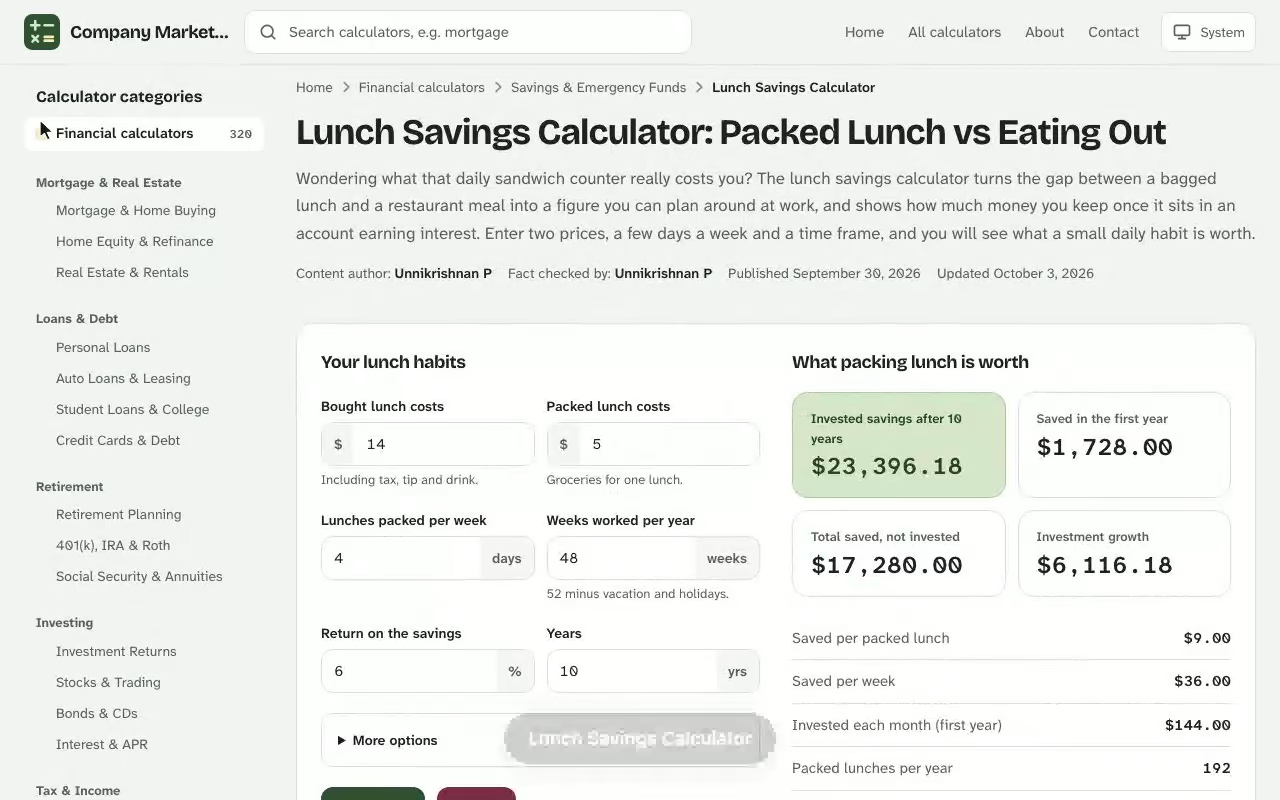
Lunch Savings Calculator. Wondering what that daily sandwich counter really costs you? The lunch savings calculator turns the gap between a bagged lunch and a restaurant meal into a figure you can plan around at work, and shows how much money you keep once it sits in an account earning interest. Enter two prices, a few days a week and a time frame, and you will see what a small daily habit is worth. The savings calculator uses the same plain-English approach, so you can compare results side by side.
What packing lunch is worth
Invested savings after 10 years
–
Saved in the first year
–
Total saved, not invested
–
Investment growth
–
Saved per packed lunch
–
Saved per week
–
Invested each month (first year)
–
Packed lunches per year
–
Year by year
What the packed days would cost bought versus packed, and the savings invested monthly.
Year
If bought
If packed
Saved
Total saved
Invested balance
Results are estimates for educational purposes and are not financial, tax or legal advice.
How the Lunch Savings Calculator Works
This personal finance tool compares two ways of eating on a workday: carrying a bagged lunch from home or paying for a meal out. It takes five inputs and returns the monthly savings, the annual savings, the principal saved over your chosen period and the final balance if you deposit that money rather than spend it. The free cool million calculator uses the same plain-English approach, so you can compare results side by side.
Because the savings calculator also grows the deposits, you get two stories in one answer: the plain subtraction of what you no longer spend, and the extra interest earned by investing the money, because you invested the difference instead of spending it. That second part is why a lunch habit worth a few dollars a day can look surprisingly large after a decade.
Home Bagged Lunch Cost
Count everything that goes in the bag for a normal day at work: the bread, the protein, a piece of fruit and the drink. Divide a week of groceries by the number of lunches it covers, and enter that average rather than a guess. A realistic home bagged lunch cost is usually between $3 and $7, and an honest figure keeps the result from flattering you.
Eating Out Lunch Cost
Use what you actually pay at the counter near work, including tax, tip and the habitual drink or side. Your eating out lunch cost is the number that moves the answer the most, because the difference between the two prices is what gets multiplied across every workday.
See how the Lunch Savings Calculator works: change the inputs and the invested savings after 13 years updates instantly. Enter your own numbers in the calculator above.
Annual Return Rate
The annual return rate is the yearly interest your deposits would earn. Use the rate on a real high yield savings account you could open today, and enter 0 if you only want the money you stop spending, with no growth at all.
Brown Bagging Math: The Formula Behind Your Lunch Savings
Brown bagging sounds casual, but the arithmetic is exact. The calculator first finds the saving on one lunch, then scales it to a year, then lets that yearly amount grow with compound interest through monthly deposits. The emergency savings calculator online uses the same plain-English approach, so you can compare results side by side.
The yearly amount is:
$$\text{Annual savings} = (\text{Eating out price} - \text{Home price}) \times \text{Lunches per week} \times 52$$
The balance after \(n\) months of depositing a monthly amount \(M\) at a monthly rate \(i\) (the annual rate divided by 12) is:
$$\text{Final balance} = M \times \frac{(1 + i)^{n} - 1}{i}$$
The total interest is then the final balance minus the principal saved. When the rate is zero, the balance simply equals the principal, because nothing is growing.
Worked Example: Packing Lunch Four Days a Week
Take a home bagged lunch cost of $4.85 and an eating out lunch cost of $13.40. You buy lunch out four days a week, you keep it up for 12 years, and your savings account pays 3.6% a year.
Saving per lunch: $13.40 − $4.85 = $8.55
Saving per week: $8.55 × 4 = $34.20
Annual savings: $34.20 × 52 = $1,778.40, or $148.20 a month
Principal saved over 12 years: $21,340.80
Final balance after monthly deposits at 3.6%: $26,643.36
Total interest: $5,302.56, about a quarter on top of what you put in
Two parts make the final balance: lunch money you did not spend, plus interest earned.
Any brown bag savings calculator would produce the same schedule from these inputs. The table shows how that balance builds. Growth is slow at the start, then speeds up as the interest itself begins to earn interest.
Years
Principal saved
Final balance
Interest earned
1
$1,778
$1,808
$30
3
$5,335
$5,625
$290
5
$8,892
$9,727
$835
8
$14,227
$16,459
$2,232
10
$17,784
$21,368
$3,584
12
$21,341
$26,643
$5,303
Principal saved versus interest earned over 12 years at 3.6% a year.
Reading Your Savings Calculator Results
Each output answers a different question. The monthly figure tells you what to move into your account every payday. The annual figure shows the size of the habit. The principal saved is the certain part, because it is money you simply did not spend, while the interest depends on the rate you can actually earn.
Savings Goal
Turn the result into a savings goal by reading the table the other way. If you want $10,000, the example above reaches it in about 62 months, a little over five years, with no change in routine. A closer target makes it a useful budget line rather than a vague intention.
Which Input Moves the Final Balance Most
Of the five values you enter, the number of lunches you swap has the biggest effect on the final balance, because it multiplies everything else. With the example prices, a 12-year plan ends at $6,661 for one lunch a week, $13,322 for two, $19,983 for three, $26,643 for four and $33,304 for five. The interest rate matters less: the same plan ends at $21,341 with no growth, $24,097 at 2% and $29,160 at 5%.
Final balance after 12 years for 2 to 5 packed days a week at 0%, 2%, 3.6% and 5%.
Checking a Brown Bag Plan with a Savings Calculator
A project coordinator whose essential bills run $5,000 a month wants a three-month cushion of $15,000, and wonders whether packing lunch could fund it without touching her paycheck. She buys lunch out three days a week, so she sits down at the calculator with her receipts to see what packing would be worth.
Her grocery receipts for the week she meal-preps come to $6.27 per lunch, so that goes in as the home price. Her usual order near the office, with tax and tip, is $16.85. She enters 3 lunches a week, 9 years, and 4.1%, the rate her online savings account currently pays.
Saving per lunch: $16.85 − $6.27 = $10.58
Per week: $31.74, which is $1,650.48 a year or $137.54 a month
Principal saved over 9 years: $14,854.32
Final balance with monthly deposits: $17,928.97, including $3,074.65 of interest
The balance clears her $15,000 three-month cushion by $2,928.97, which tells her the plan works at this rate. Before committing, she reruns it with one input changed. Cutting to 2 lunches a week drops the balance to $11,952.65, short of the target, so she keeps three. Dropping the rate to 0.4% still gives $15,122.37, so the goal does not depend on the interest alone. She sets up a $137.54 transfer for the first of each month.
Lunch Savings Account Options: High Yield vs Certificates of Deposit
Where the deposit goes decides how much of that interest you collect. A savings account lets you add a little each month and withdraw whenever you need to, which suits a habit built on small, regular amounts. Certificates of deposit usually pay a fixed rate but lock the cash for a set term, so they work better once you have collected a lump sum.
Whichever you choose, set up an automatic transfer on the same day each month. A deposit that happens without a decision is the one most likely to survive a busy week, and it keeps the personal savings from being spent on something else.
Making Brown Bag Lunches Last Past the First Month
The math only pays off if you keep packing, and that is a habit problem rather than a numbers problem. A few tactics help you save money without feeling deprived:
Cook a larger dinner and pack the leftovers the next morning, which keeps the cost per portion low.
Prepare one big dish on Sunday so the whole week of work lunches is already decided.
Skip the daily coffee stop on the same days, since it often adds as much to your savings as the meal itself.
Keep one lunch out a week as a planned treat, and set the calculator to four days instead of five so the plan matches how you really eat.
Replacing eating out at an overpriced deli every day with a planned mix of packed and bought meals is far easier to sustain than an all-or-nothing rule, and the calculator shows that the partial plan still adds up to real money. The same approach carries over to school lunches too.
It also helps to separate what you control from what you do not. You control the lunches you pack and the day you set up the transfer; you do not control the rate your bank pays or the price of groceries. Run a cautious case with a lower rate and a higher home price next to your best case, and plan around the cautious one. If the cautious figure still funds the goal you care about, the plan is safe, and anything better is a bonus rather than something you were counting on.
A short monthly check keeps the whole plan honest. Once a month, compare the amount the calculator told you to move with the amount that actually landed in the account, and note any lunches you bought instead of packing. Two or three misses in a month barely dent a twelve-year total, but ignoring them for a year quietly turns the target into a guess. Treat the schedule as a pace to hold, not a score to defend, and adjust the number of packed days rather than abandoning the habit when a busy stretch hits.
Finally, the lunch savings per year shown in your result is a snapshot, not a promise. Prices rise and rates change, so rerun it whenever either moves and see whether you are still on track.
Lunch Savings Calculator questions
How does a lunch savings calculator work?
It subtracts your home lunch cost from your eating out lunch cost, multiplies by the lunches you swap each week and 52 weeks, then grows the monthly amount at your annual return rate to give a final balance.
How much can you save by packing lunch?
It depends on the price gap and how often you pack. With a $4.85 home lunch, a $13.40 lunch out and four swaps a week, you keep $1,778.40 a year before any interest.
What interest rate should I use?
Use the rate on a real savings account you could open today, such as a high yield savings account. Enter 0 if you only want the money you stop spending.
Does the result include groceries I would buy anyway?
Only if you put them in the home lunch cost. Divide a week of lunch groceries by the number of lunches to get an honest average.
Is the interest guaranteed?
No. The principal is money you did not spend, but interest depends on the rate your account pays, which can change over time.
Why does the number of lunches matter more than the rate?
The lunch count multiplies every other value, so each extra packed day per week adds a full slice to the balance, while a higher rate only adjusts the growth on top.
Can I use it for school or other meals?
Yes. Enter the cost of a packed meal and the cost of buying it, and the calculation works for school lunches, coffee or any repeated meal.