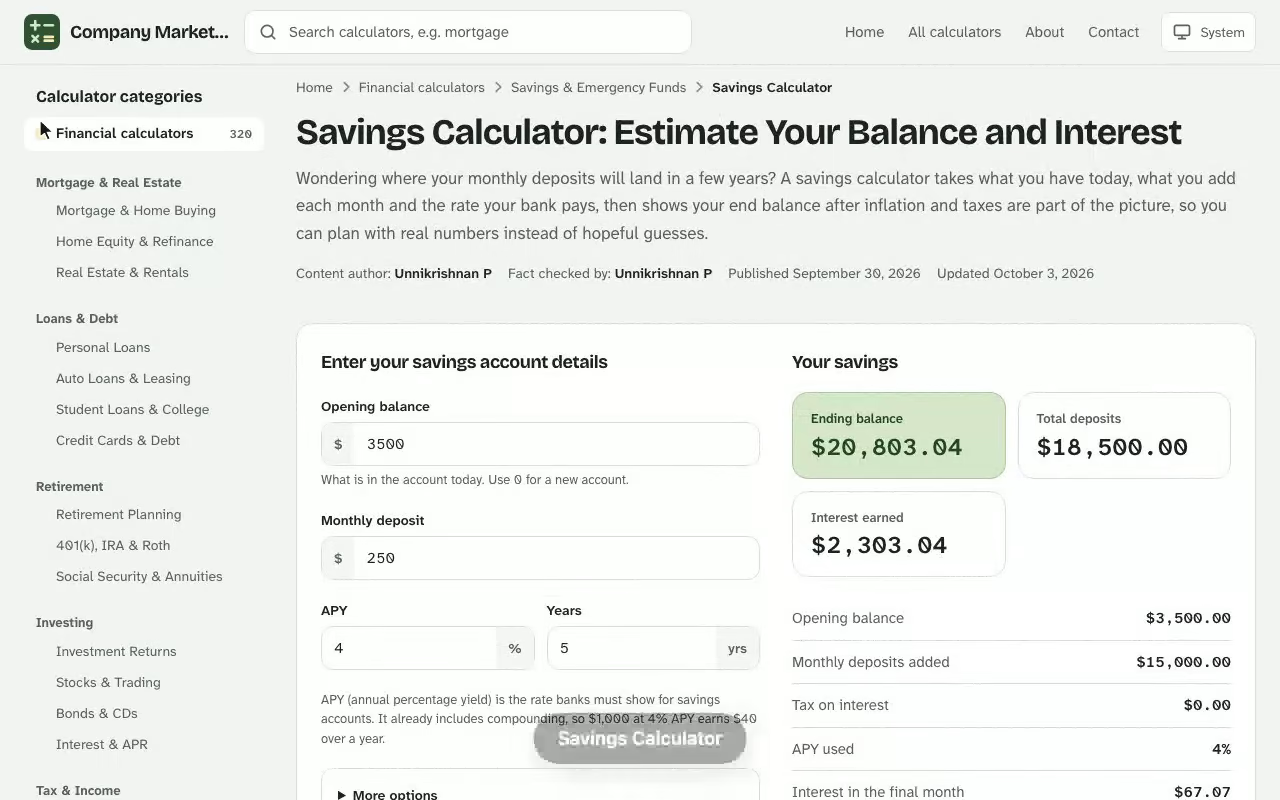
Savings Calculator. Wondering where your monthly deposits will land in a few years? A savings calculator takes what you have today, what you add each month and the rate your bank pays, then shows your end balance after inflation and taxes are part of the picture, so you can plan with real numbers instead of hopeful guesses. If you want to see how the figures change, the free currency converter gives you an instant result you can adjust as you go.
Your savings
Ending balance
–
Total deposits
–
Interest earned
–
Opening balance–
Monthly deposits added–
Tax on interest–
APY used–
Interest in the final month–
Final monthly deposit–
Savings rates are variable and can change at any time, so treat this as an estimate at today's rate.
Year-by-year savings
What you deposit and what the account pays you each year, and the balance at year end.
Year
Deposits
Interest
Tax
Balance
Results are estimates for educational purposes and are not financial, tax or legal advice.
How a Savings Calculator Turns Deposits Into an End Balance
Every savings projection starts with the same moving parts: money you already have, money you keep adding, how fast that money earns, and how long you leave it alone. Change any one of them and the result shifts, which is exactly why a quick estimate beats mental math. The free date calculator uses the same plain-English approach, so you can compare results side by side.
Inputs: Initial Deposit, Periodic Contributions, and Interest Rate
Four entries drive almost every projection. Your initial deposit is the balance you start with. Your periodic contributions are the amounts you add on a schedule, such as every month or every paycheck. The interest rate is the yearly percentage your bank pays, and the time horizon is how many years the money stays put. A fifth choice, how often the bank adds interest to the balance, matters more than most people expect and gets its own section below.
Outputs: End Balance, Total Contributions, and Total Interest Earned
The tool reports three figures. The end balance is everything you hold at the finish line. Total contributions is the sum of the deposits you made along the way, and total interest earned is the growth the bank added on top. Separating the last two shows how much of your result came from discipline and how much came from time.
The balance after each compounding period follows this standard form, where the first term grows your starting money and the second grows the stream of deposits:
Here \(P\) is the starting balance, \(PMT\) is the deposit made each period, \(r\) is the yearly rate as a decimal, \(n\) is the number of compounding periods per year and \(t\) is the number of years.
Take a worked example: you open with $8,400, add $275 at the end of every month, and earn a 4.2% yearly rate compounded monthly for 6 years. The monthly rate is \(0.042 \div 12 = 0.0035\) over 72 periods, so the growth factor is \(1.0035^{72} \approx 1.2860\). Your starting money grows to about $10,802.65, and the 72 deposits grow to about $22,473.79, which gives an end balance of $33,276.45.
Result
Amount
Initial deposit
$8,400.00
Total contributions (72 × $275)
$19,800.00
Total interest earned
$5,076.45
End balance
$33,276.45
Reading the Accumulation Schedule
An accumulation schedule lays the same calculation out year by year, so you can see growth speed up as the balance grows. Interest in year one is $423.94; by year six it is $1,292.46, roughly three times as much, even though your yearly deposit never changed.
Year
Deposit
Interest
Ending balance
1
$3,300.00
$423.94
$12,123.94
2
$3,300.00
$583.40
$16,007.34
3
$3,300.00
$749.67
$20,057.01
4
$3,300.00
$923.07
$24,280.09
5
$3,300.00
$1,103.90
$28,683.98
6
$3,300.00
$1,292.46
$33,276.45
How the example's end balance builds up: contributions dominate early, interest keeps growing every year.
Savings Goal Calculator Logic: Working Backward From a Target
A savings goal calculator flips the question. Instead of asking what a deposit will become, you name the amount you need and the tool solves for the contribution that gets you there. Rearranging the formula above for \(PMT\) gives: Next, open the budget calculator online and enter your own details to see an estimate in seconds.
Suppose you want $40,000 in 6 years from the same $8,400 start at 4.2%. Your starting money covers $10,802.65 of it, so the deposits must supply the remaining $29,197.35. Solving gives $357.28 a month, which is $82.28 more than the $275 in the first example.
Setting a Savings Goal You Can Actually Reach
A savings goal works best when it has a purpose, a date and a number. A house deposit due in 36 months, a wedding in two years and a car replacement in four each produce a different monthly figure, and the calculator makes the trade-off visible: a longer timeline lowers the monthly amount, while a higher rate trims it only a little.
Six-year end balance by rate and monthly deposit, with the worked example outlined.
Emergency Fund, 50-30-20 Rule, and 10% Rule
If you are unsure how much to contribute, three common guidelines give you a starting point:
Emergency fund: keep three to six months of living expenses in cash, so a layoff or medical bill never forces you to sell investments at a bad moment.
10% rule: move a tenth of each paycheck into savings before you spend anything.
50-30-20 rule: split income into 50% needs, 30% wants and 20% for debt payoff and savings.
Treat them as a starting point rather than a verdict. Your own spending, income and existing cushion decide whether they fit. To use one, turn it into a monthly figure, such as 10% of a $2,400 paycheck, which is $240, and enter that in the calculator's monthly deposit field, or enter the cushion you want to build as your target.
Comparing Two Savings Accounts With the Savings Calculator
Marguerite has $11,250 in a big-bank account paying 0.45% and wants $27,500 in 36 months, which is a 10% down payment on a $275,000 home. She can add $410 at the end of every month. Before moving anything, she runs both rates through the calculator, entering $11,250 as the initial deposit, $410 as the monthly contribution, 36 months and monthly compounding. Pair this with the free vice savings calculator for a fuller picture before you make a decision.
Account
Rate
Interest
Ending balance
Versus $27,500
Current bank
0.45%
$250.15
$26,260.15
$1,239.85 short
Online account
4.55%
$2,664.86
$28,674.86
$1,174.86 over
The projected balance at 0.45% misses her target by $1,239.85, so staying put means either a later closing date or a bigger deposit: the calculator shows she would need $444.22 a month to hit $27,500 there. At 4.55%, the same $410 clears the target by $1,174.86, and both accounts carry the same FDIC limit of $250,000, so the extra $2,414.71 of interest costs her no added coverage risk.
She then changes just one input, lowering the deposit to $380. The figure the calculator returns is $27,520.02, still above $27,500, and the break-even deposit works out to $379.48. She moves the money, sets the transfer to $380 and keeps the extra $30 a month for closing costs.
Compound Interest Calculator Math: APY and Compounding Frequency
Under the hood, every savings projection is a compound interest calculator: each period's interest joins the balance, and the next period earns interest on the bigger number. That is why an extra year at the end of a long plan adds far more than an extra year at the start.
Annual Percentage Yield vs Interest Rate
The annual percentage yield (APY) folds compounding into one comparable figure, while the stated rate ignores it. A 4.2% rate compounded monthly produces an APY of 4.28%, because \((1+0.042/12)^{12}-1 \approx 0.0428\). When you shop between banks, compare APY to APY.
See how the Savings Calculator works: change the inputs and the ending balance updates instantly. Enter your own numbers in the calculator above.
Frequency changes results only slightly at modest rates. Leaving the $8,400 untouched for 6 years at 4.2% gives $10,751.91 with annual compounding, $10,802.65 monthly and $10,807.25 daily, so the gap between monthly and daily is under five dollars.
Savings Withdrawal Calculator View: Taxes, Inflation, and Purchasing Power
A balance on screen is not what you will spend. Looking at the result like a savings withdrawal calculator means subtracting what taxes and rising prices take before you plan around the figure.
Income Tax on Interest
Interest counts as income tax exposure in the year it is paid. In the example above, the $5,076.45 of interest taxed at a 24% federal bracket costs $1,218.35, which lowers your after-tax balance to $32,058.10. Your bracket may differ, and some states add their own tax, so enter your own rate when a calculator offers a tax field.
Inflation and Purchasing Power
Prices rise, so a dollar buys less every year. At 3% inflation, $32,058.10 six years from now has the purchasing power of about $26,848.15 in today's money. When the rate on your account trails inflation, the balance grows on paper but your buying power slips.
The same balance after a 24% tax on interest and 3% yearly inflation.
Choosing Among Savings Accounts: Banks, Credit Unions, and FDIC Coverage
Once you know the number you are aiming for, the account you pick decides what you enter in the calculator: its yield sets the rate, and its fees and balance rules shape the deposits you can make.
Savings Accounts vs Checking Accounts
Both are deposit accounts at banks and credit unions. Checking accounts handle daily spending and pay little, while savings accounts pay more but may require a minimum balance or limit withdrawals to six a month. Only the savings account's rate and balance belong in the calculator; keep your bills in checking.
Coverage is a big reason to use them. The FDIC insures deposits up to $250,000 per depositor, per bank, per ownership category, and federal credit unions carry similar NCUA coverage. Stay under that limit at each institution and your principal is protected.
Where Savings Accounts Differ: Money Market Accounts, CDs, and Treasury Bills
Not every safe place for cash pays the same. Money market accounts often pay more than a standard savings account because the bank invests the deposits in short-term securities, and some include a debit card. Certificates of deposit lock your money for a fixed term in exchange for a set rate. Treasury bills are short-term government debt that you can hold to maturity. All three suit money you will need within a few years. In the calculator, a certificate's fixed rate and term go in as they are, while a money market account's rate can change, so rerun the projection when it does.
Minimum Balance Rules and Fees
Some savings accounts waive monthly fees only if you keep a minimum balance, so check the terms before you enter a rate in the calculator. A fee of a few dollars a month can erase a meaningful share of the interest on a small balance.
When Investments Beat Savings
Cash is liquid and low in risk, but the calculator assumes a fixed, guaranteed rate, so projecting stocks, bonds or real estate takes a different tool. Long-horizon money, such as retirement savings, belongs in investments aimed at passive income and higher returns, at the cost of real swings.
Savings Calculator questions
How does a savings calculator work?
It starts from your initial deposit, adds the interest earned each period at your rate, adds your contributions, and repeats for every period until the end date. The result is your end balance, split into the money you put in and the interest it earned.
What is the difference between the interest rate and APY?
The interest rate is the stated yearly percentage. APY, the annual percentage yield, includes the effect of compounding, so it is slightly higher whenever interest is added more than once a year. Compare accounts by APY.
Does compounding frequency matter?
Yes, but only a little at typical savings rates. Monthly compounding earns a bit more than annual, and daily adds a few dollars more on top of that over several years.
Is the interest on a savings account taxed?
Interest is generally taxed as ordinary income in the year it is paid. Enter your marginal tax rate and the calculator reduces each period's interest by that share, which gives an after-tax balance.
How much should I keep in an emergency fund?
A common guideline is three to six months of living expenses held in cash. Use the calculator to find the monthly deposit that builds that amount by your target date.
Are savings accounts insured?
Deposits at FDIC-insured banks are covered up to $250,000 per depositor, per bank, per ownership category. Federally insured credit unions carry similar NCUA coverage.
When are contributions added in this calculator?
Monthly contributions are added at the end of each month and annual contributions at the end of each year, after that period's interest is calculated.
Does inflation reduce my savings?
The balance is not reduced, but its purchasing power is. If your rate is below the inflation rate, the same dollars buy less each year, so compare your result with expected price growth.