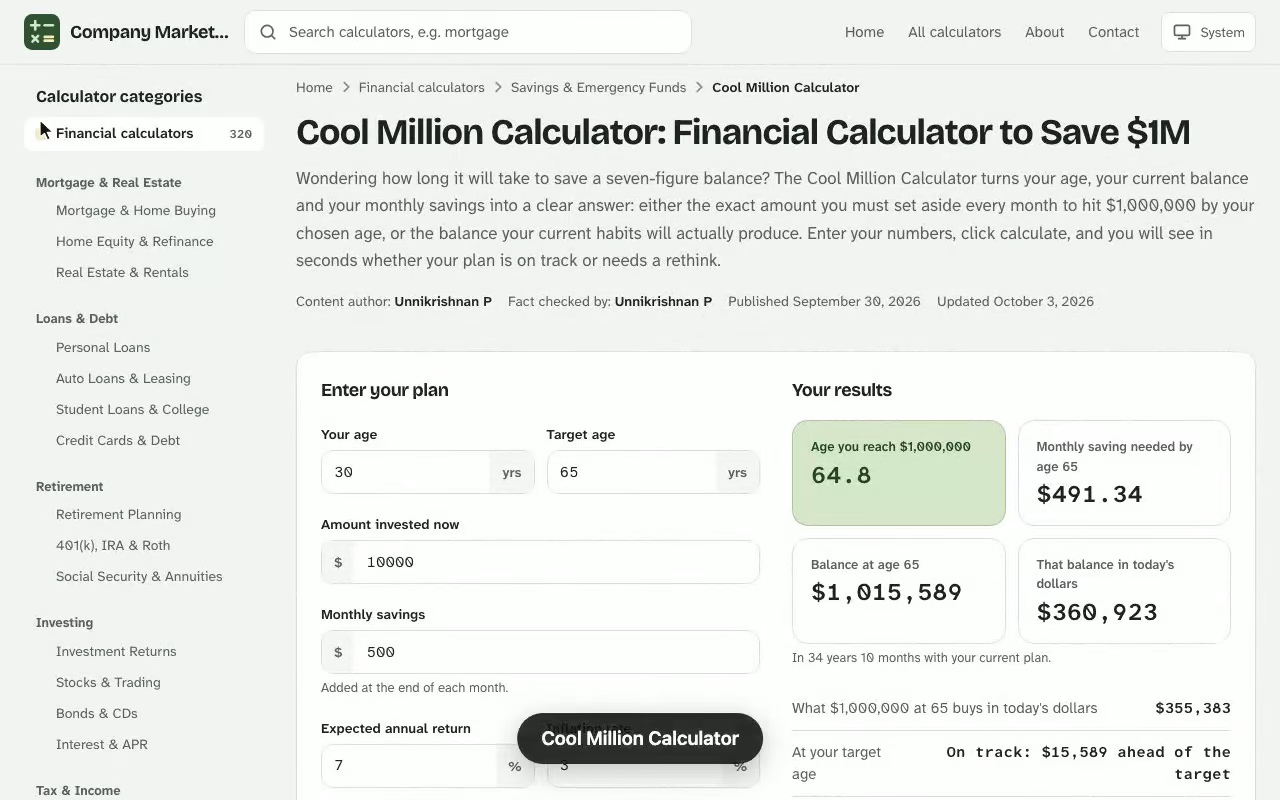
Cool Million Calculator. Wondering how long it will take to save a seven-figure balance? The Cool Million Calculator turns your age, your current balance and your monthly savings into a clear answer: either the exact amount you must set aside every month to hit $1,000,000 by your chosen age, or the balance your current habits will actually produce. Enter your numbers, click calculate, and you will see in seconds whether your plan is on track or needs a rethink. The savings calculator is free to use with no sign-up, and works on desktop and mobile.
Your results
Age you reach $1,000,000
–
Monthly saving needed by age 65
–
Balance at age 65
–
That balance in today's dollars
–
What $1,000,000 at 65 buys in today's dollars–
At your target age–
Returns compound monthly at a steady rate. Real returns vary from year to year, and taxes and fees are not included.
Balance by age
Your balance each year, with the same amount shown in today's dollars.
Age
Saved
Growth
Balance
In today's dollars
Results are estimates for educational purposes and are not financial, tax or legal advice.
How This Cool Million Calculator Helps You Save a Million
The tool asks for six inputs, and each one controls a different part of the projection. Understanding what every field means is the quickest way to get a result you can trust, so here is what to type in and why it matters to your savings plan. The free vice savings calculator uses the same plain-English approach, so you can compare results side by side.
Current age and millionaire target age
Your current age is where the clock starts, and your millionaire target age is where it stops. The gap between the two is the number of years your money has to compound, and it is the single most powerful input. Choosing a target age of 55 instead of 50 gives you five more years of contributions and growth, which can cut the required monthly amount by more than a third.
Starting balance and amount currently invested
Your starting balance is the amount currently invested: the combined value of your retirement accounts, brokerage holdings and dedicated savings. Leave out your home, car and personal property, because you cannot easily spend them or invest them. An accurate savings balance keeps the projection honest, since every dollar already invested keeps compounding without further effort from you.
Savings per month and current monthly savings
Enter the savings per month you can sustain, not the best month you have ever had. If your current monthly savings vary, average the last twelve months. The calculator assumes each contribution lands at the beginning of the month, so money starts earning immediately.
Expected rate of return
The expected rate of return is the annually compounded growth you assume for your investments. It is a forecast rather than a promise, so test several values instead of trusting one.
Expected inflation rate
The expected inflation rate does not change your balance; it translates the future balance into today's purchasing power. That is how you learn what your million will actually buy.
The Millionaire Calculator Formula
Behind the screen, a millionaire calculator combines two growth engines: your existing balance compounding on its own, and a stream of monthly deposits compounding alongside it. With a yearly return \(r\), a monthly equivalent rate \(i\), a starting balance \(B\), a monthly deposit \(M\), \(t\) years and \(n = 12t\) months, the projected balance is: Pair this with the lunch savings calculator online for a fuller picture before you make a decision.
$$FV = B \times (1 + r)^{t} + M \times \frac{(1 + i)^{n} - 1}{i} \times (1 + i), \quad i = (1 + r)^{1/12} - 1$$
To find the deposit needed for a target \(T\), solve the same equation for \(M\):
Finally, inflation shrinks the target's value: \(\text{Today's dollars} = \frac{FV}{(1 + f)^{t}}\), where \(f\) is the inflation rate.
Worked Example: Saving One Million Dollars by Age 55
Suppose you are 34 with $18,250 invested, you can save $640 per month, and you assume a 6.4% annual return and 2.6% inflation. Your target is 55, so \(t = 21\) and \(n = 252\).
Your $18,250 grows on its own to about $67,149 after 21 years.
Saving $640 a month produces a final balance of about $399,714, which is only $233,161 in today's dollars.
To reach $1,000,000 you would need to save about $1,795 per month.
Even that million is worth only about $583,318 in today's dollars at 2.6% inflation.
The results show how sensitive the answer is to your assumptions. The table below keeps every other input fixed and varies only the expected rate of return.
Expected rate of return
Monthly savings needed
4.0%
$2,446
5.0%
$2,156
6.4%
$1,795
8.0%
$1,439
9.0%
$1,245
Reading your results
A report that shows a shortfall is not a failure; it is a list of levers. When the millionaire target age or monthly savings field produces a gap, these three inputs are what close it. The definitions below summarize what you can adjust, and the view report option shows the year-by-year breakdown behind the headline number.
Longer horizon
Moving your target age from 55 to 60 lowers the required deposit from about $1,795 to about $1,166 a month.
Higher contribution
Raising $640 to $900 a month lifts the projected balance from about $399,714 to about $534,819.
Higher return
Moving from 6.4% to 8.0% adds roughly $96,000 to the projected balance, but usually requires accepting more risk.
Checking a Savings Plan Against a Millionaire Target Age at 41
Dana is 41 and has $87,430 spread across a 401(k) and an index fund. Their paycheck allows $1,185 a month into savings, and they want to know whether $1,000,000 by 60 is realistic. They open the calculator and enter age 41, a target age of 60, a balance of $87,430, monthly savings of $1,185, an expected return of 5.2% and inflation of 3.1%, the rate they read for long-run consumer prices.
After clicking calculate, the screen shows a projected balance of $684,451. Adjusted for 3.1% inflation, that is only $383,202 in today's dollars. The calculator also reports the deposit that would close the gap: $2,006 a month, about 69% more than Dana can afford.
Rather than gamble on a higher return, Dana changes one input. The Social Security Administration sets full retirement age at 67 for anyone born in 1960 or later, so working to 67 is a defined milestone rather than a vague hope. Setting the target age to 67 stretches the horizon to 26 years, and the required deposit falls to $1,037 a month. At the current $1,185, the projection now reads $1,095,748.
The decision is concrete: keep the $1,185 transfer, plan for 67 instead of 60, and revisit the assumptions every January. Because $1,095,748 is worth about $495,433 in today's dollars, Dana also marks a second check for the point when the 401(k) crosses $400,000 nominal.
Rate of Return and Inflation: What Moves Your Result
Choosing a rate of return
Look at historical data for the mix you actually own. A broad index such as the S&P 500 has delivered roughly 10% a year in nominal terms over very long stretches, counting dividends and the reinvestment of dividends, but individual decades have ranged from painful to spectacular. Treat any annualized figure as an average, not a guarantee, and remember that fees charged by investment funds reduce what you keep.
Taxes matter too. The projection ignores taxation, so if you pay tax on interest or capital gains in a taxable account, enter an after-tax rate of return instead. Money inside tax-advantaged accounts can use the higher pre-tax figure.
Using a long-term inflation rate
A long-term inflation rate is best taken from the Consumer Price Index (CPI), published by the Bureau of Labor Statistics. The Federal Reserve aims for about 2% a year, and a figure between 2% and 3% is a sensible default. Higher inflation does not stop you reaching a million; it means a million buys less when you arrive.
See how the Cool Million Calculator works: change the inputs and the age you reach $1,000,000 updates instantly. Enter your own numbers in the calculator above.
Risk and volatility
Higher returns come with risk and volatility. Stocks can fall sharply, and a hypothetical smooth 8% line hides years of losses. Because the projection assumes one steady return, treat its result as a best-case path and rerun lower-return scenarios. The loss of principal late in your timeline is the real danger, so many savers shift toward steadier assets as the target age approaches.
Using a Financial Calculator Alongside Your Savings Plan
A financial calculator is a planning aid, not a prediction machine. Use it to compare scenarios, then act on the one you can sustain. Where you keep the money affects your growth:
Savings accounts at a bank or credit union pay modest interest with very little risk, which suits short goals and emergency funds. Because savings accounts barely beat inflation over decades, they rarely carry a seven-figure goal alone.
A high-yield savings account pays more than a standard account and fits the cash portion of your plan.
Employer retirement accounts and other investments carry more risk but historically offer the growth a seven-figure goal usually needs.
A balanced plan usually blends cash savings accounts for stability with growth-oriented investments for the long haul. Spreading your investments across several asset types, and adding to those investments on a schedule, keeps one bad year from derailing everything.
Match each account to the return you enter: a high-yield account fits a modest return assumption, while stocks and funds fit a higher one. Set the monthly deposit from your real income and expenses, treat it as your monthly savings goal, and calculate again whenever your pay or plans change. Automated, steady investment and investing let compounding build wealth over decades, and a financial advisor can pressure-test the assumptions. The aim is to save a million dollars without sacrificing your daily money needs.
Is the Cool Million Calculator Accurate?
It is exactly as accurate as your inputs. Growth is smooth in the model and uneven in real markets, deposits may be irregular, and a market in the TSX or elsewhere can behave very differently from the assumed rate. Revisit the numbers once a year and compare them with your actual balance, and your savings will stay on course. If you are ahead of schedule, you can lower your monthly contribution or retire earlier; if you are behind, raise the deposit, extend the target age, or accept a smaller goal. Small, steady adjustments made early almost always beat a dramatic catch-up attempt made late, because time is the one input you cannot buy back once it is gone.
Cool Million Calculator questions
What is a cool million calculator?
It is a savings projection tool. You enter your age, the age you want to be a millionaire, your current investments, your monthly savings, a rate of return and an inflation rate, and it shows how your balance could grow and what you would need to save to reach $1,000,000.
How much do I need to save each month to become a millionaire?
It depends on how many years you have, how much you already have invested and the return you expect. A longer timeline or a higher starting balance lowers the monthly amount; the calculator shows the exact figure for your inputs.
Which rate of return should I enter?
Use a rate based on the investments you actually hold. Savings accounts pay far less than stock index funds, and returns are never guaranteed. Try a conservative and an optimistic value to see the range.
Why does the calculator ask for an inflation rate?
Inflation reduces what a dollar buys. The inflation-adjusted balance restates your future balance in today's purchasing power so you can see what your money is really worth.
Are taxes included in the results?
No. If you pay tax on interest, dividends or capital gains, enter an after-tax rate of return for a more realistic projection.
Which accounts should I include as currently invested?
Include savings, retirement accounts and other investments. It is more accurate to leave out your home and personal property, since they are not easily invested or spent.
When are monthly contributions added?
The calculator assumes each contribution is added at the beginning of the month, so it starts earning your chosen return right away.