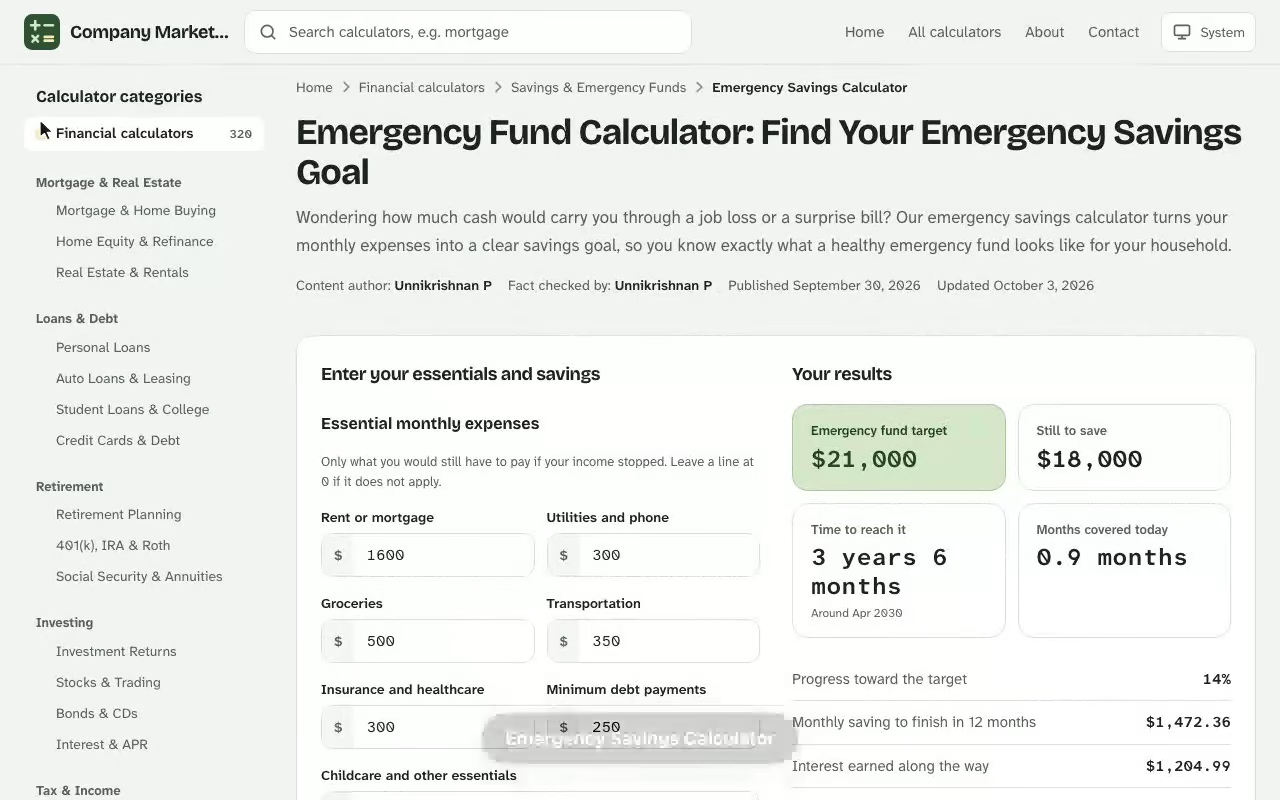
Emergency Savings Calculator. Wondering how much cash would carry you through a job loss or a surprise bill? Our emergency savings calculator turns your monthly expenses into a clear savings goal, so you know exactly what a healthy emergency fund looks like for your household. If you want to see how the figures change, the free savings calculator gives you an instant result you can adjust as you go.
Your results
Emergency fund target
–
Still to save
–
Time to reach it
–
Months covered today
–
Progress toward the target
–
Monthly saving to finish in 12 months
–
Interest earned along the way
–
Milestones on the way
When your fund will cover each step, at your monthly saving. Dates count from this month.
Milestone
Amount
Reached in
Date
Results are estimates for educational purposes and are not financial, tax or legal advice.
Emergency Savings Calculator: What the Result Tells You
An emergency fund is cash set aside for events you can't schedule, such as a layoff, a hospital stay or a failed furnace. The number this tool produces is not a guess about what might go wrong. It is your own cost of living multiplied by the number of months you want covered, which makes it a personal financial buffer rather than a generic figure from a rulebook. Next, open the free lunch savings calculator and enter your own details to see an estimate in seconds.
The core of every emergency fund calculator is one step: you multiply what you spend by the months you want covered.
$$\text{Emergency fund goal} = \text{Essential monthly expenses} \times \text{Months of coverage}$$
A second formula answers the question most people ask next, which is how long it takes to get there:
$$\text{Months to goal} = \frac{\text{Goal} - \text{Current savings}}{\text{Monthly contribution}}$$
Because these are simple, you can check any result by hand. The value of the tool is that it also accounts for interest on your balance, so the timeline reflects a real projection rather than a straight-line division, and the results update in real-time as you adjust any input. Think of the output as a way to protect your family and household from borrowing at the worst moment.
How to Use the Emergency Fund Calculator
Enter your numbers in the calculator below, then press the button to see your goal, the gap between that goal and what you hold today, and the number of months it takes to close it. Everything runs on three inputs you probably already know, plus an optional interest rate. Next, open the savings goal calculator online and enter your own details to see an estimate in seconds.
Counting Essential Expenses
Include only what must be paid if your paycheck stopped. Your essential expenses are the bills that cost you something serious when skipped. Leave out dining out, streaming and other costs you could pause within a week.
Housing: rent or mortgage, property tax and renters or home insurance
Food: groceries and basic household supplies
Transportation: fuel, transit passes, car insurance and loan payments
Utilities and phone service
Minimum debt payments on credit cards and other loans
Health costs such as premiums and prescriptions
Add these into one monthly expenses total. If a bill is annual, divide it by twelve first. Your necessary expenses are the figure the calculator multiplies, so accuracy here matters more than any other input.
Picking Your Savings Goal
Next choose how many months you want to cover. If the number feels too large, don't skip the exercise; start with a smaller first target and raise it later. Even a $500 cushion keeps a car repair off a credit card, and it is a perfectly good first step on your savings journey. Enter your current balance and the amount you can add each month, and add an APY if the money sits in an interest-bearing account; a 3.8% APY is the yield used in the example below. You can save more quickly when the rate is higher, but the deposit still does most of the work.
Emergency Fund Size: Three to Six Months and Beyond
The standard rule of thumb says to hold three to six months of living expenses in cash. That range works as a starting point, but your household may need more or less depending on how secure your income is.
The 3-6-9 Rule Explained
The 3-6-9 rule adds a tier for people whose pay is uncertain. Three months suits a dual-income household with stable income and few obligations. Six months is a sensible default if you have a mortgage or children. Nine months fits anyone who is self-employed or faces irregular income, such as freelancers and commissioned sales reps.
Months of Expenses by Situation
Think about months of expenses as a measure of how long it takes you to find equivalent work. Job stability, dependents and a second earner all shift the answer. A single person in a high-demand field may be comfortable with three months, while a couple with kids and fluctuating income can reasonably aim for nine, because one lean quarter would otherwise force them into debt.
Sizing a Freelancer's Financial Buffer with the Calculator
Dana, a freelance copywriter, has just lost her largest client, a retainer worth about 40% of her revenue. Before replying to new offers, she wants to know whether her cushion can absorb another gap like it.
She adds up what must be paid every month: $1,845 rent, $528 groceries, $391 for the car, $276 for health insurance, $214 for utilities and internet, and $192 for a student loan minimum. That is $3,246. Because her income swings month to month, she picks nine months of coverage, matching the top tier of the 3-6-9 guideline. Her current balance is $11,870, her planned deposit is $780 a month, and her account pays 4.1%.
After she presses the button, the calculator returns a goal of $29,214, a gap of $17,344, and a timeline of 21 months. Her current balance covers 3.7 months, so she is already past the usual three-month floor but well short of her own target.
The result gives her a concrete choice to make. Twenty-one months is too long while a client is missing, so she reruns it with one input changed, raising the deposit to $1,050 by moving her quarterly tax padding into a separate account. The timeline drops to 16 months. She also notes that six months of coverage ($19,476) would be reached about halfway there, so she sets that as her first milestone and keeps nine months as the finish line. Her first action is a $780 transfer scheduled for the day after each invoice clears.
Worked Example: Building a Safety Net of $16,680
Consider a hypothetical household with the following monthly essentials:
Category
Monthly cost
Housing (rent and renters insurance)
$1,412
Groceries
$463
Transportation
$287
Health insurance and prescriptions
$214
Utilities and phone
$236
Minimum debt payments
$168
Total essentials
$2,780
This household chooses six months of coverage, so the goal is $2,780 \(\times\) 6 = $16,680. They already hold $3,150, which covers about 1.1 months, leaving a gap of $13,530. At $325 per month with a 3.8% yield, the balance reaches the goal in 39 months.
Six essential costs add up to $2,780 a month, which sets a six-month goal of $16,680.See how the Emergency Savings Calculator works: change the inputs and the emergency fund target updates instantly. Enter your own numbers in the calculator above.
Reading the Result
In the calculator's timeline result, the timeline moves sharply with the monthly contribution. Raising the deposit changes the outcome far more than a slightly better rate does.
$325 per month: 39 months
$450 per month: 29 months
$600 per month: 22 months
Those three rows show the real decision the tool supports. Before choosing, compare each deposit to your take-home pay, then work backward to a deposit you can sustain without raiding the account.
Months to reach the goal by deposit and coverage; the outlined cell is the worked example at 39 months.
Where to Keep Your Emergency Fund
An emergency fund has two jobs: it must be there instantly, and it must not lose value while it waits. That points to cash, not stocks. The right home is an account at an insured bank or credit union with no penalty for withdrawals.
Deposits supply $12,675 of the $17,032 balance at month 39; interest adds about $1,207.
High-Yield Savings Account Options
A high-yield savings account is the usual choice because it pays several times the average savings account interest rate while keeping your money liquid. Compare the advertised APY, remember that the APY can change at any time, and confirm there is no minimum balance for it. A money market account works similarly and may add check-writing, while certificates of deposit pay a fixed rate but lock the money for a term, so use them only for the portion you are unlikely to need soon. Keep checking accounts for daily spending rather than for the reserve itself.
Funding Plan: Budget and Auto Deposits
A reliable budget makes the monthly contribution routine. Set up auto deposits timed to payday so regular contributions happen before you can spend the money elsewhere. Have part of each paycheck automatically deposited, and send windfalls such as tax refunds or bonuses straight to the account. Enter the amount you automate as your monthly contribution and the timeline result shows how much sooner you finish. Small amounts matter; $10 a week passes $500 in a year, and a higher APY only speeds things up slightly.
Using Your Emergency Savings to Handle Unexpected Expenses
Once the fund exists, the goal is to use it without guilt. It is meant to be tapped and replenished, not preserved at any cost.
Covering Job Loss and Medical Bills
A job loss is the scenario the whole number is built around: your balance divided by your monthly outflow equals the months you can search without borrowing. Medical bills and medical emergencies are the second big drain, followed by car repairs and a sudden car repair after a breakdown. Each of these unexpected events is smaller than a layoff but far more common, so they are the most likely reason you will dip into the account first. A fund that handles all unexpected expenses protects your credit and keeps you from relying on high-interest cash advances.
Rebuilding and Reviewing Your Financial Plan
After a withdrawal, restart contributions and rerun the calculator with your new current balance, so the gap becomes a fresh target with its own timeline. Rerun it each year too when you review your financial plan, because inflation raises your monthly expenses and therefore the size of the target. If a disaster, a new baby or a larger mortgage changes your obligations, rerun the numbers. Free tools like this one make a yearly check easy, and a financial advisor can help if your situation has become complicated. Your finances change, and your safety net should change with them.
Emergency Savings Calculator questions
How much should I have in an emergency fund?
A common rule of thumb is three to six months of essential expenses. Choose three months if your income is stable, six if you have children or a mortgage, and nine or more if you are self-employed or your income is irregular.
What is the 3-6-9 rule?
It is a guideline that scales your emergency savings to how secure your income is: 3 months of expenses with a stable job and a safety net, 6 months with dependents or large obligations, and 9 months for irregular or self-employed income.
How do I calculate my emergency fund?
Add up your essential monthly expenses, such as housing, food, transportation, utilities, insurance and minimum debt payments, then multiply the total by the number of months you want covered.
Which expenses count as essential?
Count the bills you would still have to pay if your paycheck stopped: rent or mortgage, groceries, utilities, transportation, insurance, medical costs and minimum debt payments. Leave out dining out, subscriptions and other costs you could pause.
Is $5,000 enough for an emergency fund?
It depends on your spending. If your essential expenses are $1,200 a month, $5,000 covers a little over four months. If they are $3,000 a month, it covers under two.
Where should I keep my emergency fund?
Keep it in an insured account you can reach quickly, such as a high-yield savings account or money market account. Certificates of deposit pay a fixed rate but lock the money up, so they suit only the part you are unlikely to need soon.
How can I build my emergency fund faster?
Automate a deposit on payday, send windfalls such as tax refunds straight to the account, and trim optional spending. Raising the monthly contribution shortens the timeline more than chasing a slightly higher interest rate.
Should I use my emergency fund for a planned purchase?
No. It is meant for unplanned events such as a job loss, a medical bill or an urgent car repair. After you use it, restart your contributions so the balance is replenished.