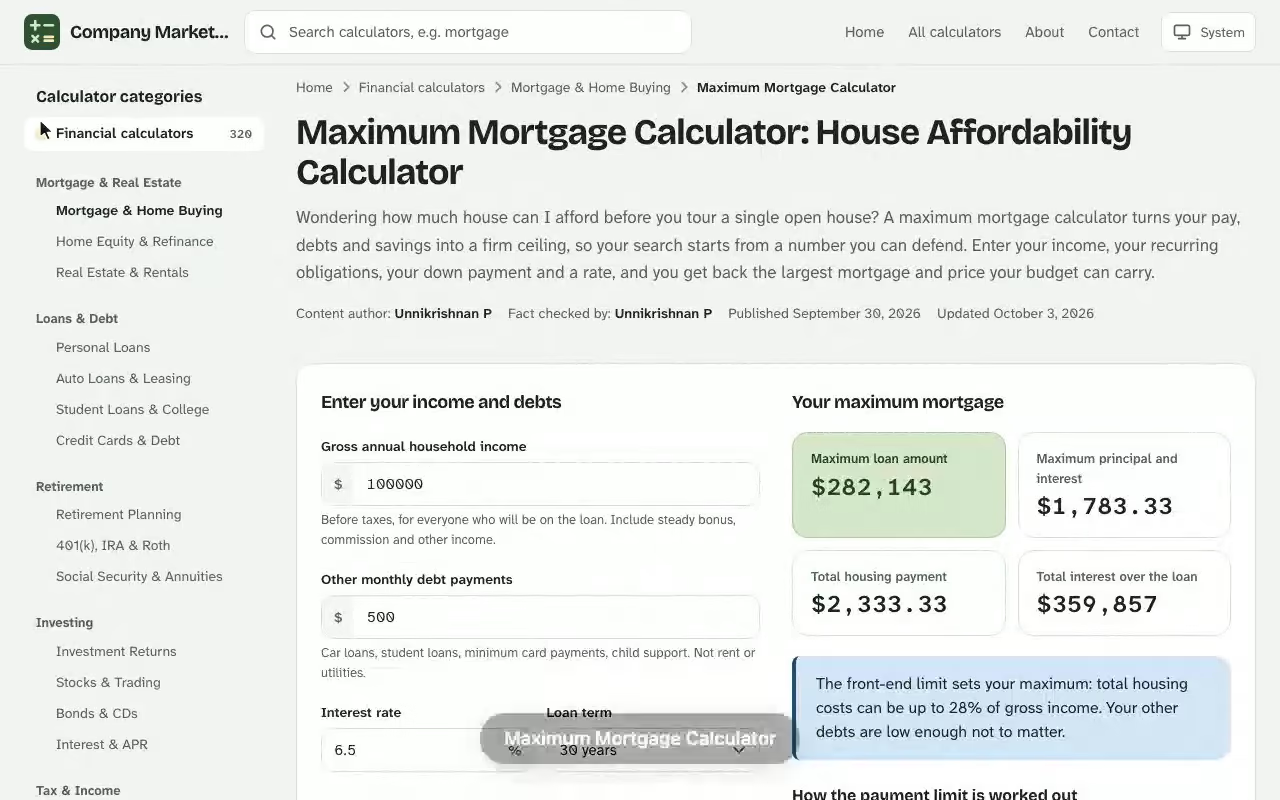
Maximum Mortgage Calculator. Wondering how much house can I afford before you tour a single open house? A maximum mortgage calculator turns your pay, debts and savings into a firm ceiling, so your search starts from a number you can defend. Enter your income, your recurring obligations, your down payment and a rate, and you get back the largest mortgage and price your budget can carry. The free house affordability calculator uses the same plain-English approach, so you can compare results side by side.
Your maximum mortgage
Maximum loan amount
–
Maximum principal and interest
–
Total housing payment
–
Total interest over the loan
–
–
How the payment limit is worked out
Gross monthly income–
Front-end limit for housing–
Back-end limit minus other debts–
Housing budget (the lower of the two)–
Less tax, insurance, HOA and mortgage insurance–
Left for principal and interest–
Maximum loan by rate and term
The same principal and interest budget at rates around the one you entered. A longer term stretches the budget further but costs more interest.
Interest rate
15-year
20-year
30-year
Results are estimates for educational purposes and are not financial, tax or legal advice.
How the Maximum Mortgage Calculator Estimates Your Maximum Home Price
The tool works backward from what you can pay each month. It takes your gross monthly income, applies the percentage limits lenders use to judge risk, subtracts what you already owe, and treats whatever is left as your monthly housing allowance. That allowance has to cover principal and interest, property taxes and homeowners insurance. Once the taxes and insurance are set aside, the rest is the payment your loan amount may produce, and that payment converts into a balance you can borrow. Try the mortgage qualifier calculator online to run your own numbers — everything is calculated in your browser and nothing you enter is stored or sent anywhere.
Add your down payment to that balance and you have the maximum home purchase price. The logic is the same one a lender's underwriter follows, which is why the answer is a better planning anchor than a rule of thumb such as "three times your salary."
The two ceilings behind every result
Every run produces two candidate payments, and the smaller one wins; it sets your mortgage affordability limit and, with it, the price you can target. The first limits housing alone, and the second limits housing plus every other bill you carry. When your obligations are modest, the housing-only cap decides the answer. When they are heavy, the combined cap takes over and pulls your price down.
Here \(I\) is your gross monthly income and \(D\) is your recurring monthly debt. Both caps use pre-tax pay, which is why the figure you see on your paycheck is the wrong starting point.
Mortgage Affordability Inputs You Enter
Each field maps to a real underwriting variable, so the quality of the output depends on the quality of what you type. Use statements and offers instead of guesses wherever you can. Try the va mortgage calculator to run your own numbers — everything is calculated in your browser and nothing you enter is stored or sent anywhere.
Gross income and monthly debts
Start with income before taxes and deductions: base pay, plus bonus or side earnings you can document for two years. Then list every recurring obligation that appears on a credit report, such as a car loan, student loans and minimum payments on credit cards. Utilities, groceries, streaming plans and insurance on your current home are not debts for this purpose, so leave them out.
Down payment and interest rate
Your cash at closing and the interest rate pull the answer in opposite directions. A bigger down payment adds to the purchase price one dollar for one dollar, while a higher rate shrinks the balance your fixed payment can service. Use a quote from a lender, or current mortgage rates for your credit tier, instead of a hopeful number.
Loan term, taxes and insurance
A 30-year loan term gives the lowest payment per borrowed dollar and therefore the highest ceiling, while a 15-year term lowers the price you qualify for even though it saves interest. Local property taxes are usually quoted as a yearly percentage of home value, and insurance is quoted per year. Optional fields cover homeowners association dues and condo fees, which count as housing costs in the same way as taxes.
Worked Example: A House Affordability Calculator Result
Suppose your household earns $92,400 a year, which is $7,700 of gross monthly income. You pay $640 each month toward other debt, you have saved $70,000 for the down payment, and you expect a 6.35% rate on a 30-year fixed loan. Property taxes run 1.1% of the home's value each year, and insurance is $135 a month.
Step 1: Find the binding limit
The housing-only cap is $7,700 × 0.28 = $2,156. The combined cap is $7,700 × 0.36 − $640 = $2,132. The smaller figure rules, so your housing budget is $2,132 a month, and your other debt is what trims it.
Step 2: Turn the payment into a balance
Subtract $135 for insurance and about $312 for taxes, and $1,685 remains for principal and interest. The standard payment formula runs in reverse:
$$L = P \times \frac{(1+r)^{n} - 1}{r\,(1+r)^{n}}$$
See how the Maximum Mortgage Calculator works: change the inputs and the maximum loan amount updates instantly. Enter your own numbers in the calculator above.
With \(P = 1{,}685\), \(r = 0.0635 / 12\) and \(n = 360\), the balance comes to about $270,742.
Step 3: Add your cash to reach a price
Add the $70,000 down payment to the $270,742 balance and the ceiling is $340,742. Your cash covers 20.5% of that price, so private coverage is not required.
How the $2,132 monthly housing budget in the worked example divides before any principal is borrowed.
Line
Amount
Gross income (monthly)
$7,700
Other debt (monthly)
$640
Housing budget (36% limit binds)
$2,132
Principal and interest
$1,685
Property taxes
$312
Homeowners insurance
$135
Loan balance
$270,742
Maximum price with $70,000 down
$340,742
The 28/36 Rule and Debt-to-Income Limits for Mortgage Affordability
Lenders judge risk through two ratios, and those same ratios turn your pay into the housing allowance behind every price the tool returns. The 28/36 rule is the long-standing benchmark for a conventional loan that follows Fannie Mae and Freddie Mac guidelines. It is a guideline lenders weigh alongside credit and reserves, not a law, and some approve borrowers above it when the rest of the file is strong.
Front-end ratio
The front-end ratio divides monthly housing costs by gross income:
Housing costs include principal, interest, taxes, insurance and association dues.
Back-end ratio
The back-end ratio adds every other recurring monthly debt to those housing costs before dividing. This is the broader debt-to-income ratio, and it is the one that most often decides your result when you carry a heavy debt load.
Limits by loan type
Measure
What it counts
Share of gross income
Front-end ratio
Monthly housing costs
28% conventional, 31% FHA
Back-end ratio
Housing costs plus other debt
36% conventional, 43% FHA, 41% VA
An FHA loan allows higher ratios because the borrower pays mortgage insurance premiums. A VA loan for eligible veterans and service members focuses on the back-end figure and charges a funding fee in place of monthly coverage.
Checking a Maximum Home Purchase Price Before Touring Open Houses
A couple with a combined salary of $118,260 wants a number before they book showings. Their gross pay works out to $9,855 a month. A student payment of $387 and a car payment of $294 make up their $681 of recurring obligations. A credit union quoted 6.12% on a 30-year fixed loan, local levies run 1.24% of value each year, insurance is $162 a month, and $82,500 is sitting in savings earmarked for the purchase.
They type those figures into the calculator one field at a time, and it reports their mortgage affordability as a price. The tool compares the two caps: 28% of $9,855 is $2,759, while 36% of the same pay less $681 is $2,867. This time the housing-only limit is smaller, so it rules, and paying off the car early would not change a thing. After $162 for insurance and about $451 for levies, $2,147 is left for principal and interest, which supports a maximum mortgage of roughly $353,515. Adding the $82,500 gives a price near $436,015.
Two details change what they do next. Their cash is 18.9% of that price, short of the 20% mark where conventional lenders stop requiring PMI. And the combined ratio at the cap is 34.9%, well under the 36% line, so the housing share, not their other bills, is what holds them back.
So they rerun the figures with one input changed: $88,200 in cash instead of $82,500, which they can reach by holding a year-end bonus in savings. The price barely moves, rising to about $440,886, but the cash now equals 20.0% of it and the coverage charge disappears from the estimate. That tells them to postpone the first showing by two months and set the search ceiling at $425,000, a little under the price the calculator returned, so a lender's appraisal and a rate change have room to land.
What Moves Your Home Affordability Calculator Result
A change in any input shifts the ceiling, but not equally. The comparison below holds the example fixed and changes one input at a time, so you can see which ones deserve your attention first.
Interest rates
Rate moves hit hardest. Dropping to 5.35% lifts the ceiling to roughly $367,322, while a climb to 7.35% cuts it to about $317,596, a swing of nearly $50,000 from rate alone.
Credit score and creditworthiness
Your credit score rarely appears as a field, yet it sets the rate you are offered. Strong creditworthiness also helps when a lender weighs cash reserves, which is the money left after closing.
Maximum home price for three rates and three down payments, with the worked example outlined.
Monthly debt and down payment
Debt acts like a tax on the ceiling. Raise the $640 to $1,100 and the price falls to $276,307. Eliminating the debt entirely moves it up only to $344,104, because the housing-only cap then takes over. A larger down payment helps, but one dollar more in cash adds a bit less than one dollar to the ceiling, since a higher price also carries more in taxes.
Shorter terms
Choosing 15 years lowers the ceiling to $272,487 and 20 years gives $303,311. The shorter term costs far less over time, with total interest of about $112,000 compared with $335,733 on the 30-year version, so the right choice depends on cash flow versus lifetime cost.
The same budget supports a lower price on shorter terms.
Costs Outside Your Home Affordability Estimate
The figure the calculator returns leaves out several bills. Plan for closing costs at settlement, moving costs, and the steady drain of maintenance and every utility account in a larger space. These sit outside the ratios yet still draw on your monthly expenses. Keep emergency savings intact after the purchase, because a burst pipe does not wait for your next paycheck.
Treat the result as an upper bound. A payment at the limit leaves little room for a lost bonus or a rate reset, so many buyers aim below it and let the monthly budget keep a margin.
PMI and your total mortgage payment
Put less than 20% of the price down on a conventional purchase and PMI joins your bill. It is charged as a small yearly percentage of the balance, then folded into each month's bill, so it eats into the same housing allowance the calculator is protecting. In the worked example, $35,000 in cash at closing is only 11.3% of the resulting price. The ceiling would already slip to about $310,236 before PMI, and the coverage charge would trim it further.
Your full mortgage payment is therefore built from several pieces, and each one should be in the estimate you rely on:
Principal and interest on the balance you borrow
A twelfth of the yearly local levies on the property
Coverage on the structure itself
PMI whenever your cash at closing is under 20%
Association dues, where the property has them
Choosing a comfortable affordable purchase amount
The ceiling a lender will approve and the affordable purchase amount you are comfortable carrying are rarely the same figure. Aim 10% to 15% below the maximum: in the earlier example a total housing payment of $1,812 points to a price near $295,918, and $1,900 points to roughly $308,245. Either one leaves a few hundred dollars a month for repairs and for a smaller paycheck, and it sits safely under your mortgage affordability limit.
How Much House Can I Afford If I Improve My Finances?
The output is a snapshot, and a few deliberate moves can lift it before you apply. Pay off a small balance to remove its monthly payment from your recurring monthly debt. Hold your credit utilization down so your score qualifies you for a sharper rate. Look into down payment assistance programs for first-time homebuyer households, which can add cash without a repayment.
When the numbers look right, ask a lender for preapproval. Those lenders verify pay stubs and credit, and a letter in hand shows sellers you are serious about homeownership. Until then, the mortgage affordability calculator style of estimate is the best guide to what you can qualify for, and checking it again with each new financial situation keeps your search realistic.
Run the house affordability calculator with several rate and down payment pairs, write down the range of prices it returns, and bring that range to your first conversation with a loan officer.
Maximum Mortgage Calculator questions
How much house can I afford on my income?
Lenders usually cap housing costs near 28% of gross monthly income and total debt payments near 36%. The calculator applies both limits to your income and debts and reports the lower result as your maximum home price.
What is the 28/36 rule?
It is a guideline for conventional loans: no more than 28% of gross monthly income on housing costs (the front-end ratio) and no more than 36% on housing plus all other recurring debt (the back-end ratio).
How do FHA and VA loans change the result?
FHA guidelines allow roughly 31% front-end and 43% back-end ratios, and VA guidelines focus on a 41% back-end ratio. Select the loan type in the debt-to-income limit field to see how the ceiling moves.
Does the calculator include property taxes and insurance?
Yes. Property tax, homeowners insurance and any HOA or condo fees are counted as housing costs, so the loan amount is what remains after they are covered.
What happens if my down payment is under 20%?
Conventional lenders typically add PMI when you put down less than 20%. With a custom debt-to-income limit the calculator adds an estimated 0.5% yearly PMI charge to your monthly housing costs in that case.
Is the maximum price the amount I should spend?
No. It is an upper bound based on lender ratios. Many buyers aim 10% to 15% below it so repairs, utilities and a smaller paycheck do not strain the budget.
Can I plan around a fixed monthly budget instead of income?
Yes. Switch the calculation mode to fixed monthly budget, enter what you can pay each month, and choose whether taxes, insurance, HOA fees and maintenance come out of that budget.