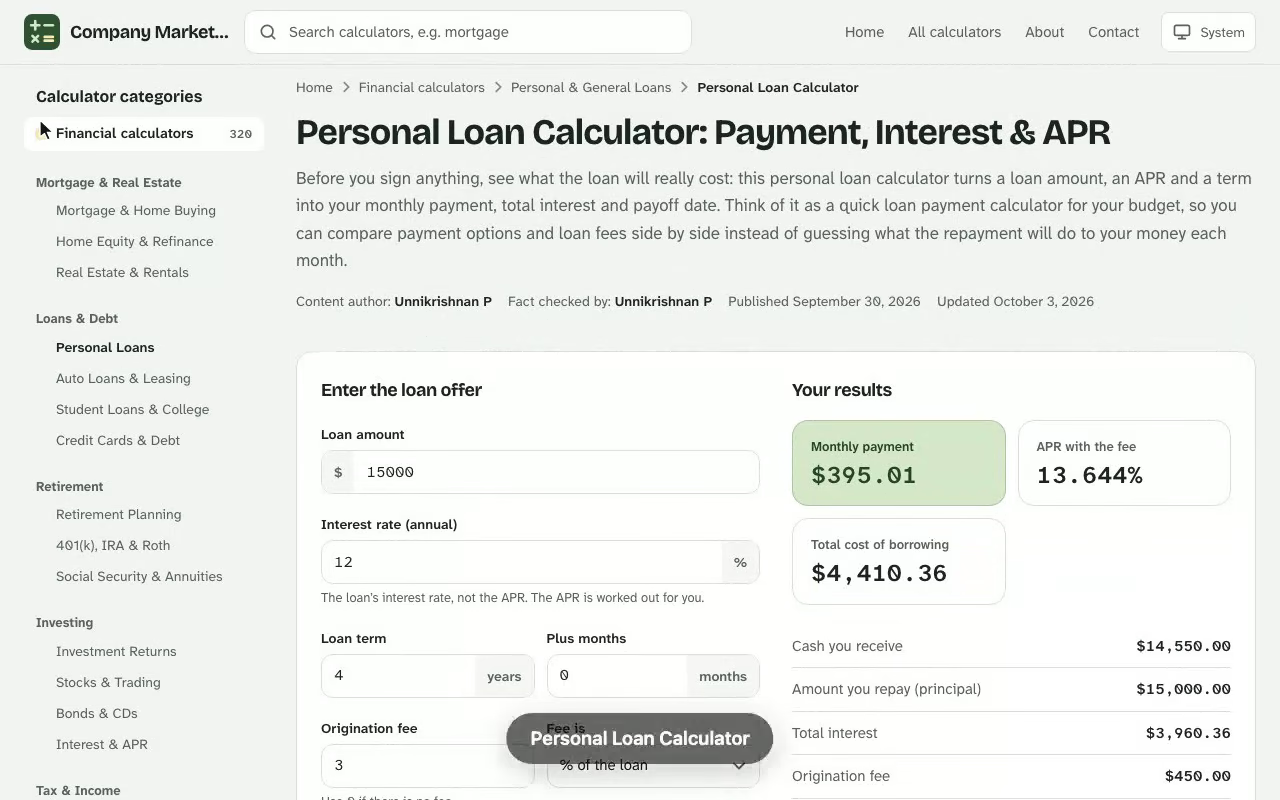
Personal Loan Calculator. Before you sign anything, see what the loan will really cost: this personal loan calculator turns a loan amount, an APR and a term into your monthly payment, total interest and payoff date. Think of it as a quick loan payment calculator for your budget, so you can compare payment options and loan fees side by side instead of guessing what the repayment will do to your money each month. Next, open the free payment calculator and enter your own details to see an estimate in seconds.
Your results
Monthly payment
–
APR with the fee
–
Total cost of borrowing
–
Cash you receive–
Amount you repay (principal)–
Total interest–
Origination fee–
Total paid, including any upfront fee–
Last payment–
Need the full amount in hand?
Amortization schedule
How each payment splits between interest and principal, by calendar year or month.
Year
Principal
Interest
Ending balance
Results are estimates for educational purposes and are not financial, tax or legal advice.
How a Personal Loan Calculator Works
A personal loan is a lump sum you receive up front and pay back in fixed monthly payments over a set term. The calculator takes your loan amount, the interest rate and the number of months, then solves for the one payment that brings the balance to zero on the final due date. Because the interest rate is applied to whatever you still owe, early payments are mostly interest and later payments are mostly principal. If you want to see how the figures change, the free repayment calculator gives you an instant result you can adjust as you go.
See how the Personal Loan Calculator works: change the inputs and the monthly payment updates instantly. Enter your own numbers in the calculator above.
Monthly Payment Formula
The monthly payment comes from the standard amortizing-loan formula, where P is the amount borrowed, r is the monthly rate (the annual rate divided by 12) and n is the number of payments:
$$M = P \times \frac{r\,(1+r)^{n}}{(1+r)^{n} - 1}$$
Total repayment cost is then \(M \times n\), and total interest is that figure minus the principal you borrowed.
Loan Amount, Loan Term and Interest Rate Inputs
Every field on the form changes the answer, so it helps to know what each one controls:
Loan amount: the principal you want to borrow, before any fee is taken out.
Interest rate or APR: the yearly price of the loan; use the APR your lender quotes so fees are reflected.
Loan term: the number of months you have to repay, which sets how long interest accrues.
Origination fee and other upfront fees: costs charged for processing the loan, entered as a percentage or a flat amount.
Extra payment: optional money added to each payment to shorten the payoff time.
Payment frequency: how often a payment is due, usually monthly.
Type exact values or drag the slider if your form has one: because personal loans are offered in fixed amounts and terms, trying two or three combinations takes seconds and shows which one fits your financial situation.
Monthly payment on $18,750 at five APRs and four terms; the outlined cell is the worked example.
Personal Loan Payment Worked Example
Suppose you borrow $18,750 at a 9.45% APR for a 48-month term, and the lender keeps a 4% origination fee ($750), so $18,000 reaches your account. The monthly rate is 0.7875%, which gives a required payment of $470.61. Over 48 payments that adds up to $22,589.34 of repayment, of which $3,839.34 is interest. The 365 360 loan calculator uses the same plain-English approach, so you can compare results side by side.
Total Interest and Total Cost
Result
Value
Loan amount
$18,750.00
Interest rate (APR)
9.45%
Loan term
48 months
Monthly payment
$470.61
Total interest
$3,839.34
Origination fee
$750.00
Total cost (payments plus fees)
$23,339.34
Payoff date
48 months after the first payment
The table shows why the sticker rate is not the whole story: the fee adds $750 to what the loan costs, even though you never repay it as part of the principal.
The $18,750 loan builds to $23,339 once interest and the fee are added.
Origination Fee and the Real Annual Percentage Rate
Because the fee is deducted before you receive the money, you repay $18,750 while only getting the use of $18,000. Solving for the rate at which $470.61 payments repay $18,000 gives an annual percentage rate of about 11.6%, noticeably higher than the 9.45% interest rate. That gap is exactly why loan comparisons should use APR, which folds the fee into the annual cost rather than the bare interest rate.
Amortization Schedule: Principal and Interest by Year
An amortization schedule lists every payment and splits it between interest and principal, with the ending balance after each one. In month one, interest on $18,750 is $147.66, so only $322.95 of your payment reduces the loan balance. By month 48 the interest charge is just $3.68. Grouped by year, the same schedule looks like this:
Year
Interest
Principal
Ending balance
1
$1,599.53
$4,047.80
$14,702.20
2
$1,200.01
$4,447.33
$10,254.87
3
$761.04
$4,886.29
$5,368.58
4
$278.76
$5,368.58
$0.00
Each year's $5,647 of payments shifts from interest toward principal.
Loan Payment Calculator Tips: Extra Payment and Payoff Time
Adding money to each payment is the simplest way to cut interest, and a good loan payment calculator lets you test it before you commit. Many lenders also publish a personal loan rate calculator, and some pair it with a personal loan rate and payment calculator that pulls in the APR you were actually offered, so use whichever shows your own rate.
Extra Payment and Interest Saved
Add an extra payment of $60 to the example above and the balance reaches zero in 42 months rather than 48. Total interest drops to $3,310.09, so the interest saved is $529.25 and your payoff time shrinks by six months. Check the prepayment fee terms first, since a few lenders charge for early repayment.
Checking a Personal Loan Payment Before Consolidating $12,640 in Card Balances
Two credit cards carry $7,915 at 24.9% and $4,725 at 21.4%, and the minimums barely touch the balances. A lender offers a consolidation loan at a 13.2% APR with no origination fee, so the question is which term fits a take-home budget. Gross income is $4,380 a month and a car payment of $610 already goes out, so the payment this calculator returns has to leave room under the 36% debt-to-income guideline many lenders apply.
The loan amount field gets $12,640, the rate field 13.2, and the term field 36 months. The monthly payment appears as $427.11, with total interest of $2,735.97. Adding the car payment gives $1,037.11 of monthly debt, a 23.7% debt-to-income ratio, comfortably inside the guideline.
Changing only the term to 48 months drops the payment to $340.36 and moves the ratio to 21.7%, but total interest climbs to $3,697.07. That is $961.10 more for $86.75 a month of relief, which the budget does not need.
Term
Monthly payment
Total interest
Debt-to-income
36 months
$427.11
$2,735.97
23.7%
48 months
$340.36
$3,697.07
21.7%
The decision follows from the numbers: take the 36-month offer, send $7,915 to the 24.9% card first, then $4,725 to the other, and cancel no accounts until the balances read zero.
Personal Loan Fees to Check Before You Borrow
Beyond principal and interest, personal loans can carry several fees. These loan fees feed straight into the calculator’s total cost, so list them before you compare offers:
Origination fee: charged for processing the application, usually deducted from the loan amount before you are paid.
Prepayment fee: a penalty for paying off the personal loan early, which is less common today.
Late payment fee: charged when a payment misses its due date, either flat or a share of the payment.
Personal loan insurance: optional cover for events such as disability or job loss, never required by law.
Other upfront fees and any insurance add to the annual cost, so an offer with a low interest rate can still be the more expensive one.
Personal Loans, Credit Score and Creditworthiness
Lenders judge creditworthiness before they quote any rates. They review your credit report, credit history, income, employment and debt-to-income ratio, and a stronger credit score generally earns a lower APR. Weak credit usually means higher interest rates or a smaller loan limit, so run the calculator at several rates to see how much your score is worth in monthly payments.
Unsecured Personal Loans and Secured Loans
Unsecured personal loans need no collateral, which is why they carry higher rates than secured loans backed by a car, savings or other assets. Given their unsecured nature, lenders price in the risk of default. Secured options can lower the rate, but you risk losing the collateral if you stop paying. A mortgage and auto loans work the same way, since the house or car backs the debt, which is why their rates sit below most unsecured offers; enter the lower secured rate into the calculator to see how much the payment drops.
Application, Approval and Same-Day Decision
The loan application normally asks for pay stubs, income tax returns and employment details. Some lenders give a same-day decision, and once approved, the money can arrive in a day or two. Before applying, enter the payment you expect into the calculator and confirm it fits your budget, because each hard credit check can lower your credit score a little.
Debt Consolidation and Other Personal Loans Uses
Personal loans pay for home improvements, medical bills and weddings, but the most common use is debt consolidation. Consolidating credit card debt into one fixed payment can cut your interest if the new APR is lower than your cards’ rates. Put both balances and rates into the calculator to confirm the saving is real, and check whether the payoff time is shorter or longer than you have now.
Loan Calculator Comparison, Refinance and Alternatives
A loan calculator also helps you decide whether to refinance an existing balance or skip borrowing altogether. Alternatives worth pricing include:
A cosigner with good credit, who shares the risk of default.
Credit cards with an interest-free introductory period, if you can repay before it ends.
A home equity loan or HELOC, which turns a loan into a secured one against your house.
Borrowing from family, savings or a community organization.
Run each option that has a rate and term through the calculator and compare its payment and total interest with the loan’s.
Comparing Personal Loans From a Credit Union, Banks and P2P Lenders
A bank, a credit union and online lenders all offer personal loans, and their terms differ. Enter each offer’s APR, fee and term into the calculator and compare the monthly payment and total repayment cost; the cheapest payback is the one that fits your budget without stretching the term. Peer-to-peer lending, also called P2P lending, matches borrowers with investors online and is one more way to finance a purchase worth pricing this way. Be wary of fraudulent or predatory offers, including payday loans and any lender that asks for a fee before approval, and consumers should walk away from pressure to decide on the spot. Use the calculator for affordability first, then confirm the repayment will not strain your monthly cash flow.
The figures here are estimates for educational purposes: real offers depend on your lender, your credit and your wider financial goals, so treat the calculator’s result as a starting point for planning rather than a promise.
Personal Loan Calculator questions
How does a personal loan calculator work out my monthly payment?
It divides your loan into equal payments using the loan amount, the interest rate and the number of payments. Each payment covers that period's interest first and puts the rest toward principal, so the balance reaches zero on the last payment.
What is the difference between the interest rate and the APR?
The interest rate is the price of borrowing the money. The APR also folds in fees such as an origination fee, so it shows the yearly cost of the whole loan and is the better number for comparing offers.
How does an origination fee change what I pay?
A fee deducted from the loan means you receive less than you borrow but still repay the full amount. The calculator adds it to total cost and raises the real APR above the quoted rate.
Will an extra payment shorten my loan?
Yes. Extra money goes straight to principal, so later interest is charged on a smaller balance. Enter an extra payment to see the interest saved and the earlier payoff date, and confirm your lender charges no prepayment fee.
Does a longer loan term cost more?
A longer term lowers each payment but keeps the balance outstanding for longer, so total interest rises. Try two terms side by side and weigh the lower payment against the added interest.
Do personal loans need collateral?
Most are unsecured, so no car or home backs them, and lenders rely on your credit score, income and debts to set the rate. Secured versions exist and often carry lower rates, but the collateral is at risk if you miss payments.
Can I use this calculator to compare debt consolidation offers?
Yes. Enter the consolidation loan's amount, APR, term and fees, then compare the total cost and real APR with the interest you are paying on your current debts.
Is the result a loan offer?
No. It is an estimate for educational purposes. Your lender's actual rate, fees and payment depend on your credit and application.