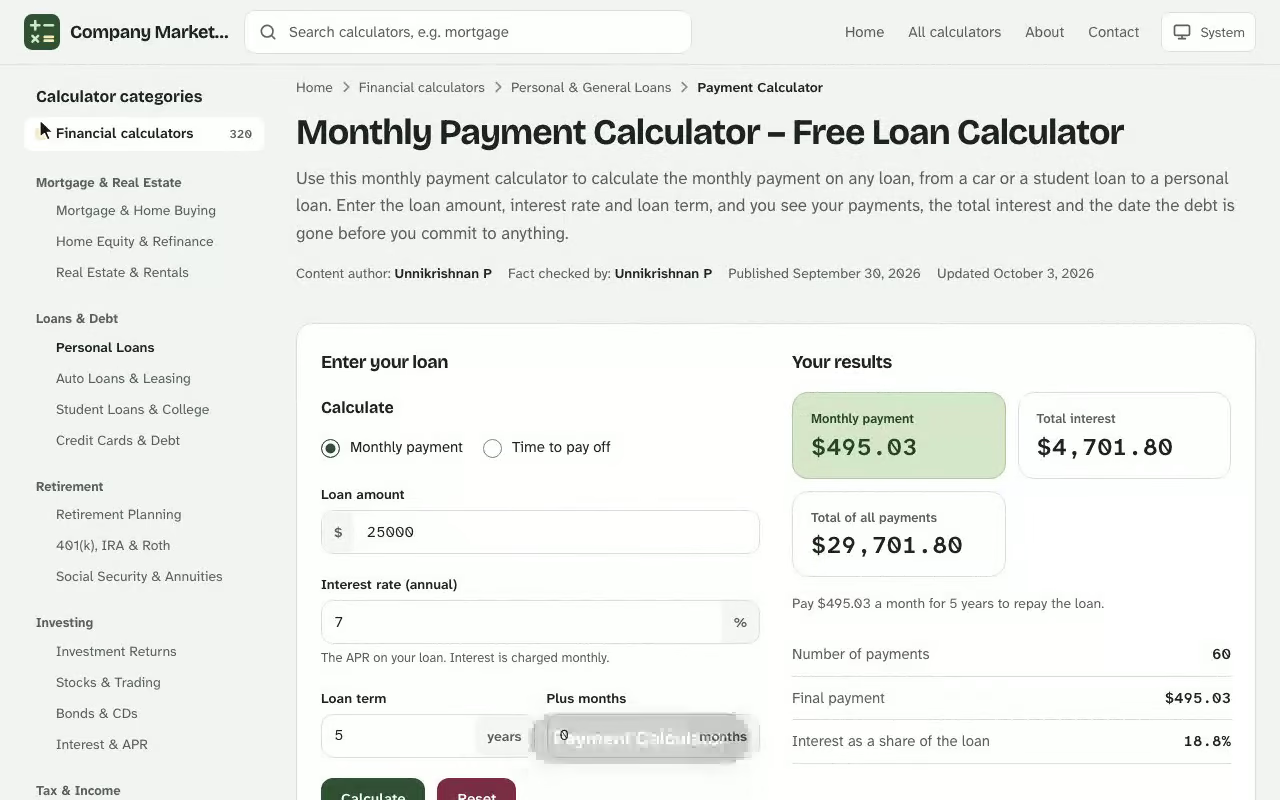
Payment Calculator. Use this monthly payment calculator to calculate the monthly payment on any loan, from a car or a student loan to a personal loan. Enter the loan amount, interest rate and loan term, and you see your payments, the total interest and the date the debt is gone before you commit to anything. The loan calculator is free to use with no sign-up, and works on desktop and mobile.
Your results
Monthly payment
–
Total interest
–
Total of all payments
–
Number of payments–
Final payment–
Interest as a share of the loan–
Payment at other terms
The same loan and rate with a different term or payment.
Term
Monthly payment
Total interest
Amortization schedule
How each payment splits between interest and principal, and the balance left after it.
Year
Principal
Interest
Ending balance
Results are estimates for educational purposes and are not financial, tax or legal advice.
How Your Monthly Payment Is Calculated
The tool solves one question: what level payment, made on a regular schedule, repays a balance plus its interest by the final due date? You supply three facts about the loan, and the estimate appears instantly. Change any input and you can compare scenarios side by side, which is the fastest way to find a loan that fits your budget. The free student loan calculator uses the same plain-English approach, so you can compare results side by side.
The same math drives a loan payment calculator and a loan calculator for a mortgage, a car loan or a credit union installment loan. Only the inputs around the core calculation differ. A car buyer adds a down payment and a trade-in, while a borrower financing tuition may add a minimum payment or origination fees.
See how the Payment Calculator works: change the inputs and the time to pay off updates instantly. Enter your own numbers in the calculator above.
Loan amount
The loan amount is the principal you borrow, which is the sales price minus anything you pay up front. Fees rolled into the balance raise it, and a rebate or incentive lowers it. Start from the real figure on your quote rather than the sticker price.
Interest rate (APR)
Your interest rate is the yearly cost of borrowing. The APR bundles the rate with required lender fees, so it is the better number to compare between offers. The calculator divides it by 12 to get the rate charged each month, and a fixed rate keeps that figure steady for the whole life of the loan.
Loan term and number of payments
The loan term is how long you have to repay, usually entered in years or months. Multiply the term in years by 12 and you get the number of payments. A longer schedule shrinks each installment but increases the cost of borrowing, a trade-off the tables below put into numbers.
The Loan Payment Formula Behind Your Monthly Payment
Every loan payment on a standard fixed-rate loan comes from one closed-form equation. It assumes standard loan amortization: equal installments, interest charged on the remaining balance and no prepayment.
$$M = P \times \frac{i\,(1+i)^{n}}{(1+i)^{n} - 1}$$
Here \(M\) is the payment, \(P\) is the principal, \(i\) is the periodic rate (the annual rate \(\div\) 12 \(\div\) 100) and \(n\) is the number of payments. The total you repay is \(M \times n\), and total interest is that amount minus \(P\). The equation follows compound interest logic, since interest is recalculated on the current balance each period. With a 0% rate the formula collapses to \(P \div n\), so a good calculator handles that case separately.
Worked Example: Monthly Payment on a $38,600 Loan
Say you finance $38,600 at a 7.35% fixed rate over 60 months. The periodic rate is 7.35 ÷ 12 ÷ 100 = 0.006125, and the formula gives a monthly payment amount of $770.72, and you owe it every month until the balance reaches zero. Across 60 installments your total payments come to about $46,243, so the interest paid is about $7,643. Pair this with the free existing loan calculator for a fuller picture before you make a decision.
Loan amount plus interest equals the total of all 60 payments.
The first installment is mostly interest, because the balance is at its highest. As the principal balance falls, the interest share shrinks and the principal share grows. This amortization schedule excerpt shows how that plays out:
Payment
Interest
Principal
Ending balance
1
$236.42
$534.29
$38,065.71
12
$199.30
$571.41
$31,968.05
24
$155.86
$614.86
$24,831.88
36
$109.12
$661.60
$17,153.17
48
$58.82
$711.90
$8,890.67
60
$4.69
$766.02
$0.00
Amortization Schedule: Where Each Loan Payment Goes
An amortization schedule lists every payment and splits it into interest and principal. The amortization pattern is why paying a loan down feels slow at first: in year one of the example above, $2,617 of your $9,249 in payments is interest, while in year five only $358 is. Reading the ending balance column tells you exactly how much you still owe if you decide to pay off the loan early.
Each year's payments split into principal and interest for the $38,600 example loan.
Because the schedule is deterministic, you can check any lender's statement against it. If your own balance after 12 payments differs from the table's figure by more than a few cents, ask the servicer about fees or a different compounding rule.
How Loan Term and Interest Rate Change Your Monthly Payments
Two sliders move your monthly payments more than anything else: the rate and the length of the loan. This table holds the 7.35% rate from the worked example and varies only the schedule:
Term
Payment
Total interest
36 months
$1,198.04
$4,530
48 months
$930.61
$6,069
60 months
$770.72
$7,643
72 months
$664.60
$9,251
84 months
$589.20
$10,893
Monthly payment on a $38,600 loan by interest rate and loan term; the outlined cell is the worked example.
Stretching from 36 to 84 months cuts the payment by $608.84 but adds $6,363 in interest. Rates matter too: on the same 60-month schedule, 5.9% costs $744.45 a month ($6,067 in interest) and 8.9% costs $799.40 ($9,364). Shopping for the lowest interest rates is therefore worth as much as negotiating the price, so compare rates from several lenders.
Fixed term vs. fixed payments
The fixed term approach starts with a repayment length and solves for the payment, as in the examples above. The fixed payments approach starts with the payment amount you can fit into each month and solves for how long the loan lasts. Adding an extra $100 to the $770.72 installment, for example, retires the example loan in 52 months instead of 60 and trims the interest to about $6,575. Both are the same equation solved for a different unknown, and a fixed interest loan works with either.
Fixed rate or variable rate
A fixed rate never changes, so the payment you calculate today is the payment you make. A variable rate resets with a market index, which means any estimate is only valid until the next reset. Treat a calculation on a variable loan as a starting point and rerun it whenever the rate changes.
Car Payment Calculator Inputs: Down Payment, Trade-In and Sales Tax
An auto loan calculator (sometimes sold as a car loan calculator) add several fields on top of the core three, because the amount financed on a car loan is rarely the sticker price. Each of these changes the balance the interest is charged on, and therefore the monthly car payment you see.
Down payment and trade-in
A down payment is cash you apply up front, and a trade-in credits your old vehicle against the price. Together they reduce the balance you finance. If you still owe money on the old vehicle, the trade-in value is reduced by that amount, and when you owe more than it is worth you start with negative equity. Many buyers aim for a down payment of at least 10% or add GAP insurance to cover the gap if the car is totaled.
Sales tax, title and registration
Sales tax is charged on the sales price, and title and registration charges are added on top. A calculator that includes them gives a truer picture than one that does not. Ask the dealer for an out-the-door figure, which includes taxes and fees, and use that number so no surprise appears at signing. Cash incentives and rebates are subtracted from the price before financing. Enter what remains, less your down payment, as the amount you finance, so the result reflects the balance you will really owe.
Credit score and lender fees
Your credit score largely decides the rate a lender offers, so a higher score can mean a noticeably lower payment. A co-signer with strong credit can improve the offer too. Some lenders also charge an origination fee, and origination fees or other loan fees are often added to the balance, which raises the payment slightly. Getting prequalified lets you see a real offer without a hard inquiry, so you can enter an accurate rate rather than a guess.
Weekly, Biweekly and Other Loan Payments
The payment frequency setting changes how many installments you make a year. The periodic rate is the annual rate divided by that number, and the loan is repaid in the same number of installments per year:
Weekly: 52 payments a year
Biweekly: 26 payments a year
Semi-monthly: 24 payments a year
Monthly: 12 payments a year, the default for most consumer lending
Quarterly: 4 payments a year, and annually means a single yearly payment
Paying more often rarely changes the math by itself, since interest is still charged on the balance. The real gain comes from making an extra full installment each year, which a biweekly plan does by accident, and from every dollar of monthly installments you pay above the minimum. Check that your lender applies extra money to principal, and confirm the minimum payment rule before you automate anything.
Checking a Truck's Monthly Loan Payments Against Your Budget
A used pickup is listed at $31,925, and you have $5,085 saved for the down payment, which leaves $26,840 to finance. Your credit union has prequalified you at 6.74% APR, and your take-home pay is $4,850 a month. Before visiting the dealer, you want to know which repayment length keeps the loan inside the 15%-of-take-home guideline, a ceiling of $727.50.
You enter 26,840 as the loan amount, 6.74 as the rate and 48 as the number of months, then press the calculate button. The monthly payment that comes back is $639.48, with $3,855 in total interest. That sits $88.02 under your $727.50 ceiling, so a 48-month schedule fits.
The dealer's finance office is pushing a longer schedule, so you rerun the loan calculator with 72 months. The payment drops to $454.25, which looks comfortable, but the interest rises to $5,866. Choosing 72 months would cost you $2,011 more than 48 months for a payment you don't need to lower, and it would also sit exactly at the 72-month ceiling that most car-loan guidance warns against.
Months
Payment
Total interest
48
$639.48
$3,855
60
$528.18
$4,851
72
$454.25
$5,866
The 60-month row is the fallback if your income dips. Your decision: accept the credit union's 48-month offer, and ask them to hold the 6.74% rate for another week so the truck purchase can close on Friday.
Student Loans, Mortgages and Auto Loans: One Loan Calculator for All
You can reuse a loan calculator for different products as long as the repayment is a level installment. Student loans that follow a standard plan, auto loans and a mortgage principal-and-interest payment all fit. A mortgage payment also carries taxes and insurance, so add those separately to the result.
The estimate does not hold for income-driven repayment or extended loan repayment plans, where the payment depends on your annual salary or steps up over time. A borrower on one of those plans should use the lender's own tool. A lender may also quote an APR that includes charges the basic formula ignores, so confirm which figure you are entering.
Keeping Your Monthly Loan Payments Affordable
A payment is affordable only in the context of your budget. A common rule of thumb keeps a car payment under about 15% of your take-home pay, and a repayment schedule below 72 months limits interest costs. Before you borrow, weigh the figure against your income, your savings goals and your other debt. Once you know what you can afford, check whether you qualify and are approved at current rates and your target price.
Shorten the schedule if the payment still fits, because the cost of financing falls quickly.
Raise the down payment instead of the loan amount to keep borrowing lower.
Get prequalified with a bank, a credit union and the dealer, then compare their offers on the same APR basis.
Rebuild your credit before applying if your score is borderline, since a better score can lower the rate and payoff cost.
Whatever you choose, run the numbers again whenever the price, rate or schedule changes, then estimate your payoff date and pay off the balance early if the loan has no penalty.
Payment Calculator questions
How is a monthly loan payment calculated?
The calculator multiplies the amount financed by the periodic rate, then divides by one minus the periodic rate plus one raised to the negative number of payments. That gives a level payment that repays both principal and interest by the final due date.
How does the interest rate affect my payment and total cost?
A higher rate raises the interest portion of every payment and the total interest over the loan. On a longer loan the effect compounds, so even a small rate difference can add up to thousands of dollars.
Does a longer loan term lower my payment?
Yes, spreading the balance over more payments shrinks each one, but you pay interest for longer, so the total cost goes up. Compare the total interest figure across terms before choosing the lowest payment.
What is the difference between the fixed-term and fixed-payment modes?
Fixed term starts with how long you want to borrow and solves for the payment. Fixed payment starts with the amount you can pay each period and solves for how long it takes to pay off the loan.
How much should I put down on a car or other financed purchase?
A larger down payment reduces the amount financed, lowers your payment and cuts interest. Many lenders and car buyers aim for at least 10% down, and more if the budget allows, to avoid owing more than the item is worth.
Do fees, taxes and trade-ins change the result?
They change the amount you finance. Sales tax, title and registration fees raise it, while rebates, a trade-in and a down payment lower it. Use the optional fields so the payment reflects the balance you will actually owe.
Can I use this calculator for a mortgage or student loan?
It works for any fixed-rate loan with equal installments, including auto loans and standard student loan repayment. It does not include mortgage taxes and insurance, and it does not model income-driven or graduated repayment plans.
Does paying biweekly instead of monthly save interest?
Changing the payment frequency here recalculates the schedule with the matching rate per period. Savings in real life come from making extra payments toward principal, so check that your lender applies additional money to the balance.