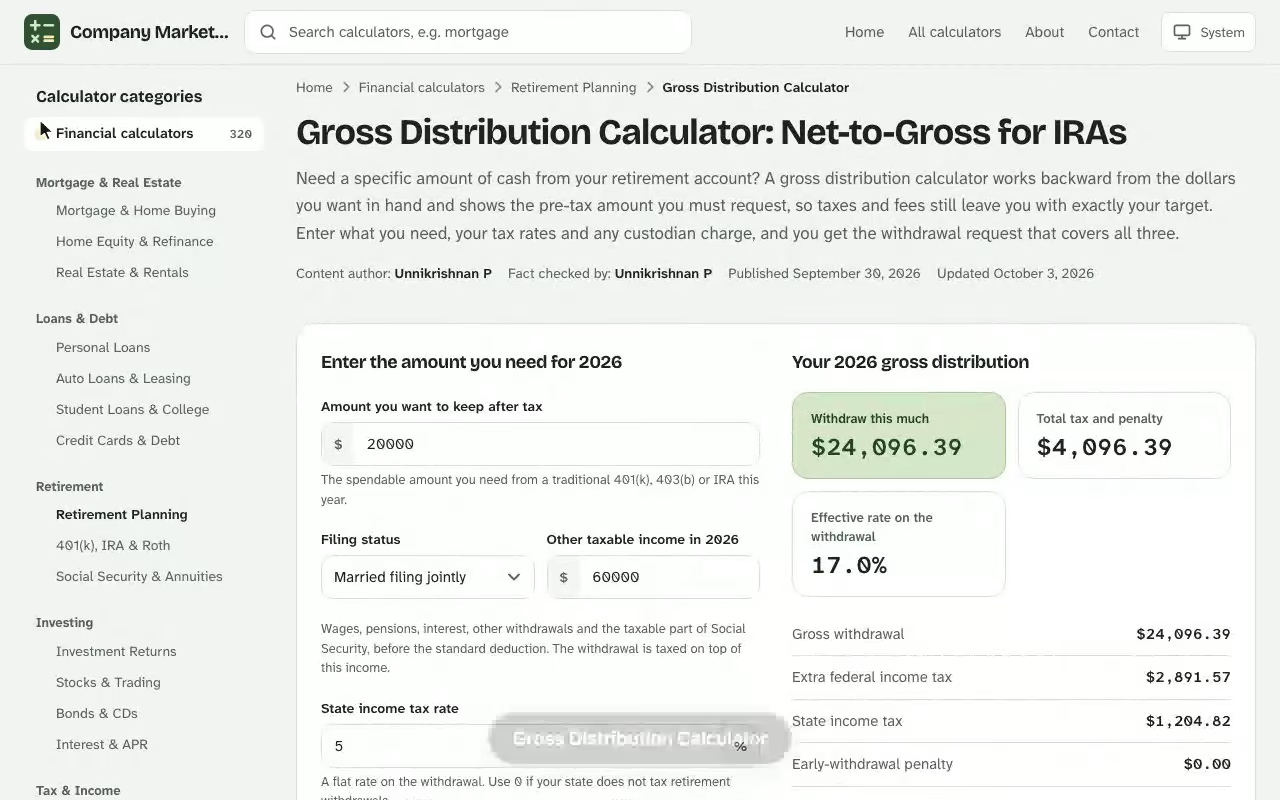
Gross Distribution Calculator. Need a specific amount of cash from your retirement account? A gross distribution calculator works backward from the dollars you want in hand and shows the pre-tax amount you must request, so taxes and fees still leave you with exactly your target. Enter what you need, your tax rates and any custodian charge, and you get the withdrawal request that covers all three. The life expectancy calculator online is free to use with no sign-up, and works on desktop and mobile.
Your 2026 gross distribution
Withdraw this much
–
Total tax and penalty
–
Effective rate on the withdrawal
–
Gross withdrawal–
Extra federal income tax–
State income tax–
Early-withdrawal penalty–
Withdrawal fee–
You keep–
Federal bracket before / after–
Uses 2026 federal brackets and standard deductions. Does not model extra Social Security becoming taxable, Medicare IRMAA surcharges or credits that phase out with income.
Gross withdrawal for other after-tax amounts
Same filing status, other income and state rate. Larger withdrawals reach higher brackets, so each extra dollar costs more.
You keep
Withdraw
Tax and penalty
Effective rate
Top federal bracket
Results are estimates for educational purposes and are not financial, tax or legal advice.
Gross Distribution Calculator Basics: Why the Check Never Matches the Request
When you ask an IRA custodian for money, the number you request is not the number that reaches your bank. The custodian withholds tax, sometimes subtracts a service charge, and sends you what is left. That makes every gross distribution a larger figure than the after-tax amount you actually spend, and the gap depends on your rates, not on a fixed percentage you can guess at. If you want to see how the figures change, the different retirement dates planner online gives you an instant result you can adjust as you go.
The calculator exists because the arithmetic runs in an awkward direction. Most people know the bill they must pay, such as a $7,250 property tax installment, and need to know what to request. Starting from that bill, the tool solves for the amount your account must release before anything is taken out.
Gross Amount Versus Net Amount
The gross amount is the full withdrawal your account balance drops by. The net amount is the cash that arrives after deductions, often called net proceeds. Everything in between is either tax withheld on your behalf or a fee, and none of it is lost: withheld tax is credited toward the bill you settle when you file your return.
Where Each Deduction Comes From
Federal withholding is taken at the rate you choose on the withholding form, or a default your custodian applies.
State tax withholding follows your state's rules, and some states make it mandatory.
A fee is a flat charge for a wire, a check or an account service, subtracted after the percentages.
The Net-to-Gross Formula Behind the Calculator
If your total withholding rate is \(R\) written as a decimal, you keep \(1 - R\) of every dollar released. A flat fee comes off whatever remains, so the formula that reverses the process is: The retirement planner with taxes is free to use with no sign-up, and works on desktop and mobile.
A net-to-gross calculator applies exactly this division for you. Here \(R = \text{Federal} + \text{State} + \text{Local}\), each as a decimal. In the other direction, the standard calculation is \(\text{Net} = \text{Gross} \times (1 - R) - \text{Fee}\).
Step by Step
Add your federal, state and local percentages into one combined rate and convert it to a decimal.
Subtract that decimal from 1 to get the share you keep.
Add any flat fee to the net you want.
Divide that sum by the share you keep.
Choose to round up to the next cent or dollar so the check never lands short.
Worked Example: Netting $7,250 from a Traditional IRA
Suppose your desired net amount is $7,250.00, deposited for a roof repair. Your federal withholding is 22%, your state withholds 3.5%, and the custodian charges a $35 wire fee. The combined rate is 25.5%, so you keep 0.745 of each dollar, and the required gross is \((7{,}250 + 35) \div 0.745\), which rounds up to $9,778.53.
Line item
Rate or basis
Amount
Required gross distribution
Solved by the formula
$9,778.53
Federal tax withheld
22.0% of gross
$2,151.28
State tax withheld
3.5% of gross
$342.25
Wire fee
Flat charge
$35.00
Net amount to your bank
Gross minus everything above
$7,250.00
How the $9,778.53 gross request breaks down into tax, fee and the $7,250.00 you receive.
The total tax withheld is $2,493.53, and your effective tax rate on the request is 25.5% before the fee, or 25.86% once the fee is counted as a cost of getting the money out. Your retirement balance falls by the gross distribution amount of $9,778.53 to deliver $7,250.00.
The Common Mistake: Adding Tax on Top of Your Net
The most frequent error is multiplying the target by the tax rate and adding the result. It feels logical, but the tax is withheld from the larger gross figure, not from your target, so the net after withholding can never reach your target. The retirement account is drained by the wrong amount before the error is even visible.
Method
Gross requested
Net received
Result
Add tax to the target
$9,142.68
$6,776.30
$473.70 short
Divide by the share you keep
$9,778.53
$7,250.00
On target
The add-tax shortcut lands $473.70 below the $7,250.00 target; the formula does not.
Because the shortfall grows with your rate, the higher your bracket, the more costly the shortcut becomes. Dividing, never adding, keeps your required net amount intact.
IRA Distribution Calculator Inputs Explained
An IRA distribution calculator only needs a handful of numbers, but each one deserves a deliberate choice. Understanding what the fields mean helps you decide whether the default rates fit your situation.
Federal Tax and State Tax Withholding Rates
Enter the percentages you expect to be withheld, not your final liability. Federal tax withholding on a non-periodic payment from an IRA is commonly 10% unless you elect otherwise, while periodic payments follow the instructions on your withholding form. Add the state tax percentage separately, and include any local tax if your area levies one. If you enter a rate below what you will truly owe, plan for the difference at filing time.
Filing Status and Marginal Tax Rate
Your filing status decides which brackets apply, and your filing status also sets the standard deduction. Together with your estimated adjusted gross income, it points to your marginal tax rate, the percentage applied to your last dollar of income. Distributions stack on top of other income, so a large withdrawal can push part of it into a higher tax bracket, which is why a 22% withholding election may not equal what you owe.
Fees and Rounding
Fees in the tool are dollar amounts deducted after tax. Rounding is a convenience: rounding the gross up to a whole dollar or ten dollars guarantees you meet the target, at the cost of a slightly larger withdrawal and a few extra dollars of tax withheld.
A $3,918.40 Property Tax Bill and a Net-to-Gross Calculator Run
Marta, a 67-year-old retiree, has a county property tax bill of $3,918.40 due in two weeks. Her pension covers monthly expenses, so the money has to come from her traditional IRA, and she wants every cent of the bill covered by one deposit with no top-up later.
See how the Gross Distribution Calculator works: change the inputs and the withdraw this much updates instantly. Enter your own numbers in the calculator above.
She opens the calculator in net-to-gross mode and types 3,918.40 as the amount. Her custodian's form shows a default federal withholding of 10%, so she enters 10, adds 4 for her state, leaves the fee at zero and clicks the calculate button. The gross distribution comes back at $4,556.28, with $637.88 withheld in total.
Before she submits, she checks the result against her own return. Her projected taxable income puts her squarely in the 12% federal bracket, not 10%, so a 10% election would leave her owing roughly two percentage points of the distribution when she files. That is the named reference point: her bracket, not the custodian's default.
Scenario
Combined rate
Gross requested
Total withheld
Custodian default, 10% federal
14%
$4,556.28
$637.88
Marta's bracket, 12% federal
16%
$4,664.76
$746.36
She reruns the numbers with 12 in the federal field and 4 in the state field. The tool returns $4,664.76: $559.77 federal, $186.59 state, and exactly $3,918.40 left over. The difference between the two requests is $108.48, a small price to avoid a balance due in April.
Her next step is concrete. She submits a withdrawal request for $4,664.76 with a 12% federal election, and she notes the figure beside the tax bill so she can compare it with the deposit when it lands.
Withholding by Account Type: Traditional, Roth and Inherited IRA
An IRA tax withholding calculator and any other withholding calculator are only as accurate as the rate you feed it, and the right rate depends on which account the money leaves.
A traditional IRA withdrawal is generally taxed as ordinary income, so every rate in the tool applies in full.
A qualified Roth IRA withdrawal, with the five-year rule met and you aged 59½ or older, is tax-free, so only a fee would separate gross from net.
An inherited IRA follows beneficiary rules, and a required minimum distribution may force a minimum withdrawal each year no matter what net you need.
Early Withdrawal Penalty Under Age 59½
If you are under 59½, a 10% early withdrawal penalty usually applies to the taxable amount, and custodians do not include it in the percentage they withhold. To cover it in advance, add 10% to your combined rate. In the example above, a 35.5% combined rate turns the required gross into $11,294.58, roughly $1,516 more than the penalty-free request. That is a real penalty for taking funds early, and it is separate from the federal and state percentages already in the calculation.
Using the Net Distribution Calculator in Reverse: Gross to Net
A net distribution calculator runs the formula the other way. If your custodian has already set the amount, enter the gross and the tool returns the tax withheld, the fee and the cash you will receive. This helps retirees who take fixed monthly withdrawals and want to know the deposit before it arrives.
For a recurring withdrawal, check the result once a year. Changing your withholding election, moving to a different state or adding another source of income all change the share you keep. Comparing the output with your actual deposit is the quickest way to spot a rate that no longer matches your records.
How the Withholding Rate Changes the Gross You Request
The withholding rate is the single biggest lever. Using the same $7,250 target and $35 fee, the table shows how fast the required gross climbs as the rate rises.
Combined rate
Share you keep
Required gross
Extra over lowest
15%
0.850
$8,570.59
Baseline
20%
0.800
$9,106.25
$535.66
25.5%
0.745
$9,778.53
$1,207.94
30%
0.700
$10,407.15
$1,836.56
35%
0.650
$11,207.70
$2,637.11
Required gross distribution for three net targets at combined rates from 15% to 35%, with a $35 fee.
The relationship is not linear, because dividing by a smaller and smaller share inflates the result faster each time. Moving from 30% to 35% costs about $800, more than moving from 15% to 20%.
Who Uses a Gross Distribution Calculator: Retirees and Pre-Retirees
The people who benefit most are those living off a retirement account, because their spending is set by bills and the account balance only funds it. A retiree whose pension covers groceries but not a new furnace must pull a lump sum from savings. A pre-retiree bridging the years before Social Security begins needs a steady monthly deposit. Both start from a cash need, and both need the larger number to request.
Some people also use the tool for a one-off decision, such as covering a tax bill with a retirement payout or paying off a small loan. The result shows exactly how much of the account the goal will consume, which makes it easier to compare against other funding options like a taxable brokerage account.
Planning Retirement Withdrawals Around Your Tax Bracket
The calculator gives a single answer for a single request, but retirement income planning is about the whole year. Each dollar you withdraw adds to your taxable income, so the cheapest way to raise a given amount of cash is often to spread it across tax years rather than take everything at once.
Spread Large Withdrawals Across Tax Years
Imagine you need $30,000 over two years. Taking it all in January could lift part of your income into a higher bracket, while splitting it into two requests keeps more of it in the lower bracket. Run the tool once per request with the rate that matches each year, and compare the combined gross figures. The saved tax is often larger than the cost of waiting.
Mix Account Types to Control the Rate
Drawing partly from a Roth account, where qualified withdrawals add nothing to taxable income, lets you hold your traditional withdrawal at a lower rate. A smaller taxable draw means a lower combined rate, a smaller gross, and less retirement savings consumed for the same cash. The calculator shows the effect immediately if you change the rate field and rerun the numbers.
Check Your Retirement Income Against Required Distributions
Once you reach the age when minimum payouts begin, part of your retirement income is mandatory. If the minimum already exceeds the cash you need, the question changes: you are no longer solving for a gross, you are deciding what to do with the surplus after tax. Entering the minimum as the gross shows how much arrives after withholding and whether it covers your budget.
Reading the Gross Distribution Amount, Tax and Net the Tool Returns
Every run returns the same four figures, and the gross you are asked to request must reproduce your net target once tax and fee come off: the gross you request, the tax withheld, any fee and the cash you receive. Check that the cash equals your target to the cent before you submit anything, because that confirms the rate and fee were entered the way you intended. If the cash is off by even a dollar, one of the percentages was probably typed as a whole number where a decimal belonged.
Next, look at the share of the gross that goes to tax. A result near your expected bracket is reassuring, while a result far above or below it suggests the wrong rate. Finally, compare the gross with your account balance. A request that takes a large fraction of the balance in one step deserves a second look at timing, since withdrawn money no longer grows and cannot be put back outside the rollover window.
Prepaying Tax with the Gross You Request: Estimated Payments and Next Steps
The gross you request only prepays tax, so withholding is a prepayment, not a final answer. If your real liability exceeds what the custodian withheld, consider estimated tax payments during the year so the balance does not arrive as a surprise bill. The same arithmetic applies to any pre-tax retirement account where tax comes off before you receive the funds, including 401(k)s rolled into an IRA.
Because these numbers are an illustration of arithmetic, they are not tax advice. Your custodian's defaults, your state's rules and your other income can change the outcome, so confirm the rates with a tax professional before you submit a large request. Also confirm any taxes and fees your custodian publishes, since they differ between firms.
Gross Distribution Calculator questions
What is a gross distribution?
A gross distribution is the full amount withdrawn from a retirement account before taxes and fees are taken out. The net distribution is the smaller amount that reaches your bank account.
How do I calculate the gross distribution I need?
Add any flat fee to the net amount you want, then divide by one minus your combined withholding rate written as a decimal. For example, with a 25% rate, divide by 0.75.
Why not just add the tax to the net amount?
Tax is withheld from the larger gross figure, not from your target, so adding it on top leaves you short. Dividing by the share you keep reaches the target exactly.
What federal withholding rate should I use for an IRA withdrawal?
Custodians often default to 10% for non-periodic payments, but you can usually elect a different rate on the withholding form. Using a rate closer to your actual bracket reduces the chance of a balance due at filing.
Does the calculator include the 10% early withdrawal penalty?
No. The penalty that can apply under age 59½ is not part of withholding. To plan for it, add 10 percentage points to your combined rate and rerun the numbers.
Are Roth IRA withdrawals taxed?
Qualified Roth IRA withdrawals, with the five-year rule met and you aged 59½ or older, are generally tax-free, so only a fee would separate gross from net. Non-qualified withdrawals may be partly taxable.
Is withheld tax lost money?
No. Withholding is a prepayment credited toward your tax bill when you file. If too little was withheld you owe the difference, and if too much was withheld you receive a refund.
Does this replace tax advice?
No. The calculator is general arithmetic. Your custodian's defaults, state rules and other income can change the result, so confirm the rates with a tax professional.