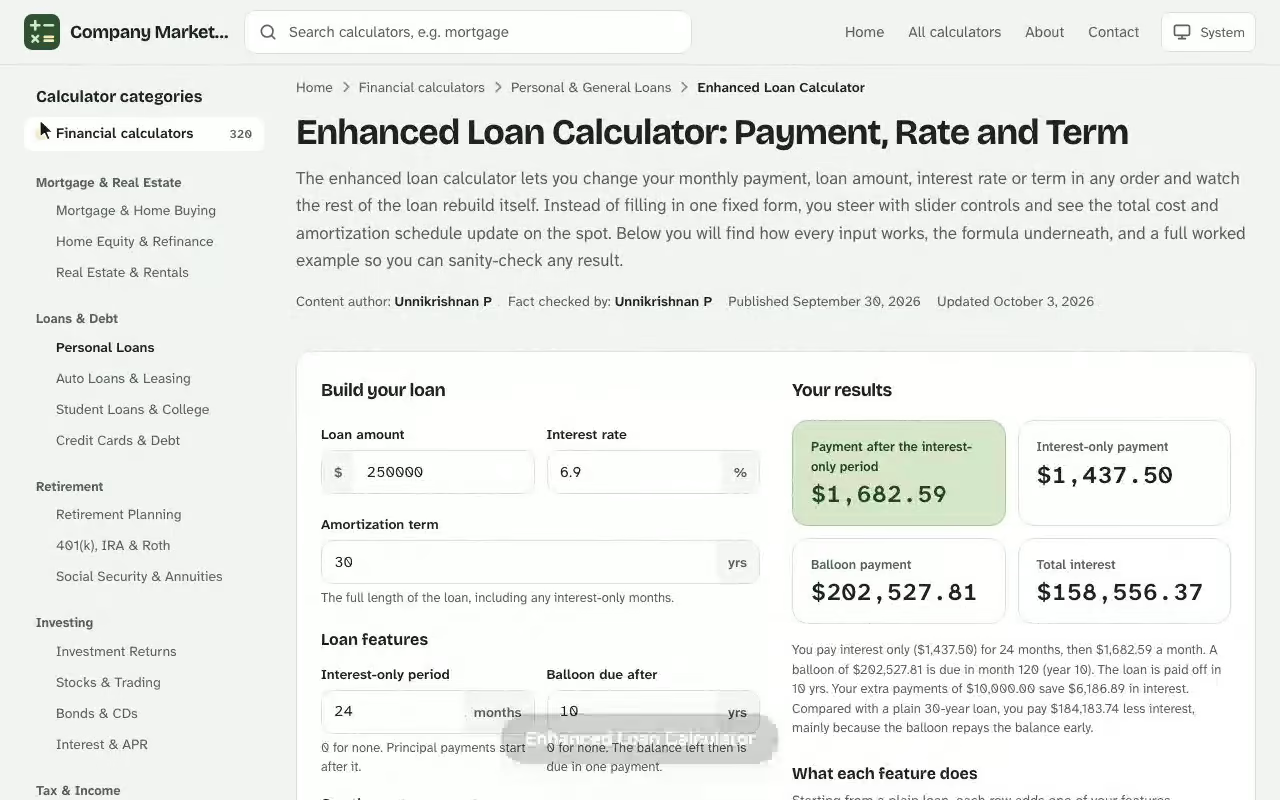
Enhanced Loan Calculator. The enhanced loan calculator lets you change your monthly payment, loan amount, interest rate or term in any order and watch the rest of the loan rebuild itself. Instead of filling in one fixed form, you steer with slider controls and see the total cost and amortization schedule update on the spot. Below you will find how every input works, the formula underneath, and a full worked example so you can sanity-check any result. Pair this with the payment calculator online for a fuller picture before you make a decision.
Your results
Payment after the interest-only period
–
Interest-only payment
–
Balloon payment
–
Total interest
–
–
What each feature does
Starting from a plain loan, each row adds one of your features.
Loan
Payment
Balloon
Ends
Total interest
Change
Payment schedule
Your loan with every feature applied: interest-only months, extra payments and the balloon.
Year
Payments
Interest
Principal
Extra
Balloon
Balance
Results are estimates for educational purposes and are not financial, tax or legal advice.
How the Enhanced Loan Calculator Works
A standard loan payment calculator asks for three numbers and returns one. This tool treats the loan as four linked values: the loan amount, the interest rate, the loan term and the monthly payment. Move any one of them and the calculator solves for whichever value you leave free, so you can ask either "what will this loan cost me each month?" or "how long until I am debt free if I can afford this much?" Next, open the deferred payment loan calculator online and enter your own details to see an estimate in seconds.
The calculator is built for fixed installment loans: the same payment goes out each month, interest is charged on the current outstanding balance, and whatever is left over after interest pays down principal. That is the same pattern behind a car loan, a personal loan, a student loan or a small business loan, which is why one tool covers all of them. A personal loan is the most common use, because it has no collateral to complicate the numbers, but the math is identical for every type.
Why sliders beat a single fixed form
Borrowing decisions are rarely one-shot. You usually start with a payment you are comfortable with and work backward, or start with a purchase price and test how far a longer term stretches the budget. Slider controls make that back-and-forth instant: drag the term from 48 to 60 months on the example below and the payment falls from $658.54 to $542.96 while total interest rises from $3,759.75 to $4,727.76, so the real-time results show the full trade-off before you commit.
Loan Payment Calculator Inputs: Amount, Rate and Term
Each input maps to a term you will see on every lender's disclosure, so it helps to know exactly what you are entering. Pair this with the loan comparison calculator online for a fuller picture before you make a decision.
See how the Enhanced Loan Calculator works: change the inputs and the payment after the interest-only period updates instantly. Enter your own numbers in the calculator above.
Loan amount
The total you borrow before any fees. If a lender deducts an origination fee, the amount received is lower than this figure.
Interest rate
The annual percentage charged on your remaining balance. It is applied monthly at one twelfth of the yearly rate.
Term in months
The repayment term, counted in months. Forty-eight months is four years.
Monthly payment
The fixed amount due each month. Leave it free and the calculator solves for it, or fix it and let the term adjust.
Choosing a realistic interest rate
The rate you are offered depends on your credit score, your credit profile and your debt-to-income ratio. Borrowers with long, clean credit histories and little existing debt are offered the lowest rates, while thin or damaged files pay a premium. Use the rate from an actual quote if you have one; otherwise test a range, a point or two above and below your best guess. Enter it as a plain annual percentage, such as 6.35, and the tool converts it to a monthly rate for you; nudging it a point either way shows its effect on the payment right away. A personal loan from an online lender usually prices differently from one at your own bank.
The Loan Payment Formula Behind Your Monthly Payment
The fixed payment on an amortizing loan comes from the present value of an annuity. With monthly rate r (annual rate divided by 12), loan amount P and n monthly payments:
$$M = P \times \frac{r}{1 - (1 + r)^{-n}}$$
Total interest is simply what you pay in all, minus what you borrowed:
$$\text{Total interest} = (M \times n) - P$$
Each month, the interest portion is \(I = B \times r\), where B is the balance at the start of that month, and the rest of the payment, \(M - I\), reduces principal. Because B shrinks every month, the interest share falls and the principal share rises, a pattern called amortization.
Worked Example: A $27,850 Personal Loan Calculator Run
Suppose you want to borrow $27,850 at 6.35% for 48 months. The monthly rate is 0.0635 ÷ 12 = 0.005292, so:
Over 48 payments you would pay $31,609.75 in all, which means $3,759.75 in total interest. The first payment splits into $147.37 of interest and $511.17 of principal; by month 48 the interest part has dwindled to $3.47.
Loan term
Monthly payment
Total interest
Total cost
36 months
$851.67
$2,810.29
$30,660.29
48 months
$658.54
$3,759.75
$31,609.75
60 months
$542.96
$4,727.76
$32,577.76
72 months
$466.17
$5,714.25
$33,564.25
Each row below is one setting of the term control on this personal loan, so you can compare every version side by side. The table shows the core trade-off in one view: stretching from 36 to 72 months drops the payment by about $385 but adds roughly $2,904 in interest costs.
Reading the Amortization Schedule: Principal and Interest by Year
The calculator's amortization schedule lists every payment with its interest share, principal share and remaining balance. Viewing it by year, rather than month by month, is the fastest way to see where your money goes. For the 48-month example above:
Year 1: $1,587 interest, $6,316 principal
Year 2: $1,174 interest, $6,729 principal
Year 3: $734 interest, $7,169 principal
Year 4: $265 interest, $7,637 principal
Each year of the 48-month example costs about $7,903, but the interest share falls from $1,587 in year 1 to $265 in year 4.
Why early payments are mostly interest
The interest rate decides how steep this front-loading is: a lower rate shrinks the interest column in every row of the schedule, which is why a stronger credit record pays off across the whole loan.
Interest is charged on the full balance at the start, so the first year carries the heaviest interest. This is why an early payoff saves more than the same extra money paid late in the loan. Adding $100 each month to the example, a payment of $758.54, clears the balance in 41 months and cuts total interest to about $3,198, a saving near $561.
Testing a $18,420 Truck Loan with the Loan Payment Calculator
You have a credit union quote for a used pickup: $18,420 at 7.45%, with the term left open. Your gross income is $5,480 a month and existing debt payments total $1,186. Before looking at the term, you check the ceiling: the common 36% debt-to-income guideline allows $1,972.80 of total monthly debt, so a new payment can reach $786.80 without crossing it. The tighter limit is your own budget, which tops out at $400 a month.
You enter the loan amount and rate into the enhanced loan calculator and try 48 months first. The monthly payment comes back at $444.95, which is $44.95 over budget. At 60 months it drops to $368.66, but total interest climbs to $3,699.69. Dragging the term slider to 54 months gives $402.53, still $2.53 too high.
At 55 months the payment is $396.36 and total interest is $3,380.03, so that is the setting you keep. Compared with the 60-month option, you save $319.66 in interest while staying under $400. Compared with 48 months, you pay $442.64 more in interest for a payment that fits.
Payment at 55 months: $396.36, which is $3.64 under your cap
Debt-to-income after the loan: ($1,186 + $396.36) ÷ $5,480 = 28.9%, below the 36% guideline
Next step: rerun the same figures with the credit union's $350 origination quote to see the APR before signing
Longer Terms vs a Shorter Term: Comparing Loan Offers
Longer terms produce lower monthly payments but more interest overall, while a shorter term raises the payment and shrinks the cost. The right choice balances affordable payments against total interest. A good test is to set the payment slider to the highest figure that still fits your budget, then read the resulting term. Fixing a $700 payment on the example loan, for instance, finishes in 45 months with about $3,504 of interest.
Monthly payment on $27,850 by interest rate and term; the 6.35%, 48-month worked example is outlined.
How a rate change moves the payment
On the 48-month example, each full percentage point of rate moves the payment by roughly $13: from $645.79 at 5.35% to $671.43 at 7.35%. Small rate gaps matter less to the monthly figure than to the lifetime total, so compare loan offers by their total cost, not just the payment.
Origination Fee and APR: What You Actually Receive
Many lenders charge an origination fee, a one-time fee taken upfront from the loan proceeds. Your payment is still calculated on the full loan amount, but you take home less. A 3% fee on $27,850 is $835.50, so the amount received is $27,014.50 while you repay the full $27,850.
That gap is why the APR, or annual percentage rate, exceeds the stated interest rate. Folding the fee in lifts the 6.35% loan to an effective APR of about 7.92%. When you compare lenders, rank them by APR, since it captures fees as well as interest. If you need a specific amount in hand, request a larger loan to cover the deduction.
Borrowing $27,850 with a 3% fee: $27,014.50 received, $31,609.75 repaid.
Amortizing Loan Calculator vs Balloon, Refinance and Line of Credit Tools
The amortizing loan calculator model fits any loan with equal payments. Other structures need different tools: a balloon loan pays less each month and leaves one large lump sum at the end, a refinance replaces an existing balance with a new rate or term, and a line of credit lets you draw and repay repeatedly with interest-only minimums. A mortgage follows the same amortization math but adds taxes and insurance on top of principal and interest.
If your goal is early payoff, test it here first: raise the payment slider and watch the term drop. If you are deciding whether to refinance, enter your remaining balance, the new rate and the new term, then compare the total interest with what you are on track to pay today.
Compare Loan Offers with the Loan Payment Calculator Before You Apply
Before you apply, run two or three scenarios side by side, the way a loan comparison calculator would. Many lenders let you pre-qualify with a soft credit check, which does not affect your credit score, so you can collect real offers first. Then run each offer through the calculator in turn, entering its amount, rate and term, and compare monthly payment, total interest and APR.
Check that the monthly payment fits comfortably in your budget alongside rent, existing debt and savings.
Look at fees as well as the rate, including origination and late fees.
Prefer the lender whose total cost is lowest for a term you can actually keep.
Rerun the calculator whenever a quote's rate, term or fee changes, and treat each personal loan quote as a draft until you have compared the total cost. Whether you borrow from a bank, a credit union or an online lender, a clear picture of repayment before you sign is the best protection against a loan you cannot carry. For decisions that affect your wider finances, a financial advisor can add personal advice that no calculator can.
Enhanced Loan Calculator questions
What is an enhanced loan calculator?
It is a loan payment calculator that treats the loan amount, interest rate, term and monthly payment as linked values, so you can test different combinations and see the total interest, total cost and amortization schedule update.
How is the monthly payment calculated?
The calculator uses the standard amortization formula: payment = loan amount × r ÷ (1 − (1 + r)^−n), where r is the annual rate divided by 12 and n is the number of monthly payments. Interest is charged each month on your remaining balance.
Why does a longer term lower my payment but cost more?
Spreading the same balance over more months shrinks each payment, but interest keeps accruing on the outstanding balance for longer. A shorter term has a higher payment and a lower total interest cost.
How does an origination fee change the result?
An origination fee is a one-time charge, usually a percentage of the loan, deducted from your proceeds. It does not change the monthly payment, but the amount you receive is lower than the amount you repay.
What interest rate should I enter?
Use the rate from your lender's quote if you have one. If not, try a range around your best estimate, since your credit score, credit profile and debt-to-income ratio all influence the rate you are offered.
Does the calculator show an amortization schedule?
Yes. The table lists each year of the loan with the principal paid, the interest paid and the balance still owed, so you can see how the interest share shrinks over time.
How can I pay off a loan faster?
Choose a shorter term or pay more than the required amount each month. Even a modest extra payment reduces the balance sooner, which cuts the interest charged in every later month.
Is the result the same as my lender's offer?
It is a close estimate. Lenders may round payments differently, add fees or use a different day-count convention, so always check the final disclosure before signing.