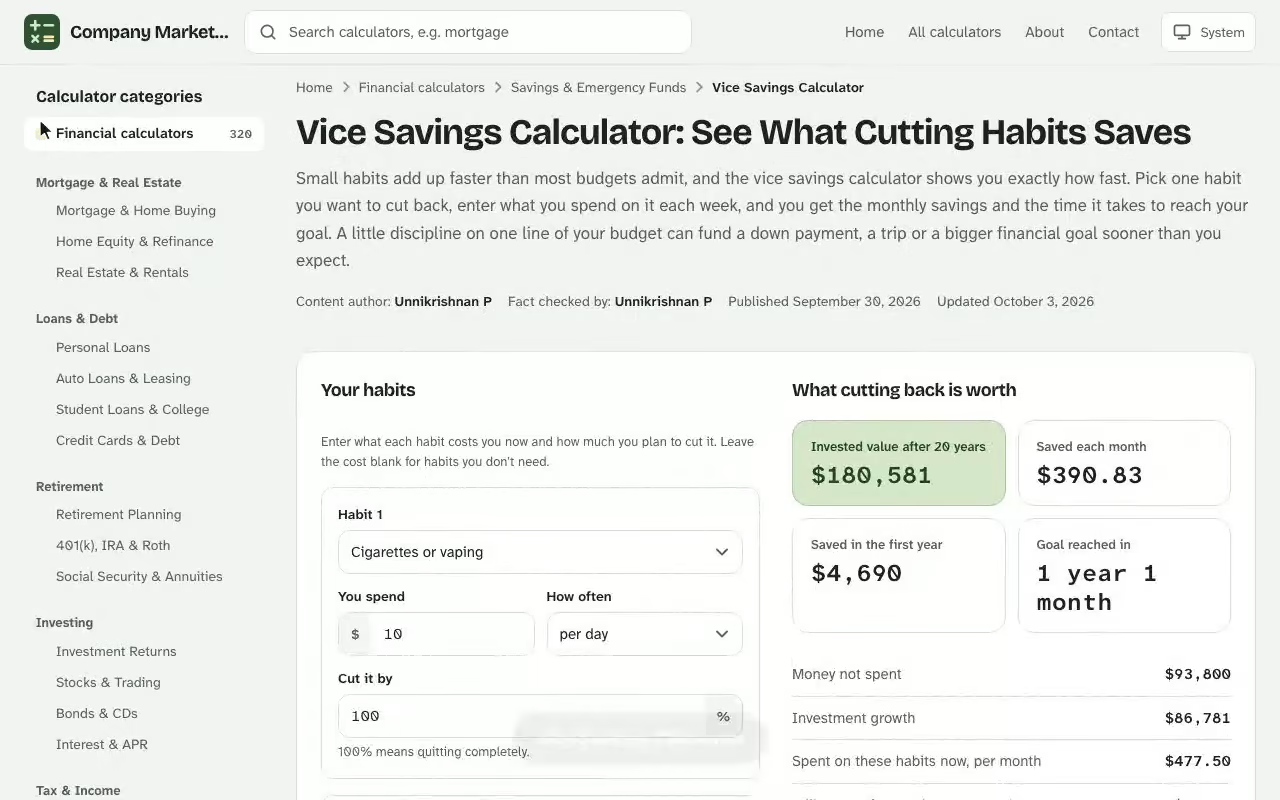
Vice Savings Calculator. Small habits add up faster than most budgets admit, and the vice savings calculator shows you exactly how fast. Pick one habit you want to cut back, enter what you spend on it each week, and you get the monthly savings and the time it takes to reach your goal. A little discipline on one line of your budget can fund a down payment, a trip or a bigger financial goal sooner than you expect. Next, open the savings calculator online and enter your own details to see an estimate in seconds.
What cutting back is worth
Invested value
–
Saved each month
–
Saved in the first year
–
Goal reached in
–
Money not spent–
Investment growth–
Spent on these habits now, per month–
Still spent after cutting, per month–
By habit
Habit
Saved per month
Worth at the end
Year by year
The money you keep, and what it grows to if you invest it.
Year
Saved that year
Saved so far
Growth so far
Balance
Results are estimates for educational purposes and are not financial, tax or legal advice.
How the Vice Savings Calculator Turns Habits into Money
A vice is any recurring habit that costs more than it gives back: smoking, drinking, shopping sprees, eating out or a long list of smaller extras. The tool starts from the money you already spend on one of them, applies the percentage you want to cut, and treats the difference as a deposit you make into savings. Because that deposit can earn interest, the balance grows a little faster than the raw total of what you set aside. Pair this with the personal economic recovery calculator for a fuller picture before you make a decision.
You do not have to give the habit up entirely. A partial reduction is often easier to sustain, and the calculator lets you test how much a 20%, 40% or 60% cut changes the answer before you commit to anything.
Vice to Reduce and Current Spending per Week
The first input is the vice to reduce, which labels the habit you are working on. The second is your current spending per week, the average you really spend, not the number you wish you spent. Pull it from a month of bank statements if you can, since vice spending is easy to underestimate when it comes in small purchases.
See how the Vice Savings Calculator works: change the inputs and the invested value after 20 years updates instantly. Enter your own numbers in the calculator above.
Reduce Spending by a Percentage
Next you choose how much to reduce spending, expressed as a percentage from 1% to 100%. A 100% reduction means quitting outright; anything lower keeps part of the habit. This percentage is the single input that moves the result most, so it is worth trying several values.
Goal to Save and Time to Reach Goal
The goal to save is the dollar target you want to hit, such as a deposit on a car or an emergency cushion. The calculator solves for the time to reach goal, so you see a number of months rather than a guess. If you prefer to fix a deadline and solve for the deposit instead, the same relationship works in reverse, and a save toward a goal calculator is built for exactly that.
Expected Rate of Return
The expected rate of return is the yearly growth you assume on the money you set aside. In this tool it is annually compounded and applied monthly. If you pay tax on interest or capital gains, enter your after-tax rate of return instead of the headline figure. Setting it to zero gives the plain arithmetic answer with no growth at all.
Vice Spending Savings Formula Explained
Two steps produce every result. First convert the weekly cut into a monthly savings deposit, then find how many months of deposits earn the target at your chosen return. The free cool million calculator is free to use with no sign-up, and works on desktop and mobile.
$$\text{Savings per month} = \text{Weekly spending} \times \text{Reduction} \times \frac{52}{12}$$
Here \(M\) is the monthly deposit, \(G\) is the goal, \(r\) is the annual rate divided by 12, and \(n\) is the number of months. When \(r = 0\), the formula collapses to \(G \div M\). The deposit is assumed to land at the end of each month, which is a conservative convention.
A Worked Example: Eating Out
Suppose you spend $87 per week on takeaway and restaurant meals, you cut that by 40%, you expect 5% a year and your goal is $4,000. The weekly cut is $87 × 0.40 = $34.80, so your savings per month are $34.80 × 52 ÷ 12 = $150.80. With a monthly rate of 0.4167%, the formula returns about 25.2 months, so the target is reached in the 26th deposit, with a balance of roughly $4,131.98.
Balance at the start, after one year, after two years and when the goal is reached.
Reduction
Savings per month
Months to reach $4,000
20%
$75.40
48.0
40%
$150.80
25.2
60%
$226.20
17.1
100%
$377.00
10.4
Read across the rows and you see the trade-off clearly: each extra step of reduction shortens the wait, but the first steps buy the most time. Notice that doubling the cut from 20% to 40% roughly halves the wait, which is why the percentage deserves the most attention.
Months to a $4,000 goal by size of cut and rate of return, with the 40% cut at 5% outlined.
Why Rate of Return Matters Less Than the Cut
In the same example, moving the rate of return from 0% to 7% only shortens the wait from 26.5 months to 24.7. Over a short horizon, the size of your deposit matters far more than the interest rate. Growth starts to dominate only when you keep depositing for many years.
Deposits make up $3,920.80 of the balance and interest growth about $211.
Savings Goal Calculator Inputs You Need Before You Start
Gather these figures first so the result reflects your real life rather than a hopeful estimate:
Savings goal: the specific dollar amount, including extras such as closing costs on a home.
Current savings: money you have already set aside toward this target.
Monthly savings: the amount you can comfortably deposit each month.
Goal deadline: the number of months you would like to give yourself.
Income and fixed bills: so you know the cut still leaves a workable budget.
Setting a Financial Goal You Will Keep
Be specific about a financial goal: a down payment, a college fund or a new car is easier to protect than a vague wish to save more. Several financial goals can run side by side, so rank them and run the calculator once for each. Research the real price, add taxes, and write down a date. Enter that target as the goal to save, and the habit you cut becomes the money that funds it. A written date makes the plan easier to defend on a tight week.
Pricing a Shopping Habit as a Savings Goal
Dana earns $3,400 a month after tax and wants $2,850 for a flight and a week's lodging next spring. The 50/30/20 rule sets Dana's monthly wants allowance at 30%, or $1,020, yet a habit of weekend clothing and gadget runs averages $142.60 per week, which is $617.93 a month, or 60.6% of that allowance. To see how long trimming that habit would take to fund the trip, Dana turns to the calculator.
Dana picks shopping as the habit, and enters $142.60 as weekly spending, a 55% reduction, a $2,850 goal and a 4.2% rate to match a high-yield account. The tool reports $78.43 saved each week, $339.86 a month, and a wait of 8.3 months, with the ninth deposit lifting the balance to $3,101.94.
The calculator's savings per month sets how much of the wants budget the habit can keep, so Dana checks what the $339.86 does to the allowance: shopping falls to $278.07 a month, or 27.3% of $1,020, which leaves room for everything else in the wants bucket. Dana then reruns the calculation with a 70% cut to see whether a harsher rule is worth it. The answer is 6.5 months, only about two months sooner, for a cut Dana is unlikely to keep.
The decision follows from those two runs. Dana keeps the 55% cut, sets a $339.86 automatic transfer for the day after payday, and plans to book the flight once the balance passes $2,850 in month 9.
Building a Savings Strategy Around Your Vice Spending
A good savings strategy has two parts: freeing up the money and putting it somewhere that suits the time frame. The calculator handles the first part, and the choices below handle the second.
Where to Put the Savings Per Month
Match the account to how soon you need the money. Short goals and emergencies belong in a safe place; longer goals can accept some risk for higher growth. Keep one separate savings account for the vice fund so you can watch it grow, and review your other investments once a year to confirm they still fit the time frame. Whichever account you choose sets the rate you enter as the expected rate of return.
Savings accounts at a bank or credit union are safe, flexible and pay a modest interest rate.
High-yield savings accounts usually pay more, though transfers from online-only providers can take a few days.
Certificates of deposit lock your deposit for a fixed term in return for higher interest rates, and early withdrawal often brings a penalty.
Investment accounts holding stocks, bonds, or mutual funds can beat a savings account over the long run, but the balance can fall.
An IRA suits retirement goals, and a traditional IRA is tax-deferred.
Compound Interest and Realistic Returns
Compound interest means you earn interest on your earlier interest, not only on the principal. For context, the S&P 500 has returned about 11.3% a year since 1970 with the reinvestment of dividends, a compounded rate of return that comes with serious volatility. Treat any figure you enter as hypothetical, because past investments say little about the next decade. A savings account pays less but protects your principal, and a savings account is the sensible home for a short goal, so enter a cautious rate for a short vice-savings goal. Reserve a higher assumed return for an investment you can leave alone for years, since each investment carries its own swings.
Tips to Reduce Spending and Keep the Habit Going
Automate your savings with automatic transfers on payday so the cut never sits in your checking account.
Eliminate unnecessary expenses and other non-essential expenses when you review your budget every few months.
Give your savings a raise whenever your income rises or a windfall arrives.
Keep track of your progress by rerunning the numbers monthly and adjusting the reduction if life changes.
Reading Your Vice Savings Results
The result is an estimate, not a promise. It assumes you really make the cut every week, that the rate holds steady and that no fees or taxes eat into growth. Investment fees in particular can lower a real return below the figure you entered.
Use it as a decision tool. If the answer is 48 months, ask whether a bigger cut or a different goal makes more sense; if it is 10 months, consider raising the target. Interest earned along the way is a bonus, and most of the final balance is simply money you chose not to spend.
Vice Savings Calculator questions
What is a vice savings calculator?
It estimates how much money you free up by spending less on a habit such as smoking, drinking, shopping or eating out, and how long that money takes to reach a savings goal.
How is the monthly saving worked out?
Your weekly spending is multiplied by the percentage you cut, then by 52 and divided by 12 to turn the weekly cut into a monthly deposit.
Do I have to quit the habit completely?
No. Enter any reduction from 1% to 100%. A partial cut is often easier to keep, and you can compare several percentages to see how each changes the wait.
What rate of return should I enter?
Use the rate your savings account or investment realistically earns. If you pay tax on interest or gains, enter an after-tax rate. A cautious rate suits short goals, and a rate of 0 shows the result with no growth.
Does the calculator include inflation or fees?
No. It assumes a steady rate and no account fees or taxes, so treat the result as a hypothetical estimate rather than a guarantee.
Where should I keep the money I save?
Short goals and emergencies suit a savings account or high-yield savings account, while a long goal may justify some investment risk for higher growth.
Why does cutting more matter more than the rate of return?
Over a short horizon your deposit dominates the balance and interest adds only a small share, so a bigger cut shortens the wait far more than a higher rate.