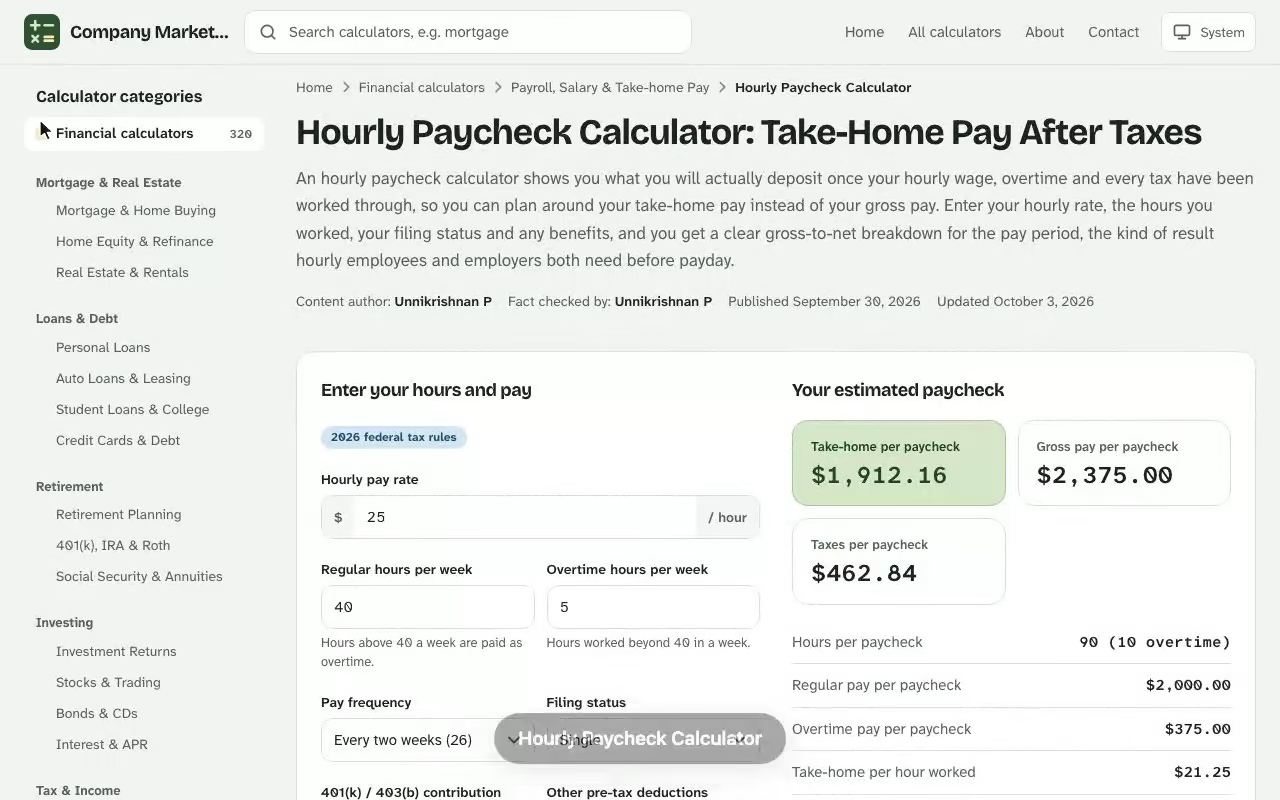
Hourly Paycheck Calculator. An hourly paycheck calculator shows you what you will actually deposit once your hourly wage, overtime and every tax have been worked through, so you can plan around your take-home pay instead of your gross pay. Enter your hourly rate, the hours you worked, your filing status and any benefits, and you get a clear gross-to-net breakdown for the pay period, the kind of result hourly employees and employers both need before payday. Pair this with the free salary increase calculator for a fuller picture before you make a decision.
Your estimated paycheck
Take-home per paycheck
–
Gross pay per paycheck
–
Taxes per paycheck
–
Hours per paycheck–
Regular pay per paycheck–
Overtime pay per paycheck–
Take-home per hour worked–
Federal overtime deduction (per year)–
Federal marginal tax bracket–
Paycheck breakdown
Gross pay from your regular and overtime hours, then each tax and deduction. Assumes the same hours every week of the year; federal tax is the estimated 2026 annual liability spread evenly, so withholding may differ slightly.
Item
Per paycheck
Per year
Results are estimates for educational purposes and are not financial, tax or legal advice.
What You Enter in an Hourly Paycheck and Payroll Calculator
Every paycheck calculator starts from the same small set of facts about your job and your tax forms. The more accurately you fill them in, the closer the estimate lands to the number printed on your paystub. Most hourly employees can find each item on a recent pay statement or on the Form W-4 they gave their employer. The free payroll deductions calculator is free to use with no sign-up, and works on desktop and mobile.
Hourly rate and the number of regular hours in the pay period
Overtime hours and the overtime multiplier your employer uses
Additional income such as tips or commissions paid on the same check
Pay frequency: weekly, bi-weekly, semi-monthly or monthly
Filing status, dependents and allowances from your W-4
Additional withholding you ask your employer to take out of each check
Your state and the pay date or check date, which decide the tax rates applied
Voluntary items: health insurance, 401(k) contributions, union dues and wage garnishments
Hourly rate, pay rate and hours worked
Your hourly rate is the amount you earn for one hour of work before anything is withheld. Some jobs pay more than one pay rate, for example a base rate and a higher night-shift rate, and a good calculator lets you enter several of them with the hours worked at each. Count only paid time: unpaid meal breaks do not belong in the total.
Overtime and additional income
Under federal rules, overtime is generally paid at 1.5 times your regular rate for hours past 40 in a workweek. Tips and commissions are taxable too, so type them into the additional income field rather than leaving them out, or your estimate will come in low.
Calculating Gross Pay From Your Hourly Wage
Gross pay is everything you earned before taxes and deductions. For an hourly worker it is the sum of regular earnings and overtime earnings, which makes the first step of any calculation simple multiplication. This is the same gross earnings figure printed at the top of a paystub. Pair this with the commission calculator online for a fuller picture before you make a decision.
Here is a worked case you can follow. Say you earn $21.35 per hour and are paid bi-weekly, with 74 regular hours and 6 overtime hours in the period. Multiplying 74 by $21.35 gives $1,579.90 in regular pay. Six overtime hours at $32.025 add $192.15, so your gross pay for the period is $1,772.05.
Earnings line
Hours
Rate
Amount
Regular hours
74
$21.35
$1,579.90
Overtime hours (1.5×)
6
$32.025
$192.15
Gross pay
80
$1,772.05
From Gross Pay to Net Pay: Where Your Paycheck Goes
Net pay is what remains after every tax and deduction leaves your paycheck. The relationship is short enough to memorize, and it is the formula the whole calculator is built around.
Three groups of deductions do most of the work: income tax withholding, payroll taxes and the benefits you choose. Each one reduces your paycheck amount in a slightly different way, so it helps to take them one at a time.
Federal income tax withholding and the W-4
Your employer estimates your federal income tax from the answers on your W-4, the year-to-date income and the IRS withholding tables. The tax system is progressive, so each slice of annual income is taxed at its own marginal rate, starting at 10% and rising in steps. The standard deduction comes off first: for 2026 it is $16,100 for a single filer, so that amount of annual income is not subject to federal withholding at all. Claiming a larger family through dependents or choosing head of household filing lowers the amount withheld further.
See how the Hourly Paycheck Calculator works: change the inputs and the take-home per paycheck updates instantly. Enter your own numbers in the calculator above.
FICA: Social Security and Medicare
FICA is the payroll tax that funds two programs. Social Security takes 6.2% of wages up to an annual cap, and Medicare takes 1.45% of all wages, so the combined employee share is 7.65%. Your employer pays a matching amount on top, which never appears as a deduction from your check. Unlike income tax, these two do not depend on your filing status, which is why they are the easiest part of a paycheck to predict.
Pre-tax deductions and post-tax deductions
Pre-tax deductions, such as a traditional 401(k) contribution or employer-sponsored health insurance premiums, come out before income tax is figured, so they shrink the wages that get taxed. Post-tax deductions like union dues or wage garnishments come out afterward and do not lower your tax. That ordering is why a $100 pre-tax contribution costs you less than $100 of take-home pay.
Applying all of this to the $1,772.05 bi-weekly example, with a 4% 401(k) contribution, a $58.00 health insurance premium, single filing status and no state income tax, produces the following breakdown.
Line
How it is figured
Per pay period
Gross pay
Regular plus overtime earnings
$1,772.05
401(k) contribution
4% of gross pay
−$70.88
Health insurance
Flat premium
−$58.00
Social Security
6.2% of $1,714.05
−$106.27
Medicare
1.45% of $1,714.05
−$24.85
Federal income tax
Withholding on $26,622.42 annualized taxable income
−$113.33
Net pay
Gross pay minus the lines above
$1,398.72
That leaves $1,398.72 out of $1,772.05, or about 78.9% of gross pay, and works out to roughly $17.48 of take-home pay for each of the 80 hours.
Gross pay to take-home pay for one bi-weekly check at $21.35 an hour.
Reading Federal Hourly Paycheck Calculator Results
The results panel is easier to use when you read it from the top. Start with gross pay, then look at each tax line, then the deductions you chose, and finish on net pay. If the net figure looks too low, the usual cause is not an error in the math but a deduction you forgot you elected, such as a dental plan or a retirement contribution rate set at a higher percentage than you remember.
A high federal withholding line often means your W-4 was filled out with no allowances or with an extra amount requested.
A FICA line near 7.65% of taxable wages is normal and confirms your pay was entered correctly.
A state withholding or local taxes line appears only if your location levies them.
Keep in mind that an estimate is not a tax return. Your actual tax liability is settled when you file, and a refund or a balance due depends on whether the year's withheld amounts matched what you owed.
Net pay over 80 hours at three hourly rates and three overtime levels.
How Pay Frequency Changes Your Paycheck Amount
Pay frequency sets how many checks you receive each year, and with it the size of each one. Switching from bi-weekly to semi-monthly does not change what you earn over twelve months; it only changes how the year is sliced. Weekly means 52 checks, bi-weekly means 26 (every other week), semi-monthly means 24 (twice a month) and monthly means 12 paychecks per year.
Pay frequency
Checks per year
Gross pay at $44,408 a year
Weekly
52
$854.00
Biweekly
26
$1,708.00
Semi-monthly
24
$1,850.33
Monthly
12
$3,700.67
The annual figure above comes from $21.35 per hour for 2,080 hours. A bi-weekly schedule has two months a year with three checks, and those months are the ones people often mistake for a raise.
Testing a Warehouse Shift Offer Against Your Hourly Pay
Dana, a forklift operator in a state with no wage tax, is offered five extra Saturday hours every week and wants to know whether the extra shift is worth giving up the weekend. Her base rate is $19.40, she is paid weekly, and she files as single, so she opens the calculator and builds a take home pay estimate for one check.
She enters 40 regular hours plus 5 overtime hours, a 3% 401(k) deferral and a $31.20 weekly health premium. Overtime at $29.10 an hour adds $145.50 to her $776.00 of regular earnings, so the gross figure reads $921.50. The tool then takes out $27.64 for the 401(k), $55.20 for Social Security, $12.91 for Medicare and $61.60 of federal withholding. Her annualized taxable income lands at $28,758.32, well inside the 12% bracket that ends at $50,400, which tells her the extra hours are not pushing her into the 22% bracket.
The result is $732.95. To see what the Saturdays are really worth, she reruns the calculator with the overtime field set to 0. That check comes to $619.88, so five extra hours add $113.07 after tax, or about $22.61 an hour compared with $29.10 gross. Seeing 77.7% of the overtime pay survive withholding, rather than the full amount, settles the decision: she takes two Saturdays a month, enough to cover a $226 car insurance bill, and keeps the other weekends free.
State and Local Taxes: Why Take Home Pay Differs by State
Nine states collect no state income tax on wages, so the same hourly rate yields a larger check there than in a neighbor that taxes wages. Other places add local taxes on top, along with state disability or unemployment contributions. The estimate also depends on your state of work, since that is where most withholding rules apply, so choose it before you read the result. The same applies to the date: tax rates and the standard deduction change from year to year, so the pay date picked in the calculator matters.
Salary Paycheck Calculator Versus Hourly Calculator
A salary paycheck calculator starts from a fixed annual salary divided by the number of pay periods, while an hourly calculator starts from hours times rate and therefore changes whenever your schedule does. To compare an hourly job with a salaried offer, convert one into the other. Multiply your hourly wage by the hours you work in a week and then by 52; for a 40-hour week at $21.35 that is $44,408. Going the other way, divide an annual salary by 2,080 to find the equivalent hourly figure.
$$\text{Hourly rate} = \frac{\text{Annual salary}}{\text{hours per week} \times 52}$$
Remember that salary and wages are not the same thing legally. An hourly worker is paid for each hour, including overtime, while many salaried roles are exempt from it, so a salary that sounds higher can pay less per hour once long weeks are counted.
How Marital Status Changes Taxes on Hourly Pay
Two people with identical checks can see different taxes withheld because of the box they tick on the W-4. A married filing jointly election uses wider brackets and a larger standard deduction than a single election, so less is held back from each check when only one spouse works. When both spouses work, the same election can under-withhold, because each employer assumes the other earner does not exist; the W-4 has a step for exactly that case.
The effect is easy to see on the earlier example. Annualized taxable income of $26,622.42 for a single filer produced $113.33 of federal withholding per check. A married couple with one earner and the same pay would see taxes closer to zero on that check, since the larger 2026 deduction of $32,200 would cover most of the annualized amount. Taxes for Social Security and Medicare stay identical in both cases, because those two are flat percentages of wages.
Single and married filing separately share the same $16,100 deduction in the 2026 tables.
Head of household sits between them at $24,150 and requires you to support a qualifying person.
An employee who is exempt owes no federal income tax withholding but still owes FICA.
If your tax picture is simple, the default withholding is usually close enough. If you hold two jobs, receive large bonuses or expect credits, adjust the W-4 and rerun the numbers, since your yearly taxes are set by total income and not by any single check. Every employee can revisit the form at any time, and the employer applies the change from the next pay run, so a quick test with different taxes and filing choices costs nothing but a minute.
Hourly Pay Terms to Know
These definitions cover words that appear on nearly every paystub and in every payroll tool.
Gross pay method
Whether the gross figure is an amount per pay period or an annual amount. Hourly workers almost always use the per period amount.
Tax-exempt
A status in which no federal income tax is withheld, which generally requires owing no tax in the prior year and expecting none this year. Claiming it wrongly can lead to a large bill and penalties.
Taxable income
Wages left after pre-tax deductions and the standard deduction. This, rather than gross pay, is the amount the tax brackets are applied to.
Each term maps to something you enter or read in the calculator: the gross pay method sets how the income field is read, tax-exempt is the exemption choice, and taxable income is what the withholding result is figured on. Employer-only taxes such as FUTA, the federal unemployment tax, are not deducted from your check and never change the net figure the calculator returns.
Tips for More Accurate Take-Home Pay Estimates
A calculator is only as precise as the numbers you give it. Follow these steps when you want a result you can budget around.
Copy your hourly wage and your typical hours from the latest paystub rather than from memory.
Match the pay frequency your payroll department actually uses.
Enter benefits and retirement contributions exactly as they appear, as a flat amount or as a percentage.
Use the same filing status and dependents shown on your current W-4, and update both if your situation changes.
Check the result against a real deposit and adjust the tool's inputs if the two differ by more than a few dollars.
Save each estimate next to the matching paystub; after three or four checks, any gap points straight at the input that needs correcting, usually a deduction that changed mid-year or a rate that was raised.
Employers can run sample checks through an hourly paycheck calculator before a first pay run to confirm compliance with withholding rules and to see what a new hire will take home from their benefits package.
Hourly Paycheck Calculator questions
How do I calculate my paycheck from an hourly wage?
Multiply each hourly rate by the hours worked at that rate, add overtime and any tips, then subtract federal, state and local taxes, Social Security, Medicare and your deductions. What is left is your take-home pay.
How is overtime taxed on an hourly paycheck?
Overtime is ordinary wages, so it is taxed at the same rates as regular pay. It can feel heavier because the extra gross pay is withheld at your top bracket for the period.
Why is my take-home pay lower than my gross pay?
Federal income tax, 7.65% in Social Security and Medicare, any state or local tax, and deductions such as health insurance or a 401(k) all come out before the deposit.
Does pay frequency change how much tax I pay?
No. Your yearly tax depends on annual income, not on how often you are paid. Pay frequency only changes how much is withheld from each individual check.
What is the difference between pre-tax and post-tax deductions?
Pre-tax deductions, like a traditional 401(k) or health premiums, come out before income tax is figured and lower your taxable wages. Post-tax deductions, like union dues, come out afterward.
How many hours are in a full-time work year?
A 40-hour week over 52 weeks gives 2,080 hours, so multiply an hourly wage by 2,080 for an approximate annual salary.
Can I use this for a salaried job?
Yes. Switch the pay type to Salary and enter the annual amount; the same tax and deduction steps are applied to each period's share.
How accurate is a paycheck estimate?
It is a close estimate based on the current federal withholding method, not exact payroll output. Employer rules, year-to-date earnings and local taxes can move the final number a little.