Civilian Pay to Equal Military Take-Home Pay Calculator
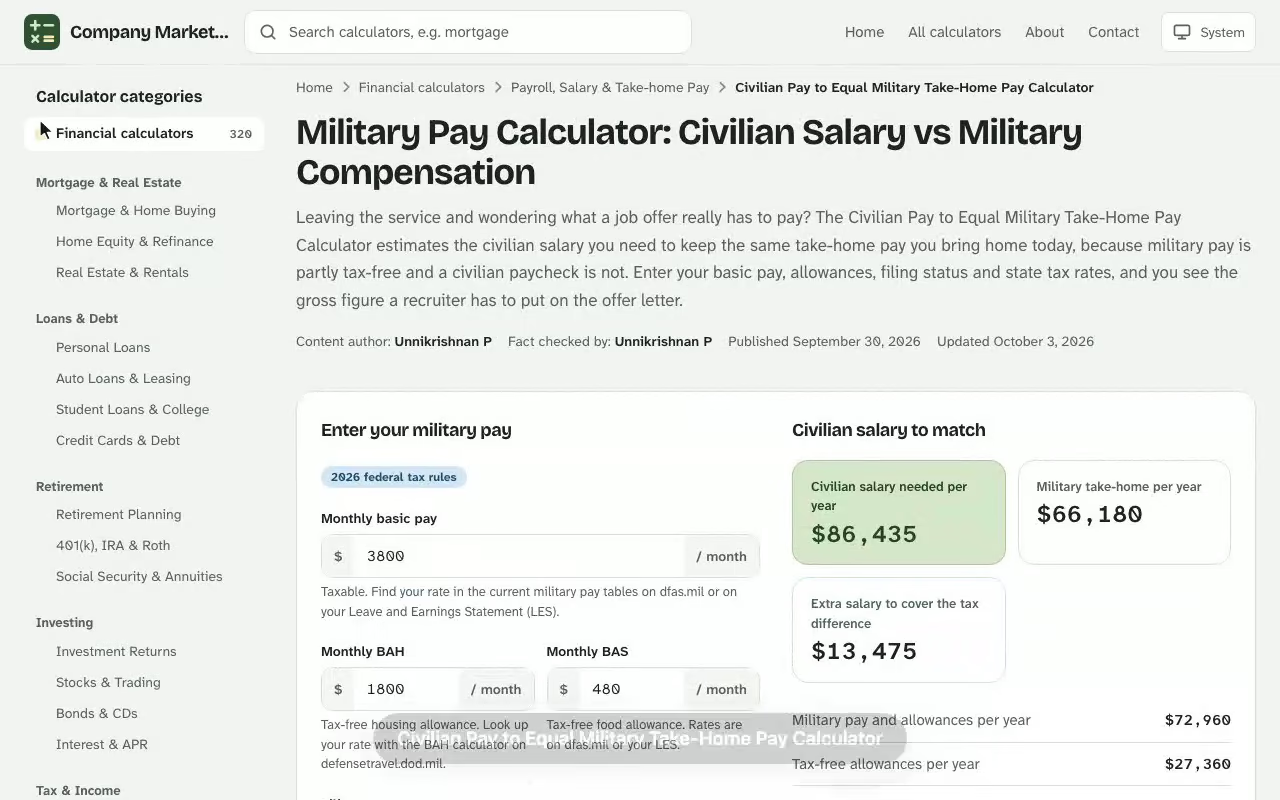
Civilian Pay to Equal Military Take-Home Pay Calculator. Leaving the service and wondering what a job offer really has to pay? The Civilian Pay to Equal Military Take-Home Pay Calculator estimates the civilian salary you need to keep the same take-home pay you bring home today, because military pay is partly tax-free and a civilian paycheck is not. Enter your basic pay, allowances, filing status and state tax rates, and you see the gross figure a recruiter has to put on the offer letter. Next, open the free salary increase calculator and enter your own details to see an estimate in seconds.
Civilian salary to match
Civilian salary needed per year
–
Military take-home per year
–
Extra salary to cover the tax difference
–
Military pay and allowances per year–
Tax-free allowances per year–
Military take-home per month–
Civilian hourly equivalent at 40 hours a week–
Compares cash pay only. Military health care, retirement, the TSP match and other benefits are not valued, and pre-tax TSP or 401(k) contributions are left out of both sides.
Military and civilian pay side by side
Yearly figures. BAH and BAS are not subject to federal income tax or Social Security and Medicare, so the civilian salary has to be higher to leave the same amount after tax.
Item
Military
Civilian
Results are estimates for educational purposes and are not financial, tax or legal advice.
How the Civilian Pay to Equal Military Take-Home Pay Calculator Works
This military pay calculator runs in two passes. First it totals your military take home pay for a year: taxable wages, plus the allowances you never pay tax on, minus federal income tax, FICA, state tax and any TSP contributions. Second, it searches for the gross salary whose net pay after civilian taxes lands on the same number. That second figure is your target salary. Pair this with the free marginal tax rate calculator for a fuller picture before you make a decision.
Think of it as a first-level calculator: it answers the tax question precisely and leaves the lifestyle questions (commute, insurance, moving costs) to you. Every input below is a monthly amount taken straight from your Leave and Earnings Statement, so there is nothing to look up in a table.
Basic pay and special pay
Basic pay depends on your pay grade and years of service; you can read it from the published pay tables or from the pay charts your finance office uses. Special pay covers taxable extras such as flight pay, sea pay or hazardous duty pay. Both are fully taxable, so the calculator adds them together and treats them like a civilian wage. If you receive several special pays, enter their combined monthly total in one box.
Housing allowance and subsistence allowance
Your housing allowance and subsistence allowance are the heart of the tax advantage. Neither one is reported as taxable income, so the calculator adds them to your take-home pay without removing any tax. If you live in government quarters, enter 0 for housing: military housing provided in kind has no cash value to tax.
BAH
The Basic Allowance for Housing (BAH) is set by duty station, pay grade and dependent status. Because BAH is tax-free housing money, it often makes up the largest block of tax-exempt pay in a military package, and it is the number civilians most often forget to replace.
BAS
The Basic Allowance for Subsistence (BAS) covers food. It is a flat monthly rate, it is tax-free, and it does not grow with dependents. Enter 0 if you eat in a dining facility and receive no cash subsistence.
COLA
If you live in a high-cost area you may also draw COLA, a cost-of-living allowance that is tax-free. Put it in the housing box if you want it counted as a tax-free monthly amount; skip it if it does not apply.
Filing status and additional dependents
Your filing status sets the standard deduction and the width of each federal bracket. The calculator accepts the same choices the IRS offers: single, married filing jointly, married filing separately, head of household and qualified widow(er). Your marital status on the last day of the year decides which one applies. The number of additional dependents lowers federal tax through the child tax credit; do not count yourself.
Filing status
2026 standard deduction
Notes
Single
$16,100
Unmarried at year end
Married filing jointly
$32,200
Also used for qualified widow(er)
Married filing separately
$16,100
Each spouse files alone
Head of household
$24,150
Pays over half of a home's upkeep
State income tax before and after you separate
States treat military wages differently from civilian wages, so the tool asks for two rates: the state income tax you pay now and the rate you expect as a civilian. You also tell it whether your basic pay is taxed where you file today. Active-duty members generally owe state tax based on legal residence rather than the base where they are stationed, and the tax treatment of military pay varies. Enter 0 for a state with no wage tax. This is the part of the state tax disclaimer that matters: a single percentage is an approximation of your tax burden, not a bracket-by-bracket return.
Military Compensation vs Civilian Salary: Why the Numbers Differ
Many military retirees and separating members accept a job that sounds generous and then find that the first civilian paycheck is smaller than they planned. The reason is arithmetic, not bad luck, and it is exactly what a civilian vs. military pay calculator is built to expose. A civilian salary is entirely taxable, while a large share of your military compensation never touches the IRS. Next, open the w 4 payroll deductions calculator online and enter your own details to see an estimate in seconds.
Imagine two service members who each net the same monthly amount. The one who keeps BAH and BAS pays tax on a small slice of income. The one with a civilian job pays federal income tax, Social Security and Medicare on every dollar. To land in the same place, the civilian has to earn the extra money before taxes. That gap is the gross-up, and it is the number this pay calculator produces.
Taxes you stop avoiding
Once allowances become salary, they join your taxable income. You then owe FICA (6.2% Social Security up to the annual wage base, plus 1.45% Medicare) and ordinary federal brackets after the standard deduction. These tax rates are the reason a flat percentage raise rarely works as a rule of thumb.
Costs that change after separation
Military healthcare through TRICARE carries little or no premium, while a civilian employer may charge for health insurance. A 401(k) or other retirement plan replaces your TSP match under the retirement system you served under. The result leaves those costs out, so add each one to the required salary: a premium or a 401(k) match you would otherwise lose raises the gross figure you should ask for.
Formula for Military Take-Home Pay and the Required Civilian Salary
Here is the arithmetic behind the result. Annual taxable wages are \(W = 12 \times (\text{basic pay} + \text{special pay})\), and tax-free allowances are \(A = 12 \times (\text{BAH} + \text{BAS})\). Your annual military take home pay is:
$$N_{\text{mil}} = W + A - T_{\text{fed}} - T_{\text{FICA}} - T_{\text{state}} - C_{\text{TSP}}$$
The required civilian gross \(S\) is the value that solves:
Here \(R\) is annual retired pay, which is taxable income but carries no FICA. Federal tax follows \(T_{\text{fed}} = \text{bracket tax}(\text{income} - \text{standard deduction}) - 2{,}200 \times \text{dependents}\), floored at zero. Because tax is not linear, the tool finds \(S\) by repeated halving instead of a single division.
Take-home pay
Money that reaches your account after taxes and retirement contributions.
Gross-up
The extra pre-tax pay needed to replace tax-free income.
Worked Example: Matching Military Pay with a Civilian Salary
Take a veteran leaving active duty as a married enlisted sergeant, filing jointly with two additional dependents. Monthly basic pay is $4,587.30, BAH is $2,214.00, BAS is $460.25 and taxable special pay is $175.00. The sergeant contributes 5% to a traditional TSP, pays no state tax today, and expects 4.25% as a civilian.
Line
Annual amount
Taxable wages (basic pay plus special pay)
$57,148
Tax-free allowances (BAH plus BAS)
$32,091
Traditional TSP contribution
$2,857
Federal income tax after dependents credit
$0
FICA on military wages
$4,372
Military take-home pay
$82,009
Civilian federal tax / FICA / state tax
$2,791 / $7,363 / $4,091
Required civilian salary
$96,254
The military take-home pay of $82,009 works out to about $6,834 a month. To bring home the same amount, the civilian job must pay $96,254, or roughly $8,021 gross per month. That is $7,016 more than the sergeant's $89,239 of gross military pay, even though the taxes look modest on paper.
Checking a $78,500 Job Offer with a Military to Civilian Take-Home Pay Calculator
A Navy E-5 separating from a Florida duty station has a written offer for $78,500 and three days to answer. The sailor opens the calculator and copies the Leave and Earnings Statement line by line: basic pay $3,912.60, BAH $1,731.00, BAS $460.25, no special pays, no retired pay, a 3% traditional TSP contribution, filing status single, no additional dependents. Florida has no wage tax, so the current state rate is 0%, and the new employer sits in a state the sailor estimates at 3.8%.
See how the Civilian Pay to Equal Military Take-Home Pay Calculator works: change the inputs and the civilian salary needed per year updates instantly. Enter your own numbers in the calculator above.
Press calculate and the military side comes back at $64,961 of annual take-home pay, or $5,413 a month, on $73,246 of gross military pay of which $26,295 is tax-free. The civilian answer is $84,344, about $7,029 gross a month. Behind it sit $9,726 of federal tax (the 22% bracket starts at $50,400 of taxable income, and $84,344 less the $16,100 standard deduction lands well past it), $6,452 of FICA and $3,205 of state tax.
The sailor then tests the offer itself. At $78,500 the same math leaves about $61,072 after $8,440 of federal tax, $6,005 of FICA and $2,983 of state tax, which is $3,889 a year, or roughly $324 a month, below the $64,961 the Navy pays. That is the gap, in plain numbers, between an offer that sounds higher and the take-home pay the sailor has now.
The decision follows directly: counter at $84,500, the first round figure above the $84,344 break-even, and ask the employer to cover the health insurance premium so TRICARE's zero-premium coverage is not quietly replaced by a payroll deduction. If the recruiter will only move to $81,000, the sailor reruns the tool with that number before replying, rather than guessing.
Retired Pay, TSP and Other Adjustments in a Military to Civilian Salary Calculator
A military to civilian salary calculator has to cope with income that does not fit a simple wage. Three inputs deserve a closer look before you trust the answer.
Retired pay and retirement
If you are retiring rather than leaving early, add your expected monthly retired pay. It is taxed as ordinary income but carries no payroll tax, so it reduces how much salary you need. Members who are separating before eligibility enter 0. Your retirement check is estimated from years of service and the plan you fall under, so confirm it with a retirement pay estimate first.
Traditional and Roth TSP contributions
Traditional TSP dollars lower taxable wages today, while Roth dollars do not. Enter each percentage separately. The calculator subtracts both from military take-home pay, because the money leaves your account either way. If you skip civilian retirement saving the comparison is easy; if not, add your planned civilian contribution percentage to the required salary, since it lowers what you take home.
VA disability and other tax-free income
VA disability compensation is not taxed and arrives whatever job you take. It is not part of the military pay inputs here, so if you want a household comparison, subtract it from the required salary yourself: tax-free disability income lowers the civilian pay you need to match your household's take-home total.
Limits of a First-Level Calculator and How to Use the Result
Treat the answer from this military pay calculator as a floor for negotiating, not a promise, and read it as a civilian pay to equal military take home pay estimate rather than a quote. The estimate leaves out deductions beyond the standard one, personal exemptions that no longer exist, combat zone tax exclusions, your rank or officer status, local expenses and benefits that shift during transition to civilian life. It also ignores different income levels in a working spouse's pay. Review your benefits and your Leave and Earnings Statement, then rerun the numbers with a candidate offer in mind.
When you compare, remember that each veteran faces a different separation date, legal residence and housing market. If the result looks high, check your housing entry first. Because it is tax-free, small changes there move the answer more than almost any other field.
Enter each allowance as a monthly amount, not annually.
Rerun the tool for every state you might live in.
Add civilian health insurance and 401(k) costs on top of the result.
Civilian Pay to Equal Military Take-Home Pay Calculator questions
Why do I need a higher civilian salary to match my military pay?
Because a civilian salary is fully taxable, while housing and subsistence allowances are not. The calculator adds the federal tax, FICA and state tax you will now owe and finds the gross pay that leaves the same net amount.
Is BAH taxable?
No. The Basic Allowance for Housing and the Basic Allowance for Subsistence are not federal taxable income, which is why they count as take-home pay with no tax removed.
What should I enter for housing if I live in government quarters?
Enter 0 for the housing allowance, since you receive no cash amount that a civilian paycheck would need to replace.
Does the calculator include retired pay?
Yes. Enter your expected monthly retired pay and it is treated as taxable income with no payroll tax, which lowers the salary you need. Enter 0 if you are leaving before retirement eligibility.
How are state taxes handled?
You enter an average state tax rate for where you file now and where you expect to file as a civilian. It is an approximation of your tax burden, not a bracket-by-bracket state return.
Does the result include health insurance and a 401(k)?
No. This is a first-level calculator. Add civilian health insurance premiums, a 401(k) contribution to replace your TSP, and moving costs on top of the result when comparing a job offer.
Which tax year does it use?
The calculator uses 2026 federal standard deductions and brackets, the Social Security wage base and a $2,200 child tax credit per dependent.