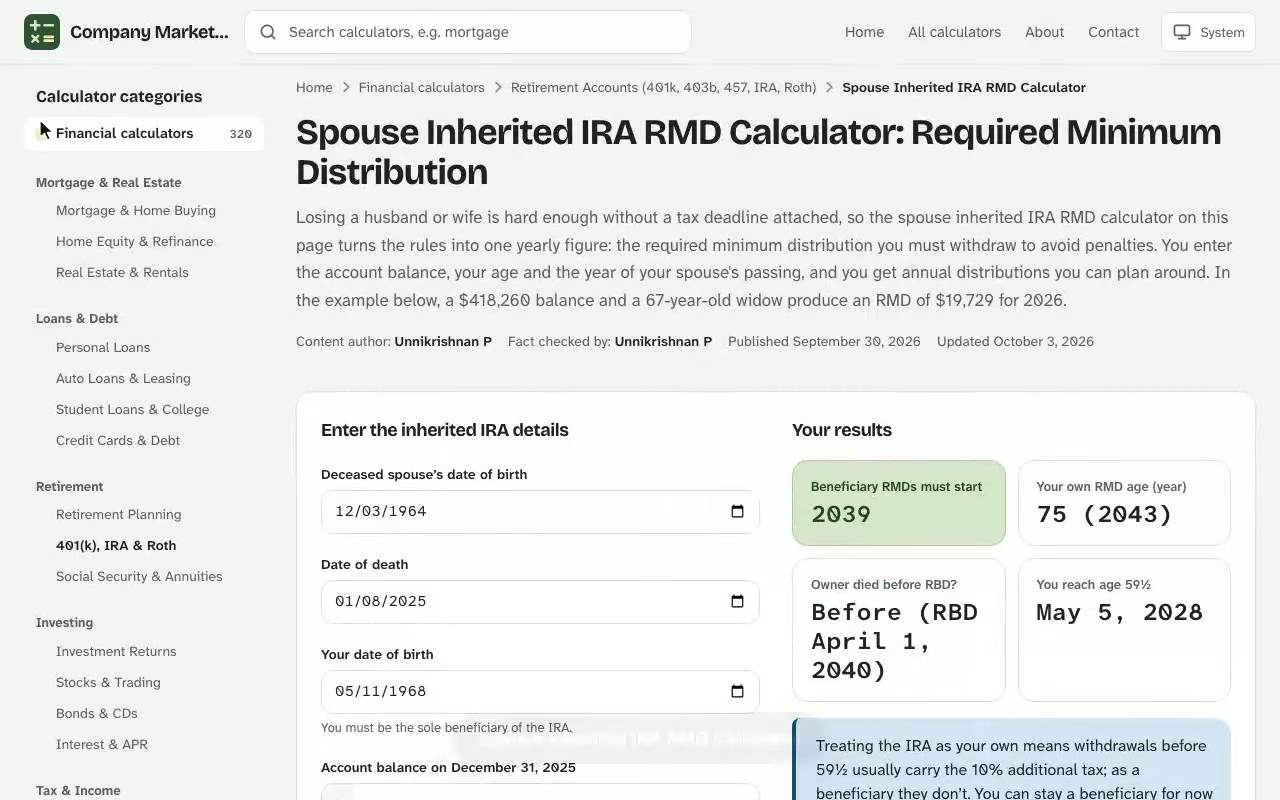
Spouse Inherited IRA RMD Calculator. Losing a husband or wife is hard enough without a tax deadline attached, so the spouse inherited IRA RMD calculator on this page turns the rules into one yearly figure: the required minimum distribution you must withdraw to avoid penalties. You enter the account balance, your age and the year of your spouse's passing, and you get annual distributions you can plan around. In the example below, a $418,260 balance and a 67-year-old widow produce an RMD of $19,729 for 2026. Next, open the free rmd calculator and enter your own details to see an estimate in seconds.
Your results
Beneficiary RMDs must start
–
Your own RMD age (year)
–
Owner died before RBD?
–
You reach age 59½
–
Treating the IRA as your own means withdrawals before 59½ usually carry the 10% additional tax; as a beneficiary they don’t. You can stay a beneficiary for now and treat the IRA as your own later. The spousal election follows proposed IRS regulations (REG-103529-23) that are not yet final, so confirm with your IRA custodian how it applies.
Your options compared
How each choice changes when RMDs start, how much you must withdraw over the projection and what is left at the end.
Option
First required withdrawal
First amount
Total withdrawn
Balance at end
10% early-withdrawal tax
Year-by-year required withdrawals
Minimum withdrawal under each option, assuming only the required amount is taken and the account earns the return you entered.
Year
Your age
Own IRA
Beneficiary (Single Life)
Spousal election
10-year rule
Results are estimates for educational purposes and are not financial, tax or legal advice.
How the Spouse Inherited IRA RMD Calculator Works
Every inherited RMD calculator starts from the same idea: divide the account balance on December 31 of the previous year by a life expectancy factor from an IRS table. A surviving spouse gets better treatment than any other beneficiary, because you look up a fresh factor for your new age every year instead of counting a single factor down by one. The beneficiary rmd calculator uses the same plain-English approach, so you can compare results side by side.
$$\text{RMD} = \frac{\text{Balance on December 31 of the prior year}}{\text{Single Life Table factor for your age this year}}$$
The worked example in one line: balance divided by the Single Life Table factor.
This inherited IRA distributions calculator needs only a few facts, and most of them sit on a statement or a death certificate:
The inherited IRA balance on December 31 of last year, taken from your custodian's year-end statement.
Your date of birth, so the factor matches the age you reach in the distribution year.
The year your spouse passed away and whether the original owner had already started taking RMDs.
The option you chose: your own IRA or an inherited IRA in your own name.
How to Use This Calculator
Type the December 31 balance of the account into the balance field.
Enter your birth date and the year of your spouse's death.
Pick whether you moved the money into your own IRA or kept it as a beneficiary account.
Press the calculate button and read the distribution requirement for the year.
Run it again for each later year, because the balance changes and the factor drops as you age, which pushes the percentage you must take upward.
Calculator Assumptions and Estimates Only
Use the result to estimate your next distribution, and treat it as one of the estimates only a calculator can give you. It assumes a single account, a sole beneficiary and a balance that is correct, so check your records before you type anything in. The final amount is whatever your custodian reports on its own RMD notice, and that notice controls if the two differ.
Reading the Distribution Requirement
The result is a minimum, not a cap. You can withdraw more than the requirement in any year, but you can never take less. Anything above the minimum does not carry over and reduce a later year's requirement, so many spouses take exactly the minimum and keep the rest invested.
Spousal Beneficiary Options for an Inherited IRA
Spousal inheritance gives a spousal beneficiary more choices than a child, sibling or friend would have. Each of these spousal beneficiary options changes when your first RMD is due, and that menu of RMD options is why the calculator asks which one you picked. The rules below follow the way the IRS and large custodians such as Fidelity describe them. The pension calculator uses the same plain-English approach, so you can compare results side by side.
Treat an IRA as Your Own
If you treat an IRA as your own, the balance rolls into your own IRA and you follow the schedule of any other account holder. Your first RMD arrives at your RMD age, which is 73 if you were born from 1951 through 1959 and 75 if you were born in 1960 or later. That is the IRS-required starting age for your birth year, and it can mean no distributions at all for years. The trade-off is that withdrawals before age 59½ can trigger the 10% early-withdrawal tax, which does not apply to a beneficiary account.
Inherited IRA in Your Own Name
Moving the money into an inherited IRA in your own name keeps the account separate from your retirement savings and keeps penalty-free access at any age. A spouse in this position usually has three paths: begin RMDs the calendar year after the death, delay taking RMDs until the original owner would have reached RMD age, or, when the owner died before starting distributions, empty the account by the end of the 10-year window.
The 10-Year Withdrawal Period
When the original owner died before beginning RMDs, the 10-year withdrawal period lets you take nothing for nine years and then withdraw the balance by December 31 of the year that marks the 10th anniversary of the death. If the owner died after beginning RMDs, you can still take a distribution in years one through nine and clear the account by that anniversary. A death in 2025 sets the deadline at December 31, 2035.
Delay Taking RMDs Until Your Late Spouse Would Have Reached RMD Age
To delay taking RMDs, you wait until the year your late spouse would have reached RMD age, then use the life expectancy method. The delay lets the balance grow, but it also makes the first payment larger. In our example, waiting until 2030 raises the first distribution from $19,729 to $28,244 because four years of growth stack on top of a smaller factor.
Required Minimum Distribution Table for a Surviving Spouse
The table projects the first five years for a 67-year-old beneficiary with a $418,260 starting balance, a 5% yearly return and a distribution taken each year. Factors come from the IRS Single Life Table, which you can confirm in Publication 590-B, and the factor is looked up again every year because a spouse recalculates.
Year
Your age
December 31 balance
Single Life factor
Required minimum distribution
2026
67
$418,260
21.2
$19,729
2027
68
$418,457
20.4
$20,513
2028
69
$417,842
19.6
$21,318
2029
70
$416,350
18.8
$22,146
2030
71
$413,914
18.0
$22,995
The yearly balance barely moves because growth of about 5% roughly offsets each withdrawal, while the dollar amount climbs about $800 a year. That steady rise is the pattern to expect, and it explains why the first inherited RMD looks small beside the later ones.
How Balance and Age Change the Result
Two inputs drive the distribution this calculator returns: the balance and your age. A $550,000 account at age 71 requires $30,556, while a $300,000 account at age 65 requires only $13,100. If you use the table to plan your yearly distribution, remember that the original owner's age matters only for the delay and 10-year options, not for the factor itself.
How the yearly minimum changes with the December 31 balance and your age.
A Widower Runs the Inherited RMD Calculator on a $263,847 Account
Tomasz is 64 and his wife Ines died in October 2025 at 76, after she had already started her own distributions. Her IRA statement dated December 31, 2025 shows $263,847.00, and he moves it into an inherited IRA in his own name rather than treating it as his own, because he wants the freedom to withdraw whenever he needs to.
He opens the calculator and enters the balance, his birth year of 1962 and Ines's death year. Because she had begun taking RMDs, the calculator compares his life expectancy with the remaining life expectancy of his late spouse and keeps the longer one, which is his. The IRS Single Life Table gives a factor of 23.7 at age 64, so the required minimum distribution works out like this:
$$\frac{\$263{,}847}{23.7} = \$11{,}133$$
That is the figure this spouse calculation produces for 2026, and Tomasz checks it against the custodian's own notice, which also reads $11,133. If he skipped it entirely, the 25% excise tax would cost him $2,783, so the next action is concrete: he schedules a transfer of $11,133 to his checking account in November, well ahead of the December 31 deadline.
He also reruns the tool with a corrected balance of $265,200 to see how sensitive it is. The result is $11,190, only $57 more, so a small statement correction does not change his plan. For 2027 he will enter age 65 and the factor of 22.9, and the same balance would then require $11,522.
Inherited RMD Rules for Spouses: Dates and Deadlines
Three dates matter. The first is the calendar year after the death, the earliest year a distribution can be required. The second is the year the original owner would have reached RMD age, the latest start for the delay option. The third is the 10-year deadline. Missing any of them leads to an excise tax on the shortfall, 25% of the amount you should have taken, reduced to 10% if you correct it within two years.
Key dates for a spouse who inherits before the original owner began RMDs.See how the Spouse Inherited IRA RMD Calculator works: change the inputs and the beneficiary rmds must start updates instantly. Enter your own numbers in the calculator above.
Original Owner's Final RMD
If the original owner died before taking that year's distribution, the final RMD still has to come out, and it falls to you as beneficiary by December 31 of the year of death. Do not fold it into the first inherited IRA calculation, because it is a separate payment based on the owner's own age and an older balance.
When the Rules Change Your Answer
A few facts move the answer. Whether your spouse had begun taking RMDs controls which options you hold, and a spouse always counts as an eligible designated beneficiary. If you are the sole beneficiary and the account holder's life expectancy is longer than yours, you may use the longer of your life expectancy or the remaining life expectancy of your spouse. Some withdrawal rules also changed in 2020 under the coronavirus relief laws, which waived RMDs for that year and shifted several deadlines.
When a Different Inherited IRA RMD Calculator Applies
This tool assumes an IRA that is treated as your own or inherited in your name by a sole beneficiary. Other situations call for different math. Vanguard's own guidance excludes a double-inherited IRA (an account you received from someone who had also inherited it), as well as accounts passed to a trust or estate. A non-spouse beneficiary also faces a different set of limits.
Trust or estate: a trust or an estate named as the beneficiary often has no life expectancy to use, so the account may follow the shorter payout schedule.
Another spouse rule: if you own the IRA and your spouse is the sole beneficiary and more than 10 years younger than you, the IRS offers a separate worksheet for your own distributions.
Other accounts: a SEP IRA and a SIMPLE IRA follow the same RMD rules as a traditional IRA, while a 401(k) and other defined contribution plans have their own comparison chart on the IRS site.
Annuities and life insurance proceeds are assets that sit outside this calculator, unlike IRAs and other retirement plans, because they follow contract rules, so ask the insurer for the payout schedule.
Taxation of RMDs, Penalties and Next Steps
Understanding the taxation of RMDs keeps the number useful. Distributions from a traditional inherited IRA are ordinary income, so the amount you withdraw is added to the tax you owe for the year, and a larger required withdrawal can push you into a higher bracket. A calculator is no substitute for tax forms: use your custodian's year-end Form 1099-R for any tax-reporting, and bring the projection to a tax advisor before you act on it.
Tax laws change often, so confirm the current RMD basics against the IRS pages and the RMD FAQs before filing. Rolling over the money to a new custodian is possible, but a required distribution can never be rolled over, so take it first. If you are unsure, check your records, compare them with the calculator, and let the custodian's figure decide.
Spouse Inherited IRA RMD Calculator questions
Does a spouse need to take an RMD from an inherited IRA?
Not always. If you treat the IRA as your own, your first RMD arrives at your own RMD age. If you keep it as an inherited IRA, you may have to start the year after your spouse's death, or you can delay until the year your spouse would have reached RMD age.
Can I withdraw more than the RMD from an inherited IRA?
Yes. The required minimum distribution is a floor, not a limit. Anything extra is taxed as ordinary income and does not reduce a later year's requirement.
How do RMDs work when a spouse dies?
A surviving spouse can roll the account into their own IRA or keep it as an inherited IRA. Under the inherited route, the yearly amount is the December 31 balance divided by a Single Life Table factor for your age.
What is the 10-year rule for a surviving spouse?
If the original owner died before beginning RMDs, you can empty the account by December 31 of the year that marks the 10th anniversary of the death, instead of taking life expectancy distributions.
What happens if I miss an RMD?
The IRS charges an excise tax of 25% of the amount you should have withdrawn, reduced to 10% if you correct the shortfall within two years.
Does a spouse recalculate life expectancy every year?
Yes. A sole spouse beneficiary looks up the Single Life Table factor for their new age each year, which is why the percentage of the balance you must withdraw rises as you get older.
Does this calculator work for a trust, an estate or a non-spouse beneficiary?
No. Trusts, estates, double-inherited IRAs and non-spouse beneficiaries follow different payout rules, so use a calculator built for those cases.
Are the results exact?
They are estimates only. Check your records and the notice from your custodian, because the custodian's figure controls.