Spouse Inherited IRA RMD Calculator for the Current Year
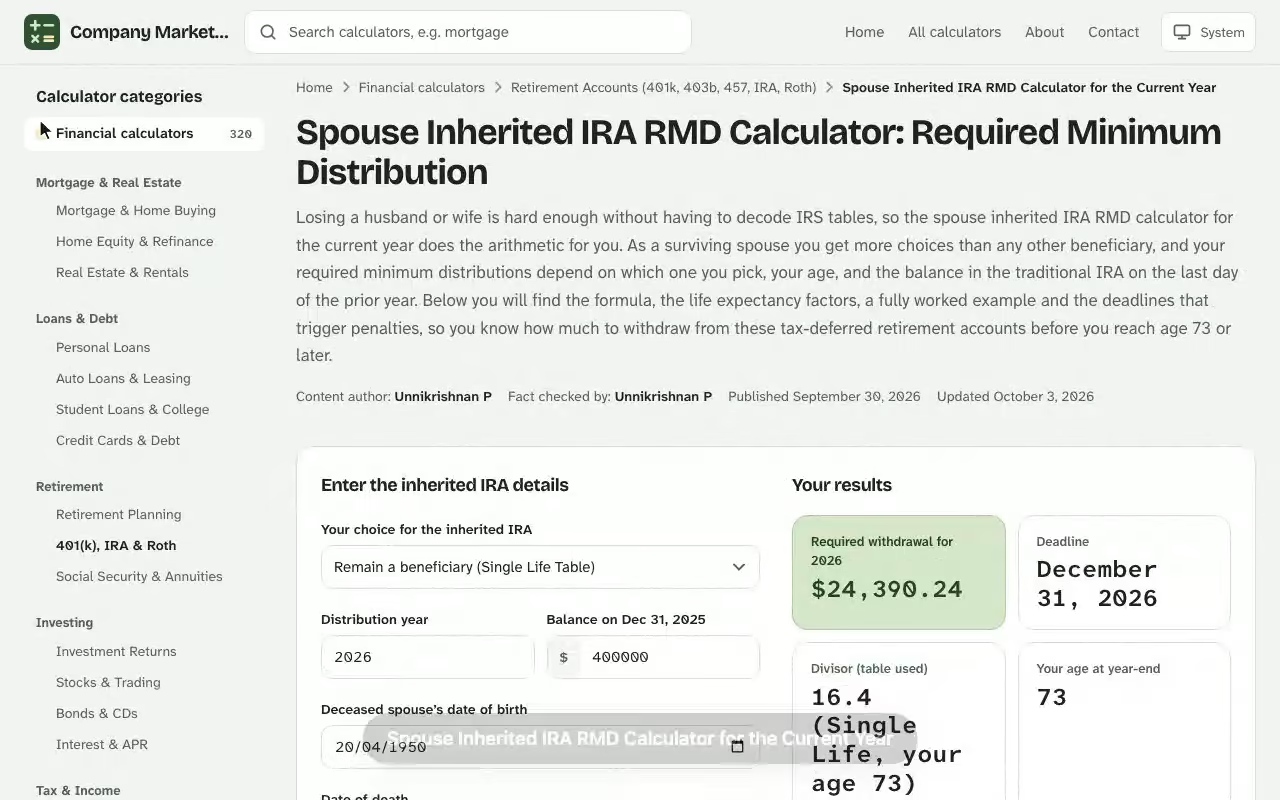
Spouse Inherited IRA RMD Calculator for the Current Year. Losing a husband or wife is hard enough without having to decode IRS tables, so the spouse inherited IRA RMD calculator for the current year does the arithmetic for you. As a surviving spouse you get more choices than any other beneficiary, and your required minimum distributions depend on which one you pick, your age, and the balance in the traditional IRA on the last day of the prior year. Below you will find the formula, the life expectancy factors, a fully worked example and the deadlines that trigger penalties, so you know how much to withdraw from these tax-deferred retirement accounts before you reach age 73 or later. Next, open the rmd calculator and enter your own details to see an estimate in seconds.
Your results
Required withdrawal
–
Deadline
–
Divisor (table used)
–
Your age at year-end
–
Uses the IRS life expectancy tables in effect from 2022. The spousal election follows proposed regulations (REG-103529-23) that are not yet final, so confirm with your IRA custodian which method it applies.
Results are estimates for educational purposes and are not financial, tax or legal advice.
Using the Spouse Inherited IRA RMD Calculator for the Current Year
An inherited IRA RMD calculator answers one question: how much must you take out of the account this calendar year so that you owe no penalty? You enter three facts, and the tool returns the dollar amount plus the percentage of the balance it represents. Unlike a generic RMD calculator built for people withdrawing from their own accounts, this version uses the single life expectancy schedule meant for a beneficiary, which is why the answers differ. Next, open the future rmd projection calculator and enter your own details to see an estimate in seconds.
Account balance: the fair market value of the inherited IRA on December 31 of last year, taken from your year-end statement.
Your age: how old you turn during the current year, since the factor changes every birthday.
Original owner details: the year your late spouse died and whether they had already begun taking withdrawals.
These estimates assume the whole balance sits in one traditional IRA. If you hold several inherited accounts, run each one separately and compare the totals with the worksheet instructions that the IRS publishes. Treat every figure as an estimate, because the custodian that holds the money performs the official calculation.
Your Spousal Beneficiary Options for an Inherited IRA
Before any RMD number means anything, you have to decide how the account is titled. As a spousal beneficiary you may choose among the following RMD options, and each one produces a different distribution schedule. Next, open the rmd start date calculator and enter your own details to see an estimate in seconds.
Treating the Account as Your Own IRA
If you roll the money into your own IRA, you are treated as the owner. You skip the beneficiary rules and begin required withdrawals only when you reach your RMD age, which is age 73 if you were born from 1951 through 1959 and age 75 if you were born in 1960 or later. A rollover also lets you name your own heirs. The trade-off is flexibility: if you are under 59½ and need money, withdrawals from your own IRA can carry the early-withdrawal penalty, which an inherited account avoids.
Keeping an Inherited IRA in Your Name
The second path is an inherited IRA in your name. Here the calculator above applies. When your late spouse had already started taking RMDs, you take yours beginning the calendar year after they died. When your spouse died before reaching their own starting age, you can wait until the year the original account owner would have reached that age, then begin annual distributions, or you can elect the 10-year rule instead.
Eligible Designated Beneficiary Status for a Surviving Spouse
A surviving spouse is an eligible designated beneficiary, the group that escapes the strict 10-year clock that applies to most heirs; minor children, disabled individuals and a sibling close in age share that status, while a non-spouse who qualifies for none is a plain designated beneficiary and an estate or trust follows its own timetable. For you, that status is why yearly withdrawals based on single life expectancy are allowed, and it is why this calculator uses the Single Life table rather than a flat 10-year payout.
How the Inherited IRA Distribution Calculator Works: Formula and Life Expectancy Factor
The math is a single division. Take the account balance from the previous December 31 and divide it by the life expectancy factor for your age this year.
For an inherited account the factor comes from the IRS Single Life Expectancy Table, refreshed in 2022. As a spouse you look up a new factor each year using your age that year, so the divisor falls by less than one each time and the remaining life expectancy is never allowed to run out unexpectedly. By contrast, an owner who treats the money as their own uses the uniform life expectancy table, which produces a smaller withdrawal at the same age.
Single Life Expectancy Factors by Age
Your age in the distribution year
Life expectancy factor
Share of balance withdrawn
60
27.1
3.69%
65
22.9
4.37%
70
18.8
5.32%
75
14.8
6.76%
80
11.2
8.93%
85
8.1
12.35%
RMD by balance and age; the outlined cell is the worked example.
The pattern is easy to see: the older you are, the higher the percentage you must take out, so the result you get for your age is a larger share of the balance every year.
Worked Example: Calculate Your Inherited IRA RMD
Suppose you turn 64 this year and your husband's traditional IRA, held in an inherited account in your name, closed last year at $487,350.00. He had already begun taking withdrawals before he died, so annual distributions apply. The factor for age 64 is 23.7.
See how the Spouse Inherited IRA RMD Calculator for the Current Year works: change the inputs and the required withdrawal for 2026 updates instantly. Enter your own numbers in the calculator above.
$$\frac{\$487{,}350.00}{23.7} = \$20{,}563.29$$
Your required minimum distribution for the year is $20,563.29, or 4.22% of the balance. Assume the remaining $466,786.71 earns 5% by the following December 31 and you take only the minimum each year. The next five years then look like this.
Year
Your age
Factor
Prior year-end balance
RMD
2026
64
23.7
$487,350.00
$20,563.29
2027
65
22.9
$490,126.04
$21,402.88
2028
66
22.0
$492,159.32
$22,370.88
2029
67
21.2
$493,277.86
$23,267.82
2030
68
20.4
$493,510.54
$24,191.69
Five years of minimum withdrawals from the worked example.
Because growth outpaces the withdrawals in this scenario, the balance stays near $490,000 even while you collect more than $110,000 across five years. A bigger drop in markets would change those later numbers, which is why you should rerun the calculation every January with the fresh year-end value.
Inherited IRA Calculator Inputs and Assumptions to Gather
Collect these items before you sit down with the form, so the result is not skewed by a guess.
Your age on your birthday this year, and the age your spouse reached or would have reached.
The balance of every inherited IRA as of December 31, including any SEP or SIMPLE plan assets that were rolled in.
Whether the account holds a Roth IRA, a 401(k) or a traditional IRA: enter each account's own balance separately, since the calculation applies to one account at a time.
The date your spouse passed away, because it sets the first calendar year of required retirement distributions and the 10-year schedule.
Your other income for the year, which is not part of the calculation but shows how the result adds to your taxable total.
Whether you plan to withdraw more than the minimum, which never satisfies a future year's requirement.
An inherited IRA distributions calculator is only as good as the figures it receives, so check each entry against your statements rather than memory. The tool leaves a few things out on purpose: it cannot see an RMD already taken in the year of death, and it cannot guess which distribution rules a custodian applies to you. When one of those matters, confirm the number against the worksheet in IRS Publication 590-B.
10-Year Rule, Deadlines and RMD Penalties
The calculator applies the post-2019 new rules created by the SECURE Act and updated by SECURE Act 2.0; if your spouse died before 2020, the old rules apply and your custodian must supply that figure.
The 10-Year Rule for Spousal Beneficiary Choices
If your spouse died before reaching their required beginning date, you may use the 10-year rule as an alternative to annual withdrawals. You then withdraw the balance by December 31 of the year that marks the 10th anniversary of their death. A shorter variation, the 10-year distribution window, lets you take nothing in some years and a lump sum in others, so long as the account is empty by that date.
Key dates for the worked-example inherited IRA.
Distribution Rules, RMD Age and Deadlines
Your annual deadline is December 31 each year. In the year you first owe a distribution as your own owner, you may delay it until April 1 of the next year, but that pushes two payments into the same tax year. Keep these distribution rules in mind:
The RMD age for your own IRA is 73 or 75 depending on your birth year.
Missing a withdrawal triggers a 25% excise tax on the shortfall, which drops to 10% if you fix it promptly.
Run the calculation for each inherited account, then withdraw the combined total from one account only when the rules allow it.
Check the IRS schedule for the calendar year that matters, since the factor and deadline both depend on it.
An inherited IRA never allows a rollover of the RMD itself into another tax-favored retirement account.
Avoiding the penalty altogether is simpler than fixing it, but a financial advisor can help you request a waiver of the excise tax if you ever miss an RMD, and the penalties shrink further when you correct it quickly.
A Widow's Run Through the Inherited IRA Distribution Calculator at Age 71
It is the first week of January, and Marguerite has just received the year-end statement for the IRA her husband left her. He died in 2024 after he had already begun taking withdrawals, and she chose to keep the money in an inherited account instead of rolling it into her own. Her statement shows $263,918.40 as of December 31, and she turns 71 this year.
She enters the balance, her age and the year of death into the spouse inherited IRA RMD calculator. It pulls the Single Life Expectancy factor for age 71, which is 18.0, and divides: $263,918.40 ÷ 18.0 gives $14,662.13, or 5.56% of the account. The remainder, $249,256.27, can stay invested.
Reference point: the IRS Single Life Expectancy Table lists 18.0 at age 71, which matches what the tool used.
Stakes: skipping the withdrawal entirely would expose her to a 25% excise tax of $3,665.53 on the shortfall.
Comparison: had she treated the account as her own, no distribution would be due until she reaches age 73, so the inherited route costs her a taxable $14,662.13 this year.
That comparison is what she needed. Because she still works part-time, she decides the inherited route is worth keeping for now, since it lets her take only the minimum. She schedules one transfer for $14,662.13 to land in her checking account by December 15, well before the December 31 deadline, and sets a January reminder to rerun the calculation with her age 72 factor of 17.2 and the new year-end balance. She also sends the amount to her tax preparer so the quarterly estimate reflects the extra income.
Common Mistakes When You Calculate Your Inherited IRA RMD
Most errors come from mixing up which table or which year applies. Watch for these before you file your return:
Entering today's balance in the calculator instead of the prior December 31 value, which is the input it is built around.
Applying the Uniform Lifetime factor to an inherited account, which understates the amount you owe.
Forgetting that a year-of-death distribution not yet taken by the original owner still has to be paid out.
Assuming a Roth IRA never requires anything once it has been inherited.
Counting a withdrawal from your own account toward the inherited account's requirement.
The calculator guards against the first two by asking for the exact year-end figure and the right life expectancy schedule, but only you can supply accurate dates and balances. When your situation includes several accounts, a trust, or a spouse who was more than ten years younger than the original owner, ask the custodian which of your options applies and keep the written answer with your tax records for the year.
Taxes on Inherited IRA Withdrawals and Your Withdrawal Strategy
Every dollar you withdraw from a traditional account counts as ordinary income, so your federal and state taxes rise in the year you take it. Your tax liability also depends on where you live, since state rules apply to the home address on file. A tax advisor can compare your bracket with the distribution to find a good withdrawal strategy.
The amount this calculator returns is the minimum taxable withdrawal for the year. Once the money is out, you cannot put it back into a retirement account, so if you do not need it for living costs you can invest it in a brokerage account, keep it in savings, or give it to a charity.
Consider this calculator a first step: it gives you the amount, the deadline and the rules, and the rest of your inheritance planning can build from there.
Spouse Inherited IRA RMD Calculator for the Current Year questions
How is a spouse's inherited IRA RMD calculated?
Divide the IRA's fair market value on December 31 of last year by the IRS life expectancy factor for your age this year. As a spouse, you look up a new factor each year.
What options does a surviving spouse have for an inherited IRA?
You can roll the money into your own IRA and follow your own RMD age, or keep it as an inherited IRA in your name. The inherited route lets you start withdrawals the year after your spouse died, or in some cases wait until they would have reached RMD age.
Does the 10-year rule apply to a spouse?
A spouse is an eligible designated beneficiary and does not have to use it, but if your spouse died before their required beginning date you can elect to empty the account by December 31 of the tenth year after their death.
What is the penalty for missing an inherited IRA RMD?
The excise tax is 25% of the amount you should have withdrawn. It can drop to 10% if you correct the shortfall promptly, so withdraw the missed amount and talk to a tax advisor.
Can I withdraw more than the RMD?
Yes. Extra withdrawals are taxed as ordinary income and do not count toward a future year's requirement.
Can I put my RMD back into an IRA?
No. An RMD cannot be rolled over or reinvested in another retirement account. You can invest it in a taxable brokerage account, save it, or donate it.
What if I inherited several IRAs?
Calculate each inherited IRA separately. Combining the totals into one account's withdrawal is only allowed where the IRS rules permit it, so confirm with your custodian.