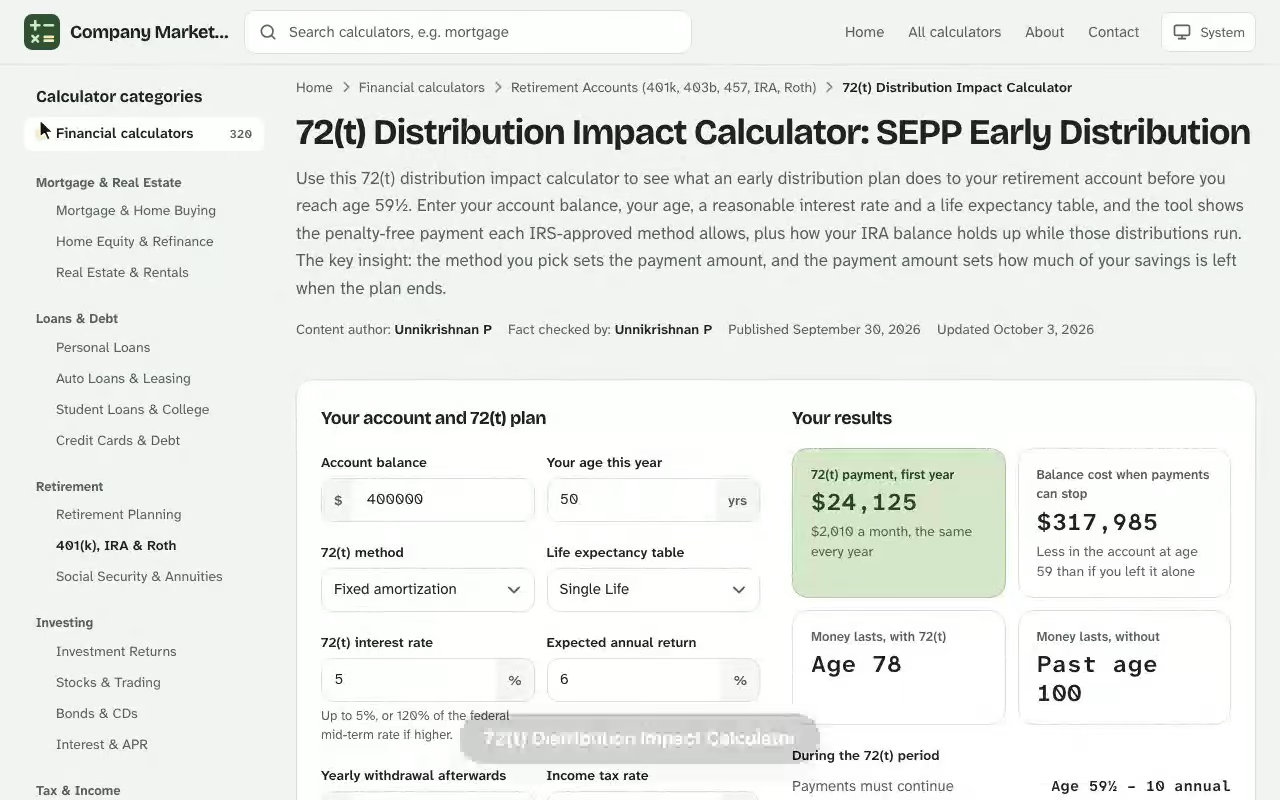
72(t) Distribution Impact Calculator. Use this 72(t) distribution impact calculator to see what an early distribution plan does to your retirement account before you reach age 59½. Enter your account balance, your age, a reasonable interest rate and a life expectancy table, and the tool shows the penalty-free payment each IRS-approved method allows, plus how your IRA balance holds up while those distributions run. The key insight: the method you pick sets the payment amount, and the payment amount sets how much of your savings is left when the plan ends. Try the roth ira calculator to run your own numbers — everything is calculated in your browser and nothing you enter is stored or sent anywhere.
Your results
72(t) payment, first year
–
Balance cost when payments can stop
–
Money lasts, with 72(t)
–
Money lasts, without
–
During the 72(t) period
Payments must continue until–
Total 72(t) payments–
Income tax on them–
10% early withdrawal tax avoided–
Balance then, with 72(t)–
Balance then, without–
If the payments change
Recaptured 10% tax–
Interest on it–
Total owed with that year’s return–
With and without 72(t) payments
Withdrawals are taken at the end of each year, after that year’s growth, to age 100.
Age
Withdrawal with 72(t)
Balance with 72(t)
Withdrawal without
Balance without
Difference
Results are estimates for educational purposes and are not financial, tax or legal advice.
What a 72(t) Early Distribution Does to Your IRA
Normally, pulling money out of an IRA or most 401(k)s before age 59½ costs you ordinary income tax plus a 10% additional tax. Section 72(t) of the Internal Revenue Code carves out an exception: if you take substantially equal periodic payments from the account, the 10% penalty does not apply. The IRS describes the exception in its guidance on these payments, and the strategy is usually called a SEPP or the rule of 72(t). If you want to see how the figures change, the roth 403b vs traditional 403b calculator gives you an instant result you can adjust as you go.
The trade-off is rigidity. Once the series starts you are locked in, and the payments you take reduce a balance that was meant to grow tax-deferred for decades. That is why running an early distribution analysis before you commit matters so much.
How a SEPP Plan Avoids the 10% Penalty
A SEPP plan works because the IRS treats a fixed, formula-driven series as a stream of annuity-like payments rather than as ad hoc withdrawals. You pick one of three approved calculations, take the resulting amount at least annually, and keep going for five years or until you reach age 59½, whichever comes later. If you start at 52, that is roughly seven and a half years, not five.
SEPP Rules for Qualified Accounts
SEPP payments can come from a traditional IRA or from a qualified workplace plan after you separate from service. Each plan applies to one account, so a second account needs its own calculation. The plan custodian, such as Fidelity or any other brokerage, must also be willing to administer the payments, which is why you should confirm support for your chosen method before you start.
Who Uses SEPP Withdrawals
People retiring in their early 50s who need bridge income until Social Security or pension age.
Owners with a large retirement account who want a predictable annual distribution without the 10% penalty.
Savers weighing early retirement against working a few more years.
See how the 72(t) Distribution Impact Calculator works: change the inputs and the 72(t) payment, first year updates instantly. Enter your own numbers in the calculator above.
Early Withdrawal Versus a SEPP Plan
A plain early withdrawal is simple but expensive: the 10% additional tax applies to every dollar, on top of income tax. A SEPP plan trades that cost for a long commitment, and a SEPP plan only works when your calculation, payment schedule and account stay untouched for the full term. Put differently, a SEPP plan is a contract with the tax code that you cannot renegotiate.
Calculating the 72t Distribution Impact on Your Balance
The 72t distribution impact comes down to one division. Every method starts with your account balance and a divisor tied to your age, and each divisor produces a different payment amount. For the simplest approach the formula is: The 457 roth vs pre-tax calculator is free to use with no sign-up, and works on desktop and mobile.
The other two methods swap that divisor for an amortization or annuity calculation that also uses your interest rate. In the amortization case, with balance \(P\), rate \(r\) and \(n\) years of life expectancy, the payment is:
$$\text{Payment} = P \times \frac{r}{1-(1+r)^{-n}}$$
Account Balance and Age
Use your balance as of December 31 of the prior year or a recent month-end, and your age at year-end. A bigger account balance scales every payment proportionally, while a younger starting age lengthens the life expectancy divisor and shrinks the RMD-style payment. Most 72t calculator tools accept an age from roughly 35 to 60.
Choosing a Reasonable Interest Rate
The reasonable interest rate drives the fixed amortization and fixed annuitization results. Notice 2022-6 sets the ceiling at the greater of 5% or 120% of the federal mid-term rate from either of the two months before your first payment. A lower interest rate yields a smaller payment, so you can dial the distribution down if you need less income. The federal mid-term rate is published monthly by the IRS.
Life Expectancy Table and Beneficiary Age
You choose among three tables: the uniform lifetime table, the single life expectancy table, or the joint life expectancy table. The joint option uses your beneficiary age and the oldest named beneficiary on the account, which lengthens the divisor and lowers the payment. The annuitization method relies on a mortality table and an annuity factor instead, and ignores your beneficiary altogether.
72(t) Distribution Options Compared
The IRS approves three distribution method choices. The required minimum distribution approach is the simplest and gives the lowest payment, the fixed amortization method usually gives the highest, and the annuitization method falls between them.
Method
How the payment is set
Does it change each year?
Typical result
RMD method
Balance divided by a life expectancy factor
Yes, recalculated annually
Lowest payment amount
Fixed amortization
Balance amortized over life expectancy at your interest rate
No, fixed
Highest payment
Fixed annuitization
Balance divided by an annuity factor from a mortality table
No, fixed
Between the other two
Required Minimum Distribution (RMD) Method
The RMD method divides your balance by the life expectancy factor and recalculates every year using your new balance and age. It is the only approach where the payment moves with your account, which makes it the gentlest choice if your portfolio is volatile.
Fixed Amortization Method
The amortization method spreads your balance over your life expectancy at the chosen rate and locks the payment. Because it assumes interest will keep working inside the account, it produces a larger amount than the RMD method, which is why people who need more cash lean on it.
Fixed Annuitization Method
The annuitization method divides the balance by an annuity factor, giving a fixed amount that lands between the RMD and amortization results. It is the most technical of the three, but the calculator handles the factor lookup for you.
Reading Your 72(t) Distribution Impact Calculator Results
Here is a full early distribution illustration. Suppose you are 52, hold a $587,400 traditional IRA, use the 5.0% rate ceiling, and pick the single life table, which gives a life expectancy factor of 34.3 at that age. Check the current IRS table before you rely on any factor.
RMD method: \(587{,}400 \div 34.3 = \$17{,}125\) in year one.
Fixed amortization: \(587{,}400 \times \frac{0.05}{1-1.05^{-34.3}} \approx \$36{,}152\) every year, or about $3,013 per month.
The gap is large: amortization pays more than twice the first-year RMD amount. The plan must run until you turn 59½, so seven years of payments are the minimum. If your account grows 5% a year while you draw the fixed amount, the balance steps down like this:
Same IRA, same age: fixed amortization pays more than twice the first-year RMD amount.
Year
Year-end balance (amortization, 5% growth)
0
$587,400
1
$580,618
2
$573,498
3
$566,021
4
$558,170
5
$549,927
6
$541,272
7
$532,184
Returns matter just as much. Drawing the same $36,152 each year, the balance after seven years is about $445,417 if the account earns 3%, $532,184 at 5%, and $630,379 at 7%. By avoiding the 10% penalty on each payment you keep roughly $3,615 a year, about $25,306 over seven years.
Balance after seven years of fixed payments depends heavily on investment returns.
What Distributions Do to Your Retirement Savings
Each year of distributions removes principal that would otherwise have compounded, so the real cost of a plan is not the penalty you avoid but the retirement growth you give up. In the example, the fixed payments take your retirement balance from $587,400 to $532,184 even with 5% returns, which means your savings keep earning on a smaller base every year. Because the payments are tied to one account, your other retirement savings are untouched, and you can keep contributing elsewhere. Think of the plan as a reallocation: you pull forward income now and accept a lower balance at 59½, while distributions from other accounts remain optional. If that lower balance would leave you short later in retirement, test a smaller reasonable interest rate, a joint life table or the RMD method before committing to the plan.
It also helps to compare the payment against your actual spending. If your annual need is $30,000, a $36,152 payment overshoots by more than $6,000 a year, and the extra distributions become taxable income you did not need. In that case, a lower-rate scenario or the annuitization method could cover the budget while preserving more of the balance for the years after the plan ends. Run each scenario in the calculator, record the payment, the ending balance and the tax cost, and pick the one that balances today's cash flow against the savings you want left for later.
Annual Figures, Monthly Payments and Timing
The 72t calculator reports annual figures, but you can take the money monthly, quarterly or semi-annually as long as the total each year matches the annual distribution it returns. A monthly schedule makes the income feel like a paycheck and simplifies budgeting.
Sizing a Bridge Income Plan with the 72t Distribution Impact Calculator
Dana, 54, has just left a logistics job with a $318,742 rollover IRA and needs about $1,500 a month until a part-time pension starts. Rather than guess, Dana opens the 72t distribution impact calculator and enters the balance, age 54, the single life table and the 5.00% ceiling from Notice 2022-6.
The results come back in seconds. With a factor of 32.5, the RMD method gives $9,807 a year, about $817 a month, which is far short of the need. Fixed amortization gives $20,042 a year, or $1,670 a month, which covers the gap but pulls more principal than necessary and adds to taxable income.
Dana changes one input, dropping the interest rate to 4.00%, which is still a reasonable rate under the IRS ceiling. The amortization payment falls to $17,696 a year, or $1,475 a month, just $25 a month under the target. That small shortfall can come from a savings account, so the lower rate is the better fit.
Plan length: age 54 to 59½ is five and a half years, longer than the five-year minimum, so the 59½ date governs.
Tax check: all $17,696 counts as ordinary income before deductions, so Dana budgets for income tax withholding on each payment.
Next step: ask the custodian to set up a fixed $1,475 monthly payment from this one account and leave the other accounts alone.
The calculator turned a vague income need into a specific rate, method and monthly amount, and showed that the 5.00% default would have drawn $2,346 a year more than Dana needs.
Rules That Trigger Retroactive Penalties
The 72(t) exception is strict. If the series is modified before it ends, the IRS applies a recapture tax: the 10% penalty comes back retroactively on every payment since the first, plus interest. That is a premature distribution penalty on money you already received.
A plan started at 52 must continue to age 59½, and stopping early triggers a retroactive penalty.
Take the example above and imagine you stop after three years of $36,152 payments. The recapture would be 10% of $108,456, or about $10,845, before interest. Only a few events are safe:
Death or disability of the account owner waives the five-year and age rules.
A one-time change from the amortization or annuitization method to the RMD method is allowed under Revenue Ruling 2002-62, which helps if the account takes a big loss and risks being depleted.
Reducing the account balance to zero ends the plan without penalty.
Tax on a 72(t)/(q) Distribution
A 72(t)/(q) distribution avoids the penalty, not the bill, and the payments this tool returns are pre-tax amounts. Every payment from a traditional account is ordinary income, so your income tax still applies at your marginal rate, and the withdrawals stop compounding in a tax-deferred account. In the worked example, the $36,152 annual payment is all added income, so check your taxes against that figure for the full run. A financial professional can confirm the tax side before you lock in the plan.
When a 72t/SEPP Calculator Fits Your Early Retirement Plan
A 72t/SEPP calculator makes sense when you want early retirement income from a retirement account and have no other penalty-free source. It is a poor fit if you only need a one-off amount, since the commitment lasts years. Compare it with alternatives: a Roth conversion ladder, taking Roth contributions first, or the rule of 55 for a 401(k) at your last employer.
Whichever route you choose, treat the 72(t) calculator as an estimate. Confirm the final distribution amount with your custodian, because the IRS expects you to follow the same calculation exactly. Run several scenarios with this 72(t) distribution impact calculator, vary the rate and table, and choose the plan whose balance still supports you after the payments end.
72(t) Distribution Impact Calculator questions
What is the 72(t) rule?
Section 72(t) of the Internal Revenue Code lets you take substantially equal periodic payments (SEPP) from an IRA before age 59½ without the 10% early distribution penalty, as long as the payments follow an IRS-approved method.
How long must 72(t) payments continue?
For five years or until you reach age 59½, whichever is longer. The calculator shows the required number of years for your age.
Which distribution method gives the biggest payment?
Fixed amortization usually pays the most, the RMD method the least, and fixed annuitization falls in between. Compare all three in the results.
What interest rate can I use?
Under IRS Notice 2022-6 the ceiling is the greater of 5% or 120% of the federal mid-term rate from either of the two months before your first payment. A lower rate gives a smaller payment.
What happens if I change or stop the payments?
Modifying the series before it ends triggers a retroactive 10% penalty plus interest on every payment taken so far, except after death or disability or a one-time change to the RMD method.
Are 72(t) payments taxable?
Yes. They avoid the 10% penalty but are taxed as ordinary income from a traditional IRA.
Can I use more than one account?
A SEPP plan applies to a single account, so each additional account needs its own calculation and plan.