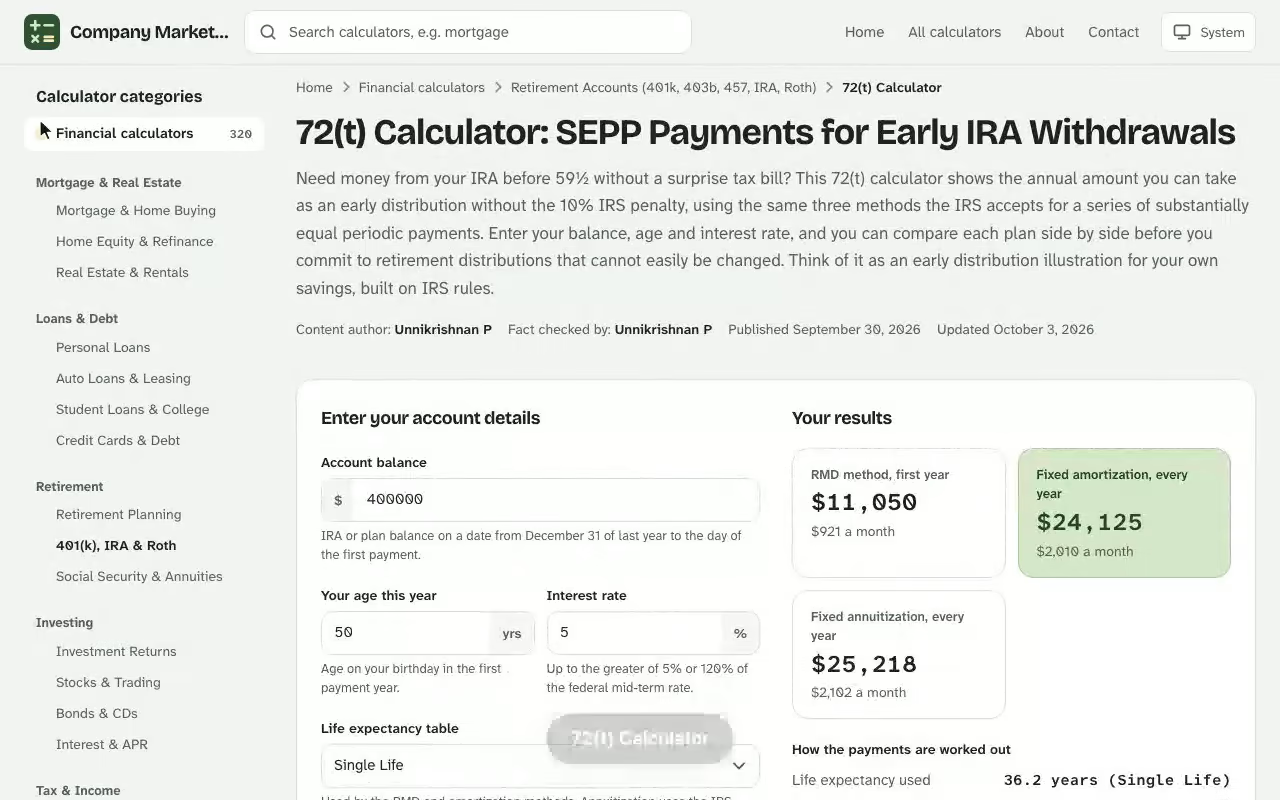
72(t) Calculator. Need money from your IRA before 59½ without a surprise tax bill? This 72(t) calculator shows the annual amount you can take as an early distribution without the 10% IRS penalty, using the same three methods the IRS accepts for a series of substantially equal periodic payments. Enter your balance, age and interest rate, and you can compare each plan side by side before you commit to retirement distributions that cannot easily be changed. Think of it as an early distribution illustration for your own savings, built on IRS rules. Pair this with the free roth ira calculator for a fuller picture before you make a decision.
Your results
RMD method, first year
–
Fixed amortization, every year
–
Fixed annuitization, every year
–
How the payments are worked out
Life expectancy used–
Amortization factor–
Annuity factor–
Payments must continue until–
Total withdrawn by then–
Balance left by then–
Changing the payments, adding money or moving money out of the account before the period ends brings back the 10% additional tax on every earlier payment, plus interest. A one-time switch to the RMD method is allowed.
Payment schedule
Year
Age
Starting balance
Payment
Ending balance
Results are estimates for educational purposes and are not financial, tax or legal advice.
How the 72(t) Calculator Estimates Your SEPP Payment
Section 72(t) of the tax code normally charges a 10% additional tax on withdrawals taken before age 59½. One exception lets you avoid it: take a SEPP (a schedule of substantially equal periodic payments) calculated with an IRS-approved formula, and the early withdrawal penalty does not apply. A 72t calculator runs that formula for you. It turns four inputs into a single annual amount, so you can see what a plan would pay before you set up your SEPP plan with your custodian, and it works for any retirement account that qualifies, from an IRA to 401(k)s. Pair this with the free 457 roth vs pre-tax calculator for a fuller picture before you make a decision.
The calculator reports an annual distribution amount and a monthly payment amount, and each input below moves that result in a predictable direction. Each one below changes the payment in a predictable direction.
Account balance
The account balance is the starting point of every method. For the required minimum distribution method it is the balance at the end of the prior year. For the other two, the IRS lets you use a reasonable figure, such as your last statement balance adjusted for any payments since. A larger balance produces a proportionally larger annual amount, and each SEPP applies to a single account, so balances from different IRAs are never combined.
Interest rate
Two of the methods use an interest rate in the math. A higher rate shrinks the present value of your future payments, which means a bigger payment today. The IRS caps the rate you may use, covered in the interest rate section below.
Life expectancy table
Your life expectancy sets how many years the balance is spread across. You choose from the Uniform Lifetime Table, the Single Life Table (your single life expectancy) or the Joint and Last Survivor Table (your joint life expectancy with a beneficiary). A longer life expectancy factor means a smaller payment, which is why starting younger always lowers the annual amount.
Beneficiary age
If you pick the joint table, the beneficiary age of your oldest named beneficiary stretches the life expectancy further and cuts the payment again. If you choose the single table or the uniform table, beneficiary age does not matter.
The Three SoSEPP Methods the 72t Calculator Compares
The IRS describes a series of substantially equal periodic payments (often abbreviated SoSEPP) in Notice 2022-6, which replaced Revenue Ruling 2002-62 for payments starting after 2022. Both documents list the same three methods for calculating periodic distributions, and each produces a different payment from identical inputs. Your SoSEPP can follow only one of them at a time, and the method you pick stays with that account. If you want to see how the figures change, the traditional ira vs roth ira calculator gives you an instant result you can adjust as you go.
Required minimum distribution method
The required minimum distribution method, called the RMD method for short, divides your account balance by a life expectancy factor from the IRS tables. It uses no interest rate and recalculates every year from the December 31 balance, so the payment rises when your investments grow and falls when they shrink. It is the simplest approach and nearly always the lowest payment, which keeps the most money tax-deferred. Choose this RMD method if you want a modest bridge income and prefer flexibility to a fixed paycheck.
Fixed amortization method
The fixed amortization method treats your balance like a loan being paid off. It works by amortizing the balance over your life expectancy at your chosen interest rate, and the result is one level fixed payment repeated every year. This amortization method pays far more than the RMD method at the same age, and the payment never changes after the first distribution, which makes budgeting easy.
Fixed annuitization method
The fixed annuitization method divides your balance by an annuity factor: the present value of $1 per year for as long as you live, built from a mortality table and your interest rate. Because it weights survival odds rather than a flat number of years, an annuity factor at your age is usually a little smaller than the amortization factor, so this annuitization method often pays slightly more. Note that the older Annuity 2003 Mortality Table applies only to payments that began under the earlier guidance.
72(t) Distribution Example: A 51-Year-Old With a $687,300 IRA
Suppose you are 51, you hold a $687,300 traditional IRA, and you want a 72(t) distribution to cover living costs while you wind down a business. You use the Single Life Table, where age 51 carries a life expectancy of 35.3 years, and you select a 5.00% interest rate, the highest rate the IRS allows unless 120% of the federal mid-term rate is higher. The formulas look like this:
Here \(r\) is the interest rate and \(n\) is the life expectancy in years. Working through the numbers gives you the following annual amount for each method:
See how the 72(t) Calculator works: change the inputs and the fixed annuitization, every year updates instantly. Enter your own numbers in the calculator above.
Method
Calculation
Annual amount
Monthly equivalent
Required minimum distribution
$687,300 ÷ 35.3
$19,470
$1,623
Fixed amortization at 5.00%
$687,300 ÷ 16.4269
$41,840
$3,487
The amortization payment is more than double the RMD payment, and a $41,840 annual amount avoids roughly $4,184 of penalty every year compared with taking the same money as an ordinary early withdrawal. The payment is still taxable, because a SEPP lifts the penalty and not the income tax. Breaking the schedule later would bring the early distribution penalty back on every payment already taken.
Choosing a Reasonable Interest Rate for Your SEPP Plan
For the amortization and annuitization methods, your reasonable interest rate is the lever with the biggest effect. The IRS lets you use any rate up to the greater of 5% or 120% of the federal mid-term rate for either of the two months before your first payment. The federal mid-term rate is published monthly by the Treasury and the IRS for retirement planners, so a quick check before you start tells you whether the 5% floor or the higher figure is your ceiling.
The same $687,300 balance and 35.3-year life expectancy give very different payments across that range:
Interest rate
Annual amount
3.00%
$31,832
3.50%
$34,213
4.00%
$36,678
4.50%
$39,222
5.00%
$41,840
Moving from 3.00% to 5.00% lifts your payment by about $10,000 a year. A lower rate means a smaller payment but also a slower drain on your balance, so picking the top of the range is not automatically the safest choice.
Annual amount by interest rate and method for the example $687,300 IRA at age 51.
SEPP Calculator Rules: The Five-Year Rule and Age 59½
A plan result is only useful if you can honor the schedule. Once a SoSEPP starts, you must keep taking the same annual distribution until the later of two dates: the fifth anniversary of your first payment, or the day you reach age 59½. This is the five-year rule, and it is why a 51-year-old is committing to roughly nine years of payments and not five.
A plan started at 51 must run until age 59½, the later of the two end dates.
You may split the annual amount into monthly, quarterly or annual installments, as long as the yearly total matches your plan, and the same SoSEPP continues unchanged.
You cannot add money to the retirement account or take any other withdrawals from it while the plan runs, and extra withdrawals count as a change to the SEPP plan.
If you are using a 401(k) or similar employer plan, you must have separated from service before payments begin. An IRA has no such requirement.
You can run only one SoSEPP per account, though you may set up a separate plan for each qualified retirement plan or IRA you want to use.
What triggers the recapture tax
Any modification before the end date brings a recapture tax: the 10% penalty on every payment taken so far, plus interest, as though the exception never applied. That includes taking an extra dollar or skipping a payment. A SEPP also ends the day your account is depleted, which is not treated as a violation.
Exceptions that do not break the plan
A few changes are allowed. These include death or disability, a distribution to a qualified public safety employee, and a one-time change from the amortization or annuitization method to the RMD method. That last switch is useful if the fixed payment starts to outrun your investments.
SEPP Calculator Walkthrough: Covering a $2,050 Monthly Gap at 55
Dana, 55, left a salaried job and expects a pension to start at 60. Until then there is a $2,050 monthly shortfall, or $24,600 a year, with no other taxable income to cover it. Dana's rollover IRA held $412,860 at last year's year-end statement, and the question is whether a SEPP can fill the gap without the 10% penalty.
Dana opens the calculator and enters age 55, an account balance of $412,860, and the Single Life Table, which gives a 31.6-year life expectancy. The first run uses the RMD method and returns $13,065 a year, or $1,089 a month, which is only about half of what is needed.
Switching to the fixed amortization method with a 4.75% interest rate, safely under the 5% ceiling the IRS sets, returns $25,493 a year, about $2,124 a month. That clears the $24,600 target with $893 a year to spare. Dana tries 4.00% as a check, and the amount falls to $23,245 a year, or $1,937 a month, which leaves the budget short by $113 a month. So 4.75% is the lowest rate that works.
Result: $25,493 a year under the amortization method at 4.75%.
Next action: set up $2,124 monthly installments from this one IRA only, leaving the other accounts untouched.
Penalty avoided: about $2,549 a year compared with taking the same money as a plain early withdrawal.
Because the schedule must run until Dana turns 59½ in about four and a half years, or until five full years pass if that is later, Dana locks in the five-year rule date of the 60th birthday instead and writes it on the calendar next to the pension start.
Taxes on Substantially Equal Periodic Payments
The annual amount this tool returns is a gross figure, not take-home pay. Avoiding the penalty does not make the money free. Payments from a traditional IRA are taxed as ordinary income, so each year's income tax depends on your bracket plus any other earnings. If your account holds after-tax contributions, part of each payment is a return of cost basis and escapes tax. A premature distribution from a Roth IRA follows different ordering rules, so check your own account type with a financial professional before relying on any estimate.
Because the payments are fixed, you also lose the ability to turn the spigot down in a lean year. That makes tax planning part of the decision: a $41,840 payment on top of other income can push you into a higher bracket than you expect.
Limits of a 72(t)/(q) Distribution Plan and Alternatives
A 72(t)/(q) distribution plan locks you in: breaking the schedule triggers the penalty on every payment, so a payment that is too large can drain the account before 60, while one that is too small may not cover your costs. Early retirement plans built on it work only when the schedule can be kept. If your payment is too large, you can drain the account and have nothing left at 60. If it is too small, you may not cover your costs. The model also assumes no investment losses beyond what the method already builds in. Estimates from a sepp calculator are illustrations, not tax advice, and your custodian may support only some of the methods.
Before you start, weigh these alternatives to a SEPP plan:
Withdraw Roth IRA contributions, which come out tax-free and penalty-free at any age.
Use a taxable brokerage account first and let the tax-free and tax-deferred balances keep growing.
Check for another exception, such as the Rule of 55 for a 401(k) after leaving your job.
Borrow against a 401(k) if your plan allows it, rather than taking a permanent early withdrawal.
If you do go ahead, run your numbers again with a different 72(t) early distribution analysis each year you are tempted to change course, and remember that the calculator is only as accurate as the inputs and tables behind it.
72(t) Calculator questions
What is the 72(t) rule?
Section 72(t) lets you take penalty-free withdrawals from an IRA or workplace plan before 59½ if they are a series of substantially equal periodic payments calculated with an IRS-approved method. You still owe ordinary income tax.
How long do 72(t) payments have to last?
Until the later of five years after your first payment or the day you turn 59½. A 52-year-old therefore commits to about seven and a half years, while a 57-year-old must still take five.
Which method gives the largest payment?
The fixed amortization and fixed annuitization methods usually pay far more than the required minimum distribution method, because they use an interest rate. A higher rate, up to the IRS ceiling, raises the payment further.
What interest rate can I use?
Any rate up to the greater of 5% or 120% of the federal mid-term rate for either of the two months before your first payment. Choosing a lower rate lowers the payment.
What happens if I change or stop the payments?
A modification before the end date brings back the 10% penalty on every payment taken so far, plus interest. Death, disability and a one-time switch to the RMD method are the main exceptions.
Can I use more than one account?
Each plan covers a single account, and balances cannot be combined. You may set up a separate plan on each IRA you want to use, and each is managed on its own.
Is the calculator's life expectancy exact?
It is an estimate fitted to the IRS tables. For a filing-ready figure, enter the factor from Notice 2022-6 for your age in the life expectancy override field.