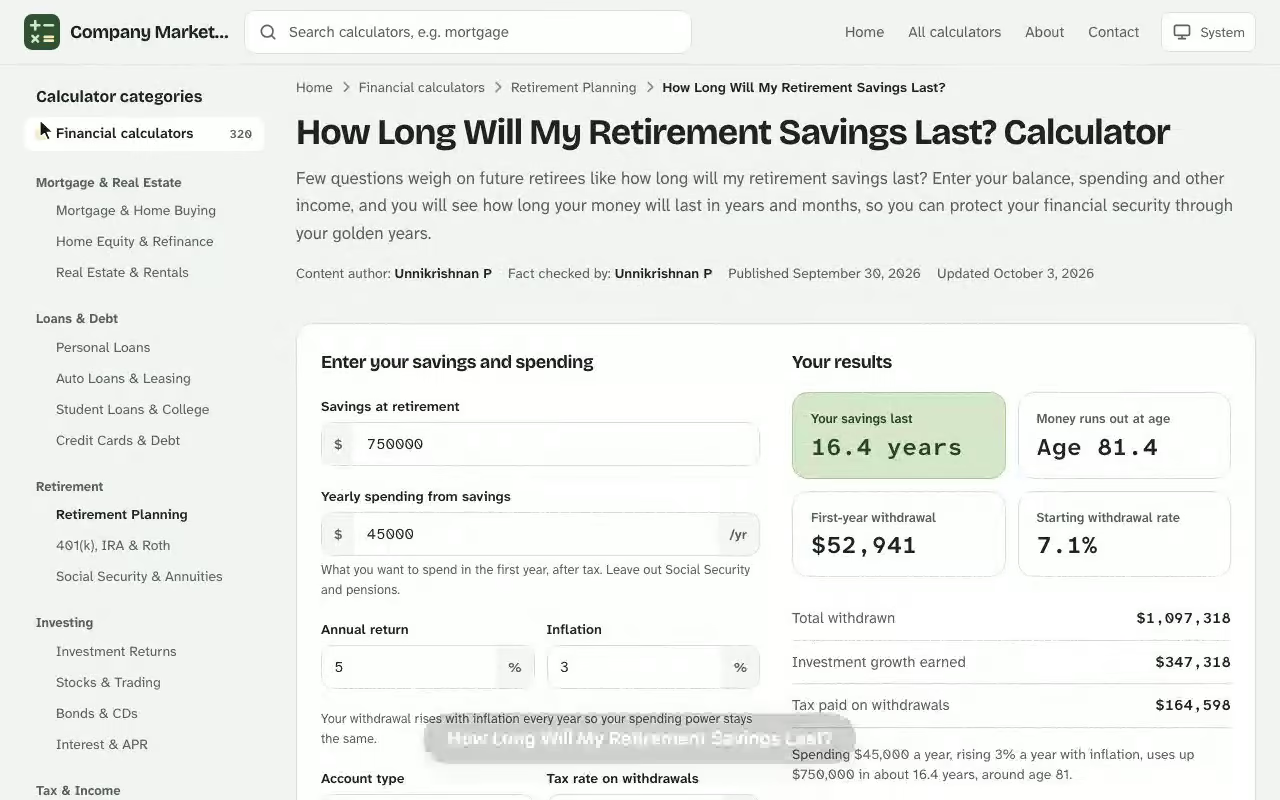
How Long Will My Retirement Savings Last? Few questions weigh on future retirees like how long will my retirement savings last? Enter your balance, spending and other income, and you will see how long your money will last in years and months, so you can protect your financial security through your golden years. If you want to see how the figures change, the life expectancy calculator online gives you an instant result you can adjust as you go.
Your results
Your savings last
–
Money runs out at age
–
First-year withdrawal
–
Starting withdrawal rate
–
Total withdrawn–
Investment growth earned–
Tax paid on withdrawals–
Years your savings last at other returns and spending levels
Each cell keeps your savings, inflation and tax the same and changes only the return (rows) and the first-year spending (columns).
Year-by-year drawdown
Each year's withdrawal is taken at the start of the year and the rest earns your annual return.
Year
Age
Spending
Withdrawal
Growth
Balance
Results are estimates for educational purposes and are not financial, tax or legal advice.
How Long Will My Retirement Savings Last? The Core Calculation
Asking "how long will my retirement savings last?" really means asking when withdrawals, growth and rising prices cross paths. Each month your retirement funds earn a little return, then you pull out whatever your income does not cover. The savings duration is the number of months until the balance reaches zero. A good retirement income calculator repeats that step month after month, and this one does exactly that. Pair this with the retirement income calculator for a fuller picture before you make a decision.
Here \(B_m\) is your balance in month \(m\), \(r\) is the annual rate of return, \(S_y\) is your monthly spending after inflation in year \(y\), \(I_y\) is your inflation-adjusted benefit, \(P\) is your fixed pension or other income, and \(t\) is the tax rate on withdrawals. The calculator stops when \(B_m\) drops to zero or below, and that month count is your answer.
Monthly spending and other income you enter
Start with the figures you can state with confidence. The inputs below describe what you need and what already arrives each month before touching your nest egg:
Cumulative savings: the balance you hold, or expect to hold, on the day you retire.
Monthly spending: everything you expect to pay for housing, food, travel and living expenses.
Social Security: the monthly benefit amount you expect to receive.
Monthly pension: any guaranteed payment from a former employer.
Other income: rental checks, royalties or any extra retirement income not listed above.
Marginal tax rate: the rate that applies to the money you withdraw.
Rate of return and rate of inflation
Two percentages decide the shape of the curve. The rate of return is what your investments earn each year, and the rate of inflation is how fast your costs climb. When the first beats the second by a wide margin your balance holds up; when the gap narrows, the balance shrinks faster than most people expect.
Worked Example: Retirement Income Calculator Results
Suppose you retire with $742,500 in a traditional account. The figures below are the inputs for this scenario. In this model your spending and Social Security benefit rise with inflation each year, while your pension stays flat. The retirement account contribution accelerator is free to use with no sign-up, and works on desktop and mobile.
Input
Value
Cumulative savings
$742,500
Monthly spending
$5,380
Monthly Social Security
$2,140
Monthly pension
$420
Annual rate of return
5.2%
Rate of inflation
2.8%
Marginal tax rate on withdrawals
14%
See how the How Long Will My Retirement Savings Last? works: change the inputs and the your savings last updates instantly. Enter your own numbers in the calculator above.
In month one your net need is \($5{,}380 - $2{,}140 - $420 = $2{,}820\). Because withdrawals are taxed, the gross amount is \($2{,}820 \div (1 - 0.14) = $3{,}279.07\). That is an opening annual draw of about 5.3% of your balance. The result: your money lasts 295 months, or 24 years and 7 months.
Year of retirement
Ending balance
5
$724,240
10
$660,361
15
$531,398
20
$311,238
24
$46,382
Reading the result
The answer here is 24 years and 7 months, and the table shows how it unfolds. Notice how little the balance moves in the first five years, then how quickly it falls. Growth on a large balance masks the withdrawals early on, while inflation pushes each year's draw higher. By year 20 you hold $311,238, and the final four years use it up. Over the whole span you withdraw about $1,425,075 in total, nearly twice the starting balance, which shows how much investment returns do for a portfolio that is spent down slowly.
Key Factors That Shape Retirement Savings Longevity
Several inputs move the answer far more than the rest. Retirement savings longevity is most sensitive to your spending, the return you earn and the inflation you face. The table shows what happens when you change one input at a time in the example above.
Change from the example
How long the money lasts
Return of 3.2%
19 years 5 months
Return of 4.2%
21 years 7 months
Return of 6.2%
29 years 3 months
Spending of $4,880
31 years 10 months
Spending of $5,880
20 years 1 month
Inflation of 1.8%
29 years 5 months
Inflation of 4.8%
19 years 5 months
Withdrawal rate and withdrawal strategy
Your withdrawal rate is the share of the balance you take out each year. Sensible withdrawal rates leave room for markets to recover after a bad stretch. Pairing that with a flexible retirement withdrawal strategy, such as trimming spending after a down year, matters more than hunting for the perfect number. Any withdrawal strategy should be tested against several return assumptions, not one.
Inflation, purchasing power and cost of living
Inflation quietly erodes purchasing power. A 20-30 year retirement is long enough for the cost of living to rise by half or more, and retirees on a fixed income feel it first. You can partly offset it with stocks and Treasury Inflation-Protected Securities, and by choosing to delay your Social Security claim, since benefits are indexed to rising prices.
Taxes, tax rate and account type
The account that funds each withdrawal sets its tax rate. Money from a traditional IRA or 401(k) is pre-tax and tax-deferred, so withdrawals are taxed as ordinary income. A Roth account is funded with after-tax dollars, so qualified withdrawals come out tax-free. These tax implications explain why the 14% setting in the example shortens the result by more than six years compared with a 0% setting.
Unexpected costs and healthcare
Plan for unexpected costs: a roof, a car, a hospital bill. Keep a cushion outside your invested balance. Healthcare deserves its own line, covering Medicare premiums, out-of-pocket costs and long-term care. A health savings account is a tax-advantaged place to hold money for those expenses.
How to Make Your Retirement Money Last Longer
If the calculator gives you a shorter answer than you hoped, you have more levers than you think. These steps are the ones that change the result most:
Revisit your retirement budget: list your monthly expenses on a retirement expenses worksheet and cut nonessential expenses first.
Delay Social Security: waiting raises the monthly check, which cuts the amount you draw from savings accounts.
Consider part-time work: even a modest paycheck for a few years lets your balance keep compounding.
Diversify: a diversified portfolio of stocks, bonds and mutual funds spreads risk across the market.
Lower your withdrawals: a smaller draw in the first years protects the balance when markets fall.
Investment mix and risk tolerance
Review your asset mix against your risk tolerance as you age. Look at historical returns for a guide, but remember that past performance does not guarantee future results. Because markets swing, running the calculator with a low, middle and high return is better than trusting a single estimate.
Testing a $418,260 Balance: A Savings Duration Check at 66
Dana is 66, retired in March, and holds $418,260 in a rollover IRA. Her monthly Social Security deposit is $1,865, and she has no pension. Before she signs a lease on a smaller condo, she wants to know how long her money will last if she keeps living the way she does now.
The calculator needs her balance, income and spending to work out how long her money will last, so she adds up her statements: mortgage-free housing costs, groceries, insurance and a standing travel habit come to $3,915 a month. She enters 4.6% for the return, 3.1% for inflation, which matches the recent run of consumer price readings, and a 12% rate on withdrawals, since most of her income falls in the 12% federal bracket.
The result comes back in a moment: 209 months, or 17 years and 5 months. Her net need is $3,915 − $1,865 = $2,050, and grossing that up for tax makes the first withdrawal $2,329.55. Set against $418,260, that is a 6.68% opening draw, well above the 4% rule of thumb that planners use as a starting benchmark. The money would run out near age 83.
That number is a prompt, not a verdict, so she changes one input. Trimming travel and a few subscriptions takes spending to $3,650, a cut of $265. She reruns it, and the answer moves to 245 months, or 20 years and 5 months, carrying her to about age 86 with a 5.82% opening draw.
The cut buys three extra years, but 20 years and 5 months still sits above the benchmark draw, so before she signs the condo lease she reruns the calculator with a delayed Social Security claim to see how much longer the balance holds.
Mistakes That Change How Long Your Retirement Savings Will Last
A calculator is only as honest as the numbers you give it, and a few habits quietly distort the answer. Knowing them helps you read how long your retirement savings will last with the right amount of caution.
Planning to the average lifespan: half of all people outlive the average, so test a horizon five to ten years longer than you expect to need.
Treating spending as flat: costs usually shift as you age, with travel fading and care needs rising, so rerun the figures at several ages.
Counting the whole balance as spendable: money in a traditional account is owed partly to the tax collector, which is why the net figure matters.
Trusting one return number: a single average hides bad early years, which hurt a spent-down balance far more than good late ones.
Forgetting one-time costs: a new roof or a car is not in monthly spending, so set them aside separately.
The worked example's 24 years and 7 months carries a retiree who stops work at 65 to about age 89 and a half, which leaves little margin if you live to 95. Running several scenarios shows that gap before you commit to a lifestyle.
Retirement Funding Sources Beyond Your Balance
Your balance is only one piece of retirement funding. Guaranteed payments such as Social Security and a pension reduce what you must withdraw, which is why they extend the answer so much. During your retirement years, pairing them with the right accounts keeps taxes manageable.
Many retirement planning accounts exist: a traditional IRA, a Roth IRA, a 401(k) or a Roth 401(k). Each has its own rules on contributions and withdrawals, so check how every account is taxed before you decide which to draw from first.
Good retirement planning uses the calculator's answer as a starting point. Take it to a financial advisor or investment professional to build a written financial plan, or bring it to a retirement workshop, then rerun the calculator whenever your spending or investment mix changes.
How Long Will My Retirement Savings Last? questions
How do I know how long my retirement savings will last?
Compare your monthly spending with the income you already have, such as Social Security and a pension. The gap is withdrawn from your balance each month, and the calculator tracks that balance month by month with your expected return, inflation and tax rate until it reaches zero.
What rate of return should I use?
Use a cautious long-run estimate that matches your investment mix. Stocks have historically earned more than bonds or savings accounts but with larger swings, and past performance does not guarantee future results, so try a low, middle and high rate.
What inflation rate should I enter?
A range of 2-4% is a common planning assumption. Even modest inflation raises your costs over a 20-30 year retirement, so higher inflation shortens how long your money lasts.
Why does the calculator ask for a tax rate?
Withdrawals from traditional IRAs and 401(k) plans are taxed as ordinary income, so you must withdraw more than you spend. Qualified Roth withdrawals are tax-free, so a lower rate may fit if most of your money is in Roth accounts.
Does the calculator include Social Security increases?
Yes. Your spending and Social Security benefit both rise each year with the inflation rate you enter, while a pension and other income stay flat.
What can I do if my savings will not last long enough?
Lower your monthly spending, delay Social Security, work part-time for a few years, review your investment mix, or reduce your withdrawal rate. Rerun the calculator after each change to see its effect.
What is a safe withdrawal rate?
Many planners use about 4% of the starting balance as a benchmark. The opening annual withdrawal rate shown in the results lets you compare your plan against it.