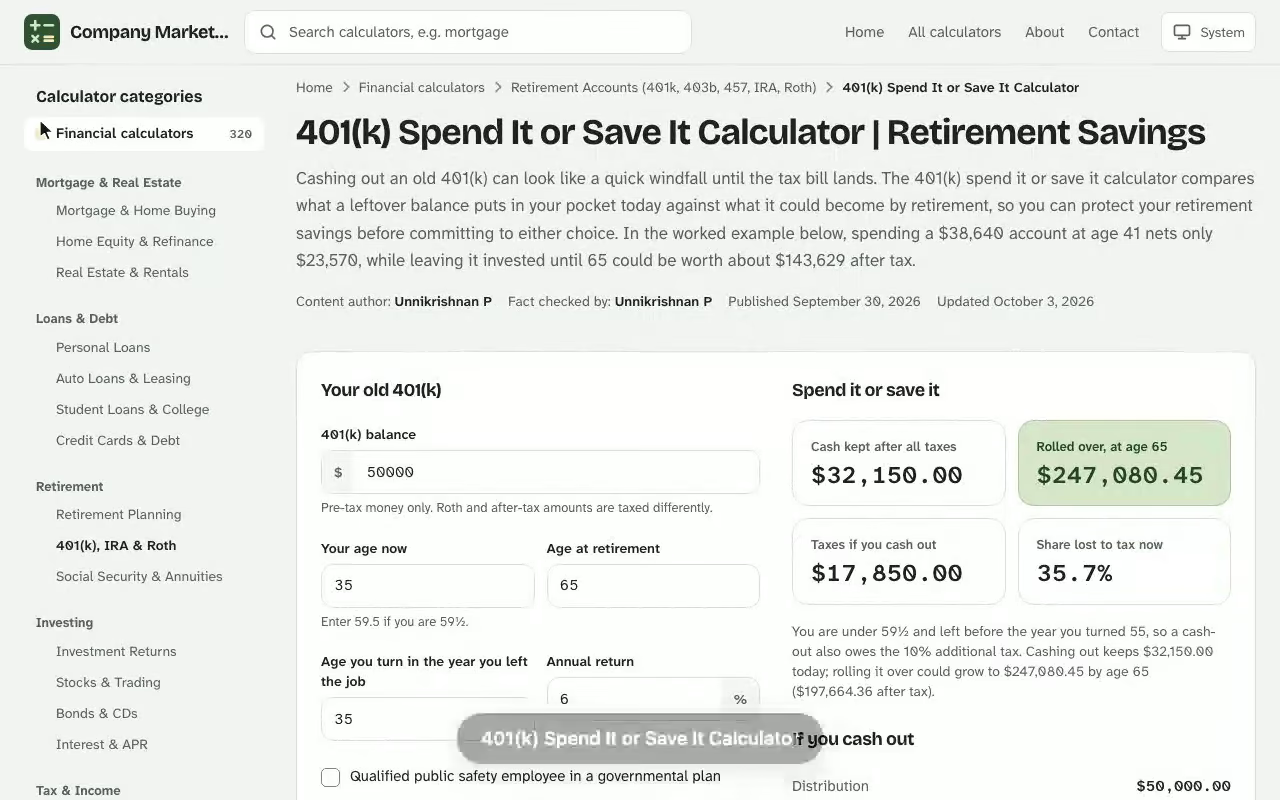
401(k) Spend It or Save It Calculator. Cashing out an old 401(k) can look like a quick windfall until the tax bill lands. The 401(k) spend it or save it calculator compares what a leftover balance puts in your pocket today against what it could become by retirement, so you can protect your retirement savings before committing to either choice. In the worked example below, spending a $38,640 account at age 41 nets only $23,570, while leaving it invested until 65 could be worth about $143,629 after tax. If you want to see how the figures change, the 401k calculator online gives you an instant result you can adjust as you go.
Spend it or save it
Cash kept after all taxes
–
Rolled over, at retirement
–
Taxes if you cash out
–
Share lost to tax now
–
If you cash out
Distribution–
Mandatory 20% federal withholding–
Check you receive–
Federal income tax–
10% additional tax–
State income tax–
Federal tax still owed at filing–
Compare your three choices
Choice
Tax now
Cash now
Value at retirement
After tax at retirement
A direct rollover moves the money straight to an IRA or a new employer's plan, so nothing is withheld or taxed. Leaving it in the old plan keeps the age 55 rule: money taken from that plan after you leave in or after the year you turn 55 (50 for qualified public safety employees) avoids the 10% additional tax. Once rolled into an IRA, withdrawals before 59½ generally face the 10% tax.
The 60-day indirect rollover trap
If the plan pays you instead of the new account, it must withhold 20%. You then have 60 days to deposit the full balance, including the withheld part from your own money, to avoid tax on it.
Check you receive–
Extra cash you must add within 60 days–
Tax if you deposit only the check–
Withholding credited back when you file–
Growth until retirement
Age
Rolled over to an IRA
Left in the plan
Results are estimates for educational purposes and are not financial, tax or legal advice.
How the 401(k) Spend It or Save It Calculator Works
When you leave an employer, the money in your old plan has to go somewhere. You can take it as cash, or you can keep it growing in an IRA or in your new employer's plan. This free 401(k) calculator puts both paths side by side. It subtracts every tax and penalty from the cash-out route, grows the invested route at your chosen rate, and shows the gap in dollars, so a decision that feels small today is measured against what your future self would hold. The 457 plan paycheck calculator uses the same plain-English approach, so you can compare results side by side.
Think of it as a focused 401(k) calculator for one question only: should this particular balance be spent now or saved for later? It does not replace a full financial review, but it answers the question that most people face once, at a job change, and often get wrong.
Starting Balance, Tax Bracket and Retirement Age
Every result rests on a handful of numbers you can find on your latest plan statement and your last tax return. Enter them as precisely as you can, because small changes compound over decades.
Starting balance: the vested amount in the old plan, not the amount you hope to see.
Tax bracket: your federal marginal rate for the year you would take the cash, plus any state rate.
Retirement age: the age you expect to stop working, which sets how many years the money can grow.
Yearly return: the average gain you assume on the invested money.
A fuller comparison can also use the total fees your plan charges, annual income growth if you will keep adding money, your monthly contributions and the yearly annual contribution they add up to, which cannot pass the IRS contribution limit. The employer match limit, the share of pay your company will match, belongs here too.
Reading the Result
The calculator reports two headline figures: the net cash you keep if you spend it, and the after-tax value of the same money at the age you retire. The ratio between them tells you how many dollars of future income you give up for every dollar you spend today. In most job-change situations under age 59½ that ratio is well above one, which is why the saved path usually wins. Next to those figures sits the balance at retirement, the number to compare with the savings needed for your lifestyle, and any shortfall shapes your overall retirement outlook. Treat every figure as an estimate, not a quote.
Cash Out or Roll Over: A Worked Retirement Savings Calculator Example
Here is a full run through a retirement savings calculator style comparison, using numbers chosen for this page. You are 41, you plan to retire at 65, and you have just left a job with a $38,640 balance. You sit in the 24% federal bracket and pay 5% state income tax. You assume the money earns 6.5% a year if it stays invested, and you expect an 18% tax rate on withdrawals in retirement. The 403b savings calculator is free to use with no sign-up, and works on desktop and mobile.
Spending the money means paying tax on the whole amount, plus a 10% additional tax because you are under 59½:
Here \(r\) is the yearly return, \(n\) is the number of years until you retire, and \(t_{\text{retirement}}\) is your expected tax rate in retirement.
Step
Spend it now
Save it until 65
Starting balance
$38,640.00
$38,640.00
Federal tax (24%)
-$9,273.60
Deferred
State tax (5%)
-$1,932.00
Deferred
10% penalty
-$3,864.00
None
Value after 24 years at 6.5%
Not applicable
$175,157
Tax in retirement (18%)
Not applicable
-$31,528
What you end up with
$23,570.40 today
$143,629 at 65
Spending the account costs $15,069.60, or 39% of the balance, before you buy anything. Saving it turns the same $38,640 into roughly six times the cash you would have received. Even if you invested the $23,570.40 you kept, it would reach only about $106,846 by 65, so the cash-out route trails by around $36,800 even in its best case.
How a $38,640 balance shrinks to $23,570.40 when you spend it.
Early Withdrawal Penalties and Mandatory Withholding
If a plan pays the money directly to you, it must withhold 20% for federal tax, which here is $7,728. That amount is only a down payment. Your actual federal bill and the early withdrawal charge are settled on your tax return, so a cash-out check can look larger than what you finally keep. The additional 10% tax belongs to the family of penalties that apply before age 59½, with a few narrow exceptions.
The original $38,640 and its growth at 6.5% a year until age 65.
Taxes and Penalties That Shrink a Cashed-Out Retirement Account
Most traditional 401(k)s are funded with pre-tax dollars, which is why every withdrawal counts as ordinary income. The distribution is added on top of your wages, so it can push part of your taxable income into a higher bracket than you normally reach. A $38,640 payout on top of a $92,000 salary, for example, is taxed at the top of your range, not at an average rate.
Three costs stack on one another when you spend an old balance:
Federal income tax at your marginal tax rate on the full distribution.
State income tax, where your state taxes retirement distributions.
The 10% early distribution charge if you are under 59½.
The lost earnings are a fourth cost, and the largest. Every dollar you remove stops working for the next 24 years, so the true price of spending $15,069.60 in taxes is not that sum but everything it would have produced.
Roth 401(k) and Roth IRA Differences
Roth 401(k)s follow different rules. They are funded with after-tax money, so qualified withdrawals are tax-free once the account is at least five years old and you are 59½ or older. If you are comparing a Roth balance, set the retirement tax rate to zero and treat the contribution portion separately from earnings. Pretax contributions defer the bill, while Roth money pays it up front. A Roth IRA works the same way, while a traditional IRA behaves like the pre-tax plan in the example above.
Retirement Planning Assumptions That Change Your Result
No calculator can predict markets, so good retirement planning means testing a range of assumptions instead of trusting one. The result above is sensitive mainly to two inputs: how many years the money has to grow and the yearly return you assume. The table below shows the after-tax value at 65 for a few combinations, using the same $38,640 balance and an 18% retirement tax rate.
Years until retirement
At 5.5%
At 6.5%
At 7.5%
10 years
$54,122
$59,477
$65,303
18 years
$83,061
$98,434
$116,467
24 years
$114,528
$143,629
$179,744
After-tax value at retirement by years invested and assumed return; the worked example is outlined.
Estimated Rate of Return and Inflation
Most people enter an estimated rate of return between 5% and 8% for a diversified account, and the right figure depends on how much sits in stocks versus bonds or mutual funds. Your investment style, conservative or growth-focused, drives that choice. Remember that investment returns are not guaranteed. Inflation pulls the other way, because a dollar in 24 years buys less than a dollar today. At an expected inflation rate of 2.5%, the $143,629 in the example has the purchasing power of roughly $79,000 in today's money. Even a modest rate of inflation matters, yet that figure remains far above the $23,570 you would hold now, and the rising cost of living hits both choices equally.
Social Security and Retirement Spending
The saved balance is not meant to fund your whole retirement, but it is the piece the spend-or-save choice controls. It sits beside Social Security and any pension, and together they should cover your planned retirement spending and set your retirement income. Add up your expected monthly spending, subtract guaranteed income, and see how much your projected savings must supply. In the example, keeping the $143,629 invested could supply an extra $5,700 or so a year at a 4% withdrawal pace, which is exactly what cashing out gives up, and it counts toward your total savings alongside everything else you own.
Weighing a $64,310.55 Old Plan: Spending Versus Retirement Savings
A 52-year-old quality-assurance tester has just left a logistics company and gets a roof quote of $44,000. The old plan holds $64,310.55, and cashing out looks like a clean way to pay for it. Before requesting the check, they open the calculator and run the spend-or-save comparison.
They enter the balance, a 22% federal bracket, 4.25% state tax, a 10% early distribution charge, a retirement age of 67 and a 6% yearly return. They expect a 15% tax rate on withdrawals later. The calculator returns two figures side by side:
Spend it: $14,148.32 federal tax, $2,733.20 state tax and $6,431.06 in penalties leave $40,997.98, a 36.25% loss.
Save it: $64,310.55 grows to $154,124 over 15 years, or $131,005 after the 15% retirement tax.
The first number settles it before any investing question comes up: $40,997.98 does not even cover the $44,000 quote, and a plan administrator would also withhold 20%, or $12,862.11, at payout. The saved path is 3.2 times larger than the cash route.
See how the 401(k) Spend It or Save It Calculator works: change the inputs and the rolled over, at age 51 updates instantly. Enter your own numbers in the calculator above.
Then they test the one rule that could change the answer. The IRS age-55 separation exception waives the 10% charge for people who leave an employer in or after the year they turn 55, and at 52 it does not apply yet. Changing the age input to 55 would remove the $6,431.06, but it would not remove the taxes. The next steps are concrete: request a direct rollover into an IRA, which withholds nothing, and ask the roofer for a payment schedule instead.
Retirement Plan Options After You Leave Your Employer
You usually have four choices when you separate from a company, and the calculator only prices the first two directly:
Cash it out and accept the taxes and penalties shown above.
Roll it over to an IRA, where you control the investment options and often pay lower fees.
Move it into your new employer's retirement plan, if the plan accepts transfers.
Leave it in the old plan, which is allowed for most balances above a small minimum.
A direct rollover sends the money from one custodian to the next without it touching your hands, so no tax is withheld and no penalty applies. That is the cleanest way to keep the entire balance working.
Employer Match and Vesting Period
Before you run any numbers, confirm how much of the account is actually yours. The employer match you earned may be subject to a vesting period, which means a share of it can disappear if you leave too soon. Your own contributions are always yours. Use only the vested amount as your starting balance, or the calculator will overstate both paths.
When Spending Part of It Can Make Sense
There are real emergencies where cash is the only tool, such as avoiding foreclosure or covering urgent medical bills. In that case, run the calculator again with only the amount you need to withdraw, and compare the tax and penalty cost it shows against alternatives like a low-interest loan, a hardship exception or tapping a savings account first. Taking the smallest amount that solves the problem keeps most of the nest egg intact and shows, in dollars, how much of the saved path you keep.
Investing a Rolled-Over Retirement Fund: Goals and Length
Choosing to save is only half of the result. The saved figure assumes investing the rolled-over money in investments that can earn the return you entered, so they have to match your investment goal, such as retiring at 65 with enough income to cover your budget. Your investment length is the years input in the calculator. Twenty-four years lets a growth-oriented portfolio of low-cost funds ride out downturns, while a five-year window calls for far less risk.
Long-Term Investment and Tax-Advantaged Growth
A long-term investment inside a retirement account enjoys tax-advantaged growth, because gains are not taxed each year. That is the main reason the saved path in the example outruns the spent one. Over decades it builds long-term wealth that no single cash-out can match, and a steady savings rate in your next job multiplies the effect.
Healthcare Costs and Long-Term Care
A larger saved balance matters most for expenses you cannot predict. Rising healthcare costs, possible long-term care and the years before Medicare starts at 65 can take a large share of your benefits and savings, which is why the gap between $23,570 and $143,629 in the example is also a gap in financial security. Build those costs into your financial plan so the money you chose to save lasts through your golden years.
Limits of a Retirement Calculator and Smart Next Steps
Like any retirement calculator, this tool shows a hypothetical outcome based on the numbers you give it, and it is not a promise. It is also different from a retirement distribution calculator, which models how long money lasts while you spend it down. Here the goal is simpler: measure the cost of spending versus saving at one moment. For broader projections, an investment calculator can model ongoing deposits and regular investing, and a financial advisor can help you build a complete plan around your risk tolerance and retirement goals.
A few habits make the result more useful. Run several scenarios by changing one input at a time, such as the rate or the retirement age. Reuse the same annual income and tax assumptions each time so the comparisons are fair. Write down the figure you get for the saved path, then ask what you would need to replace it with if you spent the balance today. For most people, the honest answer is that nothing else on the table comes close.
401(k) Spend It or Save It Calculator questions
Should I cash out my 401(k) when I leave a job?
In most cases no. Cashing out adds the whole balance to your taxable income and, if you are under 59½, triggers a 10% additional tax. The calculator shows the dollar cost next to what the same money could grow into.
How much tax will I pay if I cash out my 401(k)?
The distribution is taxed as ordinary income at your marginal federal rate, plus any state income tax, and the plan must withhold 20% for federal tax at payout. The withholding is only a down payment, so your final bill can be higher or lower.
What is the early withdrawal penalty?
A 10% additional tax applies to most distributions taken before age 59½. A few exceptions exist, such as separating from service in or after the year you turn 55, so check your situation with a tax professional.
What is the difference between a rollover and a cash-out?
A direct rollover moves the money to an IRA or a new employer plan without it touching your hands, so no tax is withheld and no penalty applies. A cash-out pays you the money and makes it taxable.
Does the calculator work for a Roth 401(k)?
Yes. Roth withdrawals that are qualified are tax-free, so set the tax rate on withdrawals in retirement to 0 and treat the earnings and contributions portions separately if the account is not yet qualified.
What rate of return should I use?
Many people use 5% to 8% for a diversified account. Returns are not guaranteed, so try a few rates and compare the results rather than relying on one number.
Is the result guaranteed?
No. The result is a hypothetical estimate based on the numbers you enter. Actual taxes, fees and investment returns will differ.