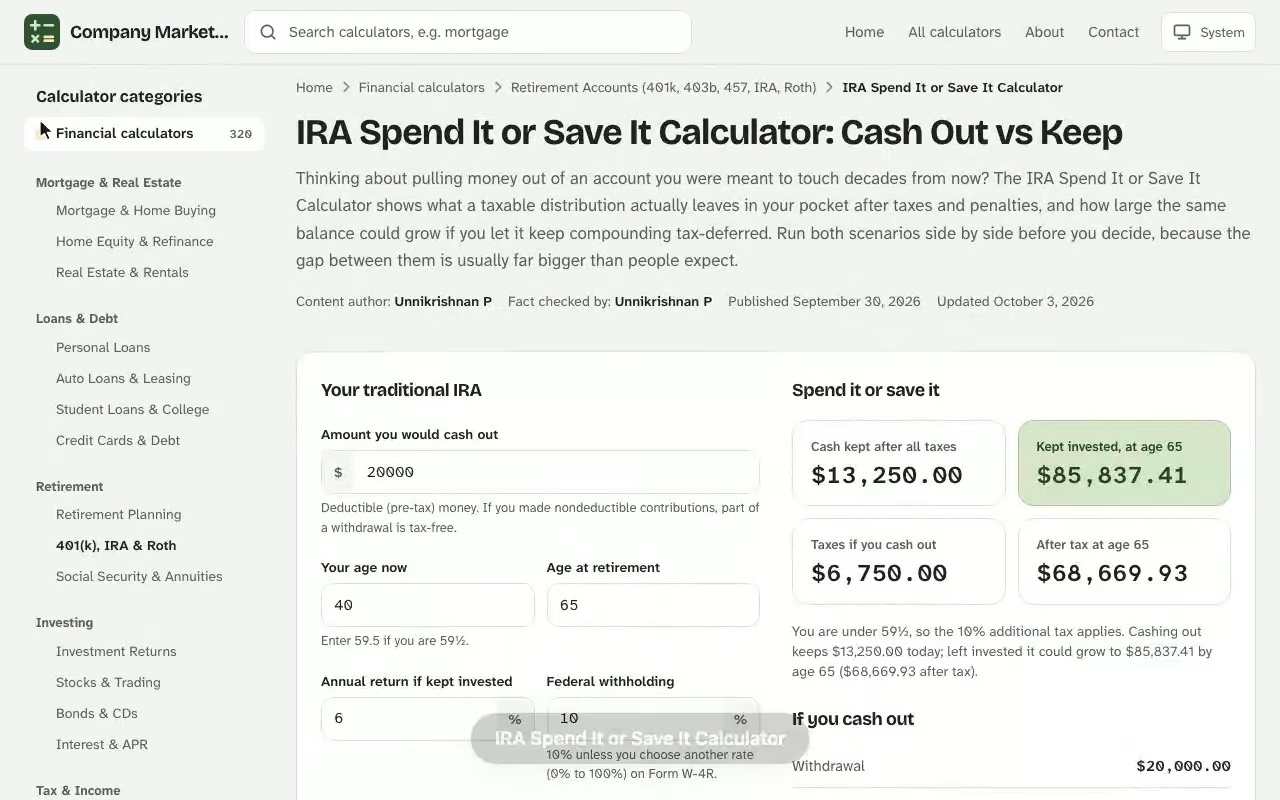
IRA Spend It or Save It Calculator. Thinking about pulling money out of an account you were meant to touch decades from now? The IRA Spend It or Save It Calculator shows what a taxable distribution actually leaves in your pocket after taxes and penalties, and how large the same balance could grow if you let it keep compounding tax-deferred. Run both scenarios side by side before you decide, because the gap between them is usually far bigger than people expect. The free roth ira calculator is free to use with no sign-up, and works on desktop and mobile.
Spend it or save it
Cash kept after all taxes
–
Kept invested, at retirement
–
Taxes if you cash out
–
After tax at retirement
–
If you cash out
Withdrawal–
Federal tax withheld–
Amount you receive–
Federal income tax–
10% additional tax–
State income tax–
Federal tax still owed at filing–
If you keep it invested
The IRA balance each year until retirement, and what it would be worth after tax if withdrawn then.
Age
IRA balance
After tax if withdrawn
Other exceptions to the 10% additional tax include payments to a beneficiary after the owner's death, a series of substantially equal periodic payments (72(t)), qualified disaster recovery distributions and distributions to domestic abuse victims. The 10% tax applies only to the taxable part of a withdrawal.
Results are estimates for educational purposes and are not financial, tax or legal advice.
How the IRA Spend It or Save It Calculator Compares Cashing Out and Keeping Your Money Invested
The tool runs a rough comparison of two paths for the same dollars. Path one is the cash out: you take the full amount as a distribution, pay federal and state tax on it, and, if you are under 59½, pay a 10% early-withdrawal penalty on top. Path two is the rollover: the money stays inside a rollover IRA or your existing account, earns a steady return, and is only taxed when you eventually take withdrawals. The roth ira conversion with distributions calculator uses the same plain-English approach, so you can compare results side by side.
The calculator then reports the net cash you would receive today against the after-tax ending balance you could have at your target age. The difference between the two numbers is the true price of spending the money early, made up of the taxes and penalties you pay now plus the lost earnings the money never produces.
The two formulas behind the result
Spending the money means paying everything up front. With a balance of \(B\), a federal rate of \(f\), a state rate of \(s\) and a penalty rate of \(p\):
$$\text{Net cash today} = B \times (1 - f - s - p)$$
Saving the money means it compounds for \(n\) years at a rate of return \(r\), and the income tax rate is applied only once, at the end:
$$\text{After-tax ending balance} = B \times (1 + r)^{n} \times (1 - f - s)$$
Notice what is missing from the second formula: the penalty. Money that stays in the account is never an early withdrawal, so the 10% charge never applies.
Inputs for the Spend It or Save It Decision
Every field in the calculator maps to a term in those formulas. Gather these figures first, using statements from your retirement plan provider where you can. The roth 403b vs traditional 403b calculator uses the same plain-English approach, so you can compare results side by side.
Current IRA balance
This is the initial investment that is either cashed out or left alone. Use the full balance of the traditional IRA you are considering, not just the part you hope to spend, because the calculator compares a full distribution with continued growth. If you only plan a partial withdrawal, enter that amount as the balance instead.
Current age and age at retirement
Your current age and your age at retirement set the time horizon, the number of years the money would compound. A 41-year-old planning to stop work at 65 has 24 years of growth at stake, which is why early spending hurts so much more for younger savers than for someone five years from the finish line. Your retirement age also matters for the penalty, since withdrawals after 59½ avoid the 10% charge.
Federal income tax rate and state income tax rate
Enter your federal income tax rate as the marginal rate of the tax bracket the distribution would land in, and your state income tax rate separately. Remember that a large distribution is stacked on top of your normal wages, so it can push part of the money into a higher bracket. Because traditional IRAs hold pre-tax dollars, every dollar withdrawn is taxed as ordinary income.
Annual rate of return
The annual rate of return is a hypothetical figure, not a promise. A diversified portfolio that follows broad stock indexes such as the S&P 500 will swing in value from year to year, and that volatility is the price of higher growth. Savings accounts pay less but carry far less risk of losing principal, and the more investment risk you take, the wider the range of outcomes. Use a conservative compounded rate of return for planning, test several values, and weigh your tolerance for risk against the time you have left.
Worked Example: Cash Out vs Rollover IRA
Suppose you are 41 and hold an IRA balance of $64,300. You expect to retire at 65, assume a 7% annual return, and face a 24% federal rate and a 5% state rate. Here is what each choice produces:
Item
Spend it (cash out)
Save it (rollover IRA)
Starting balance
$64,300
$64,300
Federal tax (24%)
-$15,432
Deferred
State tax (5%)
-$3,215
Deferred
Early-withdrawal penalty (10%)
-$6,430
None
Balance at age 65, before tax
Spent
$326,153
Taxes owed at age 65 (29%)
Already paid
-$94,584
Net amount
$39,223 today
$231,569 at age 65
Cashing out turns $64,300 into $39,223, because $25,077 vanishes to taxes and penalties immediately. Keeping the account invested lets the same dollars grow to $326,153, which leaves $231,569 after-tax. Saving ends up roughly 5.9 times larger, even after the tax bill that arrives at the end.
Cashing out the example IRA leaves $39,223 after $25,077 of taxes and penalties.
Reading the ending balance
The $231,569 ending balance from the save-it path is expressed in future dollars, so your real purchasing power will be lower once inflation works on it. That shrinks the gap between cashing out and keeping the money invested in today's terms, but it does not close it, so treat the figure as a planning estimate rather than a forecast.
Retirement Calculator Assumptions That Change the Spend vs Save Result
Like any retirement calculator, this cash-out versus keep-invested comparison is only as good as its assumptions. Three of them move the result the most, and the table below shows how the worked example changes when you vary the rate of return and the years until retirement.
Annual return
14 years
24 years
34 years
5%
$90,390
$147,235
$239,831
7%
$117,718
$231,569
$455,531
9%
$152,560
$361,165
$855,008
Every cell is the after-tax amount from the $64,300 starting balance. Even the weakest case in the grid, 5% for 14 years, beats the $39,223 you keep by cashing out.
Inflation rate and purchasing power
A higher inflation rate shrinks what the after-tax balance from the saving path can buy. Long-run inflation of 2% to 4% is a common planning range, and over 24 years it can cut the real value of a lump sum by roughly half. When judging whether to keep the money invested, compare the return you entered against it rather than looking at the nominal number alone, since savings that merely keep pace with prices have not truly grown.
Tax rates in retirement
The calculator assumes the same tax rate today and at the end. In practice your income in retirement may be lower, which would favor saving even more, or tax law may change. If you expect a different bracket later, rerun the numbers with that marginal tax rate for the rollover path.
Compound interest and time
Compound interest is the engine behind the saving path: the rollover balance compounds on the full pre-tax amount, while cashing out stops that compounding on the $25,077 lost to taxes and penalties. A longer horizon is what widens the gap between the two results. The last six years of the example add more than $108,000, more than the first twelve years combined, which is why leaving the account untouched early matters most.
Left invested for 24 years, the same balance grows to $326,153 before tax.
Checking a Cash Out Against a Rollover IRA for a $20,000 Roof Repair
A homeowner, 52, gets a roofing quote of $20,000 and notices a traditional IRA statement showing $87,420. Cashing it out looks tempting, so the numbers go into the calculator first: current age 52, age at retirement 65, annual rate of return 6%, federal income tax rate 22%, state income tax rate 4.75%.
See how the IRA Spend It or Save It Calculator works: change the inputs and the kept invested, at age 51 updates instantly. Enter your own numbers in the calculator above.
The result for spending it: $55,293 in hand, since the 22% federal tax, 4.75% state tax and the 10% early-withdrawal penalty together take $32,127. That covers the roof with $35,293 to spare, which is exactly why it feels harmless. The saving side tells a different story: 13 years at 6% grows the balance to $186,461, and after the 26.75% combined tax at 65 it is worth $136,582, about 2.5 times the cash-out figure.
The homeowner then reruns the tool with a 4% return to see whether a weak market changes the verdict. The after-tax ending balance drops to $106,623, still nearly double the cash. Because the full distribution would also push a large lump sum beyond the 22% bracket into the 24% one, the net cash is probably even lower than shown.
The decision: the spend-it figure of $55,293 costs roughly $81,000 of after-tax retirement value, so the homeowner looks for other funding first. If an IRA withdrawal is still needed, the next run uses only the amount the roof requires, so the rest of the balance keeps compounding.
Early Withdrawal Penalties and Tax-Deferred Growth
An early withdrawal from a traditional IRA before age 59½ is generally subject to a 10% additional tax on top of ordinary income tax, and the calculator applies that penalty to the cash-out path only when your current age is below 59½. Exceptions exist for certain situations, such as some medical costs, a first-home purchase up to a limit, and disability, so a financial professional can tell you whether one applies to you.
Tax-deferred growth is the other half of the story. Inside the account, earnings are not taxed each year, so the full amount keeps working. Cashing out hands that advantage back and also gives up future contributions room you may not be able to rebuild, because annual limits cap what you can put back.
Withdrawals after 59½
If your current age is 59½ or older, the penalty term drops out of the spend-it result: taking withdrawals then removes the 10% charge, though the money is still taxed as ordinary income. Required minimum distribution rules also eventually force money out of traditional accounts, so deferral is a delay, not an escape.
Rollover options when you change jobs
When you leave an employer-sponsored plan such as a workplace plan like 401(k)s, you can move the balance into a rollover IRA with no tax or penalty, provided it goes directly to the new account. A direct rollover is the tax-free way to keep investment capital invested, which is exactly the save-it path the calculator models. Ask your financial advisor about direct trustee-to-trustee transfers so no check is made out to you.
Alternatives to Spending Your IRA
If you need cash, cashing out is rarely the cheapest route. Consider these options first:
Roth IRA contributions: the amounts you contributed to a Roth IRA can usually be withdrawn tax-free and penalty-free, because they were funded with after-tax money.
Emergency savings: a dedicated savings reserve avoids touching long-term accounts at all, which protects your retirement savings and keeps your other savings intact.
Delaying Social Security: postponing benefits raises your monthly check, so you draw less retirement income from the IRA and avoid a large lump-sum withdrawal.
Part-time work: earning extra income for a few years can bridge a gap without a large taxable distribution.
A loan from another source: borrowing may cost less than the combined penalties and lost growth, though the debt must be repaid.
Comparing against other investment returns
If you are weighing whether to use the money for another goal, any alternative must earn more than the after-tax saving figure this calculator shows to beat keeping the IRA invested. An investment returns calculator can test that alternative, and a retirement savings calculator can check whether your retirement goals still hold if the IRA is smaller.
How to Use the Results in Your Retirement Planning
Enter your balance, current age, retirement age, tax rates and expected return.
Click the calculate button and read the net cash from spending against the after-tax result from saving.
Change one input at a time, such as the return or the age, to see how sensitive the gap is.
Decide whether any retirement planning gap justifies the cost, then talk to a licensed professional before you act.
Because the tool is a rough comparison, it ignores your changing tax bracket, fees and the chance of poor market years. Treat it as a starting point for retirement planning, not a guarantee, and revisit it whenever your balance or after-tax assumptions change.
IRA Spend It or Save It Calculator questions
What does the IRA Spend It or Save It Calculator tell me?
It compares the cash you would keep today after taxes and any early-withdrawal penalty with the after-tax balance your IRA could reach at retirement if you leave it invested.
Is there a penalty for cashing out an IRA early?
Withdrawals from a traditional IRA before age 59½ are generally subject to a 10% additional tax on top of ordinary income tax, with a few exceptions. The calculator applies it when your current age is under 59½.
Which tax rates should I enter?
Use the marginal federal and state rates that the distribution would be taxed at. A large lump sum can push part of the money into a higher bracket, so consider testing a higher rate.
What rate of return should I use?
Use a conservative, hypothetical figure and try several. Returns are not guaranteed, and higher-return investments carry more risk and volatility.
Does the calculator account for inflation?
No. Results are in future dollars, so your purchasing power at retirement will be lower. Inflation affects both choices, so the comparison still holds.
How can I avoid taxes when moving my retirement money?
A direct rollover from an employer plan into a rollover IRA is generally tax-free and penalty-free when the funds go straight to the new account.
Can I take out only part of my IRA?
Yes. Enter just the amount you plan to withdraw as the balance to see the cost of a partial distribution.