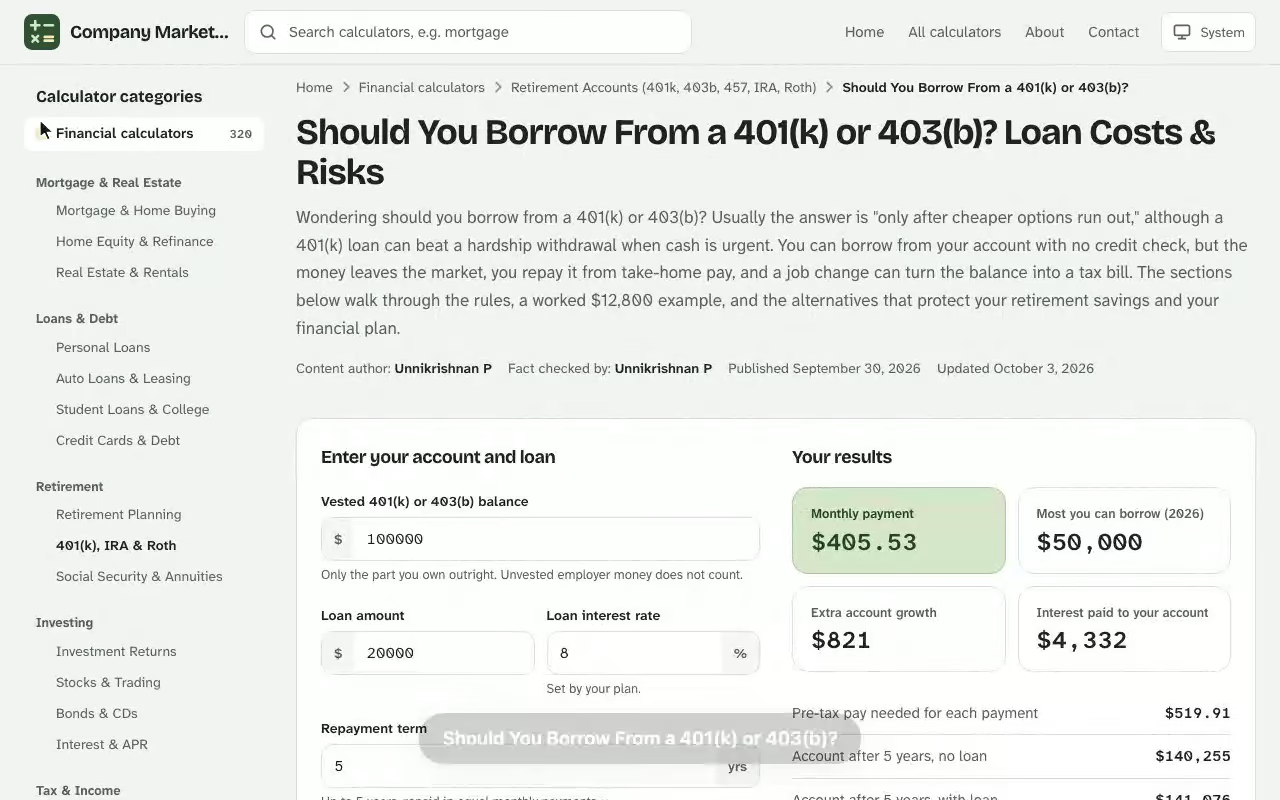
Should You Borrow From a 401(k) or 403(b)? Wondering should you borrow from a 401(k) or 403(b)? Usually the answer is "only after cheaper options run out," although a 401(k) loan can beat a hardship withdrawal when cash is urgent. You can borrow from your account with no credit check, but the money leaves the market, you repay it from take-home pay, and a job change can turn the balance into a tax bill. The sections below walk through the rules, a worked $12,800 example, and the alternatives that protect your retirement savings and your financial plan. Pair this with the 401k calculator online for a fuller picture before you make a decision.
Your results
Monthly payment
–
Most you can borrow (2026)
–
Lost investment growth
–
Interest paid to your account
–
Pre-tax pay needed for each payment–
Account after 5 years, no loan–
Account after 5 years, with loan–
Compared with another loan
Other loan monthly payment–
Cost of the 401(k) loan, after tax–
Cost of the other loan (interest)–
Year-by-year loan and account balance
The loan balance you still owe, and your account with and without the loan, at the end of each year.
Year
Loan balance
Account with loan
Account without loan
Difference
If you leave your job, many plans want the loan repaid quickly. Any amount you do not repay is treated as a withdrawal: it is taxed as income and, before age 59½, may also face a 10% additional tax.
Results are estimates for educational purposes and are not financial, tax or legal advice.
Should You Borrow From a 401(k) or 403(b)? The Short Answer
Borrowing makes sense when three things line up: the expense is genuinely necessary, you have a stable employer and a repayment plan you can actually meet, and no cheaper source of cash exists. If any of those fail, taking a loan from your retirement plan usually costs more than it appears to. The loan itself is not the villain. The costs hide in the details: repayment with after-tax dollars, a pause in regular contributions, and a short deadline if you leave your job.
Good reasons to consider a loan: paying off high-interest debt, a home improvement that raises your property's value, or bridging a short, one-time gap.
Poor reasons: a vacation, a gift, or any expense you could cover with emergency savings or a smaller budget cut.
Deal-breakers: an unstable job, no repayment plan, or a plan that stops contributions while the loan is open.
The right call also depends on your financial goals, your risk tolerance and how close you are to retirement age. A 35-year-old has decades of compounding to lose; someone five years from retirement has less time to recover, yet also less time for the borrowed money to have grown.
How a 401(k) Loan and a 403(b) Loan Work
A 403(b) loan follows nearly the same rules as a 401(k) loan. Both let you borrow money from your own vested savings and pay it back to yourself, with interest, through payroll deductions. Neither is required by law, so whether you can borrow from retirement at all depends on what your employer's plan document allows. The free individual 401k savings calculator is free to use with no sign-up, and works on desktop and mobile.
Loan limits and your vested balance
The IRS caps a plan loan at the lesser of 50% of your vested balance or $50,000. If half of your vested amount is under $10,000, many plans let you borrow up to $10,000 anyway. Only the part of the account you own outright counts, so unvested employer money is excluded. With an $84,500 vested balance, the ceiling is $42,250 (half of $84,500), well under the $50,000 cap.
A plan loan does not count toward annual contribution limits, because you are moving your own money rather than adding new money.
Repayment terms and the five-year rule
Most loans must be repaid within five years, with loan payments made at least quarterly; in practice, payroll deductions make them every pay period. A loan used to buy a primary residence can often run longer. Your plan sets the interest rate, commonly the prime rate plus one or two points, and the interest goes back into your own account rather than to a bank. To repay the loan on schedule, build the payment into your monthly budget before you sign.
Longer terms lower the monthly payment far more than a small change in the interest rate does.
Whether your plan allows it
Many 403(b) plans are run by nonprofit organizations, including hospitals, schools, churches and other tax-exempt organizations, and some of them do not offer loans. Ask your plan administrator for the loan terms: how many loans you can hold at once, the minimum amount, the fees, and whether you need consent from your spouse. Unlike a bank, the plan does not run a credit check, and a loan does not appear on your credit report, but that is only half the story.
Loans and Withdrawals Compared
When you need cash, your retirement account offers two routes. A loan is borrowed and repaid. A hardship withdrawal is taking money out for good, with no obligation to put it back. The difference in cost is large, as the table shows for a $12,800 need.
Feature
401(k) or 403(b) loan
Hardship withdrawal
Amount needed in hand
$12,800
$12,800
Amount taken from the account
$12,800
$20,645
Taxes and penalty at the time
$0
$7,845
Account balance afterward ($84,500 start)
$71,700 plus a $12,800 note you owe yourself
$63,855
Repayment
48 monthly payments of $314
None
Credit score impact
None while you repay
None
See how the Should You Borrow From a 401(k) or 403(b)? works: change the inputs and the monthly payment updates instantly. Enter your own numbers in the calculator above.
How a hardship withdrawal is taxed
The IRS allows a withdrawal for an immediate and heavy financial hardship: medical expenses, preventing foreclosure or eviction, tuition, funeral expenses, repairs to a primary home, and certain disaster losses. A hardship withdrawal is not a loan, and it counts as ordinary income. That means income tax on top of a 10% early withdrawal penalty if you are under 59½. Because you must receive a set amount after federal tax withholding, state tax and the 10% penalty, you have to withdraw more than you need:
With a 24% federal bracket, 4% state tax and the 10% penalty, the combined rate is 38%, so $12,800 \(\div\) 0.62 = $20,645. Of that, $4,955 goes to federal tax, $826 to state tax and $2,065 to the early distribution penalty.
Taxes and the penalty turn a $20,645 withdrawal into $12,800 of usable cash, while a loan of $12,800 delivers the full amount.
Worked example: borrowing $12,800 over four years
Suppose you owe $12,800 for a roof repair. With an 8.25% loan rate and 48 monthly payments, the payment formula gives:
You repay $15,072 in total, so the interest is $2,272. In year one, $2,817 of your payments reduce the loan balance and $951 is interest; by year four, only $163 is interest. The interest returns to your own account, which is why the loan looks almost free. The next section explains why it is not.
Interest falls from $951 in year one to $163 in year four as the loan balance shrinks.
The Real Cost of a 401(k) Loan
The interest you pay yourself is rarely the problem. The true cost of a 401(k) loan comes from three places, and none of them show up on the loan statement.
Double taxation on loan interest
Money inside a tax-advantaged account is shielded for a reason. Your contributions went in as pre-tax dollars, but you make loan payments from take-home pay, which is after-tax dollars. When you retire, every dollar withdrawn from a tax-deferred account is taxed again as taxable income. This is the double taxation critics describe. On $2,272 of interest at a 24% tax bracket, that second round of taxes is about $545 you would not owe if the money had stayed invested in the account untouched.
Lost growth potential and missed employer match
While the loan is outstanding, the borrowed $12,800 sits outside the market. Your growth potential shrinks whenever the account's investment returns beat the loan rate, and the lost investment gains compound too. If the markets earned 7% a year, the $12,800 would have grown to roughly $16,778 over four years, which is more than the $15,072 you repay in total, so the potential growth gap can exceed the interest you pay yourself.
The bigger risk is the fine print. Some plans stop new contributions until the loan is cleared. If your employer match is 3% of a $72,000 salary, that is $2,160 a year, so a four-year pause forfeits $8,640 of missed employer-matching contributions, or about $10,138 once 6.5% growth is added. Even if your plan lets you keep contributing, juggling the repayment plan with your regular saving can squeeze your retirement savings in practice. Employer contributions are free money, so protect them first.
Smaller fees add up too: many plans charge a loan origination fee and an annual maintenance charge, which weigh more on a small financial cushion.
Weighing a 403(b) Loan Against a Personal Loan for a Furnace
Priya, a school librarian, needs $9,430 to replace a failed furnace before January. Her 403(b) shows a vested balance of $61,340, so the 50% rule puts her ceiling at $30,670, comfortably above what she needs. A credit union has quoted her 13.9% on a 36-month personal loan, while her plan administrator confirms a loan rate of 8.75%.
She enters both offers into the borrow-or-not calculator: $9,430 borrowed, 36 months, a 22% tax bracket and a 6% assumed return. The result lands in seconds:
Plan loan at 8.75%: $298.78 a month, $1,325.92 of total interest.
Credit union loan at 13.9%: $321.84 a month, $2,156.14 of total interest.
The plan loan saves $830.22 in interest, but she does not stop there. The interest repaid to her own account comes from after-tax pay, so the calculator's double-taxation line shows about $291.70 that her 22% bracket will claim again at withdrawal. That trims the saving to roughly $538, still in the plan's favor.
The deciding detail is the fine print. Her plan keeps accepting deferrals during a loan, and the district's 4% match on a $58,000 salary, $2,320 a year, stays intact. Had contributions been blocked, she would have forfeited $6,960 of match over the three years, far more than the savings, and the credit union loan would have won.
Because she works a 10-month contract, her last step is a stress test: she reruns the calculator with a job exit after month 12. The outstanding balance of about $6,556 would be taxed as a distribution if unpaid within the plan's 90 days, so she signs the loan and sets aside the first $2,000 of her summer pay as a repayment buffer.
Risks of Borrowing From Your 403(b) If Your Job Changes
The single biggest danger of borrowing from your 403(b) or 401(k) is a sudden exit from the employer. Plans usually accelerate the repayment when you leave your job, whether you quit, are laid off or leave or lose your job for any other reason.
Job loss and the repayment deadline
Many plans give you about 90 days after separation to pay the outstanding balance. Fail to do so and the unpaid loan balance becomes a taxable distribution, and under age 59½ it also triggers the 10% penalty. In the worked example, if job loss hits after 24 payments, $6,925 is still owed; at 38%, the tax and penalty bill is about $2,632. Because this is a default on paper only, it does not hurt your credit score, since plan loans never go to the credit bureaus. It still erodes your nest egg and your financial security.
Read the fine print before you sign
Can you keep making catch-up contributions or regular deferrals during the loan?
What happens to the remaining balance if you retire or move on?
Is there a limit on how many loans you can hold, and what are the origination fees?
Does the distribution rule treat an unpaid loan as a deemed taxable event on a fixed date?
How 401(k) and 403(b) Plans Differ for Borrowers
Both plan types are tax-advantaged, yet the details around borrowing differ a little. This quick comparison shows where.
Feature
401(k)
403(b)
Sponsoring employer
For-profit companies
Nonprofit and school employers
Typical investment options
Wide range of funds
Often annuities and mutual funds
Employer contributions
Match is common
Less common
Loan available
Plan decides
Plan decides
Repayment term
5 years standard
5 years standard
Alternatives to Taking Money From Your Retirement Account
Because borrowing from a plan has trade-offs, experts treat it as a last resort. Compare it with these first.
Alternatives worth trying first
Emergency savings or other non-retirement savings in checking, savings and brokerage accounts.
An HSA for any qualified medical cost.
A Roth IRA: you can withdraw contributions, though not earnings, at any time without tax or penalty.
A balance transfer on credit cards to a lower or zero interest offer.
A personal loan or a home equity line of credit if you have equity and stable income.
Debt consolidation or credit counseling to reduce what you owe without touching retirement.
Weigh each against the plan loan on cost, speed and risk. A plan loan is fast and has no credit check, but a personal loan keeps your investments working, and nothing resets if you change jobs.
When a Retirement Loan Might Make Sense
A plan loan can be reasonable when it replaces something worse. Using it to clear high-interest debt on credit cards, for instance, can cut your total interest as long as you stop adding new debt. A home improvement that lifts your property's value can also offset the cost of repaying with after-tax money.
Before you decide, run four checks: your job is secure, your employer keeps matching, a fixed monthly payment fits your budget even on a fixed income, and the extra tax on repaid interest is smaller than what other investing or borrowing choices would cost. If any check fails, a plan loan is the wrong choice and one of the alternatives above is safer.
Should You Borrow From a 401(k) or 403(b)? questions
Can I borrow from both a 401(k) and a 403(b)?
Only if your employer offers a loan feature in each plan, and each plan sets its own rules. Many plans limit how many loans you can hold at once, so check the loan terms with your plan administrator.
How much can I borrow from a 401(k) or 403(b)?
The IRS limit is the lesser of 50% of your vested balance or $50,000. If half of your vested balance is under $10,000, many plans still let you borrow up to $10,000. Your plan may set tighter limits.
How long do I have to repay a plan loan?
Most loans must be repaid within five years through payments at least quarterly, usually via payroll deduction. A loan used to buy a primary residence can often run longer.
What happens to the loan if I leave my job?
Many plans require the outstanding balance to be repaid within a short window, often around 90 days. Anything unpaid is treated as a taxable distribution, and under 59½ a 10% early distribution penalty can apply.
Does a 401(k) or 403(b) loan affect my credit score?
Plan loans involve no credit check and are not reported to the credit bureaus, so they do not appear on your credit report. A default still creates a tax bill.
Why is borrowing from retirement called double taxation?
Your contributions went in pre-tax, but you repay the loan and its interest with after-tax dollars, and withdrawals in retirement are taxed again as income.
Is a hardship withdrawal better than a loan?
Usually not. A withdrawal permanently removes money, adds income tax and often a 10% penalty, and forces you to take out more than you need. A loan avoids those costs up front but carries repayment and job-change risk.