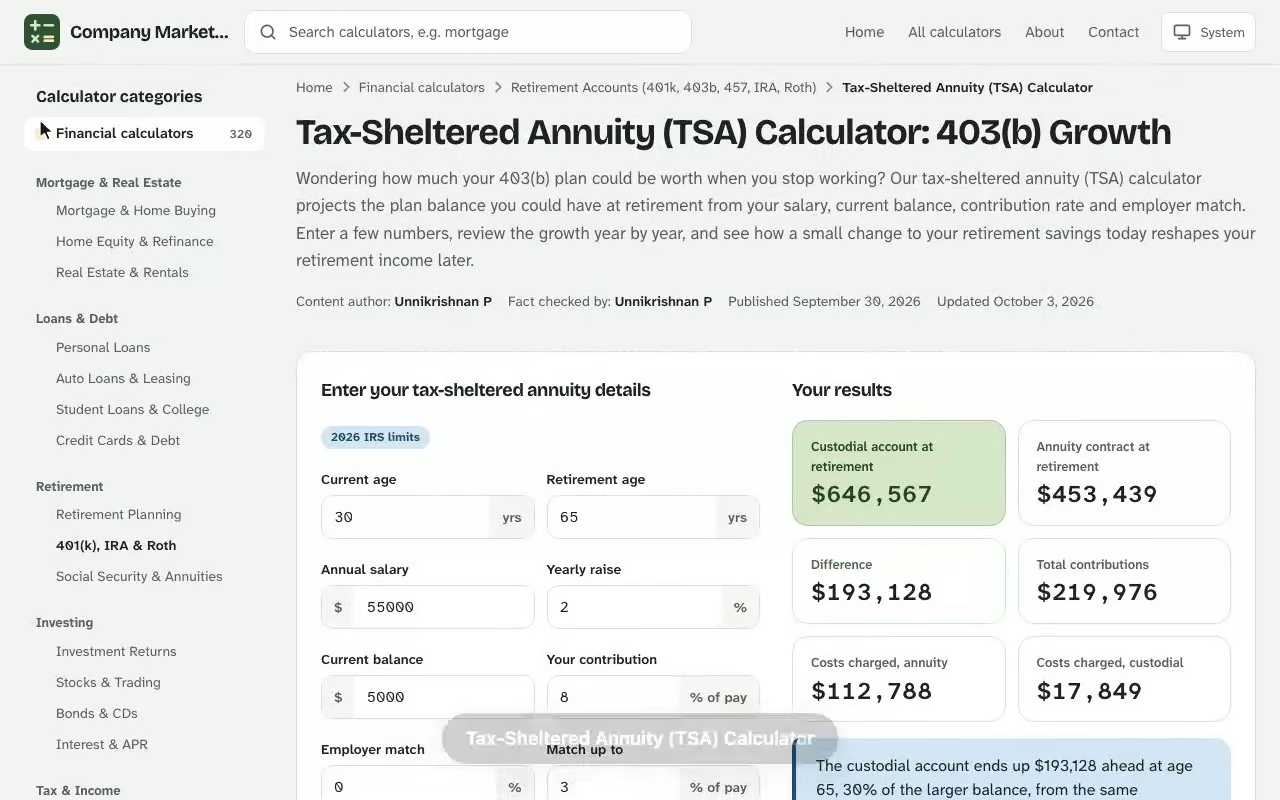
Tax-Sheltered Annuity (TSA) Calculator. Wondering how much your 403(b) plan could be worth when you stop working? Our tax-sheltered annuity (TSA) calculator projects the plan balance you could have at retirement from your salary, current balance, contribution rate and employer match. Enter a few numbers, review the growth year by year, and see how a small change to your retirement savings today reshapes your retirement income later. Pair this with the 401k calculator online for a fuller picture before you make a decision.
Your results
Custodial account at retirement
–
Annuity contract at retirement
–
Difference
–
Total contributions
–
Costs charged, annuity
–
Costs charged, custodial
–
Year-one numbers
Your contribution–
Employer contribution–
Your 2026 deferral limit–
Yearly cost rate, annuity vs custodial–
In today’s dollars, custodial account–
Long-serving employees may also qualify for the 403(b) 15-year catch-up, which is not included here.
Year-by-year comparison
The annuity’s cash value is what you would get after any surrender charge if you cashed out or moved the money at that year end.
Age
Contributions
Annuity value
Surrender charge
Annuity cash value
Custodial account
Results are estimates for educational purposes and are not financial, tax or legal advice.
How the Tax-Sheltered Annuity (TSA) Calculator Works
A TSA calculator takes the money you already have in your account, adds the pre-tax salary you contribute each year, adds any matching contributions from your employer, and lets everything compound at an assumed rate of return until your retirement date. The result is a single projected figure, plus a split showing how much came from you, how much came from your employer and how much came from investment growth. Pair this with the free 457 plan withdrawal calculator for a fuller picture before you make a decision.
The calculator mirrors how a real 403(b) plan behaves: contributions come out of your paycheck before income tax, they are deposited into your account, and the earnings stay tax-deferred until you withdraw them. Because the math is simple, you can rerun it as often as you like and compare scenarios in seconds.
Current balance and years until retirement
Your current balance is the amount already sitting in the account, and years until retirement is how long that money has to grow. Time is the strongest lever in the whole calculation: a balance left to compound for 24 years behaves very differently from the same balance given 14 years, even if every other input stays identical.
Annual contribution and before-tax contribution rate
Most calculators ask for your before-tax contribution as a percentage of salary, which produces your annual contribution in dollars. Because you contribute with pre-tax salary, each dollar saved lowers your taxable wages today, so your take-home pay drops by less than the amount you contribute.
Employer match and maximum employer match
The employer match is the percentage of your contribution that your employer adds, and the maximum employer match is the ceiling, expressed as a share of your salary, that the employer will pay in any year. A 50% match with a 4% ceiling, for example, means the employer adds half of what you contribute until its own contribution reaches 4% of your pay.
Annual salary increases and pay period frequency
Annual salary increases matter because contributions are a percentage of pay, so a raise lifts every future deposit. Pay period frequency (weekly, bi-weekly, semi-monthly, monthly or annual) controls how often deposits land in your account; more frequent deposits start earning sooner, which nudges the final figure slightly higher.
Rate of return and investment fees
The assumed rate of return is the most uncertain input, because it depends on how your plan administrator lets you invest. Use a long-run average that fits your mix of holdings, and subtract your investment fees first; a fund that earns 7% before costs and charges 0.5% in fees behaves like a 6.5% investment.
The Formula Behind a 403(b) Calculator
Under the hood, a 403(b) calculator repeats one short equation for every year until retirement. Your balance at the end of the year equals last year's balance grown by the rate of return, plus your contribution, plus the employer's contribution: Pair this with the free individual 401k contribution comparison for a fuller picture before you make a decision.
Here \(B_t\) is the plan balance after year \(t\), \(r\) is the annual rate of return, \(S_t\) is your salary that year and \(c\) is your contribution rate. Your salary rises with your annual salary increases rate \(g\), so \(S_t = S_{t-1} \times (1 + g)\). The employer's share is capped by the match rules:
$$E_t = \min\left(m \times S_t \times c,\; M \times S_t\right)$$
In that expression \(m\) is the employer match percentage and \(M\) is the maximum employer match as a share of salary. The calculator starts with \(B_0\) equal to your current balance and loops through every year, which is why the order of the inputs never changes the answer.
Worked Example: Projecting a 403(b) Plan Balance
Take a school-district employee earning $74,800 a year with $41,250 already in the account and 24 years until retirement. They contribute 7% of salary, expect 2.5% annual salary increases and assume a 6.5% annual return. The employer matches 50% of contributions up to 4% of salary.
In year one the employee contributes \(74{,}800 \times 0.07 = \$5{,}236\), and the employer adds half of that, \$2,618, which is below its 4% ceiling. After applying growth to the opening balance, the account closes year one at \$51,785. Repeating the calculation for every year gives these checkpoints:
Year
Salary
Your contribution
Employer match
Plan balance
1
$74,800
$5,236
$2,618
$51,785
5
$82,565
$5,780
$2,890
$103,381
10
$93,415
$6,539
$3,270
$194,663
15
$105,690
$7,398
$3,699
$326,696
20
$119,579
$8,371
$4,185
$515,476
24
$131,993
$9,240
$4,620
$721,910
Where the $721,910 comes from
The projected plan balance at retirement is $721,910. Of that, $41,250 is the money already in the account, $169,380 is the employee's own contributions and $84,690 is the employer's matching contributions. The remaining $426,590 is pure investment growth, which means nearly 60% of the final balance was never deposited by anyone.
Plan balance at retirement versus out-of-pocket cost
Your out-of-pocket cost is what you deposit from your own pay: $169,380 over 24 years, before counting the income tax you avoid on each deposit. Against that, the account grows to $721,910, so each dollar you contribute is backed by roughly $4.26 at retirement once the starting balance, employer money and growth are included.
Investment growth supplies about 59% of the projected $721,910 plan balance.
Reading Your Results with a 403(b) Growth Calculator
A 403(b) growth calculator is most useful when you treat the first result as a baseline and then change one input at a time. Keeping the other numbers fixed shows you which lever matters most for your situation.
Investment growth overtakes deposits in year 19 and ends at $426,590.See how the Tax-Sheltered Annuity (TSA) Calculator works: change the inputs and the custodial account at retirement updates instantly. Enter your own numbers in the calculator above.
Compare scenarios before you decide
Running the same example with a few alternate scenarios shows how sensitive the outcome is. Raising the contribution rate from 7% to 10% lifts the projected balance to $900,217. Removing the employer match entirely drops it to $543,602. Lowering the return assumption to 5% gives $578,003, while 8% gives $908,808. If you left the account untouched with no new deposits at all, the opening $41,250 would still grow to $186,988.
Check your assumptions
Every projection is only as good as its assumptions. Test a conservative return, a lower salary growth rate and a slightly earlier retirement date, then see whether the plan balance still supports your goal. If it only works under the optimistic case, you have found the gap to close.
Projected balance after 24 years by contribution rate and rate of return; the worked example is outlined.
Adjust for inflation
The balance above is in future dollars. Inflation at 2.5% a year would shrink $721,910 to roughly $399,000 in today's purchasing power after 24 years, so judge the result against what your spending will cost then, not what it costs now.
Market conditions and time horizon
Real market conditions never deliver a smooth 6.5% each year. A long time horizon softens the effect of bad years, but a downturn close to your retirement age hurts more, so revisit your savings goals and your investment mix as the date approaches.
Risk also shifts with age. Investments weighted toward stocks can swing sharply from year to year, while safer investments earn less, so a calculator run at 6.5% is really a statement about how much risk you are willing to carry. Test a lower return alongside a higher one before you decide how much to put into each of your investments.
Testing a Raise from 9% to 14% in a 403(b) Growth Calculator
A 52-year-old hospital pharmacist is looking at her retirement date: age 65, thirteen years away. Her 403(b) holds $186,420, her salary is $91,350, and her payroll portal shows she defers 9%, or $8,222 a year. Her employer matches 100% of contributions up to 3% of pay, which is $2,741 in the first year. She opens a 403(b) growth calculator to see whether that is enough.
She enters the balance, thirteen years, a 9% contribution, 3% annual salary increases and a 5.5% return, which is her fund lineup's average after fees. The match is 100% with a 3% maximum. The calculator returns a projected plan balance of $609,485, built from $128,402 of her own deposits and $42,801 of employer money.
Next she compares the result with her target. A 4% first-year withdrawal on $609,485 is $24,379, below the $28,000 she wants before Social Security. So she changes only one input, the contribution rate, to 14%, which is $12,789 in year one.
Result at 9%: $609,485 projected balance.
Result at 14%: $707,639 projected balance, or $98,154 more.
Withdrawal at 14%: 4% of $707,639 is $28,306, which clears her $28,000 target.
Before she commits, she checks the figure against the IRS 2026 limit. At her age the catch-up allowance lifts the deferral ceiling from $24,500 to $32,500, and $12,789 uses only 39% of it, so the new rate fits comfortably. The employer match does not change, since she already clears the 3% ceiling, which means the extra five points are entirely her own money.
Her next step is concrete: she submits a payroll change to 14% effective the next pay period and sets a reminder to rerun the projection with her actual balance each January.
What Is a Tax-Sheltered Annuity?
A tax-sheltered annuity, usually shortened to TSA, is a retirement savings plan for employees of public schools and certain tax-exempt organizations. You contribute part of your salary, the tax shelter defers income tax on both the deposits and the earnings, and the IRS collects its share when you withdraw. The name comes from the original funding vehicle, an annuity contract issued by an insurance company.
Two benefits stand out. The first benefit is the immediate tax break, because every dollar deferred reduces this year's taxable pay. The second is that your employer may add matching money, and those added benefits compound alongside your own deposits. The idea of a tax shelter here is perfectly legitimate: it is a government-approved account, not an offshore loophole. You are simply postponing income tax until the money leaves the plan.
TSA versus 403(b): same plan, two names
The IRS calls this arrangement a 403(b) plan after the section of the tax code that created it, and 403b is a common spelling in search results and plan documents. People use TSA, 403(b) and 403(b) account interchangeably, although the modern 403(b) can also hold mutual funds rather than only annuities.
Who can use tax-sheltered annuities
Eligible employers include public school systems and other public education employers, such as a college or a university, plus churches and charitable 501(c)(3) organizations. That covers public school employees such as teachers, plus staff at a hospital, a nonprofit or a charity, and workers at other charities and cooperative hospital service organizations. Certain ministers and chaplains qualify too, whether employed by a church or self-employed.
TSA Plan Contribution Limits and Catch-Up Contributions
The IRS caps how much goes into a TSA plan each year, and a good calculator should flag when your inputs exceed the cap.
Annual contribution limits
The contribution limits for 2026 allow you to defer up to $24,500 of salary into your 403(b) plan. Total additions, counting employer money, can reach $72,000 or 100% of pay, whichever is lower. In the worked example, the employee's $5,236 deposit is far under the limit, so there is room to save much more.
Catch-up contributions
If you turn 50 or older during the year, catch-up contributions let you add another $8,000, for a total of $32,500. Employees with 15 or more years of service at the same eligible employer may qualify for an additional lifetime allowance of up to $15,000, at no more than $3,000 per year.
Universal availability rule
The universal availability rule says that if an employer lets one employee defer salary, it must offer the same opportunity to everyone. Narrow exclusions exist: employees who would contribute $200 or less a year, those who already participate in a 401(k), 457(b) or another 403(b), nonresident aliens, students and anyone who normally works fewer than 20 hours a week. For your projection, this means that if your employer offers a plan at all, you can enter a contribution rate in the calculator, and the plan's terms set the match that goes with it.
Annuity Contract or Custodial Account: Investment Options
A 403(b) plan can be funded in two main ways, and the choice affects both your return assumption and your fees.
An annuity contract issued through an insurance company, sold as an insurance product.
A custodial account invested in mutual funds.
A retirement income account for church employees that can hold either.
Fixed annuity, variable annuity and indexed annuity
A fixed annuity pays a guaranteed rate, a variable annuity passes through the results of the sub-accounts you choose, and an indexed annuity links its credited return to a market index with a floor and a cap. Whichever you pick, extra savings in a contract with high charges reduce what you keep. Each also comes in an immediate annuity form, which starts paying right away, or a deferred annuity form, which grows first and pays later. Inside a 403(b), the deferred type is the one that matters during your working years.
Mutual funds and other investment options
Your employer chooses the menu of investment options. Many 403(b)s now include target-date funds, index mutual funds and exchange-traded funds, similar to 401(k)s, while others lean heavily on annuity products. Keep your savings diversified, and ask your plan administrator for the fund lineup and the historical average return before you pick a rate for the calculator.
Investment fees and administrative costs
Costs compound against you the same way returns compound for you. Fees in a 403(b) can include fund expenses, annuity charges and administrative costs. Because fees reduce the net rate of return, a one-point difference over 24 years can remove six figures from a balance like the example above, so enter your net return, not the headline number.
Withdrawals, Taxes and Roth Options for a 403(b) Account
Understanding how and when you can withdraw money tells you how to read the calculator's final figure, which is a pre-tax number.
The 59 1/2 rule and the 10% penalty
Because deposits were never taxed, every distribution is taxed as income tax at your ordinary federal rate, and often at the state level as well. Taking money out before 59 1/2 usually adds a 10% penalty, with exceptions such as a rollover to another plan after a job change or a distribution after death.
Designated Roth account
Some employers also offer a designated Roth option. A Roth account takes contributions after income tax but pays qualified withdrawals, earnings included, tax-free. The calculator's projection works the same way for both; what changes is whether the final balance is pre-tax or after-tax money.
Hardship distributions, participant loans and in-service withdrawals
Plans may allow participant loans, hardship distributions and in-service withdrawals. These features add flexibility, but each one removes money that would otherwise compound, and a loss of principal in a falling market makes early withdrawals costlier still. Add a loan to your scenario before you take one.
From Plan Balance to Monthly Income: Annuity Estimator Basics
The projected balance is a lump sum, but retirement runs on a paycheck. An annuity estimator translates the lump sum into monthly income by asking how much you will use to buy a life annuity, your age, and whether a joint annuitant such as a spouse is covered.
Several things set the payout: your age at purchase, the amount used as the premium, the type of contract, the options you add and the annuity interest rate on the day you buy. In return you give up control of the money in exchange for guaranteed retirement income that arrives as monthly payments for your lifetime or a set period. For a rough sense of scale, a 4% annual withdrawal from $721,910 would be about $28,876 a year, or $2,406 a month, before tax.
Seeing how accumulation converts into a payout is why many savers pair a growth projection with an annuity calculator; the first estimates what you will have, the second what it can pay.
Tax-Sheltered Annuities Compared with a 401(k)
Both plans let you save pre-tax and grow money tax-deferred. The key difference is who offers them: 401(k)s belong to private employers, while a TSA serves schools and nonprofits. Each is a retirement plan, and the two work in much the same way. Fee structures and menus can differ, and a 403(b) plan historically leaned toward annuities.
What employers must do to run a 403(b) plan
An employer must adopt a written program, deposit contributions on time, review the plan periodically and provide participant disclosures. Plans subject to ERISA may need to file Form 5500 every year, and most plans must meet nondiscrimination testing for employer contributions. This is mostly the administrator's job, but those same documents set the employer match and maximum employer match that the calculator asks for, so check them before you enter those two inputs.
Ways to Improve Your TSA Projection
Once you have your baseline, work through these steps in order:
Capture the full employer match first, since it is the only part of your matching contributions that is free money.
Raise your contribution rate by one point with each raise, since steady retirement savings habits matter more than any single decision.
Compare your funds' fees and move to lower-cost investment returns options where available.
Rerun the numbers each year with your actual balance and updated salary growth.
Talk to a financial advisor about taxes, Social Security timing and withdrawal strategy before you retire.
A retirement calculator like this one is a starting point, not financial advice. It gives you the right questions to ask: how much to save, how aggressive to be and how much income your savings could replace.
Tax-Sheltered Annuity (TSA) Calculator questions
What is a tax-sheltered annuity (TSA)?
A tax-sheltered annuity is a retirement savings plan for employees of public schools and certain 501(c)(3) nonprofits. You contribute pre-tax salary, and income tax on the deposits and earnings is deferred until you withdraw. It is the same arrangement the IRS calls a 403(b) plan.
Is a TSA the same as a 403(b)?
Yes. TSA and 403(b) are two names for the same plan type. Older plans were funded only with annuity contracts, while a modern 403(b) can also hold mutual funds in a custodial account.
How does this calculator estimate my plan balance?
It starts with your current balance, grows it at your expected annual return, and adds your contributions and any employer match each pay period. Your salary rises each year by the salary increase you enter, so contributions grow with it.
How does the employer match work?
The employer match is the percentage of your contribution your employer adds. The maximum employer match caps what the employer will contribute in a year, expressed as a percentage of your salary.
What are the 403(b) contribution limits?
For 2026 you can defer up to $24,500 of salary. If you are 50 or older, a catch-up contribution of $8,000 raises the limit to $32,500. Employer contributions count toward a separate, higher overall limit.
When can I withdraw from a TSA without a penalty?
Generally at age 59 1/2. Withdrawals before then usually carry a 10% penalty on top of ordinary income tax, with exceptions such as rollovers to another plan or distributions after death.
Is the projected balance before or after tax?
It is a before-tax figure in future dollars. Pre-tax withdrawals are taxed as income, and inflation will reduce what the balance can buy, so compare the result with your expected retirement spending.
What return rate should I enter?
Use the long-run average return of your actual investment mix after fees. Your plan administrator can usually provide the historical average, and it is wise to test a lower rate as well.