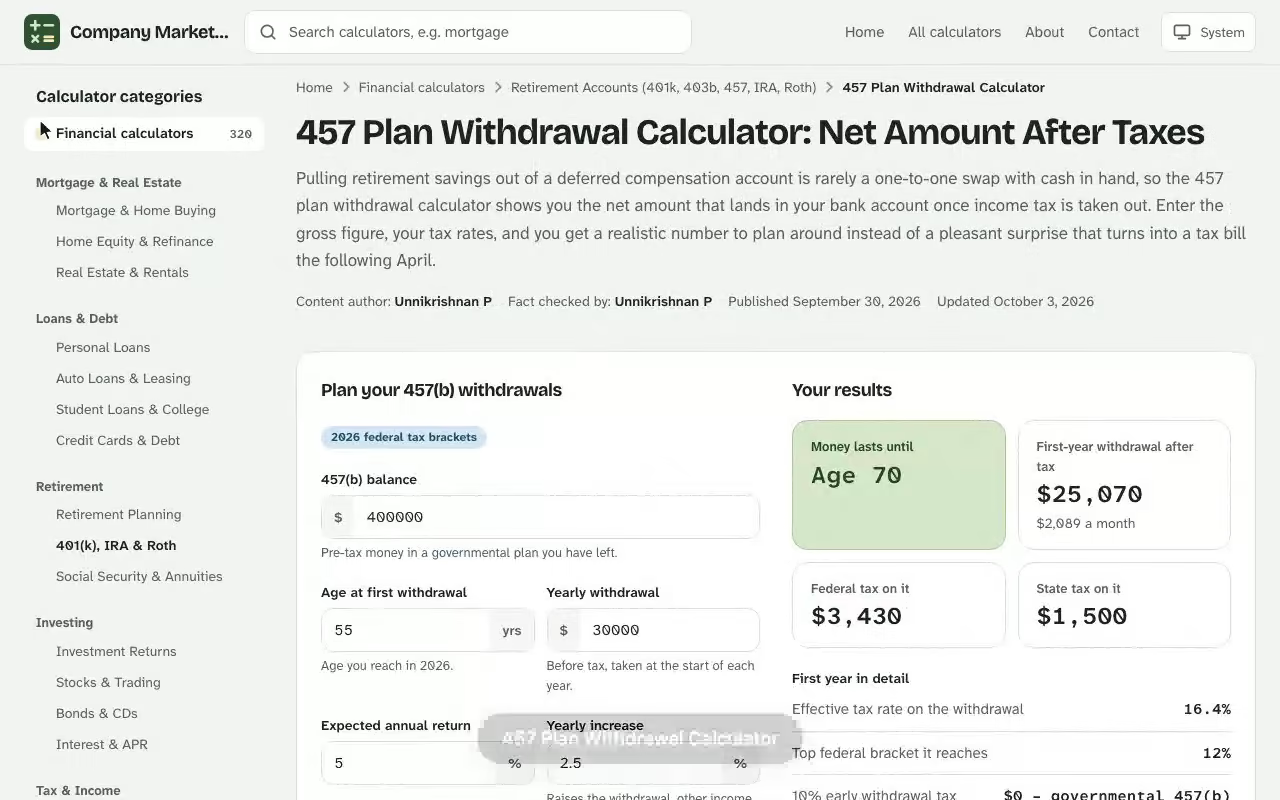
457 Plan Withdrawal Calculator. Pulling retirement savings out of a deferred compensation account is rarely a one-to-one swap with cash in hand, so the 457 plan withdrawal calculator shows you the net amount that lands in your bank account once income tax is taken out. Enter the gross figure, your tax rates, and you get a realistic number to plan around instead of a pleasant surprise that turns into a tax bill the following April. The 401k calculator online uses the same plain-English approach, so you can compare results side by side.
Your results
Money lasts until
–
First-year withdrawal after tax
–
Federal tax on it
–
State tax on it
–
First year in detail
Effective tax rate on the withdrawal–
Top federal bracket it reaches–
10% early withdrawal tax–
Withdrawal that lasts to your chosen age–
Total withdrawn–
Total federal and state tax–
Federal tax is the extra tax the withdrawal adds on top of your other income, using the standard deduction. Roth money and state rules aren’t modeled.
Withdrawal schedule
Each year’s withdrawal, the tax it adds and the balance left, until the money runs out or age 110.
Year
Age
Withdrawal
Federal tax
State tax
After tax
Ending balance
Results are estimates for educational purposes and are not financial, tax or legal advice.
How the 457 Plan Withdrawal Calculator Works
Think of it as a 457(b) withdrawal tax calculator for your retirement planning: it shows what you keep after taxes, and it starts with a simple idea: every dollar you take from a pre-tax account is taxed as income in the year you receive it. You supply three numbers, and the calculator subtracts both layers of tax to show what is left. Because a 457(b) plan is a qualified retirement plan and a form of deferred compensation offered by state and local governments and some tax-exempt employers, the contributions were normally made before taxes, which is why the whole distribution is treated as taxable. The individual 401k savings calculator online uses the same plain-English approach, so you can compare results side by side.
Amount to withdraw
This is the gross withdrawal: the full figure you ask your plan administrator to send you, before anything is held back. It is the amount to withdraw that drives every other line in the result. If some of your contributions were made with after-tax money, only part of the distribution is taxable, so treat the result as a conservative estimate: the calculator assumes your contributions were tax-deductible, and only your plan administrator can confirm the split.
Federal income tax rate
Enter your federal income tax rate, ideally the marginal rate that applies to the top slice of your income once the withdrawal is stacked on top of your other earnings. If you are unsure, a rate between 22% and 25% is a common starting point for a middle-income household. A large withdrawal can push you into a higher tax bracket, so test a few rates rather than trusting one guess.
State income tax rate
Next comes the state income tax rate. Some states tax retirement distributions fully, a few exempt part of them, and several have no income levy at all. Use the marginal rate your state charges on additional income, then run the numbers again at zero to see how much of the difference comes from where you live.
Net Withdrawal Formula for a 457(b) Plan
The arithmetic is short, which is exactly why it is easy to trust and easy to check by hand. Total tax is the gross amount multiplied by the two rates, and the net withdrawal is whatever remains: The tax sheltered annuity tsa calculator is free to use with no sign-up, and works on desktop and mobile.
$$\text{Net} = W - (W \times r_{f}) - (W \times r_{s})$$
Here \(W\) is the gross withdrawal, \(r_{f}\) is the federal rate and \(r_{s}\) is the state rate, both written as decimals. When a penalty applies, subtract \(W \times 0.10\) as well. The same relationship can be written as \(\text{Net} = W \times (1 - r_{f} - r_{s})\), which shows that the net withdrawal amount is simply a fixed share of the gross figure.
See how the 457 Plan Withdrawal Calculator works: change the inputs and the money lasts until updates instantly. Enter your own numbers in the calculator above.
Early withdrawal penalty rules for governmental plans
This is where a governmental 457(b) differs from a 401(k). Distributions taken after separation from service are generally not hit by the 10% additional tax, even if you are younger than 59½. The exception covers amounts that came into the account as a rollover from another plan or an IRA, which are treated as if they never left that earlier account. That is why the early withdrawal penalty question deserves its own line in your planning rather than a blanket assumption either way.
Non-governmental plans offer fewer protections
A plan sponsored by a tax-exempt employer follows different distribution rules, and its assets generally cannot be rolled into an IRA. Funds also remain a general asset of the employer, and the timing of payouts is typically fixed in advance. Check the plan document before you assume that a governmental rule applies to your account.
Worked Example: A $38,500 Withdrawal From a 457(b) Plan
Suppose you have left a county job at 54 and need to cash out part of your retirement account to cover a roof replacement. You decide to take $38,500. Your combined income puts you at a 22% federal rate, and your state charges 4.85%. Because the money comes from a governmental plan after separation and none of it is rolled-in money, no 10% additional tax applies.
Line item
Calculation
Amount
Gross withdrawal
Amount requested
$38,500.00
Federal income tax
$38,500 × 22%
$8,470.00
State income tax
$38,500 × 4.85%
$1,867.25
Total taxes
Federal + state
$10,337.25
Net amount you keep
$38,500 − $10,337.25
$28,162.75
How a $38,500 gross withdrawal becomes a $28,162.75 net amount after federal and state tax.
What the result tells you
You keep about 73.15 cents of every dollar, so the combined tax rate is 26.85%. To net a round $30,000 for the roof, you would need to request roughly $41,015, because the formula divides the target by 0.7315.
What a rollover-sourced penalty would add
Now imagine $10,000 of that $38,500 had been rolled in from an old IRA. That slice could carry a 10% penalty of $1,000, which lowers the net figure to $27,162.75. Penalty exceptions exist, but a calculator cannot confirm whether one fits your case.
Federal and State Taxes on 457(b) Withdrawals
Understanding 457(b) withdrawals means separating three different numbers that people often blur together: the tax rate you expect to owe, the amount your plan holds back, and the tax you actually owe on your return.
Marginal tax rate and withholding
Your marginal tax rate is the rate on your last dollar of income, not an average across everything you earn. Withholding is a separate matter: a plan paying an eligible rollover distribution to you generally withholds 20% for federal income tax, which can be more or less than you will really owe. Treat withholding as a prepayment, not the final tax bill.
Why your tax bracket matters
Income tax is progressive, so a withdrawal is taxed in layers. A modest amount stays inside your current bracket, while a large one spills into the next, and the portion above the line is taxed at the higher rate. Splitting a big need across two calendar years often keeps more of it in the lower tax bracket.
Net amount from the same $38,500 withdrawal at different federal and state rate combinations; the outlined cell is the worked example.
Reading Your Net 457(b) Withdrawal Result
The headline number is the net 457(b) withdrawal, the cash you can really spend. Check it against the purpose of the money: if the need is fixed, work backward from the net figure to the gross request. If the withdrawal is optional, compare the net amount with the growth you give up.
What the result does not settle
The result is your net amount after taxes, and a calculator is a tool for estimating, not a binding statement of tax owed. It does not confirm eligibility for a statutory exception, it cannot read your plan document, and it ignores the opportunity cost of removing money from a tax-deferred account that would have kept compounding. Retirement planning also involves inflation, which erodes the buying power of every dollar you leave invested or spend.
Taxes and penalties beyond the headline figure
The taxes and penalties shown are only part of the picture. A larger distribution can raise your adjusted gross income, which may in turn increase Medicare premiums and the share of Social Security benefits that is taxable.
Funding a Car Purchase With a 457(b) Retirement Calculator
Marisol, 57, retired from a water district in March and has a quote for a used delivery van for her bakery: she needs $15,000 in her checking account by Friday. Her pension plus part-time wages puts her in the 22% federal bracket, and her state charges 3.9%. She has never touched her governmental 457(b), so before calling the plan she opens the calculator to see what a payout really delivers.
Her first entry is the obvious one: $15,000 as the amount to withdraw, 22% federal, 3.9% state. The after-tax figure comes back as $11,115.00, because $3,300.00 goes to federal tax and $585.00 to the state, leaving her $3,885.00 short. She works backward instead: $15,000 divided by 0.741 is $20,242.91, so she rounds the request up to $20,250. Re-entered, the calculator shows $4,455.00 federal, $789.75 state and a net of $15,005.25.
Then she tests the risk that worries her. Her wages this year are not final, and an extra $20,250 could lift the top slice of her income into the 24% bracket. Rerun at 24%, the same request nets only $14,600.25, roughly $400 under the van price. The plan will not process a second payout until January, so she decides to request $20,850 instead. At 24% that still nets $15,032.85, and if her income stays in the 22% bracket it nets $15,449.85, which leaves about $450 for registration and plates.
She also confirms one thing before she signs the form: the money is coming from her own deferrals, with no rolled-in funds, so the 10% additional tax does not apply after separation from service. Her last step is to ask the plan to withhold at a flat 22% so the January tax statement holds no surprise. The calculator did not decide anything for her, but it turned a vague $15,000 need into a request she could defend line by line.
Withdrawal Strategies Before You Cash Out
Good withdrawal strategies start by asking whether a taxable payout is the best route at all. Before you request money, run through this short list:
Confirm whether the plan is governmental or sponsored by a tax-exempt employer, since that decides the penalty rules.
Compare a direct rollover with a taxable distribution, because a rollover postpones the bill.
Check your federal and state marginal tax rates for the year you will receive the money.
Ask about plan withholding versus your actual year-end tax.
Look at the effect on retirement income, RMDs and Medicare premiums, and on your long-term retirement income plan.
Direct rollover versus taxable distribution
A direct IRA rollover keeps your retirement savings intact and sends the money to another account without triggering income tax, keeping the balance tax-deferred. Accepting a taxable distribution instead pays the bill now. Move funds this way only when the rollover is allowed for your type of plan.
Required minimum distributions
Once you reach the age set by your birth year, required minimum distributions (RMDs) force a yearly payout whether you need the cash or not. Those payouts are taxed as ordinary income tax, so planning earlier withdrawals can smooth your brackets over time.
Roth 457(b) and tax-free distributions
If your plan offers a Roth option, qualified withdrawals from that bucket are tax-free, because contributions were taxed up front. The tax implications therefore differ sharply between a traditional and a Roth balance, so the calculator is built for pre-tax money.
Using the 457(b) Calculator to Protect Retirement Savings
Every dollar you withdraw is a dollar that stops working for your retirement. Money left inside the plan keeps benefiting from tax-deferred growth and compound interest, so a $38,500 withdrawal today can cost far more than $38,500 in future retirement income. Run several scenarios with the 457(b) calculator: a smaller withdrawal, a later start date, and a split across two tax years, and compare each net figure against the investment growth you would forgo, and against the savings you would need to rebuild. Even a conservative investment return adds up over fifteen years of savings.
Use the net figure to decide how much you really need to take. If the result shows you can cover the expense with a smaller payout, the rest of your retirement account keeps its investment growth. When the money is meant to become steady retirement income, an annuity purchased with the leftover balance is one option to price against the savings you keep inside the plan, and a withdrawal that fits your IRS bracket leaves more of that annuity budget intact. Keeping a cushion of savings outside the plan also means a surprise expense never forces an investment sale at a bad moment, and an annuity is one more way to protect retirement income, not a replacement for planning.
Who Should Use a 457(b) Retirement Calculator
A 457(b) calculator of this kind suits people considering a payout from a governmental plan, early retirees comparing penalty rules, and workers choosing between cash, a rollover, or lifetime withdrawals from an annuity. It does not suit anyone who needs a binding figure for a tax filing; for that, speak with a financial advisor or tax professional.
Reducing future payouts with higher deferrals
If you are still working, the other side of the ledger matters too. IRS contribution limits cap what you can defer each year (the IRS publishes the current figure), and catch-up contributions allow extra deferrals in the final years before the plan's normal retirement age. Boosting deposits now can reduce how much you ever need to withdraw, which is the same as entering a smaller gross figure in the calculator later.
457 Plan Withdrawal Calculator questions
How much tax will I pay on a 457 plan withdrawal?
Withdrawals from a traditional 457(b) are taxed as ordinary income at your federal rate and, in most states, your state rate. The calculator multiplies the amount you withdraw by each rate and subtracts both from the gross figure.
Is there a 10% early withdrawal penalty on a 457(b)?
A governmental 457(b) generally does not charge the 10% additional tax on distributions taken after separation from service, even before age 59½. Amounts that were rolled in from another plan or an IRA are the usual exception, which is why the calculator has a separate penalty field.
Why is the amount in my bank account different from what I requested?
The plan may withhold tax before paying you, and the net figure shown here is after your estimated federal and state tax. Withholding is a prepayment, so your final bill can be higher or lower once you file your return.
What tax rate should I enter if I am not sure?
Use your marginal federal rate, the rate on the last dollar of income. A large withdrawal can move part of your income into a higher bracket, so try two or three rates to see the range.
Does this calculator work for a Roth 457(b)?
It is built for pre-tax money. Qualified Roth distributions are generally tax-free, so the taxes shown would not apply to that part of your balance.
Can I roll my 457(b) into an IRA instead of taking cash?
Many governmental plans allow a direct rollover to an IRA or another eligible plan, which postpones the tax. Plans sponsored by tax-exempt employers usually do not allow it, so check your plan document.
What else should I check before I withdraw?
Look at your plan's withholding, whether a penalty exception applies, and how extra income could affect required minimum distributions, Medicare premiums and the taxable share of Social Security.