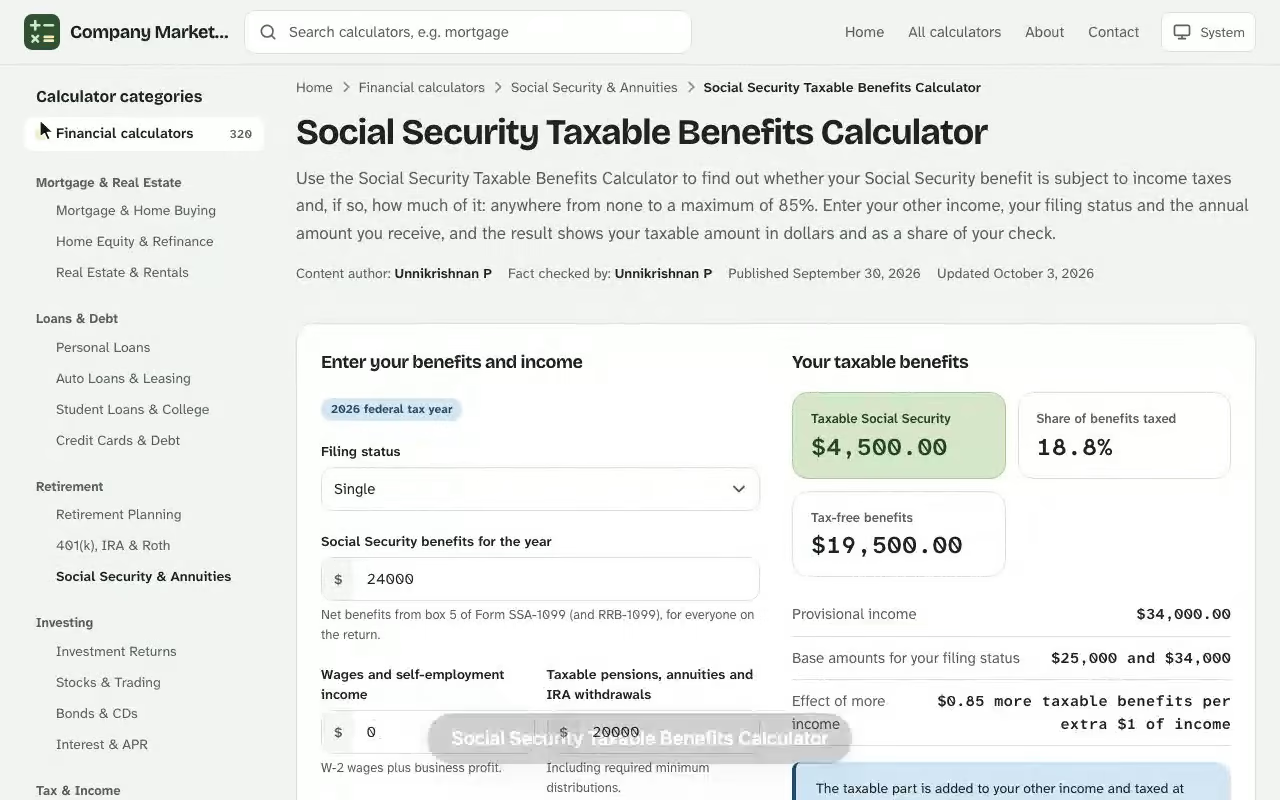
Social Security Taxable Benefits Calculator. Use the Social Security Taxable Benefits Calculator to find out whether your Social Security benefit is subject to income taxes and, if so, how much of it: anywhere from none to a maximum of 85%. Enter your other income, your filing status and the annual amount you receive, and the result shows your taxable amount in dollars and as a share of your check. The annuity calculator is free to use with no sign-up, and works on desktop and mobile.
Your taxable benefits
Taxable Social Security
–
Share of benefits taxed
–
Tax-free benefits
–
Provisional income–
Base amounts for your filing status–
Effect of more income–
The taxable part is added to your other income and taxed at your normal rates. The base amounts are set by law and are not adjusted for inflation.
Worksheet, line by line
The same steps as the taxable benefits worksheet in the Form 1040 instructions and IRS Publication 915. A dash means the line is skipped.
Line
Step
Amount
Results are estimates for educational purposes and are not financial, tax or legal advice.
How the Social Security Taxable Benefits Calculator Works
Unlike wages, Social Security checks are not taxed from the first dollar. Whether any of the money is taxable depends on a figure the IRS calls provisional income, sometimes labeled combined income. The calculator takes your income, adds half of your benefit, compares the total with fixed thresholds for your filing status, and then applies a 50% or 85% inclusion rate to the part above each threshold. Think of it as a quick estimate, not a substitute for your tax return. Try the immediate annuity calculator to run your own numbers — everything is calculated in your browser and nothing you enter is stored or sent anywhere.
What you enter
Filing status: single, head of household, married filing jointly or married filing separately.
Annual benefit amount: the net total of your monthly benefit payments, shown in Box 5 of Form SSA-1099.
Other gross income: pensions, IRA withdrawals, wages, interest and dividends, before any Social Security.
Tax-exempt interest: municipal bond interest still counts toward provisional income.
What you get back
The tool returns your provisional income, the taxable portion of your benefit, the taxable percentage and the remainder that stays tax-free. These figures feed directly into your Form 1040, so you can see the effect before you file.
Provisional Income: The Formula Behind Taxable Benefits
Once you know that number, the taxable amount follows in two tiers. The first tier is the smaller of 50% of your benefit or 50% of the excess over the lower threshold. The second tier adds 85% of the excess over the upper threshold. In symbols, for a single filer:
Here \(B\) is the annual benefit and \(PI\) is provisional income. If \(PI\) falls below the lower threshold, none of your benefit is taxed. The cap means that no more than 85% of your Social Security benefit is ever taxable, and in the first tier no more than 50% of your Social Security benefit is added to income, so a portion of every check always stays tax-free.
Taxable Benefits Thresholds for Married Couples Filing Jointly and Single Filers
The thresholds are fixed by statute and are not adjusted for inflation, which is why more retirees cross them every year. They are facts you can rely on, whatever calculator you use.
See how the Social Security Taxable Benefits Calculator works: change the inputs and the taxable social security updates instantly. Enter your own numbers in the calculator above.
Filing status
Up to 50% taxable above
Up to 85% taxable above
Single, head of household
$25,000
$34,000
Married couples filing jointly
$32,000
$44,000
Married filing separately, living together
$0
$0
Married couples filing jointly
Spouses combine their income and their benefits into a single provisional income figure, then compare it with the higher joint thresholds. A spouse with no earnings of their own still raises the total through the household benefit amount.
Married filing separately
If you lived with your spouse at any point in the tax year and file separately, the threshold is effectively zero, so up to 85% of your benefit becomes taxable almost immediately.
Worked Example: How Much of Your Social Security Benefit May Be Taxed
Take a single filer who receives $26,400 a year in benefits, a $22,000 pension and $9,750 in IRA withdrawals, plus $1,350 of tax-exempt municipal interest.
Step
Calculation
Result
Other income plus tax-exempt interest
$22,000 + $9,750 + $1,350
$33,100
Half of annual benefit
0.5 × $26,400
$13,200
Provisional income
$33,100 + $13,200
$46,300
Excess over $34,000
$46,300 − $34,000
$12,300
Second tier at 85%
0.85 × $12,300
$10,455
First tier amount (capped at $4,500)
min($13,200, $4,500)
$4,500
Taxable benefit
$10,455 + $4,500, below the $22,440 cap
$14,955
About 56.6% of the benefit is added to taxable income, and the remaining $11,445 stays tax-free. The same numbers for married couples filing jointly would give a taxable amount of $7,955, because the joint thresholds sit higher.
Checking a Couple's Taxable Benefits Before an IRA Withdrawal
Marcus and Elena are both retired and file jointly. Before booking a $5,000 IRA withdrawal for a roof repair, Marcus pulls their paperwork: Box 5 of their two SSA-1099 forms adds up to $38,640, Marcus's pension pays $24,800, and their savings produced $3,915 of taxable interest and dividends.
He selects married filing jointly and enters $28,715 of other income. The calculator halves the benefit to $19,320 and reports provisional income of $48,035. That sits $4,035 above the $44,000 joint threshold, so the result is $9,430 taxable, or 24.4% of their benefit. The tax-free remainder is $29,210.
Then he reruns the estimate with the $5,000 withdrawal added. Provisional income rises to $53,035 and the taxable benefit climbs to $13,680, an increase of $4,250. That is 85 cents of extra benefit taxed for every withdrawn dollar, so $9,250 of new taxable income instead of $5,000. At the 12% federal bracket for married couples, the tax bill rises by about $1,110, not the $600 he expected.
The result gives Marcus a specific next step. He pays for the roof from the couple's Roth IRA instead, since qualified Roth withdrawals never enter provisional income, so their taxable benefit stays at $9,430. He keeps the second run's printout beside the Form 1040 worksheet as the record of why he chose the Roth account.
Which Retirement Benefits Count and Which Do Not
The rules apply to monthly retirement benefits, survivor benefits and disability benefits paid by Social Security. Supplemental Security Income payments are never taxable, and neither are benefits you receive on behalf of a dependent child. Tier 1 railroad retirement benefits, the part equal to what the Social Security system would pay, follow the same formula, and railroad retirement benefits are reported on Form RRB-1099 instead.
The IRS runs an interview-style tool for this question that takes about nine minutes. It is built for U.S. citizens and resident aliens for the entire year; if that is not you, read Publication 54, the tax guide for citizens and residents abroad.
Ways to Lower the Share of Benefits Subject to Income Taxes
You cannot change the thresholds, but you can change what lands above them. Timing matters because each extra dollar of IRA income in the second tier can make 85 cents of benefit taxable on top of the dollar itself.
Spread IRA withdrawals and Roth conversions across several years instead of one.
Consider qualified charitable distributions, which can reduce your gross income once you are old enough.
Keep an eye on tax-exempt interest, which does not help here.
Draw from Roth accounts, since qualified withdrawals do not enter provisional income.
The upside is a higher net after-tax benefit, since less of every check is added to taxable income. Households with modest and low incomes often owe nothing on their benefit.
Using a Taxable Benefits Calculator for Retirement Planning
Run the taxable estimate each year, not only when you claim. Income changes with required distributions, a spouse's claim, or a part-time job, and the earnings test can also trim your check if you claim before full retirement age, which changes the benefit that gets taxed. Whether you choose early retirement or delayed retirement, a larger monthly benefit means a larger taxable slice later, and your life expectancy is worth weighing against that tax cost. Each extra dollar of retirement benefit raises provisional income by 50 cents.
Where to get the inputs
Form SSA-1099 shows what you actually received, and it is the number the calculator needs for the benefit field. Your Social Security statement adds your earnings record and retirement estimates at 62, full retirement age and 70, which help you project next year's benefit amount; your date of birth confirms the age. If you still work, compare estimated earnings against annual earnings, since wages enter provisional income too.
Limits of a quick estimate
These self-help tools are for planning. They do not give personalized advice or tax advice, and state taxes vary: some states also tax benefits, most do not. If your situation involves annuities, pensions or other financial products, review the result with a qualified professional.
Social Security Taxable Benefits Calculator questions
How much of my Social Security benefit can be taxed?
Anywhere from none to a maximum of 85%. The share depends on your provisional income: half of your benefit plus your other income and any tax-exempt interest, compared with the thresholds for your filing status.
What are the income thresholds for taxable Social Security?
For single filers, head of household and qualifying surviving spouse, 50% can become taxable above $25,000 and up to 85% above $34,000. For married couples filing jointly the thresholds are $32,000 and $44,000.
Where do I find my total annual benefit?
Box 5 of Form SSA-1099 shows your net benefits for the year. Railroad retirement tier 1 benefits are reported in Box 5 of Form RRB-1099.
What income should I enter?
Enter income excluding Social Security: pensions, IRA withdrawals, wages, taxable interest and dividends, and similar items from your Form 1040. The calculator adds half of your benefit itself.
Is Supplemental Security Income taxable?
No. SSI payments and benefits you receive on behalf of a dependent are not part of taxable Social Security benefits.
Do I still owe tax if my provisional income is below the threshold?
No. If provisional income stays at or below the base amount for your filing status, none of your Social Security benefit is included in taxable income, though other income may still be taxed.
Is this result my final tax bill?
No. It estimates the taxable part of your benefit only. Your tax depends on your full return, your deductions and your bracket, so check with a qualified tax professional.