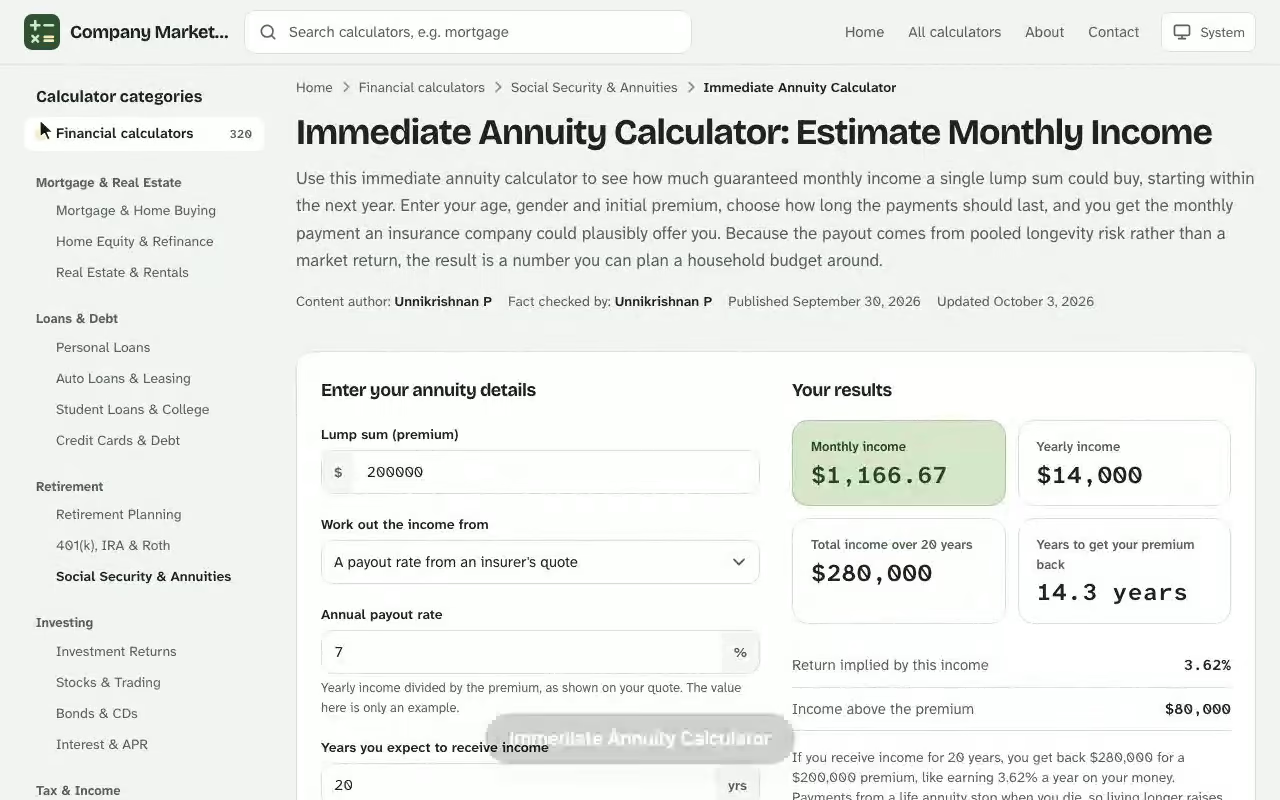
Immediate Annuity Calculator. Use this immediate annuity calculator to see how much guaranteed monthly income a single lump sum could buy, starting within the next year. Enter your age, gender and initial premium, choose how long the payments should last, and you get the monthly payment an insurance company could plausibly offer you. Because the payout comes from pooled longevity risk rather than a market return, the result is a number you can plan a household budget around. If you want to see how the figures change, the annuity calculator gives you an instant result you can adjust as you go.
Your results
Monthly income
–
Yearly income
–
Total income over 20 years
–
Years to get your premium back
–
Return implied by this income–
Income above the premium–
Real quotes depend on your age, sex, current interest rates and the options you choose, such as life only, a guaranteed period or a joint annuity. Use the payout rate from an actual quote for the most useful result. Taxes are not included.
Year-by-year income
The income you receive each year and how much of your premium has come back to you so far.
Year
Income
Total received
Premium not yet returned
Results are estimates for educational purposes and are not financial, tax or legal advice.
How the Immediate Annuity Calculator Turns a Premium into Monthly Income
An immediate annuity is a contract in which you hand an insurer one payment and receive a stream of checks that begins within twelve months. The insurance company prices that stream by asking two questions: how long will payments probably last, and what can it earn on your money while it waits to pay you? The calculator answers both with a mortality curve for your age and gender, an interest assumption, and a small deduction for the insurance company's expenses. Try the free social security calculator to run your own numbers — everything is calculated in your browser and nothing you enter is stored or sent anywhere.
The core relationship fits on one line. Your net premium is divided by an annuity factor, which is the present value of one dollar paid every month for as long as you are expected to live:
Here \(S(t)\) is the probability you are still alive after \(t\) months, \(i\) is the annual interest rate and the load covers expenses. The sum runs month by month until survival probability fades to nearly zero. A higher survival probability or a lower interest rate makes the denominator larger, so each check shrinks.
Initial premium and funding source
The initial premium is the single lump sum you deposit, and the payment scales almost in direct proportion to it. Some insurers price larger deposits slightly better because part of their administrative expense is fixed per contract. The funding source does not change the pricing, but it changes how each check is taxed, which is why most estimators ask whether the money is qualified or nonqualified.
Qualified money comes from a traditional IRA, a 401(k) or a similar plan that has never been taxed.
Nonqualified money comes from savings, a brokerage account or a maturing certificate that you already paid tax on.
Your retirement savings can be split, so you might put only part of an account into a single premium.
Age, gender and life expectancy
Age is the strongest lever. The older you are when the contract starts, the fewer years the insurance company expects to pay, so the same premium supports a larger check. Gender matters because women, on average, live longer than men, which stretches the same dollars across more months. Your own life expectancy is not what the insurer uses; it prices the average of everyone your age, and your health only matters if you buy a specialised impaired-risk contract.
Interest rates and bond yields
An insurance company invests your premium mostly in high-grade bonds, so interest rates set what they can afford to pay. Quotes move with Treasury and investment-grade corporate bond yields. When yields rise, a new buyer gets a larger check for the same premium; when they fall, the check falls. Once the contract is issued, the rate is locked for the life of the payments.
Reading Your Immediate Annuity Payout Estimate: A Worked Example
Numbers make the mechanics concrete. Suppose a man aged 68 places a $342,750 single premium into a life-only contract, priced at a 5.0% interest rate, and wants checks to begin next month. The calculator returns a check of $2,638 per month, which is $31,661 per year, or roughly 9.2% of the premium paid out annually. The social security taxable benefits calculator online uses the same plain-English approach, so you can compare results side by side.
The example inputs and the monthly payment
That 9.2% figure looks high only because it is not a yield. It blends interest with a return of your own principal and with the money released by people who do not live as long as average. The estimate changes smoothly as the inputs change, as the grid below shows for the same premium at different ages and pricing rates.
Age at purchase
4.0% rate
5.0% rate
6.0% rate
Age 62
$2,048
$2,248
$2,452
Age 65
$2,224
$2,423
$2,627
Age 68
$2,439
$2,638
$2,841
Age 71
$2,705
$2,904
$3,108
Age 74
$3,035
$3,236
$3,440
Monthly life-only payout by age and pricing rate, with the age-68, 5.0% example outlined at $2,638.
Break-even and guaranteed lifetime income
Divide the premium by the monthly check and you get the break-even point: $342,750 ÷ $2,638 is about 130 months, or 10.8 years. After roughly age 78.8, every additional check is money you receive beyond what you paid in. In the pricing table used here, about 75% of 68-year-old men are still alive at 78 and about 35% at 88, which is exactly the longevity risk the contract insures. That promise of guaranteed lifetime income is why some buyers call the contract longevity insurance and accept its illiquidity.
Key ages in the $342,750 example: payments pass the premium at about age 78.8.
Choosing a Payout Option for Your Income Annuity
The payout option decides who keeps receiving money if you die early. Every guarantee you add costs a slice of the monthly check in your future annuity payments, because the insurer must plan for payments it would otherwise have avoided. Using the same $342,750 and age-68 buyer, the options compare like this:
See how the Immediate Annuity Calculator works: change the inputs and the twice-yearly income updates instantly. Enter your own numbers in the calculator above.
Payout option
Monthly payment
Who is protected
Life only
$2,638
Nobody; checks stop at death
Life with 10-year period certain
$2,453
Beneficiary, if you die within ten years
Life with cash refund
$2,350
Beneficiary receives any unpaid premium
Period certain only, 20 years
$2,163
Beneficiary, but payments end after 20 years
Joint life, spouse aged 66
$2,049
Spouse, for as long as either is alive
Each guarantee lowers the monthly payment from the $2,638 life-only amount.
Single life and life only
A single life contract, also called a life annuity or life only, pays for your lifetime and then stops. It produces the highest check because the insurer owes nothing after your death. It suits someone with no dependents, other assets to leave, or a spouse already covered by a pension.
Period certain and cash refund
A period certain guarantees payments for a set number of years even if you die sooner. Life with period certain blends the two: you are paid for life, but a beneficiary collects the balance of a 10-year or 20-year guarantee if you die early. With life with cash refund, the cash refund pays your beneficiaries the difference between the premium and everything already paid. Both are forms of refund at death protection, and both reduce your check in return.
10-year period certain: ten years of guaranteed payments, then life.
Cash refund: the premium is never forfeited, only returned gradually.
Life only: highest check, no value left after death.
Funding source: a qualified premium or a nonqualified one can use any of these.
Joint life and survivor benefit
A joint life contract, sometimes described as joint and survivor, keeps paying while either annuitant lives. The surviving spouse's survivor benefit can stay at 100% or drop to a lower share, such as 50% or 75%, in exchange for a larger check while both of you are alive. A common alternative is to buy a single-life contract with a refund feature and name your spouse as beneficiary, though that gives your spouse a smaller guarantee.
Single Premium Immediate Annuity vs. Deferred and Longevity Annuity Contracts
The formal name for this product is a single premium immediate annuity, shortened to SPIA. Payments begin within twelve months, often within thirty days. A deferred income annuity (DIA) pushes the first check years into the future, and a longevity annuity is the deferred version designed to start in your late seventies or eighties.
Income start date and payment acceleration
Delaying the income start date raises the check because the premium earns interest during the wait and fewer payments remain. In the example, pushing the start one year out lifts the life-only check from $2,638 to $2,907; five years out produces $4,428, but only if you survive the wait. Payment acceleration works in the opposite direction: some contracts let you convert remaining guaranteed payments into a lump sum, usually at a discount.
QLAC rules for IRA and 401(k) money
A QLAC is the deferred counterpart to this calculator's start-within-twelve-months case: a qualified longevity annuity contract bought with traditional IRA or 401(k) money, with income starting no later than age 85. Use the income start date field to see the same effect, since waiting raises the payout.
Taxes on Lifetime Income from an Immediate Annuity
How your checks are taxed depends on the source of the premium, and the tax treatment can change your net result by thousands of dollars a year. Check your marginal tax rate in retirement before comparing offers.
Qualified money and ordinary income
If the premium came from pre-tax savings, every dollar of each payment is taxed as ordinary income. Qualified savings were tax-deferred while they sat in the IRA or 401(k), and the deferral simply ends when the checks arrive, because the money was never taxed on the way in.
Nonqualified money and the earnings portion
With after-tax money, only the earnings portion of each payment is taxable. The IRS uses an exclusion ratio: your premium divided by the total payments you are expected to receive. In the example, the expected total is about $514,700, so roughly 66.6% of each check comes back tax-free and about 33.4%, or $10,577 of the $31,661 annual payment, is taxed. Once you outlive the expected term, the exclusion ends and the full payment becomes taxable.
Using a Single Premium Immediate Annuity to Cover a $1,420 Monthly Gap
Marisol Quintana, 71, retired from dental hygiene last spring. Her Social Security deposit is $2,180 a month and her fixed bills (mortgage, insurance, utilities, groceries) run $3,600, which leaves a shortfall of $1,420. She has $312,000 in a savings account and no pension, so she opens the immediate annuity calculator in its premium-needed mode instead of guessing.
She enters a desired payment of $1,420, an age of 71, female, nonqualified funds because the money already had tax paid on it, and a 10-year period certain so her daughter is covered if she dies early. At the 5.0% pricing rate the estimator answers with a single premium of $196,670. Switching the option to life only drops the requirement to $183,378, so the guarantee costs her $13,292 up front.
Premium needed for life with 10-year period certain: $196,670
Premium needed for life only: $183,378
Minimum guaranteed to her daughter: 120 checks of $1,420, or $170,400
Two outside checks shape what she does next. The $196,670 sits under the $250,000 coverage limit that many state guaranty associations apply to annuity benefits, so one highly rated company is reasonable. She also reruns the pricing at a more cautious 4.5%, where the same premium buys $1,368 a month, $52 short of her target, so she treats $1,420 as the best case and plans to confirm it with real quotes. Because the premium is after-tax money, only part of each $1,420 check will be taxable income, which she confirms with her accountant.
The decision: she will request written quotes for $196,670 from three insurers, and she keeps the remaining $115,330 in savings for repairs and emergencies. The calculator turned a vague worry into a specific amount, and the amount into a short list of next calls.
Using an Income Annuity Estimator for Retirement Income Planning
An income annuity estimator works best as a planning tool, not a quote. Start with your essential expenses, subtract the guaranteed sources you already have, and use the estimate to see how much premium would close the gap. The result is guaranteed income that works like a paycheck you cannot outlive, which also reduces the market risk in the rest of your portfolio.
Pairing with Social Security and a pension
Social Security and a pension already behave like an annuity, so the premium you commit should cover the remaining gap in your fixed budget, such as housing, insurance and food. Everything beyond that can stay invested for growth, emergencies and legacy goals. Thinking in terms of an income stream for essentials rather than a single portfolio number is the main idea behind the product. A useful rule of thumb is to match guaranteed income to fixed costs and let variable income, such as portfolio withdrawals or part-time earnings, cover the discretionary spending that can flex from year to year. If your fixed costs rise faster than your checks, revisit the plan before the gap grows, and consider whether a second purchase later would restore the balance.
Inflation protection and increasing payout
A level check loses purchasing power over decades. Contracts with inflation protection offer an increasing payout, often rising 2% or 3% a year, and they start lower to pay for it. Compare the starting amount against the level option and judge how long you expect to live before choosing.
Withdrawals, investment risk and peace of mind
Once a slice of your savings becomes guaranteed income, your remaining investment accounts no longer have to fund every bill, so you can take smaller withdrawals from them in a down market. To size that slice, total your fixed retirement expenses, subtract the checks from Social Security and any pension, and enter the gap as the desired payment in the calculator's premium-needed mode. The premium it returns is the amount of your retirement savings to commit; if it exceeds what you are willing to lock away, shrink the target or plan a second, later purchase. Treat the result as one line of your financial plan, and remember that taxes, medical costs and insurance premiums come out of the gross check. Many retirees say the real benefit is peace of mind, but the arithmetic should come first.
Risks, Fees and Costs to Weigh Before You Buy
The promised check is only as strong as the company behind it, and the contract trades flexibility for certainty. Review the following before you commit:
Liquidity: an immediate annuity has no cash value, and you cannot withdraw lump sums later.
Insurer strength: look at independent ratings and company financial strength, and remember state guaranty associations cap protection if an insurance company fails.
Costs: ask about commission, fees and charges and whether the quoted income is already net of them.
Legacy: a life-only choice leaves nothing to heirs, so decide how much legacy matters.
Stability: the payment is fixed, so it never benefits from a later rise in rates.
Liquidity, cash value and surrender charges
Immediate contracts rarely carry surrender charges because there is nothing to surrender, and the estimate shown here has no cash value column for the same reason. This calculator does not price a fixed annuity, which grows tax-deferred through an accumulation phase at a minimum guaranteed rate before the distribution phase begins; you would convert that balance into an immediate contract later to see a payout.
Insurer ratings and company financial strength
Compare the company across at least two rating agencies, and spread very large premiums across more than one company if the amount exceeds your state's guaranty limit. Pay attention to expected longevity as well: the older and healthier you are, the more valuable the guarantee.
Annuity Estimator Limits and Terms to Know
This annuity estimator approximates real pricing with a transparent model, so it will not match a live quote to the dollar. Actual offers depend on the state of residence, the insurer's own mortality tables and the day's rates, and some companies pay slightly more for gender-neutral or impaired-risk cases. Treat the output as a range, then request written quotes from several insurers for a final comparison.
Annuitant
The person whose life determines how long the payments last.
Payout frequency
How often a check arrives: monthly, quarterly, semi-annual or annual. Less frequent payments are slightly larger each time.
Guaranteed payments
Payments owed for a minimum term regardless of survival.
Monthly payout
The amount deposited each month before taxes.
Lifetime income
Income that continues until the annuitant's death, with no end date.
Immediate Annuity Calculator questions
What is an immediate annuity?
An immediate annuity, also called a single premium immediate annuity (SPIA), converts one lump sum into guaranteed payments that start within twelve months and can last for life or a set number of years.
How much monthly income will an immediate annuity pay?
It depends on your premium, age, gender, payout option and the interest rates when you buy. Older buyers and life-only contracts pay more per month; guarantees such as a cash refund or a spouse's survivor benefit lower the check.
What is the difference between life only and period certain?
Life only pays until you die and then stops. Period certain guarantees payments for a set number of years, and a beneficiary collects the rest if you die early. Combining the two pays for life with a minimum guarantee.
Are immediate annuity payments taxable?
Payments funded with pre-tax money (qualified) are taxed as ordinary income. With after-tax money (nonqualified), only the earnings portion of each payment is taxed, based on an exclusion ratio.
Can I get my money back from an immediate annuity?
Generally not as a lump sum. Immediate annuities have no cash value, so choose a cash refund or period certain option if you want your beneficiaries to receive any unpaid premium.
Is this calculator a quote from an insurance company?
No. It uses a simplified mortality and interest model to estimate payments. Actual offers vary by insurer and state, so request written quotes before you buy.
What happens to my payments if the insurance company fails?
State guaranty associations protect annuity benefits up to a limit, commonly $250,000 per person per company, so check your state's limit and company ratings.