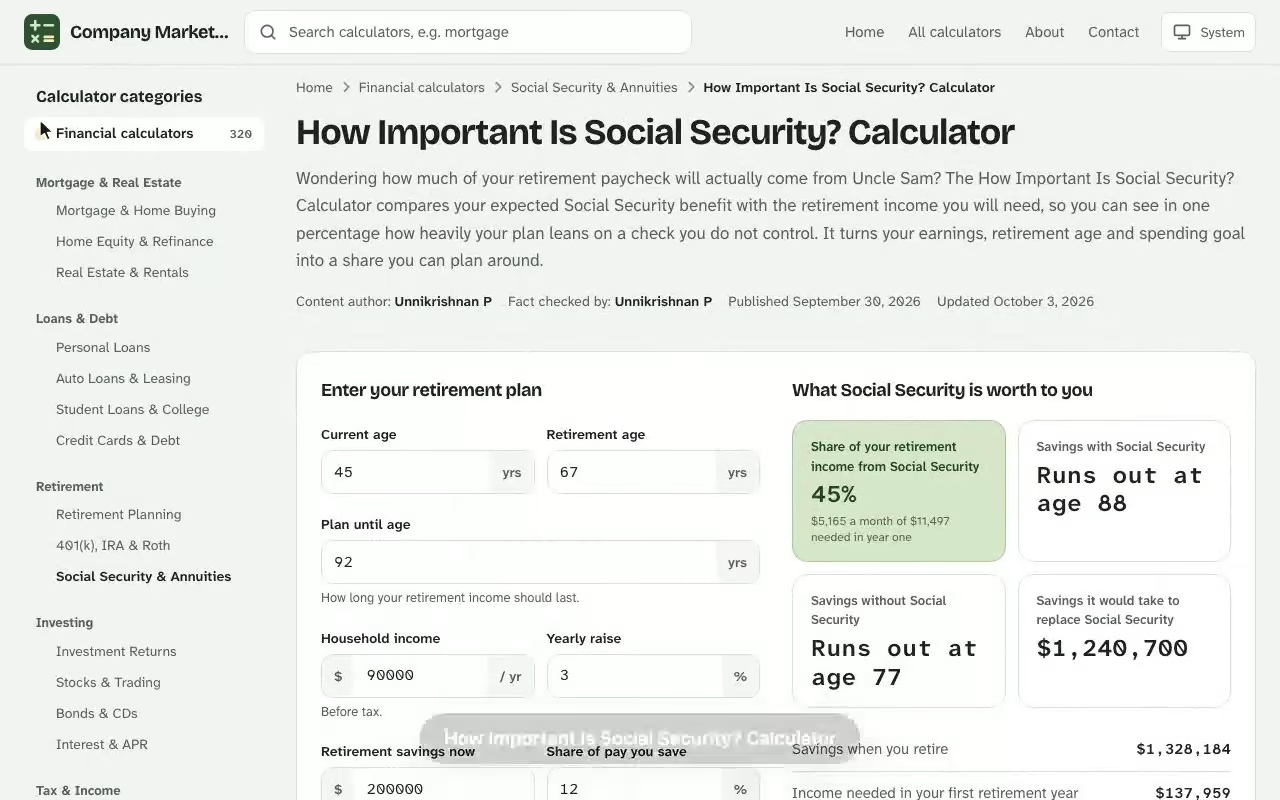
How Important Is Social Security? Calculator. Wondering how much of your retirement paycheck will actually come from Uncle Sam? The How Important Is Social Security? Calculator compares your expected Social Security benefit with the retirement income you will need, so you can see in one percentage how heavily your plan leans on a check you do not control. It turns your earnings, retirement age and spending goal into a share you can plan around. If you want to see how the figures change, the free annuity calculator gives you an instant result you can adjust as you go.
What Social Security is worth to you
Share of your retirement income from Social Security
–
Savings with Social Security
–
Savings without Social Security
–
Savings it would take to replace Social Security
–
Savings when you retire–
Income needed in your first retirement year–
Social Security in your first retirement year–
Savings needed with Social Security–
Savings needed without it–
Extra saving needed with Social Security–
Extra saving needed without it–
Your savings in retirement, with and without Social Security
Future dollars. Withdrawals are taken at the start of each year; once the savings are gone the balance stays at $0.
Age
Income needed
Social Security
Withdrawal needed with it
Savings with it
Savings without it
Results are estimates for educational purposes and are not financial, tax or legal advice.
How Important Is Social Security? Calculator Results Explained
The result of this calculator is a ratio: the monthly benefit amount you can expect divided by the monthly spending you want to support once your paychecks stop. A high share means your lifestyle depends on the government check; a low share means your own retirement savings carry most of the load. Next, open the free social security taxable benefits calculator and enter your own details to see an estimate in seconds.
To get a useful answer, have these four numbers ready before you start:
Your current monthly pay, which anchors how much income you want to replace.
The share of that pay you plan to spend once you stop working, often between 70% and 90%.
The age you plan to claim, because timing moves the check up or down by decades of compounding adjustments.
Any guaranteed monthly amounts from outside the program, so the leftover gap is visible at a glance.
Reading Your Social Security Benefit Against Retirement Income
Take a worker who earned $7,900 a month before leaving the job and wants to spend 80% of that, or $6,320 a month. If the estimated monthly benefit at full retirement age is $2,787.40, the share is \(2{,}787.40 \div 6{,}320 = 44.1\%\). The other 55.9% has to come from a 401(k), an IRA, a pension or an annuity.
Why Preretirement Earnings Set the Baseline
Social Security replaces only part of your preretirement earnings. In this example the benefit equals about 35.3% of the $7,900 monthly paycheck, which is why most households need other assets and a financial advisor's help with the rest. A rule of thumb from the Social Security Administration is that the program is designed to deliver around 40% of what you earned before retiring.
How Is Social Security Calculated? From Wages to Benefit Amount
Understanding how is Social Security calculated shows you which levers you control. The agency follows the same five steps for everyone, and a Social Security benefit calculated this way depends on your lifetime earnings rather than your last few paychecks. The social security breakeven calculator uses the same plain-English approach, so you can compare results side by side.
See how the How Important Is Social Security? Calculator works: change the inputs and the share of your retirement income from social security updates instantly. Enter your own numbers in the calculator above.
Work Credits and the Top 35 Years
You need 40 work credits to qualify, which works out to at least 10 years of covered work. The formula then uses your top 35 years of wages. If you have only 30 years of income, the missing five count as zero. Using the worked example, a worker whose average drops from $6,380 to about $5,469 because of five zero years would see the benefit fall from $2,787.40 to roughly $2,495.80 a month.
Average Indexed Monthly Earnings
Each year of wages is adjusted for inflation with a national wage index, then the 35 years are added together and divided by 420 months. That result is your average indexed monthly earnings, or AIME. In our example it is $6,380.
Primary Insurance Amount and the Sliding Scale
Your primary insurance amount (PIA) applies a sliding scale that pays low earners a bigger percentage than high earners. For workers first eligible in 2026 the bend points are $1,286 and $7,749.
AIME slice
Rate
Calculation
Amount
First $1,286
90%
1,286 × 0.90
$1,157.40
$1,286 to $7,749 (we use $5,094)
32%
5,094 × 0.32
$1,630.08
Above $7,749
15%
0 × 0.15
$0.00
Total PIA
$2,787.40
The PIA is rounded down to the nearest dime and is what you receive at full retirement age.
Two tiers of average indexed monthly earnings add up to the primary insurance amount.
Social Security Quick Calculator vs. Online Benefits Calculator
The Social Security Administration offers several benefit calculators, and they differ in how much of your personal information they use. The Social Security Quick Calculator asks only for your date of birth and current annual earnings, then guesses the rest of your earnings history, so its answers are rough. The online benefits calculator wants every year of covered earnings copied from your Social Security statement, which makes its benefit estimate far closer to the real thing.
The fastest route is a my Social Security account, because it reads your earnings record straight from the agency's database. Any retirement benefits calculator that does not link to your record is only as good as the numbers you type in, so treat a retirement benefit estimate from a quick tool as a ballpark. Your benefits estimate will also change as the agency updates its tables.
Today's Dollars and Inflated Dollars
Most tools let you see results in today's dollars or in inflated dollars. Today's dollars are easier to compare with your current budget, while inflated dollars show the larger nominal figure you would see on a future check. Pick one and stay consistent when comparing your retirement benefit with your target spending.
Testing Age 64 Against a Social Security Benefit Estimate
Dale, a 61-year-old hospital administrator, wants to know whether leaving at 64 is realistic. The income statement from the agency shows an average indexed monthly earnings figure of $5,912, and Dale's budget needs $5,150 a month in retirement. A 403(b) balance of $412,600 is the only other source, with no pension.
Dale enters those three numbers into the calculator and picks age 64 as the claiming date. Born in 1962, Dale has a full retirement age of 67, so a start 36 months early cuts the check by 20%. The calculator applies the 90% and 32% tiers to get a primary insurance amount of $2,637.70, then reduces it to $2,110.10.
Claiming age
Monthly benefit
403(b) at 4%
Share of $5,150
Monthly gap
64
$2,110.10
$1,375.30
41.0%
$1,664.60
67
$2,637.70
$1,375.30
51.2%
$1,137.00
The figure that matters here is the share this calculator reports: 41.0% of spending comes from the benefit, and the 4% withdrawal rate from the 403(b) supplies another $1,375.30, leaving a shortfall of $1,664.60 each month. Dale changes only the claiming age to 67 and the gap falls to $1,137.00, which is $527.60 less. The next step is concrete: test a part-time contract paying $1,200 a month through age 66, so the larger check can start at full retirement age instead of three years earlier.
Social Security Retirement Benefits Calculator: Choosing Your Claiming Age
A Social Security retirement benefits calculator lets you test different start dates, because when you claim changes the check more than almost any other input.
Full Retirement Age
Your full retirement age is 66 to 67 depending on your birth year. In the example the worker was born in 1964, so it is 67. Claiming at age 62 brings a penalty of 30%, which turns $2,787.40 into $1,951.10.
Delayed Retirement Credits
Each year you wait past full retirement age earns delayed retirement credits of 8%, which stops at age 70. Three years of waiting lifts the monthly check to $3,456.30.
Claiming age
Adjustment
Monthly benefit
Share of $6,320 spending
62
-30%
$1,951.10
30.9%
67
0%
$2,787.40
44.1%
70
+24%
$3,456.30
54.7%
Claiming later raises the benefit's share of monthly retirement spending.
Maximum Benefit, Average Benefit and Other Social Security Rules
Maximum Benefit and the Tax Cap
The maximum benefit goes only to people who earned at the taxable ceiling for 35 years and waited until age 70. Wages above the tax cap are not taxed for Social Security and do not raise your check, so a very high income still gets a capped result. The average benefit for all recipients is far lower than that ceiling, so do not use it as your personal target.
Spouse, Survivor and Disability Rules
A spouse or dependent may qualify for extra money, and survivor benefits can replace part of a deceased partner's check. The same system pays disability benefits. If you receive a pension from work not covered by Social Security, the windfall elimination provision and the government pension offset can shrink your payment, so use the agency's special versions of its tools. Each of these rules changes the monthly check you enter into this calculator, which in turn moves the share of your spending that Social Security covers.
Using a Social Security Benefit Estimate in Retirement Planning
Your estimate is the foundation of retirement planning, not the entire structure. Social Security is a safety net that guarantees future payments for life, adjusted for inflation, but it rarely covers a full lifestyle.
Suppose the worker above has $640,000 in a 401(k). The 4% rule suggests withdrawing about $25,600 a year, or $2,133 a month. Added to the benefit, that makes $4,920 a month against a $6,320 target, leaving a $1,400 monthly gap in income. To bridge the gap you could work part-time, buy an annuity, add investment income, delay claiming or trim your budget. Remember that withdrawals and part of your benefit can be subject to taxes.
How Important Is Social Security? Calculator questions
How accurate is a Social Security calculator?
A quick calculator that does not read your earnings record guesses your past earnings, so its result is a rough estimate. An online benefits calculator that uses every year of your earnings from your Social Security statement, or a my Social Security account, comes much closer to the real figure.
How is my Social Security benefit calculated?
The agency indexes your wages for inflation, averages your highest 35 years into a monthly figure called AIME, then applies a sliding scale of 90%, 32% and 15% to three slices of it. The result is your primary insurance amount, which is paid at full retirement age.
How much Social Security will I get if I only worked 10 years?
You qualify with 40 work credits, which takes about 10 years. But the formula averages 35 years, so the 25 missing years count as zero and the benefit will be much smaller than for someone with a full career.
What happens if I claim at 62?
Claiming at 62 permanently reduces your check. For someone with a full retirement age of 67 the cut is 30%. Waiting until 70 adds delayed retirement credits of 8% a year, which raises the monthly amount by up to 24%.
What is my full retirement age?
It depends on your birth year: 66 for people born in 1943 to 1954, rising by two months a year to 67 for anyone born in 1960 or later. The calculator shows yours below the result.
Should I use today's dollars or inflated dollars?
Today's dollars show what the check could buy now and are easier to compare with your current budget. Inflated (future) dollars show the larger nominal amount you would see on a future check.
Is Social Security enough to live on in retirement?
For most people it is not. The program is designed to replace only about 40% of your preretirement earnings, so savings such as a 401(k) or IRA, a pension or other income usually need to fill the gap.