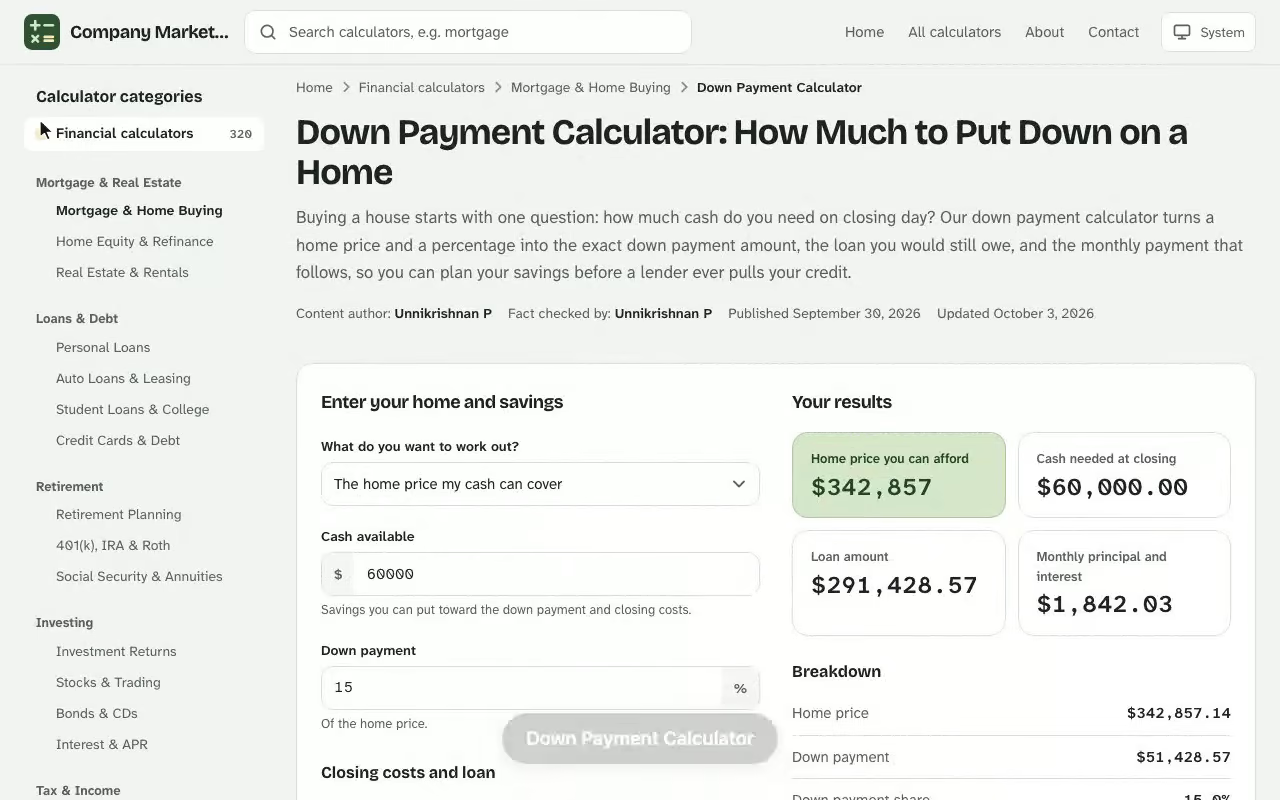
Down Payment Calculator. Buying a house starts with one question: how much cash do you need on closing day? Our down payment calculator turns a home price and a percentage into the exact down payment amount, the loan you would still owe, and the monthly payment that follows, so you can plan your savings before a lender ever pulls your credit. Pair this with the house affordability calculator for a fuller picture before you make a decision.
Your results
Home price you can afford
–
Cash needed at closing
–
Loan amount
–
Monthly principal and interest
–
Breakdown
Home price–
Down payment–
Down payment share–
Closing costs–
Loan-to-value–
–
Down payment options for this home
Each row uses the same price, closing costs, rate and term. Monthly payments are principal and interest only.
Down
Down payment
Cash needed
Loan amount
Monthly P&I
Typical loan
Results are estimates for educational purposes and are not financial, tax or legal advice.
What a Down Payment Is and How It Works
A down payment is the upfront portion of the purchase price that you pay out of your own pocket when you buy a home. Whatever is left becomes your mortgage loan, which is amortized over a set number of years. In other words, the purchase price of a house equals your down payment plus the loan amount, and each extra dollar you put down is a dollar you do not borrow and do not pay interest on. Pair this with the seller closing cost calculator for a fuller picture before you make a decision.
Lenders usually describe the down payment as a percentage of the purchase price. On a $368,900 home, 12% down is $44,268, while 20% down is $73,780. The percentage matters because it decides which loan programs you can use, whether you pay mortgage insurance, and how much equity you own on day one.
Why the Down Payment Percentage Matters
A larger down payment tells the lender you have real money at stake, which often earns lower rates, lower interest charges over the years and a smaller monthly payment. A smaller one keeps more savings in your account for repairs and moving, but it raises your loan balance and usually adds mortgage insurance. Neither choice is wrong; the right one depends on your budget and how long you plan to stay.
Down Payment vs. Cash to Close
Your down payment is only one upfront payment among the several upfront costs at the closing table. Lenders and title companies also collect closing costs, HOA transfer fees, prepaid items and sometimes reserves, so your real cash to close is always higher than the down payment alone.
How to Use This Down Payment Calculator
You can work the problem from either direction. Pick the version that matches what you already know, then compare a few scenarios side by side. The home buyer savings calculator uses the same plain-English approach, so you can compare results side by side.
Know your home price? Enter the purchase price and a down payment percentage to see the dollars you need to bring, plus closing costs of about 2% to 5%.
Know your cash available? Enter your savings and a percentage to find the affordable home price those funds can support.
Know both? Enter the home price and the cash available to see which down payment percentage you can actually reach.
Want the monthly payment too? Add the interest rate and loan term to see principal and interest, then add mortgage insurance, property taxes and homeowners insurance.
Inputs You Will Need
Gather the home price you are considering, your estimated closing costs, a realistic interest rate from today's mortgage rates, and the loan term. If you have been preapproved, your lender's rate quote is the best number to use, because it reflects your credit score and debt load.
Results You Get Back
You receive the down payment amount, the loan amount, the closing cost estimate, the total cash to close and the monthly principal and interest. Use them to test what happens when you add or remove a few thousand dollars from your savings target.
The Down Payment Formula Explained
The math behind any down payment calculator is short. First multiply the purchase price by your chosen percentage, then subtract that amount to find the loan:
The monthly principal and interest then follow the standard amortization formula, where \(L\) is the loan amount, \(i\) is the monthly interest rate (the annual rate divided by 12) and \(n\) is the number of payments:
$$M = L \times \frac{i}{1 - (1 + i)^{-n}}$$
Finally, your cash to close is down payment + closing costs. If you only know your savings, reverse the first formula and divide your cash available by the down payment percentage plus the closing cost percentage.
A Worked Example With Real Numbers
Say you find a home listed at $368,900 and plan to put 12% down on a 30-year fixed-rate loan at 6.43%. Closing costs are estimated at 2.8% of the price.
Line item
How it is calculated
Amount
Down payment
$368,900 × 12%
$44,268.00
Loan amount
$368,900 − $44,268
$324,632.00
Closing costs
$368,900 × 2.8%
$10,329.20
Cash to close
$44,268 + $10,329.20
$54,597.20
Monthly payment (principal and interest)
6.43% for 360 months
$2,036.97
Because 12% is below 20%, a conventional lender would also add private mortgage insurance. At a typical 0.62% yearly rate on the loan, that is about $167.73 a month, which brings the monthly payment to $2,204.70 before property taxes and homeowners insurance.
Comparing Down Payment Percentages Side by Side
The table below holds the same $368,900 price, 6.43% rate and 30-year term constant, so the only thing that changes is how much you put down.
Down payment percentage
Down payment
Loan amount
Monthly principal and interest
Cash to close
3.5%
$12,911.50
$355,988.50
$2,233.73
$23,240.70
5%
$18,445.00
$350,455.00
$2,199.01
$28,774.20
10%
$36,890.00
$332,010.00
$2,083.27
$47,219.20
12%
$44,268.00
$324,632.00
$2,036.97
$54,597.20
15%
$55,335.00
$313,565.00
$1,967.53
$65,664.20
20%
$73,780.00
$295,120.00
$1,851.79
$84,109.20
Moving from 3.5% to 20% down raises your upfront cash by more than $60,000 but trims the monthly payment by about $382 and removes mortgage insurance entirely.
Cash to close for the same home at four percentages: the 12% column totals $54,597.
Large vs. Small Down Payment
A large down payment lowers your loan, your total interest and your risk of owing more than the home is worth. A small one gets you into a home sooner and leaves savings untouched, which matters if a new roof or a job change is possible. Many buyers choose a middle path, such as 10% to 12%, and cancel mortgage insurance later.
See how the Down Payment Calculator works: change the inputs and the your down payment updates instantly. Enter your own numbers in the calculator above.Monthly principal and interest across five down payment percentages and four rates.
Mortgage Insurance and the 20% Rule
The 20% figure is not a law; it is the point where most lenders stop requiring private mortgage insurance (PMI). This coverage protects the lender, not you, if payments stop. Put less than 20% down on a conventional loan and PMI is added to your monthly payment until your balance falls far enough.
When You Can Drop PMI
Because the 12% down payment amount leaves you under 20% equity, PMI stays on the bill until the balance falls far enough. On the example loan above, your balance reaches 80% of the original price in month 80, about six years and eight months in, and you can ask the lender to cancel. PMI ends automatically at 78%, which arrives in month 96. Paying extra principal pulls both dates closer.
When PMI can be removed on the worked-example loan.
FHA Loan Mortgage Insurance Premium
An FHA loan accepts as little as 3.5% down but charges a mortgage insurance premium of 1.75% of the loan at closing plus a monthly premium. That monthly charge lasts for the life of the loan unless you refinance into a conventional mortgage.
Down Payment Requirements by Loan Type
Each loan program sets its own minimum, so the best down payment amount for you depends on which one you qualify for.
Conventional loan: loans that follow Fannie Mae and Freddie Mac guidelines can start at 3% to 5% down, though 20% avoids PMI.
FHA loan: backed by HUD, with a minimum of 3.5% for borrowers who meet its credit score rules.
VA loan: available to eligible veterans and service members, often with no money down.
USDA loan: a zero-down option for homes in eligible rural areas, subject to income limits.
Navy Federal: a credit union that offers some members a no-down-payment mortgage.
Conventional and Jumbo Loans
The upfront cash required rises with loan size: jumbo loans above the conforming limit usually ask for 10% to 20% down and larger cash reserves. Conventional lenders also look closely at your credit score, debt and gross income..
Planning the Upfront Cash for a $297,450 Home
Dana has $26,800 in savings and a seller's agent who has just sent over a listing at $297,450. Before touching the offer, Dana wants to know which down payment percentage the savings can actually carry.
Dana enters the price, a 5% down payment, closing costs of 3.1% from the lender's loan estimate, a 6.51% rate and a 30-year term. The calculator returns a down payment amount of $14,872.50, closing costs of $9,220.95 and a loan of $282,577.50. Cash to close lands at $24,093.45, and the monthly principal and interest reads $1,787.94.
The savings balance minus that cash to close leaves only $2,706.55. That is about one and a half monthly payments, thinner than the two-month cushion Dana set as a personal rule before moving in, and well short of the first repair a house of this age tends to bring.
Scenario
Cash to close
Savings left
Principal and interest
5% down
$24,093.45
$2,706.55
$1,787.94
3.5% down
$19,631.70
$7,168.30
$1,816.17
Dana reruns the figures at 3.5%, the FHA minimum. The down payment drops to $10,410.75 and cash to close to $19,631.70, so $7,168.30 stays in the bank, which covers nearly four monthly payments. The cost is $28.23 more each month in principal and interest, plus the FHA premium. The next step is clear: Dana asks an FHA lender for a quote, and keeps the 5% conventional loan as the comparison, since neither choice reaches the 20% level that avoids mortgage insurance.
Closing Costs on Top of Your Down Payment
Plan for closing costs of roughly 2% to 5% of the purchase price. They bundle lender fees, an appraisal fee, an inspection fee, a survey fee, title insurance, prepaid property taxes and the first year of homeowners insurance.
How to Estimate Closing Costs
Add this estimate to your down payment to get your total cash needed; the calculator's closing cost field takes it as a percentage. A quick rule is 3% of the home price, then refine it with the loan estimate your lender sends within three business days of your application. In the example above, 2.8% came to $10,329.20, which is why the cash to close was $54,597.20 rather than $44,268.
Where to Find Down Payment Funds
The upfront cash you bring usually comes from several sources, and lenders want to see where each dollar of your down payment originated.
Savings and the proceeds from selling a previous home
Gifted money from a relative, backed by a gift letter
Retirement funds, such as a first-time withdrawal rule or a 401(k) loan
Grants and down payment assistance from state and local housing agencies
Down Payment Assistance Programs
Down payment assistance can come as a grant, a forgivable second loan or a deferred loan repaid at sale. Eligibility depends on your income, credit score and whether you are one of the first-time home buyers a program targets.
Buying a House With No Money Down
Truly zero-down paths are rare: VA and USDA loans, plus a handful of lender programs. Entering 0% in the percentage field models a VA or USDA loan, but you still owe closing costs, so the total you must bring stays above zero.
How Your Down Payment Affects Affordability
A bigger down payment improves home affordability in two ways: a smaller loan and a smaller mortgage payment. Compare it against the 28% rule, which suggests keeping your housing payment near 28% of gross income. Try our home affordability calculator, or a general mortgage calculator, alongside this tool to find your comfortable price range.
Interest Rates, Loan Term and Your Payment
Every quarter point on the interest rate changes the payment, and so does the term. A 15-year loan carries a higher monthly payment but far less interest than a 30-year loan. A fixed-rate loan keeps principal and interest steady, while an adjustable-rate loan can reset after its introductory period.
How a Bigger Down Payment Frees Budget Room
Every home buyer who raises the down payment amount lowers the monthly payments the calculator returns, which frees room in the budget for the costs of homeownership, such as HOA dues and repairs. A buyer with preapproval also sees which financing options a lender will support, so rerun the numbers at each price you consider.
Tips to Save Faster for a Down Payment
Use the calculator to set a target down payment amount, then divide it by the months until closing to get a monthly savings goal and automate that transfer into a separate savings account.
Prequalify with a lender so the price range you enter in the calculator matches what you can borrow.
Check whether your state offers down payment assistance before you commit to a savings target.
Down Payment Calculator questions
How much should my down payment be?
It depends on the loan. Many conventional loans accept 3% to 5% down, FHA loans allow 3.5%, and VA or USDA loans can need nothing down. Putting 20% down removes private mortgage insurance on a conventional loan.
Is a 20% down payment required?
No. A 20% down payment avoids PMI and usually lowers your payment, but plenty of lenders approve smaller amounts. You will pay mortgage insurance until your equity grows.
What costs do I need to pay besides the down payment?
Plan for closing costs, often 2% to 5% of the price. They include lender fees, appraisal, title insurance and prepaid taxes. The calculator adds them to show your total cash needed.
How do I work out the down payment from my savings?
Choose the upfront cash option, enter your savings and a down payment percentage. The calculator subtracts closing costs and returns the home price those funds can support.
How does a larger down payment change my monthly payment?
A bigger down payment shrinks the loan, so principal and interest fall. It can also remove PMI. Compare a few percentages to see how each dollar changes the monthly total.
Can I use gift money or retirement funds for a down payment?
Often yes. Lenders usually accept documented gifts from family, and some programs allow retirement account withdrawals or loans. Rules vary, so confirm with your lender.
What is PMI and when does it end?
Private mortgage insurance protects the lender when you put less than 20% down. You can usually request removal at 80% of the original value, and it ends automatically at 78%.
Do down payment assistance programs exist?
Yes. State and local housing agencies offer grants and deferred or forgivable loans to eligible buyers, often first-time buyers with income limits. Ask your lender which programs fit your purchase.