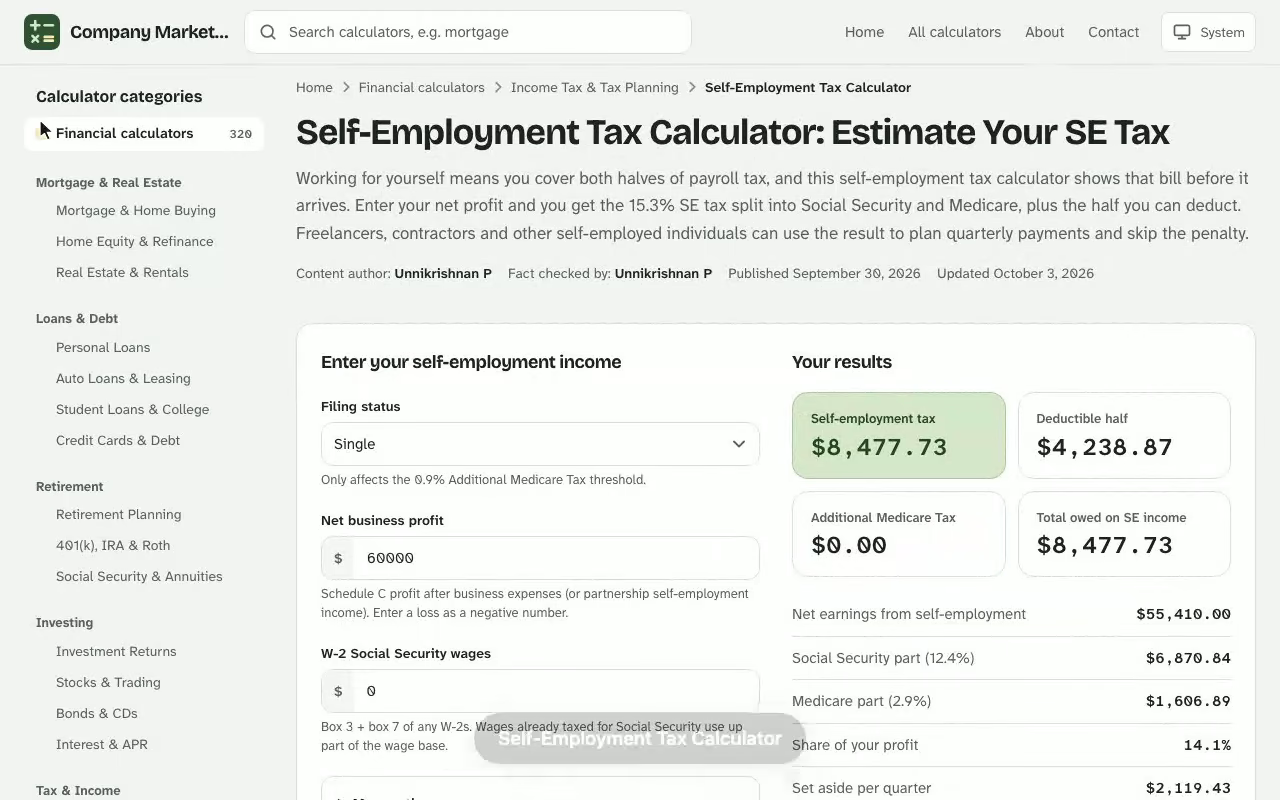
Self-Employment Tax Calculator. Working for yourself means you cover both halves of payroll tax, and this self-employment tax calculator shows that bill before it arrives. Enter your net profit and you get the 15.3% SE tax split into Social Security and Medicare, plus the half you can deduct. Freelancers, contractors and other self-employed individuals can use the result to plan quarterly payments and skip the penalty. The free income tax calculator uses the same plain-English approach, so you can compare results side by side.
Your results
Self-employment tax
–
Deductible half
–
Additional Medicare Tax
–
Total owed on SE income
–
Net earnings from self-employment–
Social Security part (12.4%)–
Medicare part (2.9%)–
Share of your profit–
Set aside per quarter–
Tax year 2026 rules and a $184,500 Social Security wage base. Income tax on your profit is separate — the deductible half lowers it.
How the tax is worked out
Line by line, in the same order as Schedule SE and Form 8959.
Step
Amount
Results are estimates for educational purposes and are not financial, tax or legal advice.
How the Self-Employment Tax Calculator Works
The tool follows the same steps as Schedule SE: it takes your net profit, trims it to the taxable base, applies the Social Security and Medicare rates, and adds the pieces together. You supply a handful of numbers and read the total, so there is no tax table to look up and no arithmetic to redo when your income changes. Pair this with the taxable vs tax deferred investments calculator for a fuller picture before you make a decision.
Inputs You Enter
Net profit from your business: gross income minus business expenses, the figure that appears on Schedule C.
Wages already taxed for Social Security at a W-2 job, if you also have an employer.
Filing status, which sets the threshold for the Additional Medicare Tax.
What You Get Back
The estimate shows your total self-employment tax, the Social Security and Medicare parts on their own, the deductible half, and the amount to set aside for each quarter. Treat it as a planning figure: your final tax return can differ once every credit and adjustment is applied.
Self-Employment Tax Formula and Rates
The self employment tax rate is 15.3%, made up of 12.4% for old-age, survivors, and disability insurance (Social Security) and 2.9% for hospital insurance (Medicare). Together they match the FICA taxes that an employer and an employee would normally split. The rate applies to only part of your profit, which is where the calculation starts. The taxable vs tax-deferred calculator uses the same plain-English approach, so you can compare results side by side.
See how the Self-Employment Tax Calculator works: change the inputs and the self-employment tax updates instantly. Enter your own numbers in the calculator above.
The 92.35% factor mirrors the way an employer's half of payroll tax is never part of a wage earner's pay. Your net earnings from self-employment are therefore a little smaller than your profit before the rates are applied.
Social Security Tax and the Maximum Earnings Limit
The 12.4% Social Security portion stops at a yearly cap. For the 2026 tax year the maximum earnings limit is $184,500 of combined wages and self-employment earnings. Wages from a W-2 job use up that room first, so a side hustle on top of a full salary may owe little or no Social Security tax at all.
Medicare Tax and the Additional Medicare Tax
Medicare has no cap, so the 2.9% applies to every dollar of SE earnings. Once your income passes a threshold for your filing status, an extra 0.9% Additional Medicare Tax is added. That surtax is figured on Form 8959 and is not part of Schedule SE.
Filing status
Additional Medicare Tax threshold
Single
$200,000
Head of household
$200,000
Married filing jointly
$250,000
Married filing separately
$125,000
Worked Example: SE Tax on $86,400 of Net Profit
Picture a sole proprietor, a freelance web developer who is single and has no other job. Her year ends with $86,400 in net profit on Schedule C. Here is how the self-employed tax comes out, step by step.
Step
Calculation
Result
Net profit
From Schedule C
$86,400.00
SE earnings
$86,400 × 92.35%
$79,790.40
Social Security
$79,790.40 × 12.4%
$9,894.01
Medicare
$79,790.40 × 2.9%
$2,313.92
Total SE tax
$9,894.01 + $2,313.92
$12,207.93
Deductible half
$12,207.93 ÷ 2
$6,103.97
Her total is $12,207.93, an effective rate of 14.13% of net profit. The $6,103.97 half is subtracted when she works out her adjusted gross income, which lowers her income tax but not the SE tax itself. Spread across four deadlines, the SE portion alone is $3,051.98 per quarter.
How the 12.4% Social Security and 2.9% Medicare parts build the $12,207.93 total in the worked example.
Who Must Pay Self-Employed Tax on 1099 Income
You owe SE tax when your net earnings from self-employment reach $400 or more in a tax year. Age does not matter, and neither does collecting Social Security or Medicare already. The people who typically pay it include:
Every independent contractor and sole proprietor who files Schedule C
Freelancer and gig worker income from ridesharing, delivery or selling goods online
Partners in a partnership, through their share of net earnings
Small-business owners who do not run payroll for themselves
A church employee with $108.28 or more of church wages
Being paid in cash does not change this. Even if no client sends you a 1099-NEC, the profit still counts and the tax is still due.
Common 1099 Forms for Self-Employment Income
Most 1099 income arrives on a few forms. The 1099-NEC reports payments of $600 or more from a client, the 1099-K covers card and third-party platform sales, and the 1099-MISC picks up other payments such as royalties. These forms feed the gross receipts on Schedule C, and your tax documents, bank records and invoice history back up the numbers.
Running a 1099 Tax Estimate for a Furniture Restorer
Teodora restores mid-century furniture out of a rented garage and sold $161,320 of pieces last year. After wood, finishes, rent and shipping, Schedule C shows $118,940 of net profit. In June she opens the self-employment tax estimator to decide how much of the second quarter's client money is really hers.
She types 118,940 as net profit, picks single, and leaves other wages at zero because she has no day job. The tool multiplies by 92.35% and lands on $109,841.09 of SE earnings. From there the Social Security part comes to $13,620.30 and the Medicare part to $3,185.39, so her self-employment tax is $16,805.69.
Two checks follow. Her SE earnings sit well under the $184,500 Social Security limit, so the full 12.4% applies, and her profit is far below the $200,000 single-filer line, so no Additional Medicare Tax appears. The deductible half is $8,402.84, which she notes for her adjusted gross income.
The number sets her next move. Dividing by four gives $4,201.42 of SE tax per quarter, and she adds a rough income tax share to reach a transfer of $7,300 for the June 15 deadline. Before closing the page she reruns the estimate at $104,000 of profit, because a large custom order might slip into the next year, and the SE tax drops to $14,694.74. That lower figure becomes her fallback, so September's payment can be trimmed if the order slides.
Self-Employment Tax Deduction and Ways to Lower Your SE Tax
You cannot avoid the tax itself, yet several moves shrink the profit it is figured on or the income tax that follows it. A tax pro can match them to your situation, and the main ones are below.
The Self-Employment Tax Deduction
The self-employment tax deduction lets you subtract the employer-equivalent portion, which is half of your SE tax, on Form 1040. Wage earners get no such break on their payroll tax. The deduction only reduces income tax, so it never changes the SE tax you computed above.
Business Expenses and Health Insurance
Every legitimate business expense lowers net profit, and net profit drives the whole calculation. A deduction for self-employed health insurance premiums can also apply, taken against income tax rather than against SE tax. Keeping clean records through the year makes both easier to claim.
Qualified Business Income and Retirement Savings
The qualified business income deduction can cut income tax by up to 20% of eligible profit, and a contribution to a self-employed retirement plan reduces taxable income as well. Neither one reduces the 92.35% SE earnings base, so SE tax is unchanged.
Quarterly Estimated Taxes for Self-Employed Workers
Nothing is withheld from 1099 income, so the IRS expects quarterly estimated taxes instead. Those estimated tax payments cover both SE tax and income tax, and paying too little by a deadline can bring a penalty even if you expect a refund at filing time.
First quarter (January to March): due April 15
Second quarter (April and May): due June 15
Third quarter (June to August): due September 15
Fourth quarter (September to December): due January 15 of the next year
When a date lands on a weekend or holiday, it moves to the next business day. A separate business savings account, funded each time a client pays, keeps the cash for these payments from being spent.
The four estimated payment dates, each carrying about $3,051.98 of SE tax in the example.
Using a 1099 Tax Calculator Through the Year
Rerun your numbers after each large invoice. A running estimate shows when profit crosses the Social Security cap, after which every extra dollar is taxed at only the 2.9% Medicare rate, so your quarterly payments can shrink late in the year.
How to Pay Self-Employment Tax and File Schedule SE
Once you have your number, paying it is a matter of paperwork. You report net earnings on Schedule SE, attach it to Form 1040, and the IRS adds the SE tax to your total tax due. Most taxes for the year are paid in advance through estimated payments, with any remaining balance settled when you file.
Getting an SSN or ITIN
The number you file under is how the IRS credits your self-employment taxes to the right earnings record. To pay them you need a Social Security number (SSN). A resident or nonresident alien who cannot get an SSN can apply for an individual taxpayer identification number (ITIN) with Form W-7, and the IRS will issue one so the payments can be credited to the right person.
Raising Withholding at a Day Job
If you also hold a W-2 job, you can skip some of the estimated payments by asking your employer to take more withholding from each paycheck. The IRS treats withholding as paid evenly across the year, which makes it a useful fix when you miss an early quarter. A tax professional can help you pick the right amount so the extra withholding covers the self-employment taxes and income tax on your side earnings and matches the quarterly amount your estimate shows, so you are not counting on a refund to settle the difference.
Self-Employment Tax Rate and Tax Year Rules
The tax rate for SE tax is fixed by law at 15.3% for every tax year, but the Social Security cap rises most years, so check which limit applies. If you file on a fiscal basis rather than the calendar year, use the rate and cap in effect on the first day of your tax year and keep them for the whole year, even if Congress changes them midstream.
The 12.4% and 2.9% rates stay the same from year to year.
Only the Social Security wage base moves, so a bigger cap means a bigger bill for higher earners.
Deductions such as health insurance premiums are separate from the SE tax calculation.
Credits and other deductions apply to your income tax, never to the SE tax itself.
Estimating each year on its own keeps old-year assumptions from creeping in, and the IRS publishes the current limit with the Schedule SE instructions every winter.
SE Tax at Different Profit Levels
Because Social Security stops at the cap and Medicare does not, the effective rate falls as profit climbs. These examples assume a single filer with no wages.
Net profit
SE tax
Effective rate
$32,500
$4,592.10
14.13%
$57,800
$8,166.88
14.13%
$142,000
$20,063.96
14.13%
$236,000
$29,198.43, plus $161.51 Additional Medicare Tax
12.37% (SE tax only)
At $236,000 the SE earnings of $217,946 pass the $184,500 cap, so Social Security tax is limited to $22,878.00, while Medicare is $6,320.43 on the full amount.
SE tax at four profit levels: the Social Security part stops at $22,878, the Medicare part keeps growing.
Mistakes That Skew Your SE Tax Estimate
Using Gross Receipts Instead of Net Profit
Entering revenue before business expenses overstates the tax. The calculation starts from net profit, so subtract costs first.
Forgetting Other Employer Wages
If a W-2 employer already withholds Social Security on part of the cap, only the remaining room is taxed at 12.4%. Skipping that input overstates the tax.
Treating the Estimate as a Final Tax Bill
The figure covers Social Security and Medicare only. Income tax, state tax and credits such as the earned income tax credit come on top of it, and together they decide your final tax bill or tax refund.
Skipping Quarterly Payments Because Taxes Feel Distant
Early in the year the bill feels abstract, but missed quarters add up. Putting a fixed share of every client payment aside, say 25% to 30% of profit for combined taxes, keeps the final settlement from turning into a cash crisis. The same slip shows up in estimates themselves: people work out their self-employment taxes once in January and never rerun the numbers as their earnings change.
Ignoring Allowable Deductions
Home office costs, software, mileage and similar deductions all reduce profit before the 92.35% adjustment. Missing deductions raises both the SE tax and the income tax, so a quick review of your expense records before you finalize the estimate is worth the effort.
Self-Employment Tax Calculator questions
What is self-employment tax?
It is the Social Security and Medicare tax people who work for themselves pay. An employee splits these taxes with an employer, but a self-employed person covers both halves, for a total rate of 15.3%.
How is self-employment tax calculated?
Multiply your net profit by 92.35% to get your net earnings from self-employment, then apply 12.4% for Social Security (up to the yearly wage base) and 2.9% for Medicare to that amount.
Who has to pay self-employment tax?
Sole proprietors, independent contractors, freelancers and gig workers whose net earnings from self-employment reach $400 or more generally owe it, even if they were paid in cash or never received a 1099 form.
What does the employer paid income field do?
Wages from a W-2 job already use up part of the Social Security wage base. Entering them lets the estimate apply the 12.4% only to the room that is left.
Can I deduct part of my self-employment tax?
Yes. You can deduct the employer-equivalent half of the tax when figuring your adjusted gross income. It lowers income tax but does not change the self-employment tax itself.
Do I need to make quarterly estimated tax payments?
Most self-employed people do, because no tax is withheld from 1099 income. Paying too little by a quarterly deadline can lead to a penalty, so many people set aside part of every client payment.
Does this estimate include income tax?
No. It covers only the Social Security and Medicare portions. Federal income tax, state tax, credits and the Additional Medicare Tax are figured separately on your return.