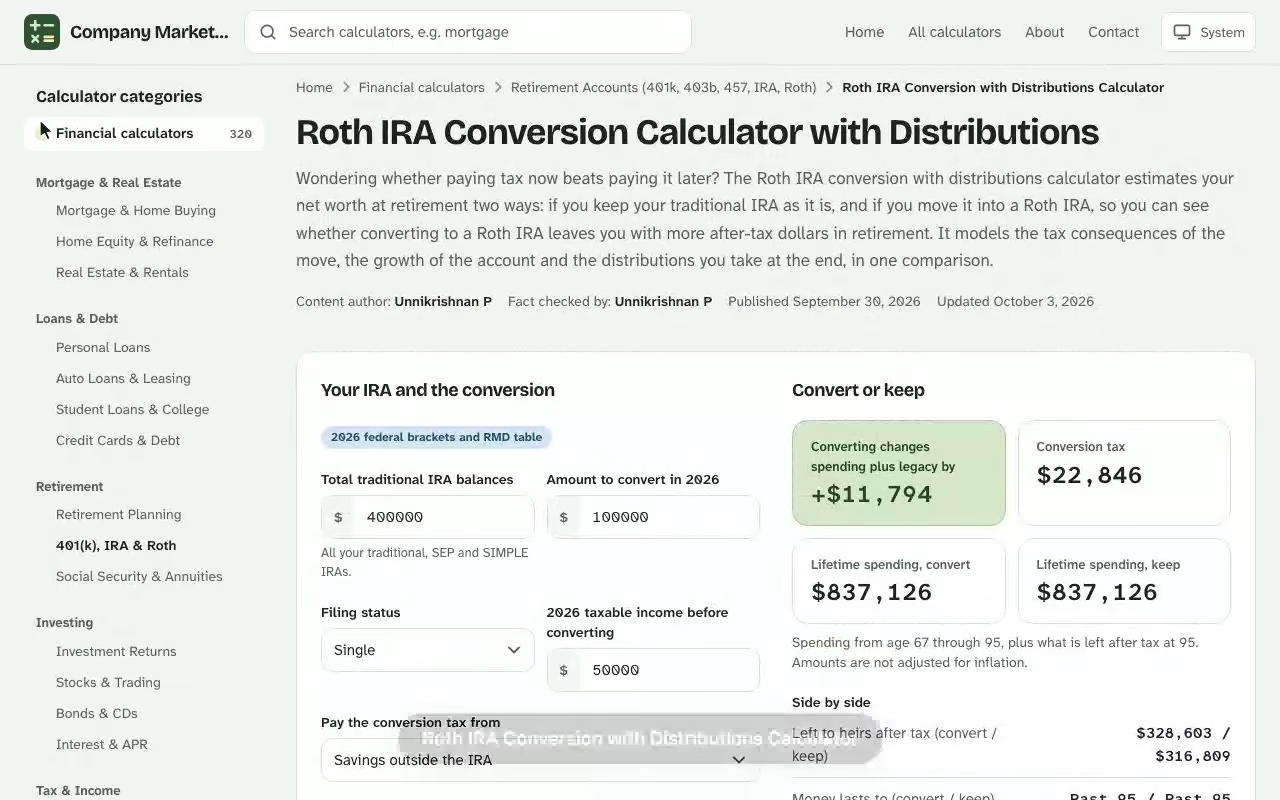
Roth IRA Conversion with Distributions Calculator. Wondering whether paying tax now beats paying it later? The Roth IRA conversion with distributions calculator estimates your net worth at retirement two ways: if you keep your traditional IRA as it is, and if you move it into a Roth IRA, so you can see whether converting to a Roth IRA leaves you with more after-tax dollars in retirement. It models the tax consequences of the move, the growth of the account and the distributions you take at the end, in one comparison. The roth ira calculator online uses the same plain-English approach, so you can compare results side by side.
Convert or keep
Converting changes spending plus legacy by
–
Conversion tax
–
Lifetime spending, convert
–
Lifetime spending, keep
–
Side by side
Left to heirs after tax (convert / keep)–
Money lasts to (convert / keep)–
First RMD (convert / keep)–
Tax on IRA withdrawals and RMDs (convert / keep)–
Taxable part of the conversion–
Federal / state tax on it–
Federal marginal rate–
Amount reaching the Roth IRA–
Each year’s RMD is taken first and unspent RMDs are reinvested in a taxable account; spending then comes from taxable savings, the traditional IRA and the Roth IRA, in that order. Roth IRAs have no RMDs for the owner. Not included: Medicare premium (IRMAA) and Social Security tax effects.
Year-by-year withdrawals
Spending, RMDs and the total of all accounts at the end of each year (traditional IRA before tax).
Age
Spending, convert
Spending, keep
RMD, convert
RMD, keep
Roth IRA
All accounts, convert
All accounts, keep
Results are estimates for educational purposes and are not financial, tax or legal advice.
How the Roth IRA Conversion with Distributions Calculator Works
Every Roth conversion is a trade: you accept a tax bill today in exchange for tax-free distributions later. The calculator puts a number on that trade by projecting the estimated future value of the same money under both paths, then stating each one in today's tax terms so the comparison is fair. Think of it as a Roth IRA conversion calculator that also reaches all the way to the withdrawal stage, so the tax on retirement distributions is part of the answer rather than an afterthought. Next, open the 72t sepp calculator and enter your own details to see an estimate in seconds.
Traditional IRA vs Roth IRA: Future Value Compared
With a traditional IRA, contributions were typically deducted, the earnings grow as deferred taxes, and every dollar you pull out in retirement is taxed as ordinary income. With a Roth IRA, you pay income taxes on the amount you convert in the year of conversion, and qualified distributions come out free of federal tax. The tool grows both balances at the same annual rate of return, so any gap in the result comes entirely from the tax treatment, not from investment choices.
Inputs: Starting Account Balance and Amount to Convert
You enter your starting account balance, the amount to convert, your current tax rate, the rate you expect when you take distributions, your current age, your retirement age and the expected return. You can convert your traditional IRA in full or only a slice of it, which matters when a full conversion would push you into a higher bracket. Tell the calculator whether you will pay the conversion bill from outside money or out of the IRA itself, because that single choice changes the outcome noticeably.
Roth IRA Conversion Calculator Formula
The projection behind a Roth IRA conversion calculator is compound growth followed by a tax step. For the traditional path, the balance grows and is then reduced by the marginal tax rate expected during retirement: The free ira spend or save calculator uses the same plain-English approach, so you can compare results side by side.
For the converted path, you pay the tax bill \(C \times t_{\text{now}}\) at conversion, and the Roth balance grows untouched:
$$\text{Roth value} = C \times (1 + r)^{n}$$
Here \(C\) is the amount you convert, \(r\) the annual return, \(n\) the years until you retire, \(t_{\text{now}}\) your rate today and \(t_{\text{ret}}\) your expected rate at retirement. If you pay the bill from outside money, that money would have kept growing in a taxable account on the traditional path, so the fair comparison adds its after-tax growth to the keep-it side. The conversion wins when your rate in retirement is higher than the effective cost of the tax you prepay.
Converting to a Roth IRA: A Worked Example at Age 51
Among IRA owners, picture one aged 51 who plans to retire at 66, so \(n = 15\) years. They choose an amount to convert of $64,000, face a 22% rate this year, expect 28% in retirement, and assume a 6.5% return. Outside savings cover the tax bill.
Item
Keep traditional IRA
Convert to Roth IRA
Amount in the IRA today
$64,000
$64,000
Tax paid at conversion
$0
$14,080
IRA balance after 15 years
$164,598
$164,598
Tax on distributions at 28%
$46,087
$0
After-tax IRA value
$118,510
$164,598
Outside savings kept (after tax)
$32,892
$0
Total net-worth at retirement
$151,402
$164,598
The conversion leaves this saver $13,196 ahead. Notice that the $14,080 tax bill, left alone in a taxable account, would have grown to $32,892, so a fair test charges the conversion for that lost growth, as this table does.
Keeping the traditional IRA ends at $151,402 once tax on distributions and outside savings are counted.See how the Roth IRA Conversion with Distributions Calculator works: change the inputs and the converting changes spending plus legacy by updates instantly. Enter your own numbers in the calculator above.
Marginal Tax Rate and Net Worth at Retirement
The result is most sensitive to the gap between the two rates. In this example the break-even rate in retirement is about 20.0%: below it, converting loses money; at 24% the advantage is $6,612, and at 32% it reaches $19,780. That is why the marginal tax rate you expect later matters more than the headline return.
Converting pulls ahead once your retirement tax rate passes about 20%.
Paying the Tax From the IRA Itself
If the same saver pays the $14,080 out of the IRA, only $49,920 stays invested and the Roth grows to $128,386, still $9,876 above the $118,510 traditional after-tax value. The advantage is smaller in dollar terms because less money is working for you, and withdrawals before age 59 1/2 can also trigger a 10% early-distribution penalty on the amount withheld.
Testing a Roth IRA Conversion With Distributions at Age 47
A single filer aged 47 holds $187,650 in a traditional IRA and wants to know if moving part of it into a Roth makes sense before a planned retirement at 65. Taxable income this year is $121,900, which sits in the 24% federal bracket that, for a single filer in 2025, runs up to $197,300. That leaves $75,400 of room before the next bracket, so a conversion has a clear ceiling.
In the Roth IRA conversion with distributions calculator they enter an amount to convert of $38,400, a 24% rate now, 28% expected at retirement, a 7% return and 18 years to go, with the tax bill paid from a savings account. The comparison returns:
Roth IRA value at 65: $129,789, free of tax on distributions.
Traditional IRA after tax at 28%: $93,448.
Tax due on the conversion: $9,216, which would have grown to $27,859 after tax in savings.
Net advantage for converting: $8,482.
The result only holds if the 28% guess holds, so the next run changes that single input. At 21% in retirement the advantage flips to a $604 shortfall, and the break-even rate works out to 21.5%. Since a 28% rate is well above that line, the conversion in this Roth conversion test passes, and the decision becomes a schedule: convert $38,400 this year, then repeat each year while taxable income stays under the $197,300 ceiling, instead of converting the whole $187,650 and pushing the extra dollars into a higher bracket.
Roth Conversion Rules: Distributions, Withdrawals and Penalties
The calculator assumes you follow the rules that make a distribution qualified. Withdrawals of earnings from a Roth IRA are tax-free only when the account has been open long enough and a trigger has been met; otherwise income tax, and sometimes penalties, apply to the earnings.
The 5 Years Rule and Age 59 1/2
Each conversion starts its own clock. Converted amounts withdrawn within 5 years, while you are under 59 1/2, can face a 10% penalty even though the conversion was already taxed. Earnings need the account to be at least 5 tax years old and you to be 59 1/2 or older, or to meet another qualifying event.
Each conversion starts its own 5-year clock in the year of conversion.
Qualifying Event: Death or Disability
Beyond age, a qualified distribution can also follow death or disability. The calculator assumes your distributions are qualified, so a withdrawal that misses age 59 1/2 or a qualifying event would shrink the Roth result it shows. The SECURE Act and the CARES Act changed related distribution rules, so check the current law before trusting an older projection.
Is an IRA Conversion Right for You? Advantages and Disadvantages
An IRA conversion has real advantages: tax-free growth, no required withdrawals during your lifetime from the Roth, and a tax-free inheritance for heirs. The disadvantages are just as real: a bigger bill on your tax return now, a possible jump in your bracket and the need for cash outside the account to pay it. The calculator's net-worth gap quantifies these trade-offs: it captures the tax-free growth and the upfront bill, though not the inheritance benefit, which is a reason to weigh the result beyond the number.
Lower Income Tax Year
The strongest case is a lower income tax year: a sabbatical, a business loss or the gap between a salary and the first Social Security check. Converting then fills up cheap brackets, and the calculator shows how much the lower rate adds to your total net worth at retirement.
Deferred Taxes and Income Level
Your income level decides how much of the conversion gets taxed at each rate, so enter the bracket you land in after the conversion is added to income as the current tax rate, not the one you pay today. The deferred taxes on a large traditional balance can be heavier than expected, and converting in slices over several years keeps that rate, and your income, inside one bracket.
Traditional to Roth IRA Conversion: Planning With a Tax Advisor
The estimate depends most on two inputs, your expected retirement tax rate and your return, so treat it as one input to your financial plan. A tax advisor, financial planner or financial advisor can check those two assumptions, your state tax and how a rollover from an employer plan fits. Re-run the calculator whenever your income, retirement savings balance or investment earnings assumptions change.
Roth IRA Conversion with Distributions Calculator questions
How does a Roth IRA conversion calculator work?
It grows the same amount at the same return two ways. The traditional path is reduced by the tax rate you expect when you take distributions; the Roth path is reduced once, by the tax due at conversion. The difference is the net advantage.
Is converting a traditional IRA to a Roth IRA taxable?
Yes. The amount you convert is added to your income for the year of conversion and taxed at your marginal rate, though no early-withdrawal penalty applies when the conversion is done correctly.
Should I pay the conversion tax from the IRA or from outside savings?
Outside savings usually give a better result because more money stays in the Roth to grow tax-free. Paying from the IRA shrinks the converted balance, and withdrawals before age 59 1/2 can add a 10% penalty.
What is the break-even retirement tax rate?
It is the retirement rate at which converting and keeping the traditional IRA end at the same net worth. If you expect a higher rate than that, converting tends to win.
What is the 5-year rule for Roth conversions?
Each conversion starts its own 5-year clock. Converted amounts withdrawn within 5 years while you are under 59 1/2 can face a 10% penalty, and earnings need the account to be at least 5 tax years old plus a qualifying event or age 59 1/2.
When does a Roth conversion make the most sense?
Often in a lower income tax year, when you expect a higher rate in retirement, and when you can pay the tax from outside savings.
Are the results a guarantee?
No. They are estimates from your inputs and assumptions, not a projection of performance. Check them with a tax advisor before converting.