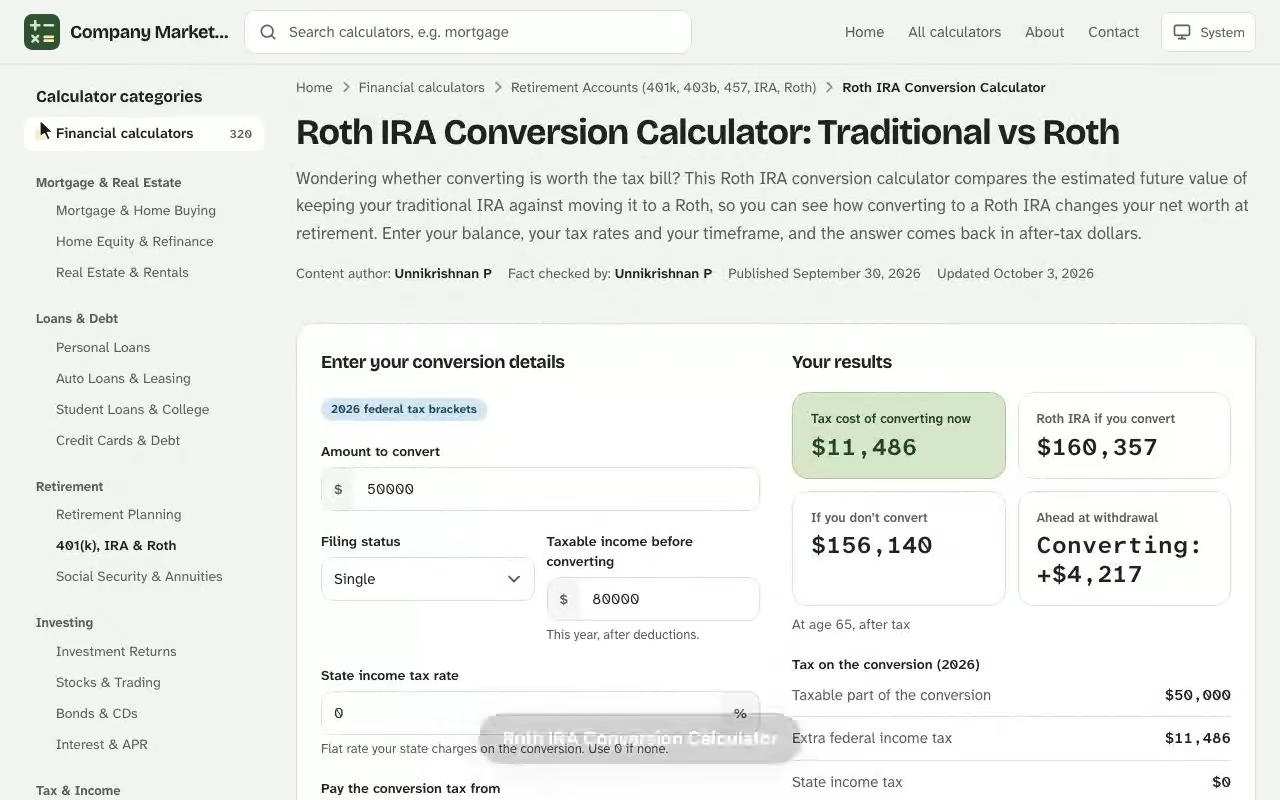
Roth IRA Conversion Calculator. Wondering whether converting is worth the tax bill? This Roth IRA conversion calculator compares the estimated future value of keeping your traditional IRA against moving it to a Roth, so you can see how converting to a Roth IRA changes your net worth at retirement. Enter your balance, your tax rates and your timeframe, and the answer comes back in after-tax dollars. Pair this with the free roth ira calculator for a fuller picture before you make a decision.
Your results
Tax cost of converting now
–
Roth IRA if you convert
–
If you don’t convert
–
Ahead at withdrawal
–
You are under 59½, so the part withheld for tax is an early distribution and also owes the 10% additional tax. Paying from savings avoids this.
Tax on the conversion (2026)
Taxable part of the conversion–
Extra federal income tax–
State income tax–
10% additional tax on the withheld amount–
Effective rate on the conversion–
Federal marginal rate–
Room left in your current bracket–
Amount that reaches the Roth IRA–
Break-even retirement tax rate–
Not included: effects of the extra income on Medicare premiums (IRMAA), Social Security taxation, the senior deduction, credits and the 3.8% investment income tax. Each conversion starts its own 5-year period before converted amounts can be withdrawn under age 59½ without the 10% additional tax.
Convert or keep: year by year
Values at the end of each year, after the tax you would owe on withdrawal.
Age
Roth IRA (convert)
Traditional IRA after tax
Tax money invested
Don’t convert, total
Difference
Results are estimates for educational purposes and are not financial, tax or legal advice.
How a Roth IRA Conversion Changes Your Net Worth
A Roth IRA conversion moves pre-tax money out of a traditional IRA and into a Roth IRA. You owe income tax on the converted amount in the year you convert, and in exchange the Roth grows tax-free. Qualified withdrawals later are not taxed at all, while every dollar you pull from a traditional IRA is taxed as ordinary income. That trade is the whole decision: pay tax now at your current rate, or pay tax later at whatever rate applies in retirement. If you want to see how the figures change, the roth vs pre-tax account calculator online gives you an instant result you can adjust as you go.
Because the tax consequences land in two different years, comparing balances alone is misleading. A $100,000 traditional IRA and a $100,000 Roth IRA are not worth the same amount, since the first carries deferred taxes. The fair comparison converts both to after-tax dollars at the same retirement date, which is exactly what a calculator does.
Why your marginal tax rate matters most
Your marginal tax rate is the rate applied to your last dollar of income, and it is the rate a conversion is taxed at. If the rate you pay on the conversion is lower than the rate you expect on withdrawals, you tend to win when you convert your traditional IRA. If it is higher, you usually come out ahead by waiting. Growth and timeframe only scale the gap; they do not flip the answer.
Tax-free growth and your earnings
Once the money sits in a Roth, all earnings compound without a tax drag. A longer timeframe magnifies the tax-rate gap, because the same gap is applied to a larger final balance. That is why a conversion in your forties often has more to gain than one at sixty-five.
The Roth IRA Conversion Calculator Formula
Behind every Roth IRA conversion calculator are two future values measured after tax. For the traditional IRA you grow the starting account balance at the annual rate of return and then subtract the tax you will owe on withdrawal: The pension plan retirement options calculator uses the same plain-English approach, so you can compare results side by side.
Here \(B\) is the amount to convert, \(r\) the yearly return, \(n\) the years until your targeted retirement age, \(t_{now}\) your tax rate on the conversion and \(t_{ret}\) the rate you expect later. Subtract one from the other and the result simplifies to \(B \times (1 + r)^{n} \times (t_{ret} - t_{now})\), which is why the tax-rate gap decides the outcome.
Paying the tax out of pocket
If you cover the conversion tax with cash from outside the account, the whole balance stays invested. A fair comparison assumes that cash would otherwise have grown at the same rate, so the out of pocket and paid-from-balance versions of the calculation land on the same difference. Either way the net-worth gain is the same; the practical benefit of paying from savings is that more money sits inside the Roth, where it shelters future growth.
Worked Example: Converting to a Roth IRA at Age 50
Suppose you are 50, want to retire at 67 and hold $38,600 in a traditional IRA. You expect 6.25% a year, you would be taxed at 22% on the conversion, and you expect 24% on withdrawals in retirement. Run it through the formulas above:
Step
Traditional IRA
Converted Roth IRA
Amount to convert
$38,600
$38,600
Tax owed at conversion (22%)
$0
$8,492
Balance invested
$38,600
$30,108
Value at 67 (17 years, 6.25%)
$108,188
$84,387
Tax owed at withdrawal (24%)
$25,965
$0
After-tax future value
$82,223
$84,387
The converted Roth finishes $2,164 ahead, which is the 2-point rate gap multiplied by a balance that grew by a factor of 2.80. Had you expected a 12% rate in retirement instead, the same conversion would trail by about $10,819.
The Roth edge flips sign at the 22% conversion rate and grows with the timeframe.After-tax value at age 67 for the $38,600 worked example: the converted Roth finishes $2,164 ahead.
Inputs That Drive a Roth Conversion
Each field in the tool maps to a variable above, so it helps to know what to enter and how sensitive the result is to each one.
Starting account balance: the traditional IRA value you could convert, all of it or a portion.
Current tax rate: the marginal rate you would pay on the conversion, which includes the extra income the conversion adds.
Retirement tax rate: your best estimate of the rate on withdrawals, using your expected income level in retirement.
Annual rate of return: the growth you assume; the result is a projection, not a guarantee.
Retirement age: the date the comparison is measured at, which sets the timeframe.
Change one input at a time. Raising the return or the timeframe stretches both outcomes, but only a different tax rate can reverse which account wins.
Running a Roth Conversion Through a Sabbatical Year
Tomasz, 51, is taking eight months unpaid to restore a sailboat, so his taxable income this year will land well below normal. His traditional IRA holds $212,350, and he is deciding whether to use the lean year to convert $41,800 of it. He opens the calculator and enters $41,800 as the amount to convert, 12% as the current rate (the federal bracket his reduced income falls into), 22% as the rate he expects in retirement, 5.8% a year, and a retirement age of 65, which gives a 14-year timeframe.
The calculator reports a conversion tax of $5,016, leaving $36,784 to grow. At 65 the traditional route is worth $71,791 after tax, while the converted Roth reaches $80,995, a lead of $9,204. Because the rate gap is 10 points and the balance more than doubles, the Roth edge is large.
Before committing, he reruns the calculator with 24% in the current-rate field, which is what the extra income would cost if the conversion pushed him into the next bracket. The result flips to a $1,841 deficit for the Roth. That tells him the exact limit: the current-rate input has to stay at 12%, so the conversion must stay inside that bracket, and he checks his projected taxable income against the bracket ceiling, subtracts it from the ceiling and caps the amount to convert at that headroom. He also confirms with his tax advisor that he has $5,016 in a savings account for the bill, so the tax does not come out of the IRA itself. The next step is a smaller second conversion in the following tax year if any headroom remains.
Eligibility for a Traditional to Roth IRA Conversion
Since 2010 there has been no income cap on a traditional to Roth IRA conversion, so anyone who is eligible to hold a traditional IRA can convert. Pre-tax money in an employer-sponsored plan such as a 401(k), 403(b) or governmental 457(b) can also move through a qualified rollover. Once the money is in a converted Roth IRA, you can also skip required minimum distributions during your lifetime.
If you also hold after-tax or non-deductible contributions, the pro-rata rule treats all your traditional IRA balances as one pool, which changes how much of a conversion is taxable.
Taxes, the Five-Year Rule and Withdrawals
Withdrawals of converted money are tax-free when the account has been open five years and you are 591/2 or older, or when another qualifying event such as death or disability applies. Taking converted funds out too early can trigger penalties, so a conversion works best with money you will not need soon. A tax advisor can confirm how the added income affects credits, Medicare premiums and your bracket before you commit.
Key dates for the worked example: tax due at conversion, five-year clock, age 59½ and retirement.
Spreading a conversion over several years
Converting in slices keeps each year's income below the next bracket. A low-income year, such as a career gap or early retirement, is the classic window for a larger Roth conversion, because the deferred taxes are paid at an unusually low rate. Rerun the calculator for each slice, entering that slice as the amount to convert and its bracket rate as the current tax rate, and add up the results.
Advantages and Disadvantages of an IRA Conversion
In the calculator, the advantages show up as the Roth's higher after-tax future value whenever your retirement rate exceeds your current rate, and the disadvantages show up as the upfront tax and a negative result when it does not. Tax-free growth and no required minimum distributions add to that edge but are not in the formula. Whether the answer fits your retirement savings goals is a question for your financial advisor and your financial plan; any investment held inside the account stays the same after converting. Revisit the result as your income, growth assumptions and contributions change.
See how the Roth IRA Conversion Calculator works: change the inputs and the tax cost of converting now updates instantly. Enter your own numbers in the calculator above.
Before acting, write down your current tax rate, your expected retirement bracket and the cash available to pay the bill from a taxable account. If you cannot pay the tax from outside the IRA, a smaller conversion is usually safer. The comparison is only as good as the rates you feed in, so rerun it with a few taxes scenarios.
Roth IRA Conversion Calculator questions
What does a Roth IRA conversion calculator compare?
It compares the after-tax future value of leaving money in a traditional IRA with the value of the same money after you convert it to a Roth IRA and pay the tax today, measured at your retirement age.
When does converting to a Roth IRA make sense?
Usually when your tax rate on the conversion is lower than the rate you expect on withdrawals, for example in a low-income year. If your current rate is higher than your retirement rate, waiting tends to win.
Is there an income limit on a Roth conversion?
No. Since 2010 anyone with a traditional IRA, or pre-tax money in an eligible employer plan, can convert regardless of income.
Should I pay the conversion tax from the IRA or from savings?
Paying from savings keeps more money inside the Roth, where it grows tax-free. Paying from the converted balance shrinks the amount invested and, if you are under 59½, can trigger a 10% early-withdrawal penalty on the part withheld.
What is the five-year rule for converted money?
Converted amounts generally need to sit for five years, or you must be 59½ or older, to avoid a 10% penalty on withdrawing the converted principal. Earnings have their own qualified-withdrawal requirements.
Does the result guarantee my future balance?
No. It is a projection from the rate of return and tax rates you enter, not a guarantee of future performance. Laws and brackets can change.
Can I convert only part of my traditional IRA?
Yes. Many people convert in slices over several years to stay within a tax bracket. Enter each slice as the amount to convert and run the comparison again.