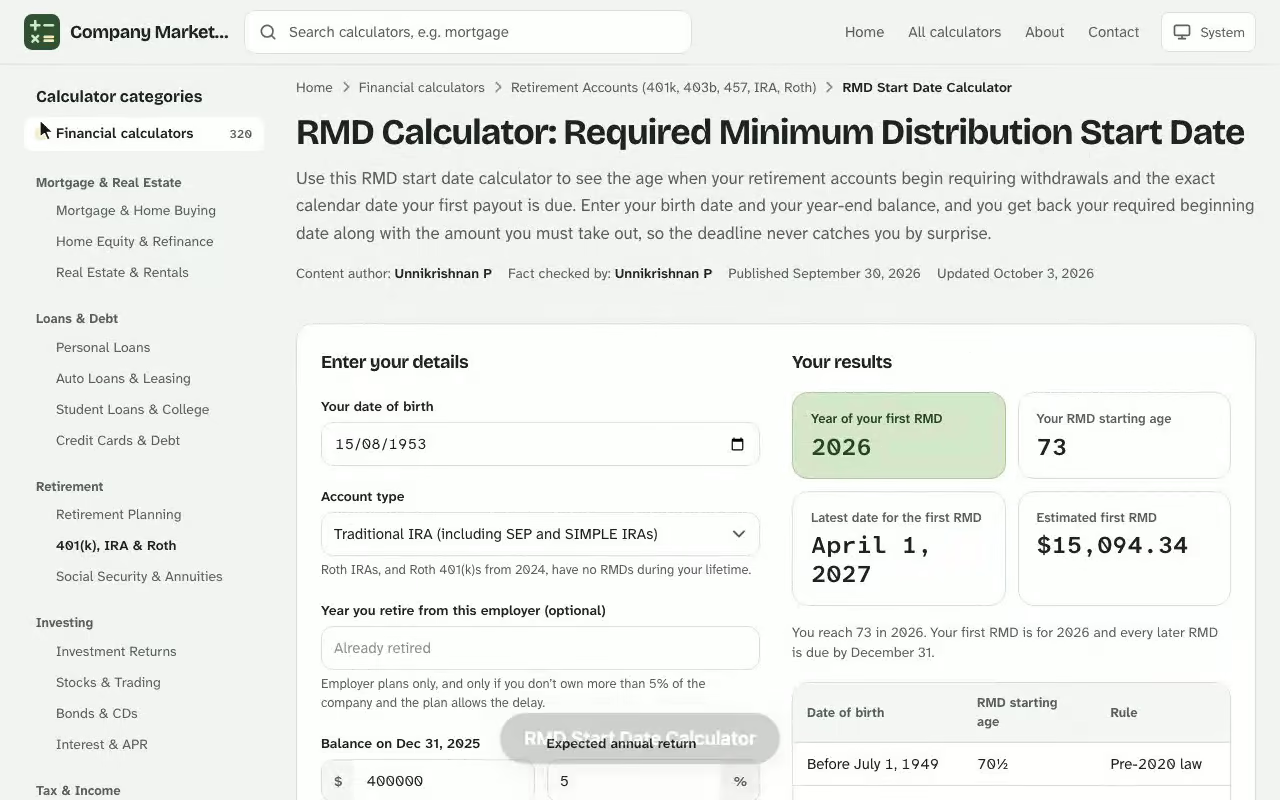
RMD Start Date Calculator. Use this RMD start date calculator to see the age when your retirement accounts begin requiring withdrawals and the exact calendar date your first payout is due. Enter your birth date and your year-end balance, and you get back your required beginning date along with the amount you must take out, so the deadline never catches you by surprise. Try the free rmd calculator to run your own numbers — everything is calculated in your browser and nothing you enter is stored or sent anywhere.
Your results
Year of your first RMD
–
Your RMD starting age
–
Latest date for the first RMD
–
Estimated first RMD
–
RMD starting age by date of birth
Date of birth
RMD starting age
Rule
Before July 1, 1949
70½
Pre-2020 law
July 1, 1949 to 1950
72
SECURE Act
1951 to 1959
73
SECURE 2.0 Act
1960 or later
75
SECURE 2.0 Act
Take the first RMD on time or delay it?
Waiting until April 1 puts two RMDs in the second year, and the second one is larger because the year-end balance wasn’t reduced by the first. Federal income tax uses the 2026 brackets for both years.
Choice
RMDs in first year
RMDs in second year
Federal tax, first year
Federal tax, second year
Total federal tax
Results are estimates for educational purposes and are not financial, tax or legal advice.
How the RMD Start Date Calculator Works
The IRS does not let tax-deferred savings sit untouched forever. Once you reach a certain age, you must begin pulling money out of most retirement accounts every year, and the rules for when that starts depend on the year you were born. This tool turns the rule into two answers: your RMD age and your deadline. If you want to see how the figures change, the spouse ira current year rmd calculator gives you an instant result you can adjust as you go.
Here is what you enter and what you get back:
Date of birth – sets your applicable age and the year your first distribution is due.
Account balance – the fair market value of the account on December 31 of the preceding calendar year.
Result – your required beginning date, the distribution period, and the RMD amount for that year.
Everything follows the life expectancy tables published by the IRS, so the figures match what a brokerage or plan administrator will calculate for the same account. Think of it as a quick check you can run before a custodian sends its own notice.
RMD Age by Birth Year: Age 73 vs Age 75
Congress has moved the starting point more than once in recent years, so two retirement savers with identical accounts can face very different timelines. The table below shows the applicable age for each birth year and the year you reach it. Try the beneficiary rmd payout options calculator online to run your own numbers — everything is calculated in your browser and nothing you enter is stored or sent anywhere.
Birth year
Applicable age
Year you reach it
1950
72
2022
1951 to 1959
73
2024 to 2032
1960 or later
75
2035 or later
See how the RMD Start Date Calculator works: change the inputs and the year of your first rmd updates instantly. Enter your own numbers in the calculator above.
Age 73 and Age 75 Under the SECURE Act 2.0
The SECURE Act 2.0, signed in December 2022, raised the starting point from 72 to age 73 and scheduled a second increase to age 75 for anyone born in 1960 or later. The original SECURE Act had already moved the starting point from 70½ to 72 in 2019. If you were born in 1959, the regulations treat 73 as your age, though a tax advisor can confirm how the transition applies to your situation.
Your Birthday Decides the Year
The rule looks at the year you reach the applicable age, not at whether your birthday has already passed. Someone who turns 73 on December 30 and someone who turns 73 on January 2 both count their first RMD year as the year of that birthday, even though one of them has barely held the age for a day.
Required Beginning Date: April 1 and December 31 Deadlines
Your required beginning date is April 1 of the calendar year after you reach your starting age. That is the latest day for your first withdrawal. Every later distribution is due by December 31 of its own year, with no extension.
Two Ways to Take Your First RMD
Take it during the year you reach your starting age, so the income lands in that tax year.
Wait until April 1 of the following year, and then take a second RMD by December 31 of that same year.
Waiting feels like extra time, but it stacks two taxable events into one year. Because both amounts count as ordinary income, the pair can lift your taxable income enough to push you into a higher tax bracket and may raise the portion of Social Security benefits that is taxed.
Employer Plans Such as 401(k)s Can Delay the Start
If you are still employed by the company that sponsors your plan and you own less than 5% of it, the plan may let you postpone distributions from that account until you retire, which is another way to delay your first RMD. That relief applies only to the current employer's plan, never to IRAs, so you will still owe distributions from your IRAs on the normal schedule. Plan terms govern, and some plans require distributions at the starting age regardless of employment.
Worked Example: Calculate Your RMD for the First Year
Suppose you were born on March 14, 1956. You reach age 73 on March 14, 2029, so your first RMD belongs to 2029 and your required beginning date is April 1, 2030. Your traditional IRA held $418,760 on December 31, 2028.
To calculate your RMD, divide the prior year-end balance by your distribution period:
$$\text{RMD} = \frac{\text{Account balance on December 31}}{\text{Distribution period}}$$
Uniform Lifetime Table and Distribution Period
For a 73-year-old, the Uniform Lifetime Table gives a distribution period of 26.5. Plugging in your numbers:
If you hold off on that first payout until April 1, 2030, you still owe the second RMD by December 31, 2030. Say your balance on December 31, 2029 was $431,215. At age 74 the table's period is 25.5:
RMD for
Year-end balance used
Distribution period
RMD
Due by
2029
$418,760
26.5
$15,802.26
April 1, 2030
2030
$431,215
25.5
$16,910.39
December 31, 2030
Total taxed in 2030
$32,712.65
Taking the first amount before December 31, 2029 would have kept $15,802.26 in 2029 income and left only $16,910.39 for 2030. Splitting the two across separate years is usually the gentler path unless you expect a much lower tax rate in the later year.
Using the RMD Calculator Each Year
Your obligation does not end after the first payout. Each January, you can return to this RMD calculator with your new year-end balance and get the amount for the current year. A balance that grows or shrinks, plus a longer age and a shorter distribution period, changes the figure every time.
Checking This Year and Next Year
Because the formula uses last year's closing value, you can estimate the amount due next year as soon as your statement arrives. Entering a projected December 31 balance lets you plan cash flow and decide whether to take one lump sum or monthly withdrawals.
Any required minimum distribution calculator is only as accurate as the balance you enter, so use the fair market value from your custodian's December 31 statement, not an estimate from memory. If a rollover, a conversion between IRAs, or a late price correction changed that value after year-end, ask the custodian to recalculate before you withdraw.
Planning a First RMD for a 1960 Birth Date
Dana Okafor, born October 9, 1960, is deciding in 2034 whether to retire from a school district job and wants to know when the IRS will start requiring withdrawals from a rollover IRA. They enter 10/09/1960 as the date of birth and a projected December 31, 2034 balance of $687,340.
The calculator returns an applicable age of 75, reached on October 9, 2035, so 2035 is the first RMD year and the required beginning date is April 1, 2036. Using the Uniform Lifetime Table's distribution period of 24.6 for age 75, the amount is $687,340 ÷ 24.6 = $27,940.65.
The result raises one question: wait until April 1, 2036, or take it in 2035? Dana changes a single input, a projected December 31, 2035 balance of $712,900, and reruns the figure for age 76, where the period is 23.7. That gives $30,080.17 for 2036. Delaying would put both payouts, $27,940.65 plus $30,080.17, or $58,020.82, on the 2036 return.
Take it in 2035: $27,940.65 lands in 2035 and $30,080.17 in 2036, so no single year carries both amounts.
Delay to April 1, 2036: one extra distribution in 2036 and a $58,020.82 total.
Missing the date entirely would trigger the 25% excise tax, about $6,985 on the first amount alone, or 10% if corrected promptly. Dana decides to schedule the $27,940.65 withdrawal for December 2035, then moves the date into a calendar reminder.
Which Retirement Accounts Require RMDs
Most tax-deferred accounts carry RMDs, while Roth accounts generally do not during the original owner's lifetime. Each rule below comes from IRS guidance:
Traditional IRA, SEP IRA and SIMPLE IRA accounts, whose owner must start on schedule
401(k)s, 403(b)s and 457(b) plans, plus profit-sharing and other qualified plans
Roth IRA accounts: no RMDs for the owner, but beneficiaries must follow the rules
Any defined contribution plan, with the balance measured separately for each one
Rollover IRAs that hold pre-tax money from an old employer
With several IRAs, calculate each one individually and then take the total from one account or spread it across several. Employer plans must be satisfied plan by plan, so a 403(b) distribution cannot cover an IRA, and an IRA withdrawal does not count toward a 401(k).
Planning Withdrawals Around Your Required Minimum Distribution
Knowing your start date early gives you years to prepare. Savers who treat the first distribution as a surprise tend to take whatever the custodian suggests, while those who plan ahead can shape the tax impact.
Withdrawals count as ordinary income, so estimate your total taxable income before choosing between a first-year and a delayed payout.
You can always withdraw more than the minimum, but extra withdrawals do not reduce the next year's requirement.
An RMD cannot be rolled into another retirement account, so decide in advance whether it funds living expenses, a taxable investment account, or a charitable gift.
Talk to a financial professional if your RMD pushes you near a bracket boundary.
Careful planning also helps with state taxes and with any tax withholding you elect on the distribution.
How RMDs Fit Into Your Retirement Income
Your start date marks the year RMDs begin, so it also marks when a predictable income stream turns on. Because RMDs rise as the distribution period shrinks, they cover a growing share of retirement spending, and the calculator's first-year figure shows how large that stream starts. Planning for RMDs early keeps them from crowding out other income.
Missed Required Minimum Distributions: Excise Tax and Penalty
If you miss your start-date deadline, skip a withdrawal or take too little, the IRS charges a 25% excise tax on the shortfall. Correcting the mistake in a timely way can reduce the penalty to 10%, and you report it on Form 5329. Under the old rule the charge was 50%, so today's rate is lighter, but it is still a cost that a quick check of your deadline each year avoids entirely.
Spouses and Beneficiaries: Do the RMD Rules Change?
If your spouse is more than ten years younger and is your only beneficiary, you can use the Joint Life and Last Survivor table, which lowers the amount. Where the spouse is closer in age, or you are unmarried, the Uniform Lifetime Table applies. A designated beneficiary of an inherited IRA usually follows a separate schedule, often the 10-year rule, and a surviving spouse can sometimes treat the account as their own. Check Publication 590-B for single life expectancy factors or work the numbers by hand with the life expectancy tables.
RMD Start Date Calculator questions
At what age do I have to start taking RMDs?
It depends on your birth year. If you were born in 1950 the age is 72, from 1951 through 1959 it is 73, and for 1960 or later it is 75 under the SECURE Act 2.0.
What is my required beginning date?
It is April 1 of the calendar year after you reach your RMD age. Every later RMD is due by December 31 of that year.
Can I wait until April 1 for my first RMD?
Yes, but you must then take a second RMD by December 31 of the same year. Two distributions in one year can raise your taxable income and push you into a higher tax bracket.
How is an RMD calculated?
Divide your account balance on December 31 of the prior year by the distribution period for your age from the IRS Uniform Lifetime Table.
Which accounts require RMDs?
Traditional, SEP and SIMPLE IRAs, 401(k), 403(b) and 457(b) plans and other defined contribution plans. Roth IRAs have no RMDs for the original owner.
What if my spouse is more than ten years younger?
If your spouse is your sole beneficiary and more than ten years younger, you use the IRS Joint Life and Last Survivor table, which gives a smaller RMD.
What happens if I miss an RMD?
The IRS charges a 25% excise tax on the amount not withdrawn, reduced to 10% if you correct it promptly. You report it on Form 5329.
Do I need to take an RMD from every account?
You calculate each IRA separately but can withdraw the total from one or several IRAs. Employer plans such as a 401(k) must be satisfied plan by plan.