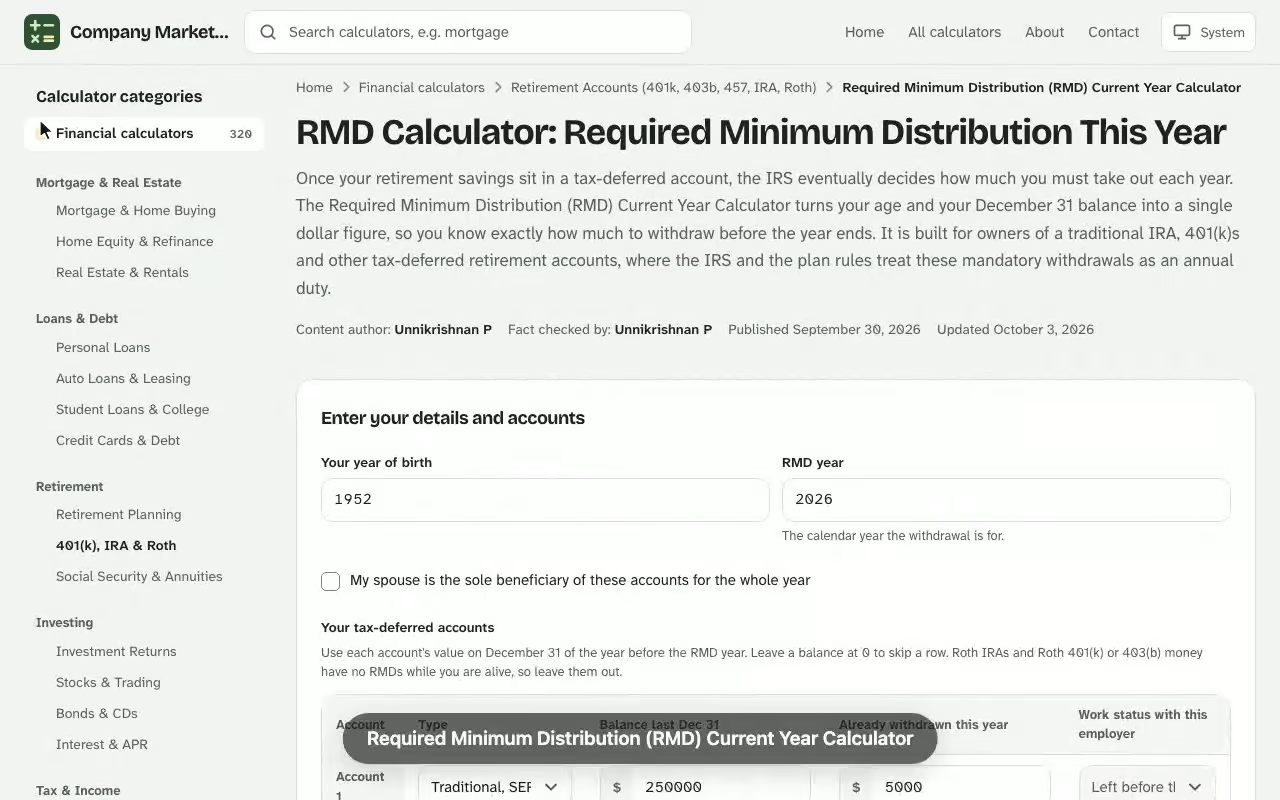
Required Minimum Distribution (RMD) Current Year Calculator
Required Minimum Distribution (RMD) Current Year Calculator. Once your retirement savings sit in a tax-deferred account, the IRS eventually decides how much you must take out each year. The Required Minimum Distribution (RMD) Current Year Calculator turns your age and your December 31 balance into a single dollar figure, so you know exactly how much to withdraw before the year ends. It is built for owners of a traditional IRA, 401(k)s and other tax-deferred retirement accounts, where the IRS and the plan rules treat these mandatory withdrawals as an annual duty. Try the free rmd calculator to run your own numbers — everything is calculated in your browser and nothing you enter is stored or sent anywhere.
Your RMD for this year
Total RMD
–
Still to withdraw
–
Deadline
–
Age at year-end
–
Distribution period
–
First RMD year (age)
–
Where each withdrawal can come from
IRA RMDs can be added together and taken from any of your IRAs, and 403(b) RMDs from any of your 403(b)s. A 401(k), 457(b) or other plan must pay out its own RMD. A withdrawal from one kind of account never counts toward another kind.
Group
RMD
Withdrawn
Still to take
Take it from
Deadline
RMD by account
Account
Type
Balance last Dec 31
Divisor
RMD
Status
If you miss it
Shortfall if nothing more is withdrawn–
Excise tax at 25%–
Excise tax at 10% if corrected in time–
The excise tax is 25% of the RMD you didn't take. It drops to 10% if you withdraw the missed amount and report the tax on Form 5329 within the correction window, which generally ends after two years. You can also ask the IRS to waive it for reasonable error if you fix the shortfall.
Results are estimates for educational purposes and are not financial, tax or legal advice.
Using the Required Minimum Distribution (RMD) Current Year Calculator Step by Step
An RMD calculator uses two inputs and one table. The first input is the fair market value of the account on December 31 of the previous year. The second is your age at the end of the distribution year. The IRS publishes a life expectancy factor for that age, and dividing the balance by the factor gives the required withdrawal. The same distribution period logic applies whether the money sits in an IRA or an employer plan. If you want to see how the figures change, the pension calculator online gives you an instant result you can adjust as you go.
The formula the required minimum distribution calculator applies is short:
$$\text{RMD} = \frac{\text{Account balance on December 31}}{\text{Life expectancy factor}}$$
Because the factor shrinks every year you age, the share of the account you must withdraw grows slowly over time. At 73 the factor is 26.5, which means about 3.8% of the balance has to leave the account.
Uniform life expectancy and the factor table
Most owners use the uniform life expectancy table, called the Uniform Lifetime Table. It assumes your beneficiary is about ten years younger than you, so it needs no information about who inherits the account.
Age on December 31
Life expectancy factor
Share of balance withdrawn
73
26.5
3.77%
74
25.5
3.92%
75
24.6
4.07%
76
23.7
4.22%
77
22.9
4.37%
78
22.0
4.55%
Year of RMD and owner's birthdate
The year of RMD is normally the current year, though you can change it to review a past or future year. Your owner's birthdate matters because the calculator reads your age as of December 31 of that year, not your age today.
Required Minimum Distributions: When They Start
The starting age depends on your birthdate, and SECURE 2.0 moved it twice. The earlier SECURE Act had already raised it from 70½ to 72. Here is where each group lands today: The inherited ira stretch rmd projection calculator is free to use with no sign-up, and works on desktop and mobile.
Birthdate
Age RMDs begin
Before July 1, 1949
70½
July 1, 1949 to December 31, 1950
72
1951 through 1959
73
1960 or later
75
Your first distribution is due by April 1 of the year after you reach that age. Delaying means you take two distributions in one tax year, which can push you into a higher bracket, so many owners take the first RMD before December 31 of the year they reach age 73. Owners in the 1960 group reach age 75 before the clock starts. Earlier rules at age 72 and age 70 1/2 only matter if you were born long ago. After that, every distribution is due by December 31.
Calculate Your RMD: A Worked Example
Suppose you turn 73 in 2026 and your traditional IRA was worth $463,825.00 on December 31, 2025. To calculate your RMD, look up the factor for age 73, which is 26.5, and divide.
Your RMD amount for 2026 is $17,502.83, or about $1,458.57 a month if you spread it evenly. To calculate your required minimum distribution for the following years, assume a 5% hypothetical rate of return on whatever remains. That projection gives you a future projection of the projected RMDs and the projected account balance:
Year
Age
Factor
Starting balance
RMD
2026
73
26.5
$463,825.00
$17,502.83
2027
74
25.5
$468,638.28
$18,377.97
2028
75
24.6
$472,773.32
$19,218.43
2029
76
23.7
$476,232.64
$20,094.20
Notice the withdrawals rise even though the balance barely moves. The shrinking factor does the work, which is why a withdrawal strategy built around these figures beats guessing.
Which Retirement Accounts Require an RMD
Not every account follows the same rule. You owe a distribution from these retirement accounts:
A traditional IRA, including a rollover IRA that holds any pre-tax money
A SEP or SIMPLE plan
Employer plans such as a 401(k), a 403(b), and a profit sharing plan
An inherited IRA, depending on the beneficiary and the date of death
A Roth IRA owner never has to withdraw, and Roth accounts in employer plans lost their requirement starting in 2024. If you hold several IRAs, you calculate each one, add the results, and withdraw the total from any of them. Each employer plan needs its own withdrawal. Moving money through a rollover, a conversion or a transfer after year-end can change the balance, so confirm the figure with your custodian.
Checking a Custodian's Year-End Notice with the RMD Calculator
A retiree turning 76 in 2026 gets a year-end statement from her brokerage and wants to confirm the amount her custodian says she owes before she schedules the withdrawals. The statement lists her rollover IRA at $618,240.17 on December 31, 2025.
She opens the RMD calculator, sets the year of RMD to 2026, enters her birthdate of March 9, 1950, and types the balance into the amount subject to RMD field. Her spouse is only four years younger, so the sole-beneficiary box stays unchecked and the Uniform Lifetime Table applies. The calculator reads her age on December 31, 2026 as 76 and pulls the factor from IRS Publication 590-B: 23.7.
$$\frac{618{,}240.17}{23.7} = 26{,}086.08$$
The result, a required minimum distribution of $26,086.08, matches the custodian's notice to the cent, so she stops worrying about a calculation error. The figure also shows what is at stake: the 25% excise tax on a missed withdrawal would be $6,521.52, which equals one quarter of the requirement.
See how the Required Minimum Distribution (RMD) Current Year Calculator works: change the inputs and the total rmd for 2024 updates instantly. Enter your own numbers in the calculator above.
That number drives her next step. She splits the requirement into four withdrawals of $6,521.52 on the first business day of each quarter, which finishes the job by October rather than leaving it to the last week of December. Then she reruns the calculator with the year set to 2027 and a 4% hypothetical return, which projects a lower balance and a factor of 22.9, to see that next year's requirement is about $26,893 before deciding how much to move into cash.
Inherited IRA RMD Calculator Rules
Beneficiaries need a different path, and an inherited IRA RMD calculator asks who you are before it asks anything else. Since 2020, most non-spouse heirs fall under the 10-year rule: the account must be empty by the end of the tenth year after the original account owner died. If the owner had already started RMDs, you also take yearly withdrawals inside that window.
An eligible designated beneficiary is exempt from that cap and can stretch withdrawals over a life expectancy. The list includes surviving spouses, minor children, disabled individuals, chronically ill individuals and heirs within ten years of the owner's age. Everyone else counts as a designated beneficiary under the 10-year rule.
Sole beneficiary and spouse more than 10 years younger
If your sole beneficiary is your spouse and is more than ten years younger, you may use the Joint Life table, which gives larger factors and smaller withdrawals. Enter the spouse's birthdate and the calculator handles the difference. Otherwise follow the worksheet in IRS Publication 590-B.
RMD Penalties and Deadlines
Missing a withdrawal is expensive. The excise tax is 25% of the amount you failed to take, and it falls to 10% if you correct the shortfall promptly. On a $17,502.83 requirement, a full miss costs about $4,375.71 in penalty tax before you even pay income tax on the withdrawal.
The deadline is December 31 each year. The CARES Act briefly offered a waiver for 2020, but that relief has ended. Withdrawals are taxed as ordinary income, which carries real tax implications for your bracket and for the retirement income you report.
Planning Annual Withdrawals Around Your RMD Amount
The figure the calculator returns is the floor of your annual withdrawals, not a ceiling. In the example, $17,502.83 is the least you must take in 2026, and the number is the starting point for retirement planning: rerun it every January, because each new year-end value changes the answer.
Funding that amount is an investment decision. Some owners keep the next year's requirement in cash-like holdings so they never sell at a bad moment, and a financial planner or an investment professional can set up recurring withdrawals sized to the calculated figure.
Spreading the withdrawal across the year
You may take your RMD in one lump, monthly, or quarterly, as long as the total is in by year-end. Monthly payments smooth cash flow, while a single late-year withdrawal leaves the money invested longer. For the earlier example, quarterly payments would be $4,375.71 each, rounded to the cent.
Reading the projection and the compounded rate of return
The calculator's output lists projected distributions year by year, and some tools draw them as a stacked column graph. The projection rests on the return you enter, and a compounded rate of return is an average: a losing year shrinks next year's requirement, while a strong year raises it. That is why the 2027 to 2029 rows in the earlier table should be rechecked each January rather than trusted as a forecast.
Required Minimum Distributions From Qualified Retirement Plans
When you enter the amount subject to RMD, the kind of plan decides which account you total. All qualified retirement plans, including individual 401(k)s, 403(b)s and Keogh plans, use the same factor table, but each plan produces its own requirement and must be withdrawn from separately. The IRS spells out the method in its RMD FAQ page and in Publication 590-B, and the IRS comparison chart contrasts IRAs with defined contribution plans.
If your own figure differs from your custodian's, the usual cause is a December 31 value that moved after year-end, such as a late-posted price correction the IRS allows the custodian to apply. Ask the plan administrator for the value it used, then rerun the calculation with that number. Keep the printed results with your tax records so the RMDs you withdrew can be matched to your return.
Plan Type, Rate of Return and Other Calculator Inputs
Several inputs shape the report you see. The plan type tells the tool whether a requirement exists at all. The amount subject to RMD is the December 31 balance. The hypothetical rate of return only drives the forecast, never the current-year number. Check the calculation notes and definitions that come with each field if a result looks off, and review the report for every year at once.
Keep in mind that a rate of return is a guess, and investments carry risk. Treat the projection as a planning aid, and talk to a tax advisor, a financial advisor or a CPA before acting on it, especially for a pension, an annuity or an inherited account.
Required Minimum Distribution (RMD) Current Year Calculator questions
What is a required minimum distribution?
A required minimum distribution (RMD) is the least amount the IRS requires you to withdraw each year from most tax-deferred retirement accounts once you reach your starting age.
How is my RMD calculated for the current year?
Divide your account balance from December 31 of the previous year by the life expectancy factor for the age you reach this year, taken from the IRS Uniform Lifetime Table.
At what age do RMDs start?
Under SECURE 2.0 the starting age is 73 if you were born from 1951 through 1959, and 75 if you were born in 1960 or later.
Do I need an RMD from a Roth IRA?
No. Original owners of a Roth IRA never have to take RMDs, and Roth accounts in employer plans have been exempt since 2024. Inherited Roth accounts follow beneficiary rules.
What happens if I miss my RMD?
The IRS applies a 25% excise tax to the amount you failed to withdraw. It can drop to 10% if you correct the shortfall in a timely way.
What if my spouse is more than 10 years younger than me?
If your spouse is your sole beneficiary and is more than 10 years younger, the IRS Joint Life table in Publication 590-B usually gives a lower required amount than the Uniform Lifetime Table.
Can I take my RMD from any of my IRAs?
Yes. Calculate the RMD for each IRA, add them together, and withdraw the total from any one or more of them. Employer plans such as a 401(k) must each be withdrawn from separately.