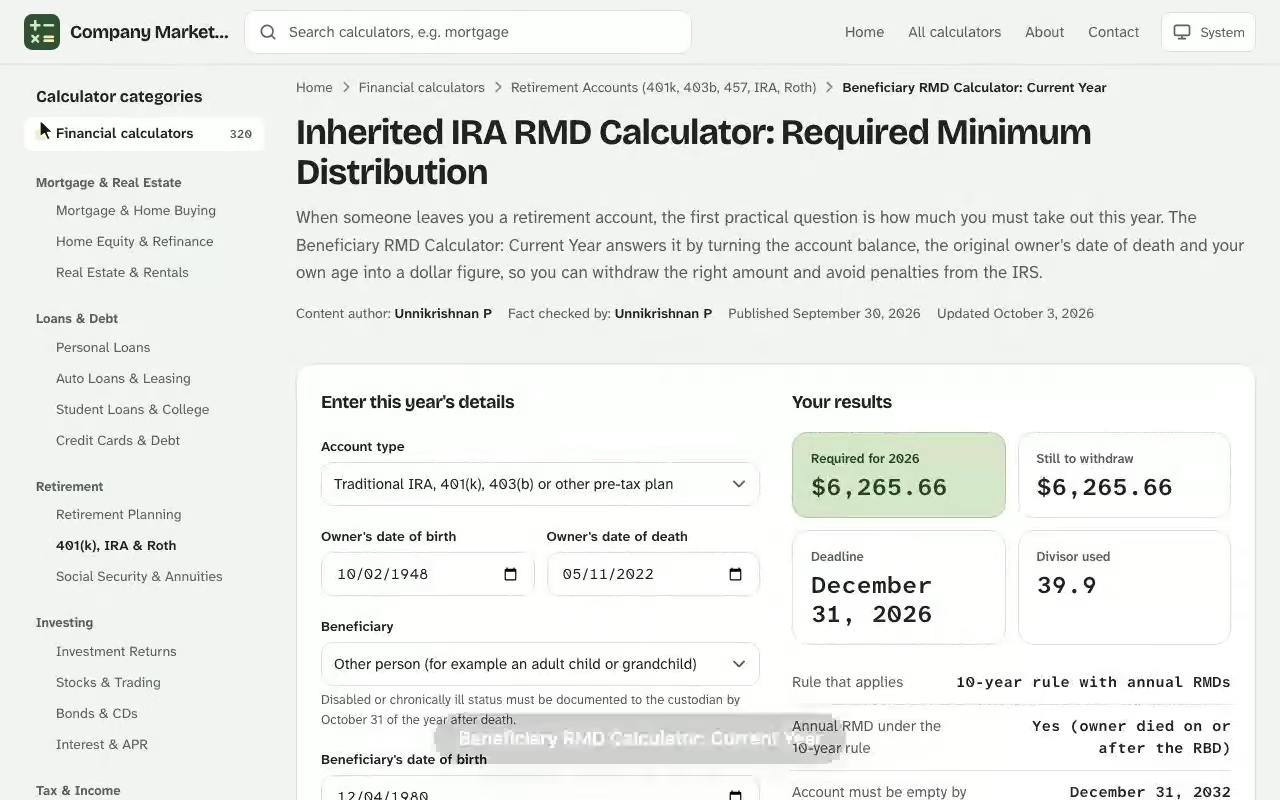
Beneficiary RMD Calculator: Current Year. When someone leaves you a retirement account, the first practical question is how much you must take out this year. The Beneficiary RMD Calculator: Current Year answers it by turning the account balance, the original owner's date of death and your own age into a dollar figure, so you can withdraw the right amount and avoid penalties from the IRS. Try the rmd calculator online to run your own numbers — everything is calculated in your browser and nothing you enter is stored or sent anywhere.
Your results
Required this year
–
Still to withdraw
–
Deadline
–
Divisor used
–
Rule that applies–
Annual RMD under the 10-year rule–
Account must be empty by–
Excise tax if the rest is missed–
The excise tax on a missed RMD is 25% of the shortfall, cut to 10% if you take it and file a corrected return within the correction window. Assumes one beneficiary for the whole account.
Results are estimates for educational purposes and are not financial, tax or legal advice.
How an Inherited IRA RMD Calculator Works
An inherited IRA RMD calculator applies one core idea: divide last year's closing balance by a divisor the IRS assigns to your situation. The divisor depends on who you are to the original account owner, how old each of you was, and whether the owner had already started taking their own distributions. Every other detail on the screen exists to find the right divisor. Pair this with the inherited ira stretch rmd projection calculator for a fuller picture before you make a decision.
$$\text{RMD} = \frac{\text{Account balance on December 31 of the prior year}}{\text{Life expectancy factor}}$$
The result is an estimate. Calculators rest on assumptions, such as a single beneficiary, a current-year distribution and a balance you type in yourself, so always check the figure against your custodian's statement.
Inputs You Need Before You Calculate Your RMD
Gather these facts first, because each one changes the divisor or the deadline:
The original account owner's date of birth and date of death
Your relationship to the account holder and your own birthday
The account balance on December 31 of the year before the one you are calculating
The year of the distribution you want to calculate
Whether the owner had already reached their RMD age (73 if born 1951 to 1959, 75 if born in 1960 or later)
What Each Result Tells You
A calculator can return one of three outcomes. It can show a yearly amount, tell you no annual distribution is due but the account must be empty by a deadline, or show that you may withdraw on your own schedule. Providers such as Schwab split the job in two: an inherited IRA distribution rules calculator first decides which category you fall into, and a separate tool then produces the dollar amount.
Required Minimum Distribution Rules for Every Beneficiary Type
The required minimum distribution you owe depends on how you are classified as a beneficiary. The categories below follow IRS Publication 590-B and the final SECURE Act regulations. Try the pension vs lump sum payout calculator to run your own numbers — everything is calculated in your browser and nothing you enter is stored or sent anywhere.
Spousal Beneficiary Options
A spouse has the widest set of RMD options. If you are the sole beneficiary, you can treat the account as your own IRA and begin distributions at your own RMD age. You can also keep it as an inherited account in your name, which lets you delay distributions until the year your late spouse would have reached RMD age, or begin in the calendar year after they passed away. A spouse who is the sole beneficiary and more than 10 years younger than the owner can use the IRS joint-life worksheet instead of the single-life table.
Non-Spouse Beneficiary Options
A non-spouse beneficiary such as an adult child, a friend or a niece normally falls under the 10-year rule. You do not get a lifetime stretch. Instead you must withdraw the balance of the account by December 31 of the year that marks the 10th anniversary of the owner's death.
Eligible Designated Beneficiary Rules
Some non-spouse heirs qualify for the older life-expectancy payout. An eligible designated beneficiary is a minor child of the owner, a disabled or chronically ill person, or an individual who is not more than 10 years younger than the owner, such as a sibling. These heirs can stretch withdrawals over their own life expectancy, which keeps the yearly amount small and lets you defer taxes on the rest.
See how the Beneficiary RMD Calculator: Current Year works: change the inputs and the required for 2026 updates instantly. Enter your own numbers in the calculator above.
Estate, Entity or Trust as the Heir
When the heir is an estate, a charity or a trust that does not qualify for look-through treatment, the rules turn on the owner's age at death. If the owner had already begun required distributions, the payout runs over the owner's remaining life expectancy. If not, the account generally has to be emptied within five years, and the calculator reports that deadline instead of a yearly amount.
Beneficiary RMD Calculator: Current Year Worked Example
Here is a complete calculation with figures chosen only for this guide. A woman passed away in 2025 at age 64, before her required beginning date, and her brother is the beneficiary. He is not more than 10 years younger than she was, so he is an eligible designated beneficiary and may use his own life expectancy. He turns 60 in 2026, and the account closed 2025 at $386,742.18.
The IRS Single Life Expectancy Table in Publication 590-B gives a factor of 27.1 for age 60. Because the first payout year is the year after death, 2026 is the first distribution year:
$$\frac{\$386{,}742.18}{27.1} = \$14{,}270.93$$
In each later year, you subtract 1 from the previous factor rather than looking up your new age. The table below assumes the remaining balance grows 5% a year, which is only an assumption for illustration.
Year
Factor
Starting balance
RMD
2026
27.1
$386,742.18
$14,270.93
2027
26.1
$391,094.81
$14,984.48
2028
25.1
$394,915.85
$15,733.70
2029
24.1
$398,141.26
$16,520.38
2030
23.1
$400,701.92
$17,346.40
Notice what happens when the balance does not grow at all. The divisor falls by 1 every year and the balance falls by one RMD, so the yearly amount stays at $14,270.93 until the funds run out. Growth is what makes later RMDs climb.
How the Balance and Your Age Move the Result
The balance moves the RMD in a straight line, while age moves it through the divisor. At a $386,742.18 balance, a 55-year-old heir would divide by 31.6 and take $12,239, while a 70-year-old divides by 18.8 and takes $20,571. A younger heir therefore withdraws less each year and keeps more invested.
Yearly RMD by balance and age; the outlined cell is the worked example.
How to Calculate Your RMD After a Parent's Death
Dana, 54, lost her father in March 2025. He was 77 and had been taking his own distributions for years, so the account sits past his required beginning date. She opens the calculator in January 2026 with his statement beside her and one question: does she owe anything this year?
She enters his date of death, her own birthday (she turns 55 in 2026) and the December 31, 2025 balance of $214,583.47. Because she is an adult child, not a spouse or an eligible designated beneficiary, the result screen puts her under the 10-year rule with annual distributions required, since her father had already started RMDs.
The tool looks up age 55 in the IRS Single Life Table, finds a factor of 31.6, and divides:
$$\frac{\$214{,}583.47}{31.6} = \$6{,}790.62$$
That is her minimum for 2026. Dana checks it against the penalty reference on the same screen: skipping it would cost 25% of the shortfall, or $1,697.65, which would fall to $679.06 at the 10% rate if she corrected it in time. She also notes the rest of the balance, $207,792.85 after the withdrawal, must be gone by December 31, 2035.
Her decision is concrete. She asks the custodian to send $6,790.62 in November, after her year-end bonus lands, and has her tax preparer add it to her 2026 income. Next January she will rerun the calculation with a factor of 30.6, because the divisor drops by one each year rather than being looked up again from her new age.
Inherited IRA Distribution Rules Calculator and the 10-Year Withdrawal Period
The 10-year withdrawal period is where most confusion starts, because it behaves differently depending on the owner's status when they died. An inherited IRA distribution rules calculator checks the owner's date of death against their required beginning date and sorts your account into one of two cases.
Annual Distributions in Years One to Nine
If the owner died on or after their required beginning date, a non-spouse beneficiary must take annual distributions in years one through nine, using their own life expectancy as the divisor, and then withdraw the balance by the end of year ten. Missing a year in this case is the mistake that most often creates a penalty.
The 10-year clock for a non-spouse heir.
No Annual Distribution Requirement Before the Deadline
If the owner died before their required beginning date, there is no yearly minimum. You may take nothing for nine years or spread withdrawals as you like, so long as the account is empty on December 31 of the tenth year. Roth IRAs follow this version, since a Roth owner never has lifetime RMDs.
Withdrawal Rules for the Employer Plan Heir
Beneficiaries of a 401(k), 403(b) and other employer retirement plans, which are defined contribution plans, follow the same categories, but the plan administrator, not an IRS worksheet, often applies them. The same divisor-and-balance calculation applies once the plan confirms your category, using the plan's December 31 balance. Check the plan's summary before you assume IRA treatment, because some plans require a faster payout.
Inherited Retirement Account Mistakes That Trigger Penalties
An inherited retirement account is unforgiving about missed deadlines. The excise tax on a missed RMD is 25% of the amount you should have withdrawn, and it drops to 10% if you correct the shortfall within the correction window. The IRS can also waive it for reasonable cause when you file the right form.
Using your own birthday and the Uniform Lifetime Table, which applies to owners, not to an inherited account
Rolling a non-spouse inheritance into your own IRA, which is not allowed
Forgetting that the 10-year clock starts the year after death, not the year of death
Ignoring a balance split between several custodians, since each inherited account needs its own calculation
Special relief existed for 2020, when COVID-19 legislation waived required minimum distributions and that year did not count toward the five-year or ten-year clocks. Treat that as a historical exception, not a standing rule.
Next Steps After You Calculate Your Inherited IRA RMD: Taxes and Professionals
Every distribution from a traditional account is taxed as ordinary income, so the RMD is also a tax decision. A larger inherited balance can push you into a higher bracket in the years you are forced to withdraw, which is why many heirs plan the timing of extra withdrawals rather than taking only the minimum.
Confirm your beneficiary classification and the owner's required beginning date.
Re-title the account as an inherited IRA, never into your own name.
Use the calculator once a year after you receive the December 31 balance.
Withdraw the amount before December 31, and keep the custodian's confirmation.
Review the investment mix, since the yearly amount you just calculated has to come out as cash.
No online tool replaces a qualified tax professional or financial professional. The IRS also publishes its own worksheet, and Publication 590-B lists the full divisor tables. Calculators like this one provide estimates, not tax advice, so confirm the figure before you move any money.
Beneficiary RMD Calculator: Current Year questions
How do I calculate a beneficiary RMD for this year?
Divide the account balance on December 31 of the prior year by the life expectancy factor that applies to your beneficiary type. The calculator picks the factor for you from the IRS Single Life Table.
Who has to take annual RMDs from an inherited IRA?
Spouses and eligible designated beneficiaries use life expectancy. Other non-spouse heirs take annual RMDs only if the owner had already reached their required beginning date; otherwise they just need to empty the account within 10 years.
What is the 10-year rule for inherited accounts?
Most non-spouse beneficiaries must withdraw the entire balance by December 31 of the tenth year after the owner's death.
What happens if I miss an inherited IRA RMD?
The excise tax is 25% of the amount you should have withdrawn, reduced to 10% if you correct the shortfall promptly. The IRS may waive it for reasonable cause.
Does the divisor change each year?
For most non-spouse heirs you look up your age once, in the year after death, then subtract 1 each following year. A spouse who treats the account as inherited uses a new age-based factor every year.
Do Roth IRAs have beneficiary RMDs?
Yes. A Roth owner never has lifetime RMDs, so heirs are treated as if the owner died before the required beginning date. Non-spouse heirs follow the 10-year rule without annual minimums.
Can I use this for a 401(k) inheritance?
The rules are similar, but a plan can require a faster payout, so check your plan administrator's terms before relying on the result.