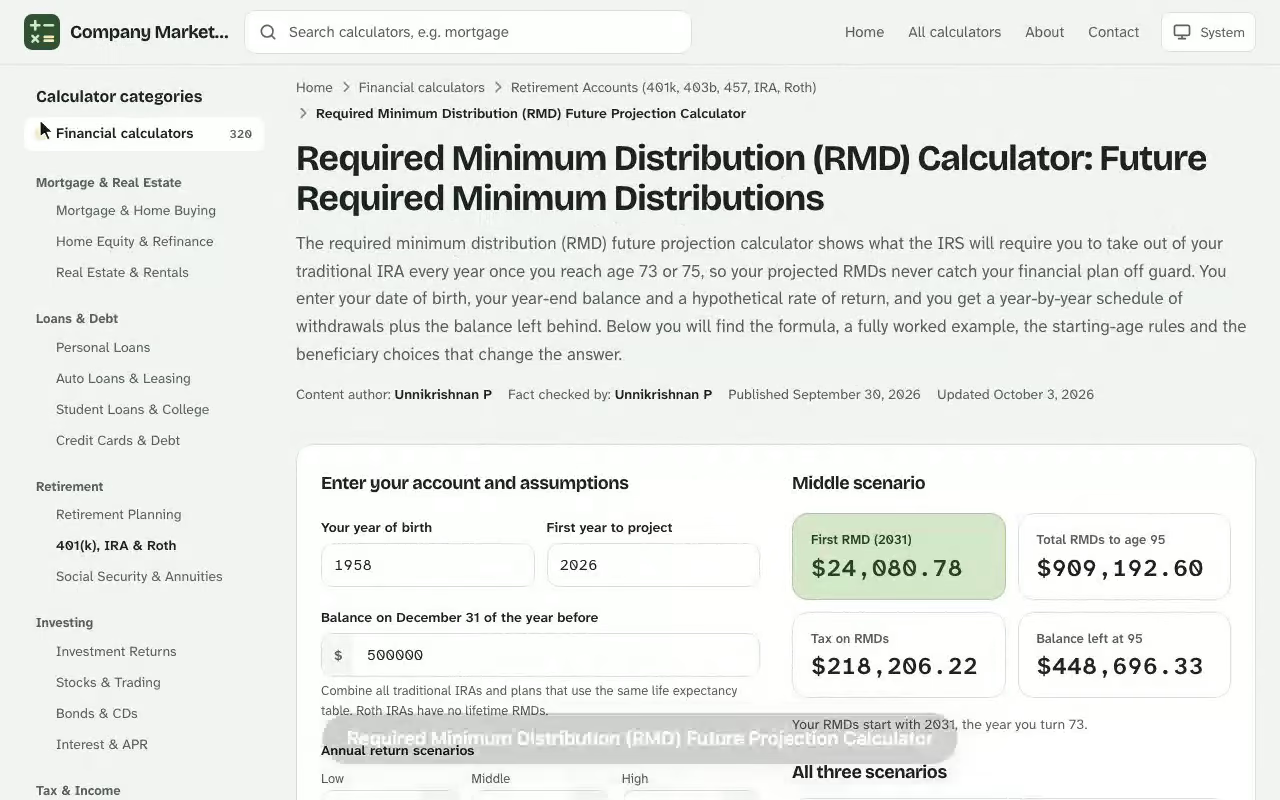
Required Minimum Distribution (RMD) Future Projection Calculator
Required Minimum Distribution (RMD) Future Projection Calculator. The required minimum distribution (RMD) future projection calculator shows what the IRS will require you to take out of your traditional IRA every year once you reach age 73 or 75, so your projected RMDs never catch your financial plan off guard. You enter your date of birth, your year-end balance and a hypothetical rate of return, and you get a year-by-year schedule of withdrawals plus the balance left behind. Below you will find the formula, a fully worked example, the starting-age rules and the beneficiary choices that change the answer. Next, open the rmd calculator and enter your own details to see an estimate in seconds.
Middle scenario
First RMD
–
Total RMDs
–
Tax on RMDs
–
Balance left
–
All three scenarios
Scenario
First RMD
Largest RMD
Total RMDs
After tax
Balance left
Assumes you withdraw only the RMD each year, at year-end, and that your spouse stays your sole beneficiary. Actual returns vary from year to year.
Year-by-year projection
Year
Age
Balance Dec 31 prior year
Divisor
RMD for the year
Withdrawn in the year
Tax
After tax
Balance Dec 31
Results are estimates for educational purposes and are not financial, tax or legal advice.
How the Required Minimum Distribution (RMD) Future Projection Calculator Works
A plain required minimum distribution calculator that only answers "how much this year?" is useful once. A projection answers a bigger question: how large will your annual withdrawals become, and will your savings last as they grow? The tool starts from your balance today, grows it at the return you choose until your first distribution year, divides by an IRS factor, and then repeats that step every year until the age you set as your assumed age at death. Pair this with the free rmd and stretch ira calculator for a fuller picture before you make a decision.
Each row in the result is built from the same three inputs: the account balance at the end of the prior year, your age on December 31, and the life expectancy factor that goes with that age. Because the balance changes every year, the schedule is a projection, not a promise. Treat it as a planning range for retirement planning and rerun it with a lower and a higher return.
Inputs you enter
Owner's birthdate – decides your starting age and the age used each year.
Previous year end value – the balance of your retirement accounts on December 31.
Hypothetical rate of return – the yearly growth you expect, usually between 0% and 12%.
Plan type – traditional IRA, SEP, SIMPLE, 401(k), 403(b) or Roth IRA.
Beneficiary birthdate – only needed when a spouse is the sole beneficiary.
What you get back
You get a report with the distribution for every year, the remaining balance after each withdrawal and a total of the withdrawals over your lifetime. Many people review the first ten years separately, because that is the window in which a large required minimum distribution can push you into a higher tax bracket.
Required Minimum Distribution Formula and the Uniform Lifetime Table
The arithmetic behind every row is a single division. The IRS takes your balance on December 31 of the previous year and divides it by the distribution period listed for your age in the Uniform Lifetime Table. If you want to see how the figures change, the spouse ira current year rmd calculator gives you an instant result you can adjust as you go.
The factor shrinks as you age, which means the percentage of your account you must withdraw rises every year. At age 73 the factor is 26.5, so you withdraw about 3.8% of the balance; at age 85 the factor is 16.0, and the share climbs to 6.25%.
Account balance and life expectancy factor
Your balance is the fair market value of the account on December 31. Your life expectancy factor comes from the Uniform Lifetime Table unless your only beneficiary is a spouse more than ten years younger than you, in which case a different, joint-life table gives a larger factor and a smaller withdrawal. The calculator applies the right table automatically once you tick the spouse box.
Hypothetical rate of return
The return you enter does not change the factor, but it changes the balance the factor is divided into. A 7% return produces larger annual withdrawals than a 3% return, even though the factor is identical. Pick a conservative number, since actual returns vary widely and inflation erodes what each withdrawal can buy.
Projected first distribution at age 73 across balance and return assumptions.
Worked Example: Projected Required Minimum Distributions From Age 73
Suppose you were born in 1958 and held $684,300 in a traditional IRA on December 31, 2025. You expect a 5% return, make no further contributions and take each withdrawal on December 31. Born in 1958, you turn 73 in 2031, so your first distribution is based on the balance at the end of 2030.
Growing $684,300 at 5% for five years gives $873,359 on December 31, 2030. Dividing by the age-73 factor of 26.5 produces a first-year distribution of $32,957. The remaining balance, grown for another year, becomes the starting point for 2032, and so on down the table.
Key dates in the worked RMD future projection, from today's balance to the tenth distribution.
Year
Age
Prior year-end balance
Factor
RMD
2031
73
$873,359
26.5
$32,957
2032
74
$884,070
25.5
$34,669
2033
75
$893,605
24.6
$36,325
2034
76
$901,959
23.7
$38,057
2035
77
$909,000
22.9
$39,694
2036
78
$914,756
22.0
$41,580
2037
79
$918,914
21.1
$43,550
2038
80
$921,309
20.2
$45,609
2039
81
$921,765
19.4
$47,514
2040
82
$920,340
18.5
$49,748
How the first-year RMD fits between the opening and closing balance.
Across these ten years the projected withdrawals add up to $409,703. The balance keeps rising until it peaks at $921,765 at the end of 2038, then declines because each distribution outruns the 5% growth.
See how the Required Minimum Distribution (RMD) Future Projection Calculator works: change the inputs and the first rmd (2024) updates instantly. Enter your own numbers in the calculator above.
Reading the schedule as the account owner
Compare each row with the retirement income you actually need. In 2031 the account owner in this example must withdraw an RMD of $32,957, which may be more than that year's spending requires. The IRS only cares that the RMD leaves the IRA; it does not say where the cash goes. The surplus can move to a taxable brokerage account as a new investment, or build up other assets such as a cash reserve. Either way the withdrawal is taxable, so fold it into your wider financial picture before you plan the spending. If your spouse is a second account owner with their own IRA, run the calculator for them too and add the two schedules to see household retirement income.
Assumed age at death and the balance that remains
The assumed age at death tells the calculator where to stop. Extending the same example to age 86 leaves $876,642 in the account, so under this return the money is not exhausted. Lower the return to 2% and rerun it to see how much faster the balance shrinks.
Plan type and the owner's birthdate
If you choose a Roth IRA as the plan type, no distribution is calculated for you as the original owner, because Roth accounts have no mandatory withdrawals during your lifetime. Every other plan type follows the traditional schedule, and the owner's birthdate alone decides when it begins.
When Required Minimum Distributions Start: Starting Age by Birth Year
The SECURE Act and SECURE 2.0 moved the starting age twice, so the year of your birth matters. SECURE 2.0 changed only the age at which required minimum distributions begin; it did not change how they are calculated.
Birthdate
Starting age
On or before June 30, 1949
70½
July 1, 1949 through December 31, 1950
72
January 1, 1951 through December 31, 1959
73
January 1, 1960 or later
75
In the year you reach your starting age you may delay the first withdrawal until April 1 of the next year. Doing so means two minimum withdrawals land in the same tax year, which can raise your bracket, so many savers take the first one by December 31 instead. If you were born in 1960 or later, your first distribution waits until age 75, two years later than in the 1958 example above, and the IRS applies the same factor table from that point. The CARES Act waived distributions for 2020 only, and the waiver no longer affects a projection.
Weighing an April 1 Delay Against Two Minimum Withdrawals in One Year
Dolores, a retired machinist born in 1952, turned 73 in 2025 and is deciding whether to use the April 1 deadline the IRS allows for a first distribution. Her traditional IRA held $538,419 on December 31, 2024, and she assumes a 4% return. She wants the calculator's projected schedule to show what each choice does to her 2026 income before she touches the account.
She enters her birthdate, the $538,419 balance and the 4% return into the calculator, then runs it twice. The projected schedule gives her 2025 distribution as $538,419 divided by the age-73 factor of 26.5, or $20,318. Taking it in 2025 leaves $539,638 at year-end, and the 2026 distribution at age 74 comes to $539,638 divided by 25.5, or $21,162.
Delaying changes the second line. If the first distribution waits until April 1, 2026, nothing leaves the account in 2025, so the year-end balance is $559,956 and the 2026 figure rises to $21,959. Both withdrawals now land in one tax year: $20,318 plus $21,959 is $42,277 of taxable income from the IRA in 2026, against $21,162 if she takes the first one on time.
Delay: $42,277 in 2026, nothing in 2025.
No delay: $20,318 in 2025 and $21,162 in 2026.
Gap in 2026 income: $21,115.
The IRS treats the April 1 date as a deadline for the first distribution only; missing it would trigger the 25% excise tax on the shortfall. Dolores takes the $20,318 in December 2025 and keeps 2026 at $21,162, then reruns the calculator in January with her actual year-end statement so the 2027 figure rests on a real balance instead of her 4% estimate.
Spouse and Designated Beneficiary Rules in Projected RMDs
Who inherits the account changes the schedule after you die, and it can change your own factor while you are alive. The calculator therefore asks for a beneficiary even though the first lines of the report depend only on you.
Sole beneficiary is a spouse
When your spouse is the only beneficiary, they can roll the account into their own IRA and keep taking withdrawals on their own schedule, using the Uniform Lifetime Table. A rollover cannot include any distribution that was still due for the year of death. If the spouse is more than ten years younger, the joint table lowers your own distribution.
Eligible designated beneficiaries and the 10-year rule
Most non-spouse heirs are a designated beneficiary and must empty the inherited IRA by the end of the tenth year after the owner's death. This is the 10-year rule. Certain eligible designated beneficiaries, such as a minor child, a disabled or chronically ill person, or someone less than ten years younger than the owner, may take distributions over a longer period. Annual withdrawals inside the ten years are required only if the owner had already started taking them.
Stretch IRA strategy
A stretch IRA keeps the smallest legal distribution going for as long as the law allows. It suits people who do not need the whole account for living expenses, though the figures stay hypothetical and tax rules can change.
Penalties, Tax and Withdrawal Strategy for Projected Withdrawals
Excise tax and the 25% penalty
If you withdraw less than the amount due, an excise tax applies to the shortfall. Under SECURE 2.0 this 25% penalty drops to 10% if you correct the mistake promptly and file Form 5329. The earlier rate was 50%, so the change is significant, but avoiding any penalty is far cheaper. The yearly RMD in your projected schedule is the amount to withdraw to stay clear of it.
Ordinary income and tax-deferred growth
Because the money grew tax-deferred, every dollar you take out is taxed as ordinary income at your personal federal rate, and state tax may apply. A large projected distribution can raise your taxable income enough to affect your Medicare premiums, so the schedule is a useful input for a withdrawal strategy. Withdrawals cannot be rolled back into an IRA; you can invest the cash in a taxable account, save it or give it to charity.
Talking to a tax advisor
The calculator gives a hypothetical illustration, not advice. A tax advisor can confirm which account to draw from first, since you may total the amounts for several traditional IRAs and withdraw them from one, while a 403(b) must be handled separately. Print the projected schedule and hand it over, so you can plan together which account to draw from each year.
Accounts That Need an RMD Projection
You should run a projection for every pre-tax account, because the rules apply to these types:
Traditional, rollover and inherited IRAs
SEP and SIMPLE IRAs
Qualified plans such as a 401(k), 403(b) or profit-sharing plan
A Roth IRA is exempt for the original owner, and Roth accounts in employer plans also lost the requirement from 2024. Past performance is no guide, since market risk and rising prices can both change the balance, so run the RMD calculator again each year when your new December 31 statement arrives.
Required Minimum Distribution (RMD) Future Projection Calculator questions
What does the RMD future projection calculator estimate?
It estimates the required minimum distribution for the year you choose and projects the following years until the age you set as the owner's assumed age at death, using your balance, rate of return and the IRS Uniform Lifetime Table.
At what age do required minimum distributions start?
It depends on birthdate: 70 1/2 for those born on or before June 30, 1949, 72 for July 1, 1949 through 1950, 73 for 1951 through 1959, and 75 for 1960 or later.
How is an RMD calculated?
Divide the account balance on December 31 of the previous year by the distribution period for your age at the end of the RMD year in the IRS Uniform Lifetime Table.
What is the penalty for missing an RMD?
A 25% excise tax applies to the amount not withdrawn, which can drop to 10% if the shortfall is corrected promptly. Check current IRS guidance with a tax advisor.
Do Roth IRAs have required minimum distributions?
Roth IRA owners are not required to take distributions during their lifetime, and Roth accounts in employer plans no longer require them from 2024. Inherited Roth accounts follow beneficiary rules.
Why does the rate of return matter in a projection?
The return does not change the IRS factor, but it changes the balance that factor divides, so a higher assumed return produces larger projected withdrawals.
Does a spouse beneficiary change the result?
If your only beneficiary is a spouse more than 10 years younger, the IRS joint life table can lower the RMD. This calculator uses the Uniform Lifetime Table and notes when the joint table may apply.