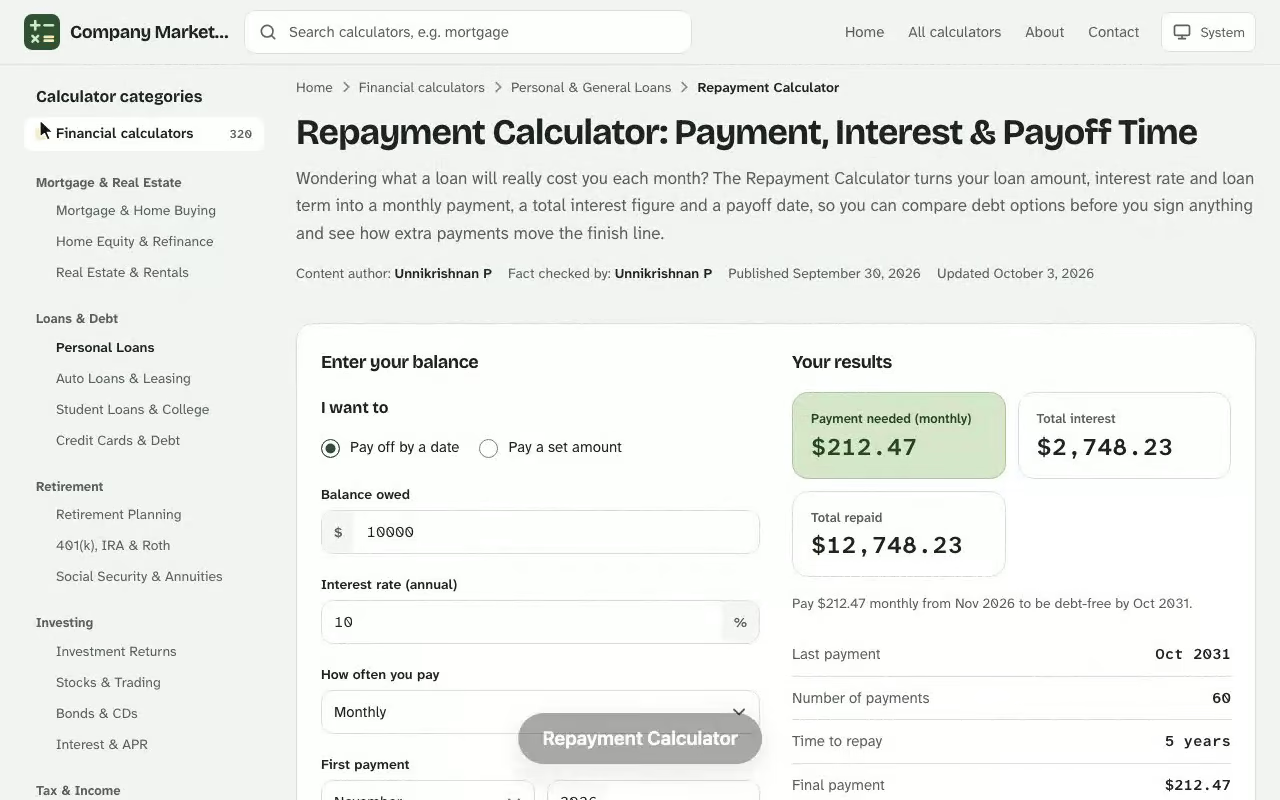
Repayment Calculator. Wondering what a loan will really cost you each month? The Repayment Calculator turns your loan amount, interest rate and loan term into a monthly payment, a total interest figure and a payoff date, so you can compare debt options before you sign anything and see how extra payments move the finish line. The payment calculator uses the same plain-English approach, so you can compare results side by side.
Your results
Payment needed
–
Total interest
–
Total repaid
–
Last payment–
Number of payments–
Time to repay–
Final payment–
Repayment schedule
Calendar-year totals, or every payment with its date.
Year
Payments
Principal
Interest
Ending balance
Results are estimates for educational purposes and are not financial, tax or legal advice.
How a Loan Repayment Calculator Works
A loan repayment calculator takes the money you borrowed and splits every payment you make into two parts: the interest the lender charges for borrowing, and the principal that actually reduces what you owe. Early in a loan most of each payment goes to interest. Later the balance flips, and most of it attacks the principal. Seeing that split in advance is what makes a calculator more useful than guessing. Try the loan comparison calculator online to run your own numbers — everything is calculated in your browser and nothing you enter is stored or sent anywhere.
Loan Amount, Interest Rate and Loan Term
Every estimate rests on three numbers. Get them from your loan agreement or your lender's account page, and the result will match your statement closely.
See how the Repayment Calculator works: change the inputs and the debt-free by updates instantly. Enter your own numbers in the calculator above.
Loan amount is the starting balance you owe, including any fees that were rolled into the loan.
Interest rate is the yearly percentage the lender charges on the unpaid balance; the calculator converts it to a monthly rate.
Repayment term is how long you have to pay the loan back, measured in months or years.
Change any one of them and the monthly payment, the total interest and the payoff date all move together. A longer loan term lowers each payment but raises the cost of borrowing, while a higher rate raises both.
The Monthly Payment Formula
For a standard loan with equal payments, the monthly installment comes from one equation:
$$M = P \times \frac{r\,(1+r)^{n}}{(1+r)^{n} - 1}$$
Here \(M\) is the monthly payment, \(P\) is the loan amount, \(r\) is the monthly rate (the yearly rate divided by 12) and \(n\) is the number of monthly payments. If you instead fix the payment and want to know how long repayment takes, rearrange it:
Total interest is simply \(M \times n - P\), the sum of all payments minus the money you originally borrowed.
Worked Example with a Loan Payment Calculator: $23,480 Over 72 Months
Suppose you borrow $23,480 at 6.85% for 72 months (six years). The monthly rate is \(0.0685 \div 12 = 0.570833\%\), so the formula gives a payment of $398.62. Across 72 payments you hand over $28,700.76, which means the borrowing costs you $5,220.76 in interest, about 18.2% of everything you pay. Pair this with the free personal loan calculator for a fuller picture before you make a decision.
The first payment shows the split clearly. Interest on the full balance is \($23,480 \times 0.570833\% = $134.03\), so only $264.59 of that first $398.62 reduces the principal. By the final payment, the interest portion is a few dollars.
Year-by-Year Amortization Table
An amortization table lists how amortization plays out period by period. Grouped by year, this loan looks like this:
Year
Interest paid
Loan balance at year end
1
$1,506.77
$20,203.32
2
$1,275.14
$16,694.99
3
$1,027.13
$12,938.66
4
$761.59
$8,916.79
5
$477.27
$4,610.60
6
$172.86
$0.00
Each year's payments total $4,783, but the interest slice shrinks from $1,506.77 to $172.86.
Reading Your Results
Look at the interest column first. Year one costs almost nine times what year six does, which is why paying down the principal early saves so much. Then check the balance column: after three years, about 45% of the loan is repaid, and the remaining balance is the figure a lender would ask for if you decided to pay off the loan at that point.
Fixed Installments or Fixed Loan Term in a Payment Calculator
Most tools let you solve the problem from either end. Pick the one that matches the question you are actually asking, because the same loan can answer "what will I pay?" or "when will I be done?".
Fixed Loan Term
With a fixed loan term, you choose the number of months and the tool returns the payment needed to reach a zero balance on time. It suits a decision such as whether a shorter or longer schedule makes more sense for the same $23,480 at 6.85%:
Loan term
Monthly payment
Total interest
Total repaid
48 months
$560.63
$3,430.01
$26,910.01
60 months
$463.27
$4,316.34
$27,796.34
72 months
$398.62
$5,220.76
$28,700.76
84 months
$352.66
$6,143.18
$29,623.18
96 months
$318.37
$7,083.50
$30,563.50
Stretching the repayment term from 48 to 96 months cuts the payment by $242.26 but adds $3,653.49 of interest.
Monthly payment on $23,480 by interest rate and loan term, with the 6.85% and 72-month example outlined.
Fixed Installments
With fixed installments, you enter the amount you can send each month and the tool tells you how many payments it takes. This is the natural choice when your disposable income sets the budget and your monthly installments can't exceed a fixed number. Putting $450 a month toward the same loan ends it in 63 payments with $4,475.10 of interest. At $500 a month it ends in 55 payments, with $3,931.98 of interest.
Testing a Refinance Quote with a Payment Calculator
Dara Okafor has 48 payments left on a truck loan: a $17,862 balance at 8.15%, currently $437.32 a month. A credit union has quoted 6.49% over 48 months, with a $175 fee rolled into the new loan. The quote looks cheaper, but the fee muddies the comparison, so Dara runs both loans through the calculator.
For the current loan, Dara enters 17,862, 8.15% and 48 months. The tool returns $437.32 a month, or $20,991.47 over the remaining term. For the refinance, the loan amount becomes $18,037 once the fee is added, with 6.49% and 48 months. The payment drops to $427.66, and the total comes to $20,527.84.
Current loan: $437.32 a month, $20,991.47 in total
Refinanced loan: $427.66 a month, $20,527.84 in total
Difference: $9.66 a month and $463.63 over four years
The saving is real but modest, so Dara tests a more aggressive idea: refinancing into 36 months at 8.15% to be done sooner. Entering 36 months and 8.15% into the tool returns a payment of $560.97. With a $1,380 rent payment and a gross income of $5,200 a month, housing plus the truck would be $1,940.97, or 37.3% of income, above the 36% debt-to-income guideline many lenders use. At the $427.66 payment, the same ratio is 34.8%, inside it.
That settles the decision. Dara accepts the 48-month, 6.49% quote, keeps the payment under the 36% line, and plans to send the $9.66 monthly difference back toward principal so the loan ends sooner than scheduled.
Student Loan Calculator Basics for Federal and Private Student Loans
Education debt follows the same math, but the rules around it differ, so a student loan calculator needs a few extra assumptions.
Federal Loans and Standard Repayment
Federal loans carry a single fixed rate for the life of the loan, and the standard repayment schedule generally runs 10 years with equal payments, which is exactly what the formula above models. Other options include extended repayment, which stretches the schedule for a lower payment, and graduated repayment, which starts low and steps up. Income-driven repayment ties the payment to your earnings and may lead to forgiveness after many years, but it does not follow a fixed amortization, so a simple calculator can't estimate it accurately. Your servicer can confirm which plans you qualify for, and a borrower with several balances may choose to consolidate them into one.
Private Student Loans: Fixed Rate or Variable Rate
Many private student loans let you choose between fixed interest rates, which never change, and variable interest rates, which follow a benchmark rate such as the SOFR index or the prime rate plus a margin. A variable rate loan can start cheaper, but the payment can climb later. The rate you are offered depends on your creditworthiness and on a co-signer, if you have one. In the calculator, enter today's variable rate as the interest rate, then re-run it one or two points higher to see the range your payment could reach.
One more caution: a typical estimate ignores the grace period and the time in school, when interest may accrue and later be capitalized, meaning it is added to your principal. If that applies to you, enter the balance you will owe when repayment starts, not the amount you first borrowed. If you are working with multiple student loans, run each one separately and add up the payments.
Using a Loan Calculator to Pay Off Debt Faster
Every dollar above the required payment goes straight to principal, which shortens the schedule and trims the interest. Here is what extra payments do to the $23,480 loan from the worked example:
Monthly payment
Months to repay
Total interest
Interest saved
$398.62 (required)
72
$5,220.76
$0.00
$473.62 (+$75)
59
$4,200.73
$1,020.03
$548.62 (+$150)
50
$3,518.96
$1,701.80
Paying $75 extra each month cuts total interest from $5,220.76 to $4,200.73.
Pay Extra Toward the Principal
If you pay extra, tell your lender to apply it to principal rather than to the next due date. Check for a prepayment penalty first; some contracts charge a fee for early payoff, and that fee can erase part of the savings.
Biweekly Payments
Sending half your payment every two weeks produces 26 half-payments a year, the same as 13 full monthly payments. Biweekly payments therefore add one extra payment annually without feeling like a big jump in your budget. To model it, enter one-twelfth of your monthly payment as the extra amount and read the new payoff date.
Refinance for a Lower Rate
To refinance is to replace your loan with a new one on better terms. A shorter term or lower rate cuts your interest expense, but upfront costs can be high, so run the numbers both ways. If interest is tax-deductible for you, compare against the after-tax interest rate, and keep an emergency fund before sending every spare dollar to the lender. Becoming debt-free sooner is rewarding only if it does not leave you without a cushion. The prepayment trade-off differs for each borrower, and the cost of capital you face elsewhere matters too. To test a refinance offer, re-run the calculator with the new rate and term, add any fee to the loan amount, and compare total interest against your current loan.
Repayment Plan Calculator Uses: Mortgage, Auto Loan and Credit Card Debt
The same repayment plan logic applies far beyond education. Choose the loan type that fits your situation and enter its terms.
Mortgage and Auto Loan
A mortgage usually repays monthly over 15 or 30 years, so comparing terms matters a great deal when you buy a house. An auto loan is shorter and typically has a fixed rate. In both cases you may pay more than required, though never less. For a home, enter the price minus your down payment as the loan amount and 180 or 360 months as the term.
Credit Card Debt and Revolving Credit
A credit card is revolving credit, so the schedule is not fixed. You owe a minimum payment each month, and the rest is up to you. To model it, treat your current balance as the loan and pick a fixed payment you will actually keep sending; the result shows how many months it takes to clear that debt. Paying only the minimum can stretch the repayment period for years and make borrowing far more expensive than expected, and in the worst case, unmanageable debt can lead to bankruptcy.
Loan Calculator Inputs That Change Your Cost: APR, Fees and Credit
APR, Loan Fees and the Origination Fee
The annual percentage rate, or APR, folds interest and loan fees into one yearly figure, so it is better than the plain rate for comparing offers. An origination fee is a percentage charged for processing; it is added to the loan balance, which means you pay interest on it too. A lender that advertises a low rate with a high fee can cost more than a competitor with a slightly higher rate and no fee.
Credit Score and Credit Rating
Your credit score and wider credit rating shape the offers you see. A better score usually earns a lower rate, and a lower rate lowers every figure in the calculator. Spend a little time on your credit before you apply, since the saving compounds across the whole schedule. Run the calculator at the rate you expect and again one point higher to see how much a better score could save. Good finance decisions start with the numbers: write down each installment, the loan balance and the finish date, so the financial plan is clear and you can repay on schedule.
Repayment Calculator questions
What is a repayment calculator?
It estimates how much you pay each period, how much interest you pay in total and how long a loan takes to clear, based on the amount, the interest rate and either a fixed term or a fixed installment.
What is the difference between a fixed time and a fixed installment?
With a fixed time you choose how long you have to repay and the calculator returns the payment needed. With a fixed installment you choose what you can pay each period and the calculator returns how long it takes.
How can I repay a loan faster?
Pay more than the required amount when there is no prepayment penalty, make biweekly payments so you add one extra payment a year, or refinance into a shorter term. Each route lowers the principal sooner and cuts total interest.
Why is most of my early payment interest?
Interest is charged on the outstanding balance, which is largest at the start. As the balance falls, a growing share of each payment goes to principal.
Can I use it for a student loan, mortgage or credit card?
Yes for student loans, mortgages, auto loans and personal loans that repay in regular installments. A credit card has a flexible payment, so enter your balance and the fixed payment you plan to make.
Does this work for income-driven repayment plans?
No. Income-driven and graduated plans change the payment over time, so a fixed-payment estimate will not match them. Ask your servicer for those figures.
What does the compound setting change?
It sets how often interest is added to the balance. More frequent compounding at the same stated rate raises the cost slightly; monthly is the common default for consumer loans.