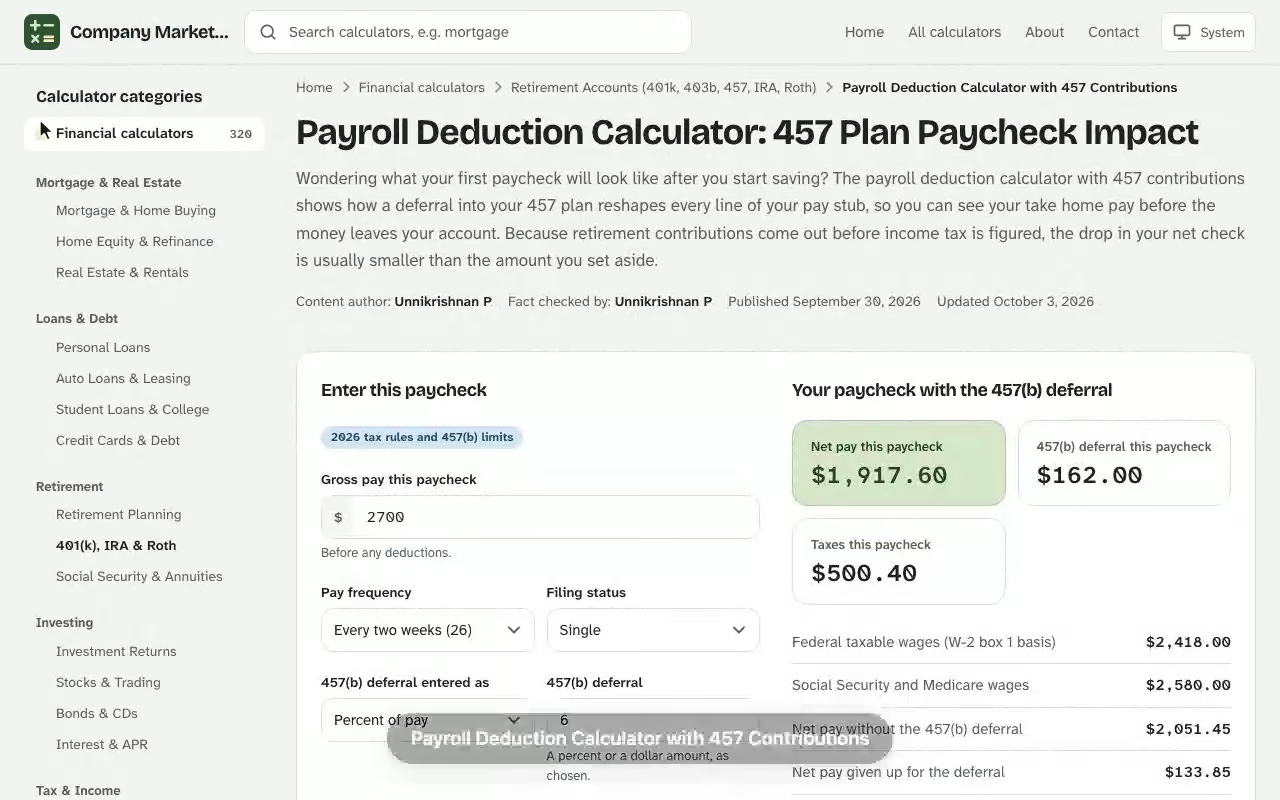
Payroll Deduction Calculator with 457 Contributions
Payroll Deduction Calculator with 457 Contributions. Wondering what your first paycheck will look like after you start saving? The payroll deduction calculator with 457 contributions shows how a deferral into your 457 plan reshapes every line of your pay stub, so you can see your take home pay before the money leaves your account. Because retirement contributions come out before income tax is figured, the drop in your net check is usually smaller than the amount you set aside. The 401k calculator uses the same plain-English approach, so you can compare results side by side.
Your paycheck with the 457(b) deferral
Net pay this paycheck
–
457(b) deferral this paycheck
–
Taxes this paycheck
–
Federal taxable wages (W-2 box 1 basis)–
Social Security and Medicare wages–
Net pay without the 457(b) deferral–
Net pay given up for the deferral–
Income tax the deferral saves this paycheck–
Federal tax bracket–
457(b) deferrals over a full year–
Pay stub
This paycheck and a full year at the same pay. Federal income tax is the estimated 2026 tax on a full year of these wages, spread evenly; your employer’s withholding may differ a little. The full-year column ignores wages earned before this paycheck.
Line
This paycheck
Full year
Results are estimates for educational purposes and are not financial, tax or legal advice.
How the Payroll Deduction Calculator with 457 Contributions Works
A payroll calculator walks your gross pay down to your net pay in a fixed order. This is the same gross-to-net path your employer's payroll system follows each pay period, and it is why a paycheck calculator can predict your deposit to within a few dollars. The 457b savings calculator uses the same plain-English approach, so you can compare results side by side.
Start with gross pay for the period.
Subtract pre-tax items: your 457 deferral and any employee paid health insurance premium.
Withhold FICA (Social Security and Medicare) from wages that remain subject to those taxes.
Annualize the remaining taxable income, apply the federal brackets, and divide back to one pay period.
Subtract state and local taxes, then any post-tax deductions.
Written as a formula, the final deposit looks like this:
$$\text{Net pay} = G - D - H - FICA - F - S - P$$
Here \(G\) is gross pay, \(D\) is the 457 deferral, \(H\) is health insurance, \(F\) is federal withholding, \(S\) is state and local tax, and \(P\) is post-tax deductions. The deferral itself is a straight percentage: \(D = G \times \text{deferral rate}\).
Entering Your Pay Period and Filing Status
Your pay period sets how many paychecks per year you receive: weekly is 52, every other week is 26, twice a month is 24, monthly is 12, and annually is one. Your filing status comes next. Choose single if you file alone, married if you file jointly, and head of household if you are unmarried and support a dependent. Each status uses its own withholding tables, so the choice changes your federal income tax withheld.
Gross Pay, Salary and Hourly Wages
Enter the gross pay for one period, before anything is removed. If you earn a salary, divide it by your paychecks per year. If you are hourly, multiply your rate by the hours in a typical period. Overtime and bonuses count as wages too, so include them if they are regular.
457 Plan Withholding and Your Retirement Savings
A 457(b) is a tax-deferredretirement plan offered by governments and some nonprofit employers. Your 457 plan withholding is the percentage of each check you send into the account. For 2026 the employee deferral limit is $24,500, and workers aged 60 to 63 can defer up to $35,750 with the special catch-up. Because 457 plan contributions reduce taxable income, you get immediate tax savings and the balance enjoys tax-deferred growth until you withdraw it. Your plan administrator may cap your deferral, so confirm the limit before you raise it. Next, open the free 457b catch-up calculator and enter your own details to see an estimate in seconds.
Pre-Tax Versus Roth After-Tax Deferrals
Many plans also offer a Roth option. A Roth deferral is after-tax, so it does not lower this check's withholding, but qualified withdrawals later are tax free. Run the calculator with a pre-tax deferral to see the immediate cut in federal tax withholding, then compare it against your long-term goals.
Worked Example: A 457 Deferral on a Biweekly Paycheck
Suppose you are single, paid every other week, with gross pay of $3,412.75 per paycheck, $118.60 of health insurance and a combined state and local rate of 3.8%. The table compares your check with and without an 8% deferral.
Line item
No deferral
8% 457 deferral
Gross pay
$3,412.75
$3,412.75
457 deferral
$0.00
$273.02
Health insurance
$118.60
$118.60
Social Security tax
$204.24
$204.24
Medicare tax
$47.77
$47.77
Federal withholding
$385.10
$325.03
State and local tax
$125.18
$114.80
Take home pay
$2,531.86
$2,329.29
You defer $273.02, yet your net check falls only $202.57. The other $70.45 never reaches the government: $60.07 less federal withholding plus $10.38 less state tax. Over 26 paychecks you move $7,098.52 into your account while giving up roughly $5,266.82 of take home pay.
How an 8% 457 plan deferral moves a biweekly paycheck from gross pay to take home pay.
Testing a Higher 457 Deferral With a Monthly Paycheck Calculator
Dana, a county librarian paid monthly, wants to raise a 457 deferral from 5% to 11% after a step increase. Gross pay is $5,286.40 a month, the health premium is $212.35, and the combined state and local rate is 4.6%. Dana files as single, and the fixed bills (rent, a car loan and utilities) total $3,310.00.
First the current 5% goes in: a $264.32 deferral, $314.59 of Social Security, $73.57 of Medicare, $395.50 of federal withholding and $221.25 of state and local tax. The deposit is $3,804.82.
See how the Payroll Deduction Calculator with 457 Contributions works: change the inputs and the net pay this paycheck updates instantly. Enter your own numbers in the calculator above.
Then the rate changes to 11%. The deferral becomes $581.50, federal withholding falls to $357.44 and state and local tax to $206.66, while the FICA lines stay put. The new deposit is $3,540.29.
The deferral rises by $317.18.
Take home pay falls by only $264.53.
The $52.65 gap is the drop in federal and state withholding.
Against the $3,310.00 of fixed bills, the new deposit leaves $230.29 each month, which clears the $200 cushion Dana wants, so 11% stands. At 12 deposits the yearly deferral reaches $6,978.00, about 28% of the $24,500 limit for 2026, leaving room to climb. The next step is to rerun the payroll deduction calculator at 14% when the January raise lands and check that the deposit still clears the $200 cushion.
Social Security Tax, Medicare Tax and Other Federal Withholding
Social Security Tax and FICA
The Social Security tax is 6.2% of wages up to the annual wage base, which is $184,500 in 2026. Unlike income tax, a 457 deferral does not shrink it: FICA is still withheld on the money you defer. That is why $204.24 stays the same in both columns above. Only pre-tax health premiums covered by a section 125 cafeteria plan escape it.
Medicare Tax and Additional Medicare Tax
The Medicare tax is 1.45% of every dollar of earnings with no cap. Employers also withhold an additional Medicare tax of 0.9% on wages above $200,000 in a calendar year. If you enter your year-to-date earnings, the calculator can tell whether this period crosses a threshold and whether you have reached the Social Security cap.
Federal Income Tax and the W-4
Your W-4 tells your employer how to apply IRS Publication 15. The IRS method annualizes your taxable pay, subtracts the standard deduction and applies the brackets. Claiming two jobs on the form raises withholding for a household with similar pay at both. The child tax credit and credit for other dependents reduce it, and dependents or exemptions claimed incorrectly can lead to a smaller or larger tax refund when your W-2 arrives. A worker who qualifies as exempt has no federal income tax withheld, but the rules are strict.
Other Payroll Deductions That Change Your Paycheck
Besides the mandated taxes, your payroll deductions may include voluntary benefits. A good payroll deductions calculator separates them by how they are taxed:
Employee paid health insurance comes out before income tax and before FICA.
Other pre-tax deductions, such as a flexible spending account or a health savings account, lower income tax. A flexible account has a use it or lose it rule, while an HSA does not.
Post-tax deductions such as union dues or garnishments come out last and offer no tax break.
Post-tax reimbursements are added back after taxes and increase your final deposit.
State and Local Taxes
State and local taxes depend on where you live and work. Some places charge none, while others use a flat rate or brackets, so treat the percentage you enter as an estimate and check it against your pay stub. Your state withholding is usually figured on the same reduced wages as federal tax, which is why a deferral trims it too.
The same paycheck with and without a 457 deferral: taxes shrink as the deferral grows.
Choosing a Deferral Rate: Savings Versus Take Home Pay
Raising your rate costs less than it seems. With the same paycheck, each two-point increase lowers your net check by roughly $50 while adding about $68 of retirement savings per period:
6% deferral: $204.76 saved, take home pay of $2,379.93
10% deferral: $341.28 saved, take home pay of $2,278.63
12% deferral: $409.53 saved, take home pay of $2,227.99
Pick the 457 plan deferral your budget can carry, then rerun the paycheck calculator whenever your income changes or your employer adds a raise. As an employee, small savings increases made early tend to matter most for your retirement. The result is an estimate of federal and Social Security and Medicare withholding on your earnings, so compare it with your payroll stub and confirm the annual limit on your account with your plan administrator.
Payroll Deduction Calculator with 457 Contributions questions
Does a 457 contribution lower my paycheck by the full amount?
No. A pre-tax 457 deferral reduces the wages used to figure federal and most state income tax, so your take home pay falls by less than the amount you defer. Social Security and Medicare tax are still withheld on the deferred money.
Are 457 plan contributions subject to FICA?
Yes. Deferrals into a 457 plan reduce income tax withholding but remain subject to Social Security and Medicare tax, which is why those lines do not change when you raise your deferral.
What is the 457 contribution limit?
For 2026 the employee deferral limit is $24,500, with a higher limit of $35,750 for workers aged 60 to 63 using the special catch-up. Your plan may set a lower cap, so confirm it with your plan administrator.
What does the two jobs or spouse works box do?
It tells the calculator that another job with similar pay exists, so withholding is figured at a higher rate. Without it, the IRS tables can withhold too little when two incomes are combined.
What is the difference between pre-tax and post-tax deductions?
Pre-tax deductions such as health premiums, an FSA or an HSA come out before income tax is figured and lower your taxable income. Post-tax deductions come out of your net pay and do not reduce your taxes.
Why do I need to enter year-to-date earnings?
Year-to-date earnings show whether this paycheck crosses the Social Security wage base or the $200,000 additional Medicare tax threshold, so the right amount is withheld.
How accurate is this paycheck estimate?
It follows the standard federal percentage method and your own state rate, so it is a close estimate. Your employer's payroll system may differ slightly because of W-4 details, local rules and rounding.