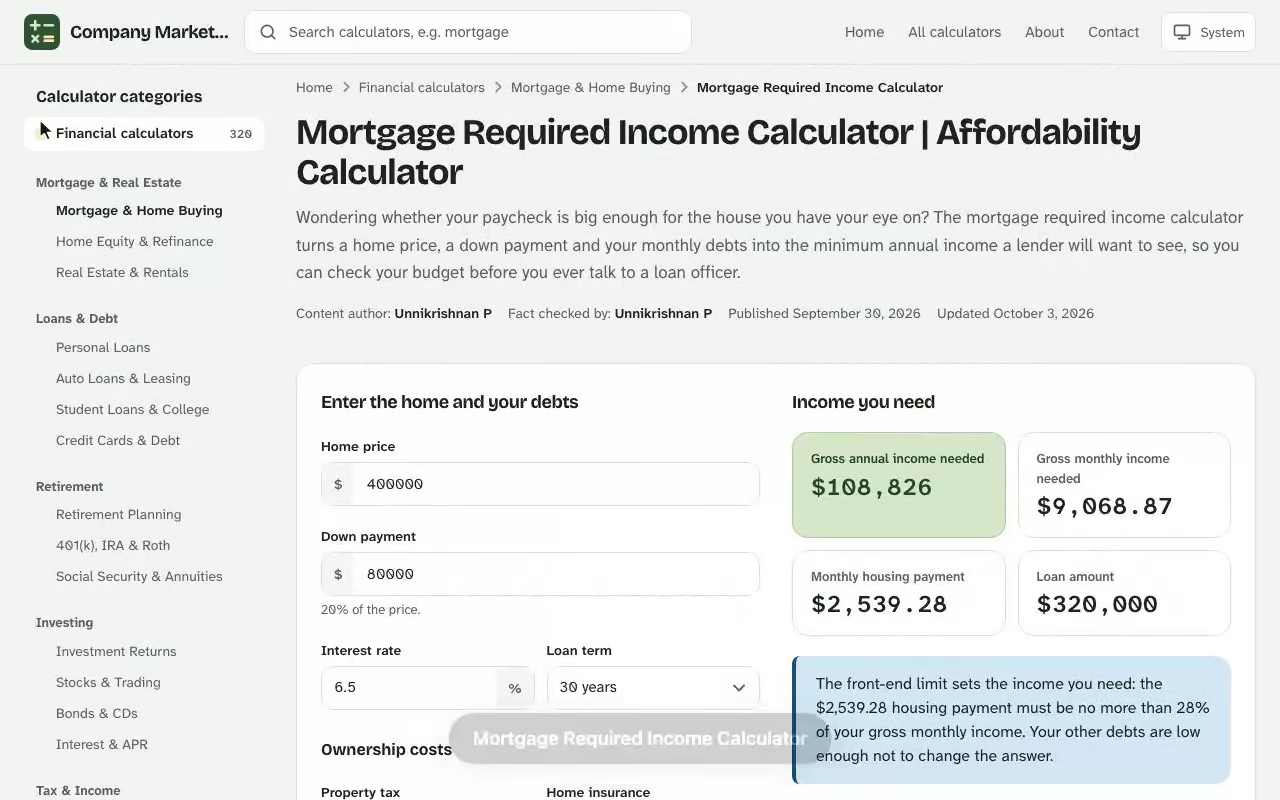
Mortgage Required Income Calculator. Wondering whether your paycheck is big enough for the house you have your eye on? The mortgage required income calculator turns a home price, a down payment and your monthly debts into the minimum annual income a lender will want to see, so you can check your budget before you ever talk to a loan officer. The free house affordability calculator is free to use with no sign-up, and works on desktop and mobile.
Income you need
Gross annual income needed
–
Gross monthly income needed
–
Monthly housing payment
–
Loan amount
–
–
Monthly housing payment
Principal and interest–
Property tax–
Home insurance–
PMI–
HOA dues–
Income needed under each limit
Front-end (housing only)–
Back-end (housing + debts)–
Income needed at other interest rates
The same price, down payment, costs, debts and ratio limits at rates around the one you entered.
Interest rate
Principal and interest
Housing payment
Annual income needed
Results are estimates for educational purposes and are not financial, tax or legal advice.
How a Mortgage Required Income Calculator Works
A mortgage required income calculator works backwards from the monthly housing payment. It first prices the full cost of owning the home each month, then asks what gross monthly income would keep that cost inside the limits a lender applies. Those limits are expressed as ratios of your income, which is why the answer is a minimum salary rather than a loan size. Next, open the like kind tax deferred exchange calculator and enter your own details to see an estimate in seconds.
See how the Mortgage Required Income Calculator works: change the inputs and the gross annual income needed updates instantly. Enter your own numbers in the calculator above.
The estimate has two steps. First, add every recurring housing cost into one monthly figure. Then divide that figure by the share of income a lender allows for housing, and repeat the test with your other monthly debt included. The higher of the two results is the income you need.
Multiply the larger result by 12 and you have the annual income a typical lender expects before it will approve the loan amount you want.
The 28/36 rule behind the result
The 28/36 rule is the rule of thumb most lenders start from: no more than 28 percent of your pretax monthly income should go to housing, and no more than 36 percent to housing plus every other debt. The first limit is often called the front-end ratio and the second the back-end ratio. Some programs stretch further. FHA loans, for example, can allow housing costs of 31 percent and total debts of 43 percent of income, so you can change both percentages in the calculator to match the loan you are considering.
Gross monthly income and pre-tax income
Lenders measure your gross income, meaning your pre-tax income (your pretax income is the figure on your offer letter, not your deposit) before taxes, retirement contributions and insurance premiums come out of your check. Your W2 shows the yearly figure, and dividing by 12 gives your gross monthly income. If a co-borrower will be on the loan, combine both incomes. Take-home pay is lower, so a result that looks high next to your bank deposits is not a mistake: the tool is speaking the lender's pretax language, and that matters when you set a household budget.
Mortgage Affordability Calculator Inputs You Need to Enter
Every field in a mortgage affordability calculator feeds one piece of the monthly housing payment. Gather these numbers first and the result will be far closer to what a lender calculates. Pair this with the mortgage qualifier calculator online for a fuller picture before you make a decision.
Home price, desired mortgage amount and down payment
Start with the home price, which is the purchase price you expect to offer. Subtract your down payment to get the loan amount, sometimes called the desired mortgage amount. Putting down 20 percent avoids private mortgage insurance on a conventional loan, while smaller down payments raise the required income because the loan is bigger and mortgage insurance is added.
Interest rate and loan term
The interest rate and loan term set the principal and interest portion. A 30-year term gives the lowest monthly payment, while a 15-year term cuts total interest but pushes the payment, and therefore the income you need, much higher. Use current mortgage rates for your credit tier rather than a teaser rate on an adjustable loan, because a start rate that resets later understates the payment you will carry for years.
Property tax, homeowners insurance and HOA fees
Escrow items sit on top of principal and interest. Property tax (real estate taxes billed by your local tax assessor), homeowners insurance (also called hazard insurance) and any homeowners association dues all count as housing costs. HOA fees, association dues and condo fees are usually paid outside the mortgage, yet lenders still add them to your monthly housing expenses. When you are unsure, ask a local agent for the tax bill of a similar home and an insurer for a quote.
Monthly debt and the debt-to-income ratio
Add the minimum payments on student loans, car loans and credit cards, plus any other monthly liabilities that show on your credit report. Utilities, groceries and phone bills do not count. Lenders divide this monthly debt, together with the new housing payment, by your income to get the debt-to-income ratio, or DTI. Because that ratio drives the back-end test, trimming a card balance before you apply can lower the income you need.
Required Income Calculator Example for a $437,500 Home
Here is a complete run of the required income calculator with figures chosen for this page. You are buying a $437,500 home with 12 percent down ($52,500), so the loan amount is $385,000. The rate is 6.35 percent on a 30-year term, property tax is 1.15 percent of the price per year, homeowners insurance is $1,740 a year, HOA dues are $85 a month, and your recurring monthly debt is $640. With less than 20 percent down, private mortgage insurance adds 0.62 percent of the loan per year.
Monthly housing cost
Amount
Principal and interest (PI)
$2,395.61
Property tax
$419.27
Homeowners insurance
$145.00
Private mortgage insurance
$198.92
HOA dues
$85.00
Total monthly mortgage payment (PITI plus extras)
$3,243.79
The five monthly costs that build the $3,243.79 payment used in the worked example.
Run the two ratio tests on that $3,243.79 payment. The front-end test gives $3,243.79 ÷ 0.28 = $11,585 of gross monthly income. The back-end test gives ($3,243.79 + $640) ÷ 0.36 = $10,788. The front-end figure is larger, so it controls: the required salary is about $139,020 a year. At that income your DTI, including the new payment, is roughly 33.5 percent.
Read the result as a floor, not a target. A $139,020 salary clears both tests, so a lender has no ratio-based reason to decline the file, and any income above it widens the margin. If your actual salary sits just under that figure, the table tells you which cost to attack first: private mortgage insurance and property tax together add $618.19 a month, and those are the lines you can change by negotiating the price, choosing a lower-tax area or saving for a larger down payment. Rerun the numbers after each change and keep a note of how many dollars of income each adjustment removes.
Home Affordability Calculator Results: Front-End Versus Back-End Income
A home affordability calculator should show both tests because the binding one changes with your debt. With low debt, the housing ratio decides. As monthly debt grows, the total-debt ratio takes over, and every extra dollar of debt requires roughly $2.78 of additional monthly income to offset it (1 ÷ 0.36).
In the example above the crossover lands at about $927 of monthly debt. Below that, the lender looks at housing alone and $139,020 is the answer. At $1,200 of monthly debt the back-end test needs $148,126, and at $1,800 it needs $168,126. This is why paying off a car loan can change your qualifying income more than a small rate drop.
Above about $927 of monthly debt, the 36 percent back-end test sets the income you need.
How Interest Rate, Down Payment and Loan Term Change House Affordability
House affordability moves with three levers you control. Each lever changes the monthly payment, and the payment changes the income you need.
Interest rate: moving from 5.85 to 6.85 percent on the example loan lifts the required income from $133,691 to $144,469.
Down payment: raising it from 12 to 20 percent, with PMI gone, lowers the requirement to $121,161.
Loan term: a 15-year loan at 6.35 percent raises it to $178,727, because principal and interest jump to $3,322.10.
Required income by interest rate and down payment for the example home; the outlined cell is the worked example.
The lesson is that a bigger down payment and a lower rate help almost equally. Shopping several lenders for rates, and saving longer for a larger down payment, are usually worth more than waiting for a pay raise. Down payment assistance programs can help a first-time buyer close that gap sooner, and every dollar they add to your down payment lowers the income figure above.
How Much House Can I Afford With a Given Salary?
You can also flip the question. If you know your salary and want to see how much house you can afford, divide it by 12, multiply by 0.28, and subtract the monthly taxes, insurance, PMI and HOA dues. What remains is the maximum principal and interest payment. Convert that payment into a loan amount using your rate and term, then add your down payment to reach a home price. A calculator saves you the algebra, but knowing the logic lets you sanity check any result.
Checking a $318,900 Offer with the Mortgage Income Calculator
Dana is about to offer on a $318,900 townhouse and earns $96,400 a year, or $8,033 a month before tax. Before signing anything, Dana opens the mortgage income calculator and enters the numbers from the listing and a lender's quote.
Down payment: 10 percent, $31,890, leaving a $287,010 loan
Rate and term: 6.72 percent over 30 years
Property tax: $2,997.66 a year, from the county record
The tool adds $138.72 a month of PMI at 0.58 percent and returns a housing payment of $2,359.85. The 28 percent test asks for $8,428 a month, so the required income is $101,136 a year. The back-end test needs only $92,395, which means the housing ratio is the problem: at $96,400 the payment is 29.4 percent of gross income, 1.4 points over the 28/36 guideline and $4,736 short of the target.
FHA loan limits of 31 percent housing and 43 percent total debt would pass this file at $91,349, but Dana would rather stay inside the conventional guideline. Paying off the card does not help, because the back-end test is not the binding one. Dana changes one input instead and drops the price to $302,500. The calculator now shows a $2,244.43 payment, a required income of $96,190, and a housing ratio of 27.9 percent.
That clears the guideline by $210 of income, a thin margin, so Dana's next step is a written offer at $302,500 with a rate lock, and a call to the county to confirm the tax figure, since a tax bill that is just $75 a month higher would push the requirement above $96,400 again.
Ways to Lower the Income You Need for a Mortgage
If the result is higher than your salary, you have more options than simply shopping for a cheaper house. Each lever below attacks a different term in the monthly mortgage payment or the debt side of the ratio, and you can test every one of them in the calculator in under a minute.
Pay off a small installment loan. Clearing a $300 car payment removes roughly $833 from the monthly income the back-end test demands.
Add a co-borrower. A second salary raises the qualifying income without changing the loan.
Save a larger down payment. Reaching 20 percent removes private mortgage insurance and shrinks the loan at the same time.
Compare lenders on rates. A quarter-point difference moves the required income by roughly $2,700 a year on the example loan.
Look at property tax before you fall in love. Two similar homes in neighboring towns can carry very different tax bills, and taxes are part of every monthly mortgage payment.
A first-time homeowner often focuses only on the listing price, yet the carrying cost is what a lender tests. A $20,000 cheaper house with a high tax rate and a large HOA fee can demand more income than a pricier home with light recurring costs. Compare homes by their full monthly housing payment, not by the price on the sign, and run the calculator once for each serious candidate before you make an offer.
What Else Helps You Qualify for a Mortgage Beyond the Required Income Figure
The calculator estimates the minimum income for your ratios, but a lender's underwriting looks at more, and meeting that income figure is necessary rather than sufficient. Your credit score determines your rate and whether you need mortgage insurance. Employment history and documented savings matter too, and lenders like to see emergency savings left over after closing costs and the down payment. Closing costs often run 2 to 5 percent of the loan amount, and a good budget also reserves money for maintenance, since a roof or HVAC repair can arrive in the first year of homeownership.
When the numbers look right, ask a lender to get you pre-qualified, then request pre-approval with documents. Pre-qualification is a quick estimate; pre-approval is a verified commitment that makes your offer stronger. Treat the calculator as the first step in that sequence, not the last.
Affordability Calculator Glossary of Terms
PITI
Principal, interest, taxes and insurance, the core of your monthly housing payment.
Private mortgage insurance
Mortgage insurance a conventional borrower typically pays when the down payment is under 20 percent.
Gross income
Your pretax earnings, the figure lenders use for every ratio.
DTI
Total monthly debt divided by gross monthly income, shown as a percentage.
Borrower
The person or people legally responsible for repaying the loan.
Keep these terms in mind, and every field in the mortgage income calculator will make sense, helping you decide how much mortgage you can comfortably carry and where your real estate budget should stop.
Mortgage Required Income Calculator questions
How much income do I need to qualify for a mortgage?
It depends on the monthly housing payment and your other debts. Lenders commonly cap housing at about 28% of gross monthly income and total debt at about 36%, so the calculator divides your payment by each limit and returns the higher result.
What is the 28/36 rule?
It is a guideline that no more than 28% of gross monthly income should go to housing and no more than 36% to housing plus all other monthly debt. Some programs, such as FHA loans, allow higher ratios.
Which costs count toward the housing payment?
Principal and interest, property tax, homeowners insurance, private mortgage insurance and any HOA or condo dues. Utilities, groceries and maintenance are not part of the lender's ratio.
Does a bigger down payment lower the income I need?
Yes. It shrinks the loan and, at 20% or more on a conventional loan, usually removes private mortgage insurance. Both reduce the monthly payment and therefore the required income.
Which debts should I enter?
Enter the minimum monthly payments on car loans, student loans, credit cards and other installment debts that appear on your credit report. Rent you will stop paying and everyday bills are left out.
Why does my required income look higher than my take-home pay?
Lenders use gross income, which is your pretax income before taxes and deductions. Take-home pay is lower, so compare the result with your salary, not your bank deposits.
Is this result a loan approval?
No. It is an estimate. A lender also reviews your credit score, employment, savings and the property before approving a loan, so ask for pre-approval once your numbers look right.