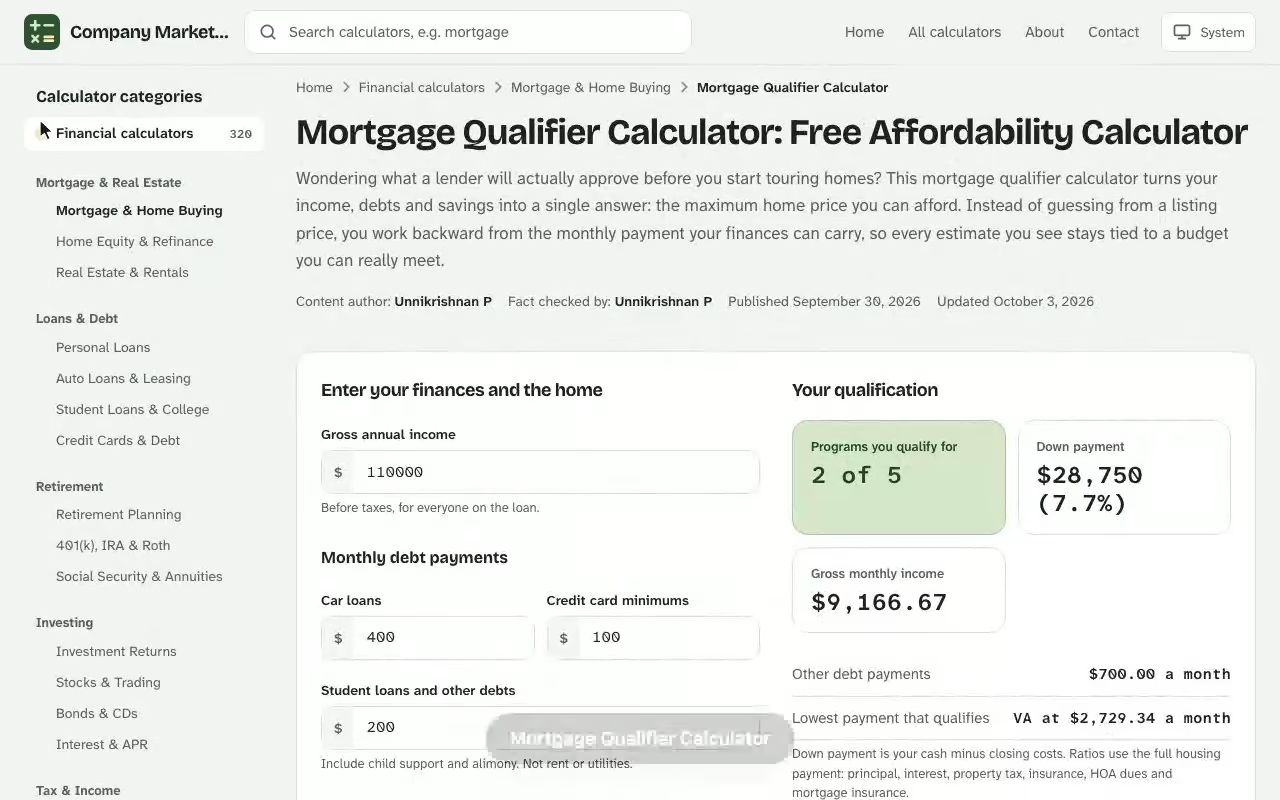
Mortgage Qualifier Calculator. Wondering what a lender will actually approve before you start touring homes? This mortgage qualifier calculator turns your income, debts and savings into a single answer: the maximum home price you can afford. Instead of guessing from a listing price, you work backward from the monthly payment your finances can carry, so every estimate you see stays tied to a budget you can really meet. Try the house affordability calculator to run your own numbers — everything is calculated in your browser and nothing you enter is stored or sent anywhere.
Your qualification
Programs you qualify for
–
Down payment
–
Gross monthly income
–
Other debt payments–
Lowest payment that qualifies–
Down payment is your cash minus closing costs. Ratios use the full housing payment: principal, interest, property tax, insurance, HOA dues and mortgage insurance.
Result by loan program
Each ratio is shown against the program's limit. The last column is the highest price that would pass with the same income, debts and cash.
Program
Result
Loan amount
Housing payment
Housing ratio
Total DTI
Why
Highest price that passes
Program rules
Typical federal and agency limits, filled in for you. Edit any figure to match a lender's overlay or a quote. Leave a housing-ratio limit blank if the program has none.
Sources: VA 41% total ratio (38 CFR 36.4340) and 2.15% first-use funding fee; USDA 29% / 41% (7 CFR 3555.151) with fiscal 2026 fees of 1% upfront and 0.35% a year; FHA 31% / 43% without compensating factors, 1.75% upfront and 0.55% annual premium; Fannie Mae 50% through Desktop Underwriter and 36% manual. Not checked here: credit score, loan limits, VA residual income, USDA income and location limits, and cash reserves.
Results are estimates for educational purposes and are not financial, tax or legal advice.
How a Mortgage Qualifier Calculator Works
A lender does not decide your borrowing limit by looking at the house first. It looks at how much of your gross monthly income is already spoken for, then checks whether a new mortgage payment fits in what remains. A home affordability calculator reproduces that same logic, which is why it is a useful way to preview mortgage qualification before you speak to anyone. Pair this with the mortgage required income calculator online for a fuller picture before you make a decision.
A mortgage affordability calculator works in four moves: it converts your yearly pay into monthly income, subtracts your existing monthly obligations, applies a lender-style spending cap, and then solves for the home price that keeps the full housing payment under that cap. Because the answer depends on your financial picture, two buyers with the same salary can qualify for very different homes. It answers the question how much house can I afford in dollars rather than in vague percentages, and it pairs naturally with a regular mortgage calculator once you have a specific listing to price.
The 28/36 Rule Behind the Estimate
Most lenders and the common 28/36 rule use two limits at once. Your housing costs should stay at or below 28% of your gross monthly income, and your total debt, housing included, should stay at or below 36%. The lower of the two limits becomes your ceiling, which is why paying down a car loan can raise your affordable price more than a small raise would.
Your DTI Ratio in Plain Words
Your DTI ratio, short for debt-to-income, is your total monthly debt divided by your gross monthly income. A lower figure tells lenders you have room to take on a new payment, and a higher one tells them you are already stretched. The calculator keeps your projected DTI at the 36% line so the result mirrors what an underwriter would test.
Home Affordability Calculator Inputs You Need
Gather these figures before you start. Each one moves the result, and being precise with them matters more than the interest rate you hope to get. Many tools offer a Simple View that needs only income, debts, down payment and rate, and an Advanced View that adds taxes, insurance and HOA dues for a tighter estimate. Either way, treat the exercise as budgeting for a major financial decision, not a formality. The free maximum mortgage calculator uses the same plain-English approach, so you can compare results side by side.
Gross Income and Monthly Debt
Enter your gross income, meaning your pre-tax pay before taxes and other deductions. Then add your monthly debt payments: car loan, student loan, credit cards and any other debts that appear on your credit report. Everyday expenses such as utilities, groceries and streaming subscriptions are not counted by lenders, so leave them out.
See how the Mortgage Qualifier Calculator works: change the inputs and the programs you qualify for updates instantly. Enter your own numbers in the calculator above.
Down Payment and Interest Rate
Your down payment is the cash you put toward the purchase price, and the interest rate is the yearly cost of borrowing the rest. A larger down payment shrinks the loan amount, while a higher rate shrinks how much loan your monthly budget can service. Check current mortgage rates for your credit profile rather than using a number you remember from a few years ago.
Loan Term, Property Taxes and Homeowners Insurance
The loan term sets how many years you repay over. A 30-year term gives the lowest monthly payment, while a 15-year term costs more each month, with faster repayment and far less in total interest. Property taxes are a yearly percentage of the home’s value set by your local government, and homeowners insurance protects the structure for any homeowner. If you are buying into a community, add the monthly dues owed to the homeowners association (HOA) or condo fees. Lenders fold all of these into the payment they test, so the calculator should too.
The Mortgage Affordability Formula
The math has two parts. First, find the largest total monthly housing payment you can carry:
Here \(I\) is your gross monthly income and \(D\) is your total monthly debt. Second, convert that budget into a price. The principal-and-interest part of a payment comes from the standard amortization formula:
$$M = L \times \frac{r(1+r)^{n}}{(1+r)^{n}-1}$$
In that formula \(M\) is the monthly principal and interest, \(L\) is the loan amount, \(r\) is the monthly interest rate (the annual rate divided by 12) and \(n\) is the number of monthly payments. Taxes, insurance and HOA dues are then added to \(M\) to reach the full mortgage payment. Solving for the price \(P\) where \(L = P - \text{down payment}\) gives the maximum home price that exactly uses your housing budget.
Worked Example With a Mortgage Affordability Calculator
Take a buyer earning $94,500 a year, with a $412 car loan, a $286 student loan and $135 in minimum credit card payments. They have $42,000 saved for the down payment and are quoted 6.45% on a 30-year fixed loan. Property taxes run 1.15% of the home price each year, homeowners insurance is $1,380 a year, and the HOA charges $65 a month.
Step 1: Find the Monthly Income and Debt
Monthly income is $94,500 ÷ 12 = $7,875. Total monthly debt is $412 + $286 + $135 = $833.
Step 2: Apply Both Spending Limits
The housing-only limit is 28% × $7,875 = $2,205. The total-debt limit is 36% × $7,875 = $2,835, and subtracting the $833 of existing debt leaves $2,002. Because $2,002 is lower, the debt limit is the one that binds, and the full housing payment must stay at or below that figure.
Step 3: Solve for the Price
Taking out the $115 monthly insurance and the $65 HOA fee leaves $1,822 for principal, interest and property taxes. Solving the formula above also reveals a maximum monthly payment of $2,002 for housing, and a maximum purchase price of about $287,889, which means a loan amount of $245,889 after the $42,000 down payment. That down payment is roughly 14.6% of the price.
Payment component
Monthly amount
Principal and interest
$1,546.11
Property taxes
$275.89
Homeowners insurance
$115.00
HOA dues
$65.00
Total housing payment
$2,002.00
Add the $833 of existing debt and the buyer lands at $2,835, exactly 36% of income. Had the buyer been judged on the 28% limit alone, the estimate would have been near $315,900, which shows how much the second limit matters.
How the example buyer's $2,835 debt limit shrinks to $1,546 of principal and interest.
How to Read Your Mortgage Qualification Result
Treat the number as a ceiling, not a target. A lender may approve a loan right up to the limit, but the payment will leave little room for repairs, a job change or rising rates. Many buyers aim for a price a notch below the maximum so the monthly payment feels comfortable rather than merely approved.
Notice also what moves the answer. Using the same income, the maximum price changes noticeably with the rate and the term you pick:
At 5.45% over 30 years, the maximum price rises to about $311,762.
At 7.45% over 30 years, it drops to about $267,074.
At 6.45% over 15 years, it falls to about $226,792, because the monthly payment on a shorter loan is much larger.
Maximum home price by rate and term for the worked example; the outlined cell is the 6.45% 30-year result.
Checking a $219,900 Listing With a Home Affordability Calculator
A buyer with a ranch-style listing at $219,900 bookmarked wants to know whether the lender’s math agrees with their hopes before booking a showing. They gather four figures: monthly gross pay of $5,962, a car payment of $391 plus $152 in minimum card payments for $543 of monthly debt, $18,750 in savings for the down payment, and a quoted 6.875% on a 30-year loan. Property taxes in the county run 1.32% a year and insurance is $1,512 annually.
The 36% total-debt guideline gives $5,962 × 0.36 = $2,146, and subtracting the $543 leaves a $1,603 housing budget. The calculator returns a maximum purchase price of $208,689, a loan of $189,939. The listing is $11,211 above that.
Testing the listing directly confirms the gap. With $18,750 down, the loan is $201,150, principal and interest come to $1,321.41, taxes add $241.89 and insurance $126, so the full payment is $1,689.30. Add the $543 of debt and the buyer’s debt-to-income ratio is 37.4%, over the 36% line this mortgage qualification check uses.
Scenario
Maximum price
$18,750 down
$208,689
$24,000 down
$213,186
$31,839 down
$219,900
Rerunning with only the down payment changed shows the target: $31,839, or 14.5% of the price, brings the payment to exactly $1,603. The buyer now has a specific next step: keep saving for roughly $13,100 more before making an offer, or negotiate the price down toward $208,689.
How to Increase Mortgage Affordability
If the estimate is lower than you hoped, the inputs you control are your debt, your credit and your cash.
Reduce Debts Before You Apply
Every dollar of monthly debt you clear is a dollar added to your housing budget when the 36% limit is the one that binds. In the example, retiring the $135 of credit card payments lifts the housing budget from $2,002 to $2,137, which raises the 30-year maximum price from $287,889 to about $306,519.
Paying off $135 a month of card debt lifts the 30-year maximum price from $287,889 to $306,519.
Improve Your Credit Score
A higher credit score signals creditworthiness and can earn favorable loan terms, including a lower rate. Even a small rate reduction can add tens of thousands of dollars to the price you can afford, as the figures above show.
Build Cash Reserves and Seek Assistance
Lenders also weigh the cash reserves left after you pay the down payment. Some states and nonprofits offer down payment assistance to eligible first-time homebuyers, which can raise the price you reach without raising your monthly payment as much.
Mortgage Qualification Versus Preapproval
A calculator estimate is an educational preview, not a commitment. Getting prequalified is a lender’s quick review of the figures you report, while preapproval involves verifying documents and your credit, so it carries more weight with sellers. If you already own and are thinking about a refinance, the same financial check applies to the new loan. Once your estimate looks workable, ask a home lending advisor to check it against real lender rules and current mortgage rates.
Homeownership Costs Your Affordability Estimate Leaves Out
A home affordability estimate covers the monthly payment, not everything that comes with buying. Plan for these separately in your budget and your financial planning:
Closing costs commonly run 2% to 5% of the loan amount, covering lender fees, title fees and prepaid items.
Earnest money and a home inspection are due before closing.
Moving costs and utility setup arrive in the first weeks.
Routine maintenance and repairs, from the roof to the HVAC system, continue for years.
An emergency savings cushion keeps one surprise from becoming a missed payment.
Used with this wider picture, a mortgage qualifier calculator gives you a realistic starting range for homebuying and a clear view of your purchasing power before you commit to anything. Treat the result as your ceiling, add these costs to your budget, and let free education on personal finance from housing counselors help you judge how much home you can afford in practice, not only on paper.
Mortgage Qualifier Calculator questions
How much mortgage can I qualify for?
It depends mainly on your gross income, monthly debts, down payment, credit and the interest rate. This calculator applies the common 28/36 guideline: housing costs up to 28% of gross monthly income and total debt up to 36%, using whichever limit is lower.
What is the 28/36 rule?
The 28/36 rule says your housing payment should stay at or below 28% of your gross monthly income and your total monthly debt, housing included, at or below 36%. Many lenders use similar limits when testing a mortgage application.
Which debts should I enter?
Enter recurring monthly payments that show on your credit report, such as car loans, student loans and minimum credit card payments. Utilities, groceries and subscriptions are not counted.
How does the down payment change the result?
A larger down payment shrinks the loan, so the same monthly budget supports a higher home price. You can enter it as a percentage of the price or as a dollar amount.
Does the estimate include taxes and insurance?
Yes. Property taxes, homeowners insurance and any HOA or condo fees are added to principal and interest before comparing the payment with your budget, because lenders count them too.
Is this the same as preapproval?
No. The calculator gives an educational estimate from the figures you enter. Preapproval involves a lender verifying your documents and credit, and the final amount can differ.
How can I increase the home price I qualify for?
Pay down monthly debts, save a larger down payment, improve your credit score to earn a lower rate, or consider a longer loan term. Each change either raises your budget or lowers the payment per dollar borrowed.