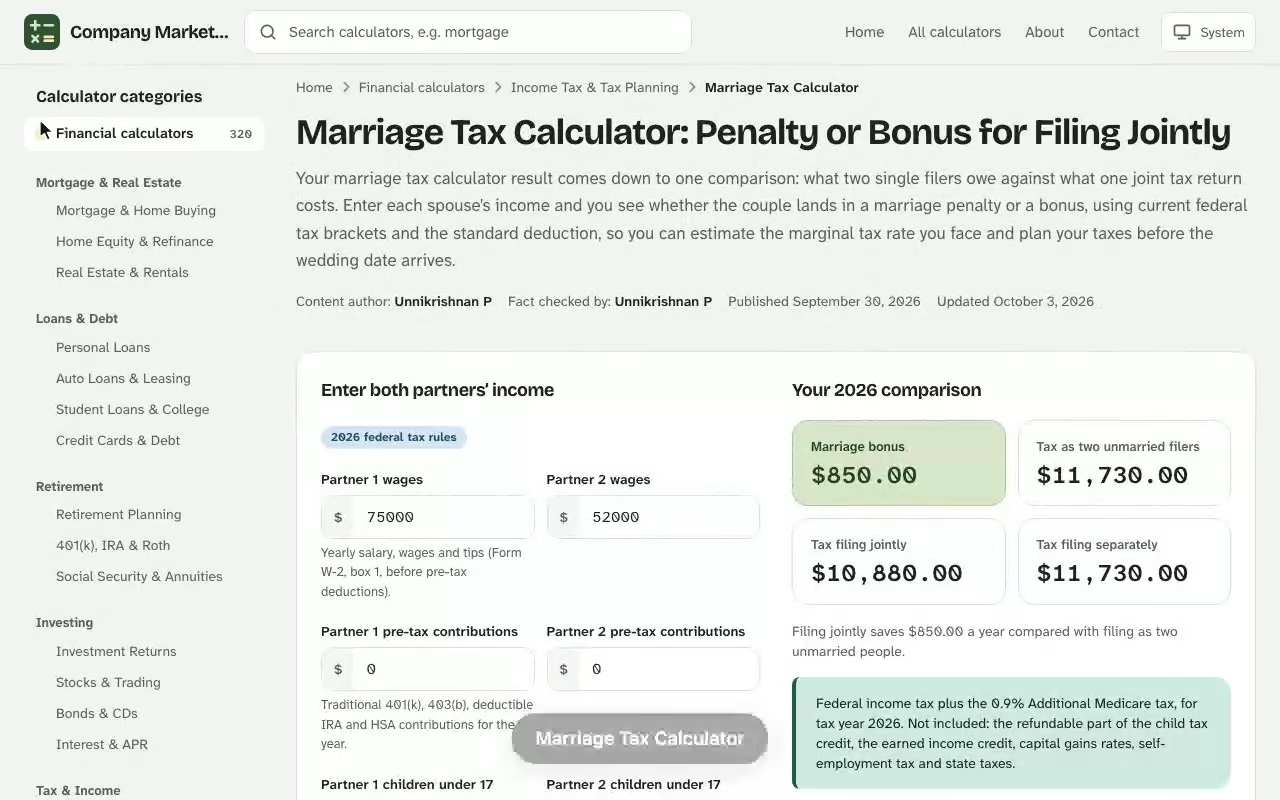
Marriage Tax Calculator. Your marriage tax calculator result comes down to one comparison: what two single filers owe against what one joint tax return costs. Enter each spouse's income and you see whether the couple lands in a marriage penalty or a bonus, using current federal tax brackets and the standard deduction, so you can estimate the marginal tax rate you face and plan your taxes before the wedding date arrives. The income tax calculator is free to use with no sign-up, and works on desktop and mobile.
Your 2026 comparison
Marriage penalty or bonus
–
Tax as two unmarried filers
–
Tax filing jointly
–
Tax filing separately
–
Federal income tax plus the 0.9% Additional Medicare tax, for tax year 2026. Not included: the refundable part of the child tax credit, the earned income credit, capital gains rates, self-employment tax and state taxes.
Side-by-side tax returns
Each column is one return. Unmarried uses the status you chose for each partner; separate returns split income, deductions and children as entered.
Partner 1 unmarried
Partner 2 unmarried
Married filing jointly
Partner 1 filing separately
Partner 2 filing separately
Results are estimates for educational purposes and are not financial, tax or legal advice.
How a Marriage Tax Calculator Compares Single and Joint Returns
This calculator runs the same income through the federal income tax system twice. First it treats each spouse as a single filer and adds the two bills together. Then it combines everything onto one return and applies the married filing jointly brackets. The gap between the two totals is your marriage tax bonus when the joint figure is lower, or your marriage penalty when it is higher. The free taxable vs tax-deferred calculator is free to use with no sign-up, and works on desktop and mobile.
The IRS decides your marital status on the last day of the tax year. A couple married on December 31 files as married for all twelve months, and a couple divorced on that date files as unmarried for the entire year. That single date is why timing a wedding can move your tax liability by thousands of dollars.
A positive result is a penalty and a negative result is a bonus. Everything else on this page explains how each of those three amounts is built.
Filing status and the standard deduction
Filing status sets which bracket table and which standard deduction apply. For the 2025 tax year, a single filer subtracts $15,750 from income, a head of household filer subtracts $23,625, and a couple married filing jointly subtracts $31,500. Because the joint standard deduction is exactly double the single one, the deductions alone never create a penalty. Itemized deductions work differently, since the state and local tax cap does not double for a couple.
Taxable income and adjusted gross income
Your tax is never charged on total pay. It starts with gross income, subtracts adjustments such as pre-tax 401k contributions to reach adjusted gross income, and then subtracts the standard deduction or itemized deductions to produce taxable income.
Federal taxes are progressive, so each slice of taxable income is charged at its own rate. The table shows where each rate begins for single filers and for a joint tax return in the 2025 tax year. Next, open the earned income credit eic calculator online and enter your own details to see an estimate in seconds.
Tax rate
Single filers start at
Married filing jointly starts at
10%
$0
$0
12%
$11,925
$23,850
22%
$48,475
$96,950
24%
$103,350
$206,700
32%
$197,300
$394,600
35%
$250,525
$501,050
37%
$626,350
$751,600
Read the table from the top down. Through the 32% rate the joint thresholds are exactly twice the single thresholds, so two spouses with similar pay see no change at all. Only the last two rows break that pattern, which is where a penalty begins.
Tax brackets and your marginal tax rate
Your marginal tax rate is the rate on your last dollar of taxable income, not on all of it, because marginal tax rates apply slice by slice. When you marry, your combined income is stacked onto one bracket ladder, and the top slice may fall in a higher tax bracket than either spouse reached alone. A spouse with little pay fills the lower tax bracket space that a high earner would otherwise leave unused, which is how a bonus appears. In that case marriage works as a benefit to the couple, not a cost.
Effective tax rate
The effective tax rate divides total tax by total income and is the figure that tells you what share of your pay really goes to the IRS in taxes. It is always below the marginal rate, because the early dollars were taxed at 10% and 12%. The calculator can compare the effective rate of two single returns against the joint return for the same couple, which is the comparison the third chart on this page draws.
Worked Example: Marriage Tax Benefits for Two Salaries
Consider two spouses with unequal pay. Spouse A earns a $94,500 salary and spouse B earns $31,200. Neither has other income, both take the standard deduction, and no tax credits apply.
Spouse A as a single filer: $94,500 − $15,750 = $78,750 taxable income. Tax is $1,192.50 + $4,386.00 + $6,660.50 = $12,239.00.
Spouse B as a single filer: $31,200 − $15,750 = $15,450 taxable income. Tax is $1,192.50 + $423.00 = $1,615.50.
Together as two single filers: $12,239.00 + $1,615.50 = $13,854.50.
The result is $10,827.00 − $13,854.50 = −$3,027.50, a bonus of $3,027.50. The reason is income disparity: spouse B's unused 10% and 12% bracket room absorbs part of spouse A's pay that would have been taxed at 22%. That is one of the clearest marriage tax benefits in the code.
How a $94,500 and $31,200 couple's two single tax bills combine into a lower joint return.
Single income households
The effect is largest for a single income couple. If one spouse earns $186,000 and the other earns nothing, the two single returns total $33,707, while the joint return costs $23,818, a bonus of $9,889. The unemployed spouse also gains access to a spousal IRA, which lets a non-working spouse contribute to retirement from the working spouse's earnings.
Pricing a December Wedding Date with a Joint Tax Return Estimate
Elena Marchetti has a courthouse slot on January 17 and a second one on December 19. She earns $142,860 and her fiancé, Tomás, earns $48,310. Before she picks, she runs the couple's numbers through the marriage calculator to see whether the extra four weeks of waiting costs them a marriage bonus on their federal return for the year.
She enters both salaries, leaves other income at zero, and keeps the standard deduction for each person. The calculator shows Elena as a single filer with $127,110 of taxable income and a tax bill of $23,353.40, with her last dollars taxed at 24%, which starts at $103,350 for single filers. Tomás owes $3,668.70 on $32,560 taxable income, all inside the 10% and 12% brackets. Together as two single filers they owe $27,022.10.
On the joint side, combined pay of $191,170 less the $31,500 standard deduction leaves $159,670, and the tax comes to $24,955.40. Their top slice now sits in the 22% bracket, which runs to $206,700 for a married couple. The marriage tax effect is $24,955.40 − $27,022.10 = −$2,066.70, a bonus.
That figure is what she weighs against the date. Because the IRS treats a couple married on December 31 as married for the whole year, the December 19 ceremony captures the full $2,066.70 on this year's return, while January 17 pushes it a year out. She also reruns the estimate with her pre-tax 401k deferral raised to $14,000, which lowers the bonus to $1,786.70, so she keeps the deferral where it is. They book December 19.
Marriage Penalty: When Filing Jointly Costs More
The marriage penalty is the opposite outcome, and it needs two large salaries. In a dual-income marriage, the 35% and 37% joint thresholds are lower than double the single thresholds, so a high-earning couple reaches the top rates sooner than two single people would. Two single filers earning $612,400 and $588,900 owe a combined $348,524.50. On one joint return the same pay costs $356,888.50, a tax penalty of $8,364.00.
Joint tax minus the two single tax bills for different income pairs; negative values are a bonus.
The table compares four typical situations, each computed with the 2025 brackets and the standard deduction.
Spouse A income
Spouse B income
Two single returns
Joint return
Marriage effect
$94,500
$31,200
$13,854.50
$10,827.00
Bonus of $3,027.50
$186,000
$0
$33,707.00
$23,818.00
Bonus of $9,889.00
$138,400
$121,700
$40,558.00
$40,558.00
No change
$612,400
$588,900
$348,524.50
$356,888.50
Penalty of $8,364.00
See how the Marriage Tax Calculator works: change the inputs and the marriage penalty updates instantly. Enter your own numbers in the calculator above.Effective federal tax rate for two single returns versus one joint return, four example couples.
Why a lower joint income can still bring a penalty
A smaller combined income does not guarantee safety. Credits and deductions phase out at income limits that are not doubled for married couples, so two moderate earners may lose an earned income credit or education tax credits that each would have kept as a single filer. These are tax credits that a simple bracket comparison does not capture, which is why it is worth reviewing them with a tax professional. The calculator flags the gap, and a professional can price the taxes tied to each credit.
Filing Jointly Versus Married Filing Separately
Couples are not forced to file jointly. Married filing separately uses its own bracket table, and its thresholds match the single table up to the 35% rate. In most cases filing separately is not better, because it also shuts you out of several tax benefits such as the earned income credit and tuition and student loan interest deductions.
When filing separately can help
Filing separately sometimes makes sense when one spouse has large medical bills, needs to protect themselves from the other's tax liability, or is on an income-driven student loan plan. A married filing separately return does not remove a penalty caused by the top rates, since the 37% rate starts at $375,800 for each spouse in that case.
Head of household and other filing status choices
A spouse who has dependents and lived apart from the other spouse for the second half of the year may qualify as head of household. That filing status is not available when you are filing jointly, so a calculator comparing single and joint returns should treat it as its own scenario.
Federal Income Tax, FICA and State Tax in a Married Filing Jointly Estimate
This estimate covers federal income tax only, and the financial picture for your household has more layers. Your paycheck also carries FICA, the combined Social Security and Medicare payroll tax, and FICA is charged per worker, so marriage does not change it. Withholding, the amount your employer sends to the IRS during the year, is also separate from what you finally owe in taxes.
State tax and the California marriage tax calculator question
State rules differ. A California-specific version has to apply California's own bracket table and its own deductions, and some states tax each spouse separately, so state taxes can move the answer. When you compare results across states, remember that the federal figure is only one layer of the total.
Retirement, estate tax and long-term tax benefits
Pre-tax 401k deferrals lower adjusted gross income for both returns and shift where the top slice falls. These effects sit outside the calculator's federal income tax comparison, but they matter to the decision. Marriage also unlocks the unlimited marital deduction, so assets passed to a surviving spouse are not subject to federal estate tax. Over decades these long-term tax benefits can outweigh a one-year penalty, and tax savings from a spousal IRA compound too, which makes the calculator's one-year number only part of the financial story.
How to Use the Marriage Calculator for Your Own Estimate
Gather this year's pay stubs and last year's return before you start. Then work through the steps:
Enter each spouse's salary, interest income, rental income and capital gain figures separately.
Add pre-tax retirement contributions, then choose the standard deduction or itemized deductions for each person.
Enter the state tax rate that applies to your household, and note any dependents.
Read the single total, the joint total and the difference the calculator reports, then rerun it with a different salary split to see how sensitive your result is.
Treat the output as an estimate, not tax advice: it does not model every credit, the alternative minimum tax or qualified dividends taxed at special rates.
Marriage Tax Calculator questions
What is the marriage tax penalty?
It is the extra federal income tax a couple pays on one joint return compared with what the same two people would pay as single filers. When the joint return costs less, the same difference is called a marriage bonus.
Who is most likely to pay a marriage penalty?
Couples in which both spouses earn high, similar incomes. Their combined income reaches the top brackets sooner on a joint return than each salary would alone, and some credits phase out at limits that are not doubled for couples.
Who usually gets a marriage bonus?
Couples with one income, or with a large gap between the two incomes. The lower earner's unused space in the 10% and 12% brackets absorbs part of the higher earner's income that would otherwise be taxed at a higher rate.
How does the IRS decide whether I am married for the tax year?
Your marital status on December 31 applies to the whole year. A couple married on that date files as married for all twelve months, and a couple divorced on that date files as unmarried for the full year.
Does the calculator compare married filing separately?
No. It compares one joint return against two single or head of household returns, because filing separately rarely beats filing jointly and uses its own bracket table.
Why does a couple with moderate incomes sometimes still pay more after marrying?
Credits and deductions can phase out at income limits that do not double for married couples, and the cap on the state and local tax deduction stays the same for a couple as for one person. A bracket-only comparison can miss these effects.
Does this estimate include state taxes or payroll taxes?
It estimates federal income tax plus self-employment tax, additional Medicare tax and net investment income tax. State and local tax is shown separately at the rate you enter, and standard payroll taxes are not part of the comparison because marriage does not change them.
Is the result tax advice?
No. It is an estimate for planning that simplifies several credits and deductions, so confirm the figures with a tax professional or the instructions for your return before you decide.