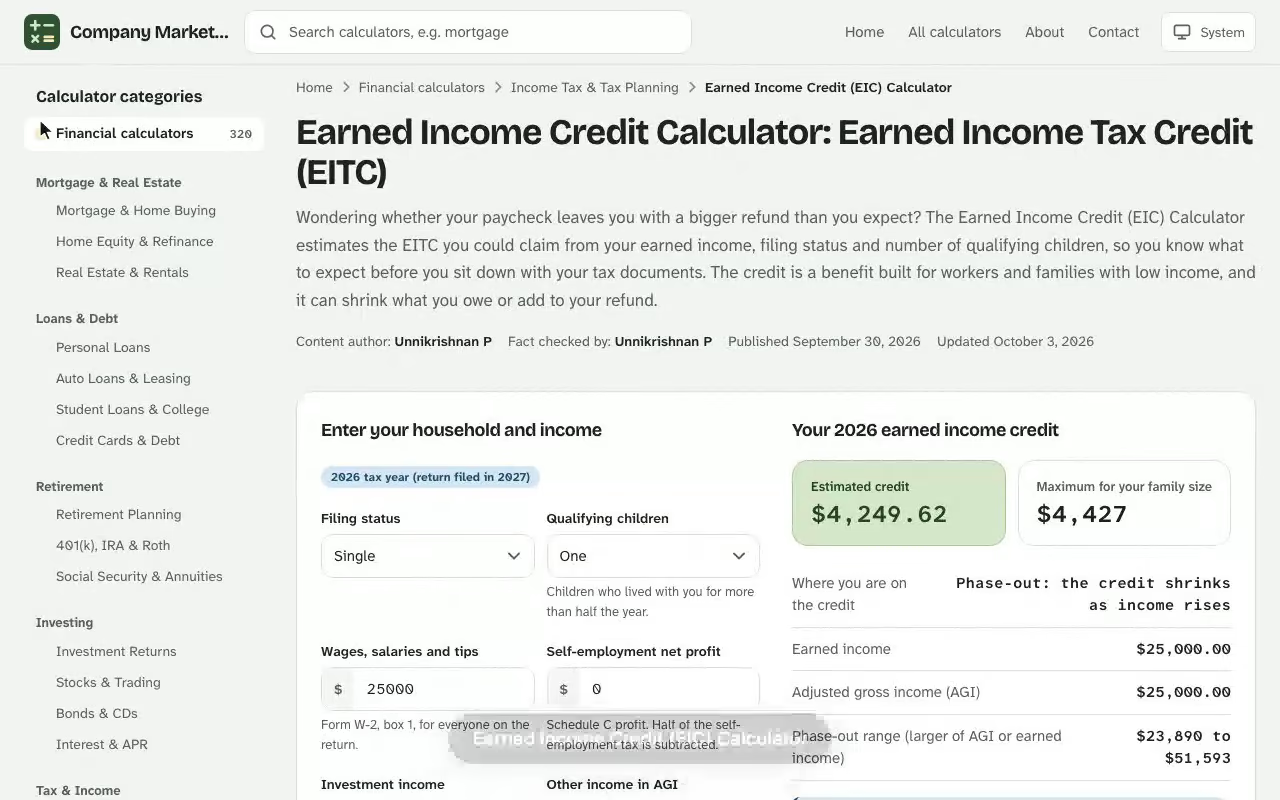
Earned Income Credit (EIC) Calculator. Wondering whether your paycheck leaves you with a bigger refund than you expect? The Earned Income Credit (EIC) Calculator estimates the EITC you could claim from your earned income, filing status and number of qualifying children, so you know what to expect before you sit down with your tax documents. The credit is a benefit built for workers and families with low income, and it can shrink what you owe or add to your refund. If you want to see how the figures change, the income tax calculator gives you an instant result you can adjust as you go.
Your 2026 earned income credit
Estimated credit
–
Maximum for your family size
–
Where you are on the credit–
Earned income–
Less half of self-employment tax–
Adjusted gross income (AGI)–
Phase-out range (larger of AGI or earned income)–
The IRS credit tables work in $50 income steps, so the amount on your return can differ by a few dollars.
2026 credit amounts by number of children
Limits for your filing status, and the credit your income would earn with each number of qualifying children if you meet the other rules. Your row is in bold.
Qualifying children
Maximum credit
Earned income for the maximum
Phase-out starts
Credit ends
Credit at your income
Results are estimates for educational purposes and are not financial, tax or legal advice.
How the Earned Income Credit (EIC) Calculator Works
An earned income tax credit calculator follows the same steps the IRS uses on the credit worksheet. It starts with the amount you earned from work, caps it at an earned income amount that depends on your children, multiplies the result by a credit rate, and then reduces the credit once your income climbs past a phase-out threshold. The final figure is the credit you could take on your return. The marriage tax calculator uses the same plain-English approach, so you can compare results side by side.
Written as a formula, the whole estimate looks like this:
See how the Earned Income Credit (EIC) Calculator works: change the inputs and the estimated credit updates instantly. Enter your own numbers in the calculator above.
In the formula, Income is the larger of your earned income and your adjusted gross income, and the credit never drops below zero. For tax year 2025 the credit rates are \(7.65\%\), \(34\%\), \(40\%\) and \(45\%\) for zero, one, two and three or more children.
Before you start, gather the following from your tax documents:
Wages and tips shown on your W-2 and any 1099 income statements
Your filing status, such as single, head of household or married filing jointly
The number of qualifying children who lived with you for more than half the year
Your adjusted gross income and any investment income for the year
Earned Income and Adjusted Gross Income
Earned income covers wages, salary, tips, net self-employment earnings, military pay, employer-based disability pay and union strike benefits. Pensions, interest, unemployment pay and Social Security benefits do not count. Your adjusted gross income (AGI) is your total income after adjustments, and the credit is measured against whichever of the two is higher, which is why a person with modest wages and a side-business loss can see a different result than the raw paycheck suggests.
Filing Status and Qualifying Children
Your filing status moves the phase-out threshold. Married couples who file jointly get a phase-out that starts roughly $7,100 higher than the one for single and head of household filers. A qualifying child must pass tests for relationship, age, residency and joint filing, and each added child raises the credit until you reach three. Married filing separately is only allowed in limited cases, so check the rules before you rely on a result.
EITC Eligibility Requirements for This Tax Credit
A calculator only produces a meaningful number if you qualify first, and the eligibility requirements are strict. You are eligible when every one of these points is true: Next, open the free tax loss harvesting calculator and enter your own details to see an estimate in seconds.
You have earned income from a job or self-employment, and your AGI is under the limit for your filing status and number of children
You, your spouse and every child you claim hold a valid Social Security number issued by your return's due date
You were a U.S. citizen or resident alien for the entire year
Your investment income stays at or below $11,950 for 2025
You do not file Form 2555 for foreign earned income and nobody else claims you as a qualifying child
Social Security Number and Residency
A work-eligible Social Security number is non-negotiable for you, your spouse on a joint return and each child you list. If you are a nonresident alien, you can still qualify when you file a joint return with a spouse who is a citizen or resident. The IRS covers the details in Publication 596, which is the best reference when your situation is unusual.
Investment Income Limit
Interest, dividends, capital gains and other investment profits must total no more than $11,950 for 2025. One dollar over that limit disqualifies you from the credit entirely, so a small stock sale late in the year deserves a second look before you file.
Age Limits
If you have no qualifying child, the age limits apply: you generally must be between 25 and 64 at the end of the year. A full-time student over 24, a young person who was in foster care after turning 14, or a qualified homeless youth can follow different age rules. Workers with children face no upper age limit on their own age.
Earned Income Tax Credit Amounts and Income Limits for 2025
The maximum credit and the income limits change each year because the IRS adjusts them for inflation. The table below lists the 2025 figures for single and head of household filers, with the matching limit for married filing jointly couples in the last column.
Qualifying Children
Maximum Credit
Income Limit (Single or Head of Household)
Income Limit (Married Filing Jointly)
0
$649
$19,104
$26,214
1
$4,328
$50,434
$57,554
2
$7,152
$57,310
$64,430
3 or more
$8,046
$61,555
$68,675
The credit grows with each dollar you earn up to the earned income amount, stays level for a while, and then declines. That shape explains why two households with different paychecks can claim the same credit, and why a raise near the top of the range can shave a few hundred dollars off the credit rather than add to it.
Worked Example: Estimating the EITC With Two Qualifying Children
Suppose you file as head of household, you have two qualifying children, your wages total $31,860 and your AGI is $32,410 because of a small side income. Run it through the steps above:
Earned income of $31,860 is above the $17,880 cap, so the base credit is the full cap times 40%, which is $7,152.
The larger of earned income and AGI is $32,410. That is $9,060 over the $23,350 phase-out start.
The phase-out reduction is $9,060 \(\times\) 21.06%, or about $1,908.
Your estimated credit is $7,152 - $1,908 = $5,244.
Because the credit is refundable, that $5,244 comes back to you even if your income tax bill is smaller. If you owe $1,200 in income tax, the credit wipes it out and the remaining $4,044 arrives as part of your refund.
Checking a Married Couple's Result With an Earned Income Tax Credit Calculator
Marisol and Dev are preparing their joint return in late January and want to know whether the credit for their 6-year-old daughter is worth planning around. Dev's W-2 shows $38,742 in wages, and Marisol's part-time bakery job adds $4,310, so they enter $43,052 as earned income and the same figure as AGI, with married filing jointly and one qualifying child selected.
The calculator caps the base credit at 34% of $12,730, which is $4,328. Their income sits $12,582 above the $30,470 joint phase-out start, so it subtracts $12,582 \(\times\) 15.98%, or $2,011. The estimate they see is $2,317, well under the $4,328 maximum and far from the $57,554 point where the credit for one child disappears entirely.
Marisol then asks the question the result invites: if she picks up extra weekend shifts worth $1,000, does the credit shrink enough to cancel the raise? She reruns the estimate with $44,052 and gets $2,157, a drop of only $160. The extra $1,000 still leaves them $840 ahead before payroll tax, so she accepts the shifts. They also set the $2,317 aside for the water heater replacement they have been postponing, and confirm the figure against the IRS assistant before Dev files Schedule EIC with Form 1040.
Why the EITC Is a Refundable Credit
A refundable credit pays out beyond what you owe. Most nonrefundable credits stop at zero, but this tax credit keeps going, which is why it works as relief for families whose employers withheld little. Your tax refund combines the credit, any taxes withheld from your paycheck and any other payments, minus your tax bill for the year.
Refunds that include the credit are held by the IRS until mid-February by law, so file early but expect a short wait. If you have claimed the credit before and the IRS denied it, you may need to attach Form 8862 before you can claim it again.
How to Claim the Credit on Your Tax Return
You claim the credit on your tax return using Form 1040, and the IRS asks workers with children to also complete Schedule EIC. Workers without children skip the schedule. Gather your tax documents first, including W-2s and other income statements, and keep records of where each child lived during the year.
Free tax preparation is available if you want a person to check your numbers. IRS-certified VITA sites and AARP Tax-Aide volunteers prepare returns at no cost, and a paid tax pro can step in for complicated cases. The IRS also lists free tax help options on its EITC page.
Other Credits to Check Alongside the EITC Estimator
An EITC estimator only covers one credit, yet people who qualify for it often qualify for others. Compare these before you file:
The child tax credit and the credit for other dependents for each dependent you support
The child and dependent care credit if you paid for care so you could work
Education credits when you or a dependent paid tuition
The IRS also offers the EITC Assistant, an official tool that checks eligibility without saving your name or Social Security number. Use it to confirm the figure from any calculator, including this one.
Common Mistakes When You Estimate the Credit
Entering AGI in the earned income field, which can lower or raise the result incorrectly
Counting a child who lived with someone else for more than half the year
Forgetting that a change in tax reform rules or inflation indexing alters the numbers from one tax year to the next
Assuming a higher raise always helps, when income in the phase-out range reduces the credit
Treat the result as an estimate. Your final credit is calculated by the IRS from the figures on your return, and a different filing status or dependent claim can change it.
Earned Income Credit (EIC) Calculator questions
What is the earned income credit?
The earned income credit, also called the earned income tax credit (EITC or EIC), is a refundable tax credit for workers with low to moderate earned income. It can lower the tax you owe and any amount above your tax bill is paid to you as a refund.
Who qualifies for the EITC?
You need earned income, a valid Social Security number, U.S. citizen or resident alien status for the whole year, investment income under the yearly limit, and income below the limit for your filing status and number of qualifying children. You also cannot file Form 2555 or be claimed as a qualifying child by someone else.
Can I get the credit with no children?
Yes. Workers with no qualifying children can claim a smaller credit if they are between 25 and 64 at the end of the year, live in the United States for more than half the year, and meet the income limits. The maximum for 2025 is $649.
What counts as earned income?
Earned income includes wages, salary, tips, net self-employment earnings, military pay, employer-based disability pay and union strike benefits. Pensions, interest, unemployment pay and Social Security benefits are not earned income.
What is the investment income limit?
For 2025 your investment income, such as interest, dividends and capital gains, must be $11,950 or less. The 2024 limit is $11,600 and the 2023 limit is $11,000.
Is the earned income credit refundable?
Yes. If the credit is larger than the tax you owe, the IRS pays you the difference with your refund. By law refunds that include the credit are not issued before mid-February.
How do I claim the credit?
File Form 1040. If you have a qualifying child, also complete Schedule EIC. Free help is available from IRS-certified VITA sites and AARP Tax-Aide volunteers.
How accurate is this calculator?
It applies the published IRS credit rates, earned income amounts and phase-out thresholds for the tax year you select, so it gives a close estimate. Your actual credit is determined from your tax return, and special cases such as separated spouses or tie-breaker rules for children can change it.