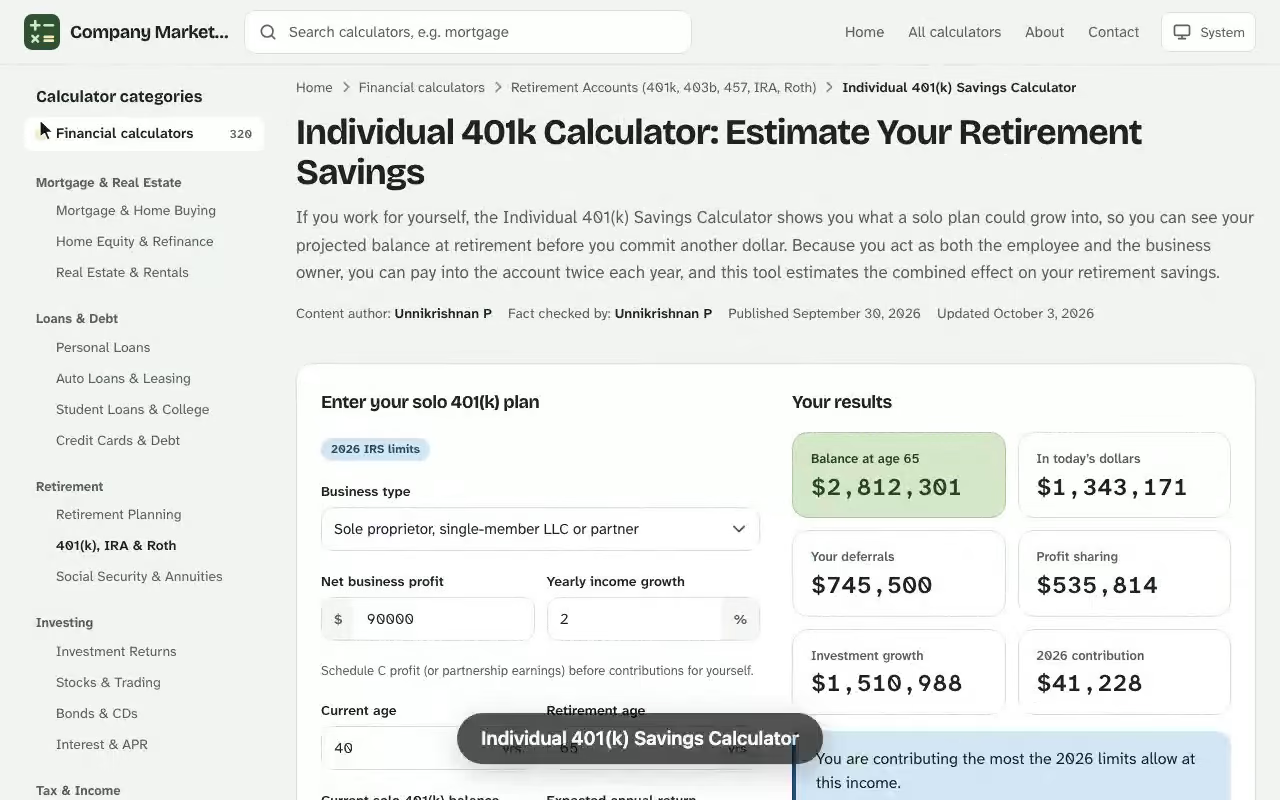
Individual 401(k) Savings Calculator. If you work for yourself, the Individual 401(k) Savings Calculator shows you what a solo plan could grow into, so you can see your projected balance at retirement before you commit another dollar. Because you act as both the employee and the business owner, you can pay into the account twice each year, and this tool estimates the combined effect on your retirement savings. The 401k calculator uses the same plain-English approach, so you can compare results side by side.
Your results
Balance at retirement
–
In today’s dollars
–
Your deferrals
–
Profit sharing
–
Investment growth
–
2026 contribution
–
Your 2026 contribution
Net earnings from self-employment–
Employee deferral–
Catch-up–
Employer profit sharing–
Total–
Maximum allowed–
Future years use the 2026 limits; the IRS normally raises them with inflation, so later maximums are likely higher.
Year-by-year projection
Contributions worked out from each year’s income, and the balance at each year end.
Age
Profit
Deferrals
Profit sharing
Balance
Results are estimates for educational purposes and are not financial, tax or legal advice.
Individual 401(k) Savings Calculator: Inputs and Results
An individual 401(k), often called a solo 401(k), is built for the self-employed and for owner-only businesses. Instead of a single paycheck deduction, you make two kinds of deposits: employee contributions from your own earnings and employer contributions that your business pays on your behalf. The calculator asks for the details of both, then projects the year-by-year growth of the account until you stop working. The borrow from 401k calculator online uses the same plain-English approach, so you can compare results side by side.
Annual Salary and Annual Salary Increase
Enter your annual salary, which for a sole proprietor means net self-employment income after business expenses. Contribution percentages are applied to this figure, so a realistic number matters more than any other input. The annual salary increase field lets your income rise a little each year, because most careers do not stay flat for two decades. A modest rate of 2% to 3% keeps the projection grounded without flattering it.
Current Age and Age at Retirement
Your current age and your age at retirement set the length of the savings runway. The difference between the two is the number of years of deposits. Remember that the year you retire you stop contributing, so retiring at 65 means your last deposit happens at 64. Pushing your retirement age back by even two years adds deposits and gives the account more time to compound.
Current 401(k) Balance and Annual Rate of Return
The current 401(k) balance, sometimes called the starting balance, is whatever sits in the plan today. Pair it with an annual rate of return that reflects your investment mix. A stock-heavy portfolio of low-cost index funds has historically returned more than a bond-heavy one, yet nothing is guaranteed, so test several values. The total fees field subtracts plan and fund costs from that estimated rate of return, because even a small annual fee compounds against you.
Percent to Contribute and Employer Maximum
The percent to contribute field is the share of your income you defer as the employee. A second field holds the employer match, which for a solo plan is really your business’s profit-sharing deposit. The employer maximum caps that deposit at a share of your income, which is the same ceiling the IRS applies to your business. Together, these inputs produce the monthly contributions flowing into the account.
What the Results Show
The main result is your 401(k) balance on the day you retire. Beside it you get the total employee contributions, the total employer contributions, and the investment returns earned along the way. Seeing those three pieces side by side makes it obvious how much of your final number came from your own effort and how much came from growth.
The Formula Behind a 401(k) Calculator
A 401(k) calculator repeats one simple step many times: grow the balance for a month, then add that month’s deposit. The monthly growth rate comes from your yearly return minus fees: The 457 plan withdrawal calculator uses the same plain-English approach, so you can compare results side by side.
$$r_m = (1 + r - f)^{1/12} - 1$$
Here \(r\) is the estimated rate of return and \(f\) is the total fee rate. Each month, the new balance is:
In that equation, \(C_E\) is your yearly employee deferral and \(C_P\) is the yearly employer contribution. Your salary grows once a year by the income growth rate, so both contributions step up at each anniversary. The employee deferral is capped at the IRS limit for your age, and the combined total is capped at the overall plan limit.
Why Compounding Does the Heavy Lifting
Early deposits earn returns for the longest time, and those returns then earn returns of their own. This is why the growth portion of a long projection usually dwarfs the money you personally put in. Many tools assume returns are compounded annually while deposits arrive monthly; the calculator above applies the monthly rate so the timing matches how a payroll or business transfer really works.
Worked Example: A Self-Employed Designer Using the 401k Calculator
Take a freelance product designer who is 41, earns $118,750 in net self-employment income, and plans to retire at 65. The designer already holds $63,400 in the plan, defers 15% of income as the employee, and has the business add 12% as an employer contribution. The estimated rate of return is 6.5%, total fees are 0.4%, and income is assumed to rise 2.5% per year.
Input
Value
Current age
41
Retirement age
65
Annual salary
$118,750
Annual salary increase
2.5%
Employee contribution
15% of income
Employer match (profit-sharing)
12% of income
Current 401(k) balance
$63,400
Estimated rate of return less fees
6.5% − 0.4% = 6.1%
In year one the designer defers $17,812.50 and the business adds $14,250.00, so $32,062.50 goes in. Over the 24 years the account receives $576,217 in employee contributions and $460,974 in employer contributions. After $1,297,181 in investment returns, the balance at retirement is $2,397,772.
See how the Individual 401(k) Savings Calculator works: change the inputs and the balance at age 45 updates instantly. Enter your own numbers in the calculator above.Investment returns supply about 54% of the example's $2,397,772 balance at retirement.
Reading the Result
Roughly 54% of that final balance is growth rather than deposits. That is the point of using a savings calculator early: the same deposits made ten years later would not have time to produce anything close to that growth share. Pairing this output with a general retirement calculator that models spending and Social Security tells you whether the number is enough.
2026 Contribution Limits for an Individual 401(k) Plan
The contribution limit is the rule that most often changes a projection. The deferral limit applies to your employee side only, while a larger overall ceiling covers employee and employer money together. Employer contributions do not count toward the employee deferral limit, which is why a solo plan can hold so much more than an IRA.
Limit
2026 amount
Employee deferral, under age 50
$24,500
Employee deferral with catch-up, age 50 and over
$32,500
Employee deferral with catch-up, ages 60 to 63
$35,750
Combined employee and employer, under age 50
$72,000
Catch-Up Contribution for Ages 50 and Over
Once you turn 50, a catch-up contribution lets you add another $8,000 beyond the standard deferral. Under SECURE 2.0, savers aged 60 to 63 can add $11,250 instead. Higher earners may be required to make those extra deposits on a Roth basis, and anyone who is highly compensated at a larger employer faces extra testing, though a true one-person plan usually avoids it.
The example balance at each career milestone, from today's plan to the retirement age.
Employer Match and Profit-Sharing Contributions
In a company plan, the employer match is a percentage of what you contribute, often called free money because you receive it simply for saving. In a solo plan there is no outside company, so your business makes matching contributions itself, generally up to 25% of compensation or about 20% of net self-employment earnings for a sole proprietor. Those employer contributions are usually deductible to the business, which makes them one of the strongest tax benefits available to a freelancer.
Pre-Tax vs. Roth 401(k) Savings in an Individual 401(k)
You can often choose how your deferrals are taxed. With a pre-tax deferral, the deposit lowers your taxable income today and the account enjoys tax-deferred growth; you pay taxes only when you withdraw. With Roth 401(k)s, you pay tax now and later withdrawals are tax-free. If you expect a higher tax bracket in retirement, the Roth route can win, and a split between the two spreads your risk.
How This Compares With a Roth IRA
A Roth IRA offers the same tax-free withdrawals but a far lower annual ceiling, so the sensible order is to run the solo plan estimate first. Many self-employed savers fill the plan and then top up a Roth IRA with whatever they can still afford. An IRA also comes with a wider choice of investments, while a plan may limit you to a short menu.
A Consultant Tests a Solo 401(k) Retirement Plan at Age 53
A management consultant, 53, wants to know whether her one-person plan can fund $50,000 a year of spending from 67, using the common 4% withdrawal guideline, which means she needs about $1,250,000. She has her latest statement open: $214,750 in the plan. Her net self-employment income last year was $96,840, and she expects 2% raises.
She enters age 53, retirement age 67, a 20% employee deferral and a 10% business contribution. The estimated return is 6% and the fees are 0.25%. Her $19,368 deferral sits comfortably under the $32,500 limit that applies at her age, and the $9,684 employer deposit is far below the 25% ceiling, so nothing gets capped.
Run
Employer deposit
Projected balance
4% income per year
First
10% of income
$1,159,667
$46,387
Second
15% of income
$1,274,654
$50,986
The first run shows $1,159,667, which supports only $46,387 a year, $3,613 short of her goal. She tests two levers, a 25% deferral and a 68th birthday, but the one she prefers is the business deposit, because her profit swings from year to year and the business can choose that amount after the books close. Rerunning the individual 401(k) projection at 15% gives $1,274,654, or $50,986 a year, which clears the target. She sets the $14,526 first-year deposit as her plan and schedules the same rerun each January.
Choosing a Retirement Calculator for Your Savings Plan
Not every tool fits every situation. A retirement calculator aimed at employees usually starts from a paycheck percentage, whereas the individual version works from self-employment income and a two-part contribution. If you want a quick estimate with common defaults, a general 401k calculator is enough. For a deeper check on whether the final balance will fund your spending, look for a 401(k) savings and planning calculator that includes withdrawals, or for a calculator that lets you compare a SEP or SIMPLE plan against a solo plan.
Use a solo-plan tool when you have no employees other than a spouse.
Use a payroll-based tool if your employer-sponsored plan runs through a company.
Use a separate withdrawal tool to test spending, taxes, and required minimum distributions.
Pros and Cons of an Individual 401(k) Plan
Like any retirement plan, a solo plan trades flexibility for advantages. This quick summary helps you weigh the tradeoffs before you open one.
Pros
Tax-deferred growth: earnings are not taxed until you withdraw them.
High limits: employee and employer deposits together far exceed an IRA ceiling.
Creditor protection: plan assets are generally shielded in bankruptcy.
No vesting period: because you are the employer, the money is yours immediately, so there is no vesting schedule to wait out.
Control: some providers offer self-directed 401(k)s with broader investment options.
High fees at some providers, including administrative costs that eat into returns.
Limited access: taking money out before age 59½ usually triggers a penalty.
A waiting period or setup deadline: you must open the plan before the year ends to defer for that year.
Eligibility: it only works if your business has no full-time employees.
Solo 401(k) Deadlines That Affect Your Savings Projection
Timing rules decide which numbers you can feed into the calculator. The plan generally has to be established by the end of the business year if you want to defer for that year, so a late setup means the employee deferral for that year is zero in your projection. The business’s own deposit can usually be made as late as the tax filing deadline, including extensions, which gives you room to see your final profit before you choose the employer percentage to enter.
Set aside a cushion for estimated taxes before you pick a deferral rate. A freelancer who defers too aggressively and then owes taxes in April may be tempted to pause saving altogether, and a paused year is exactly what a steady projection assumes will not happen. If you later hire a full-time employee, eligibility changes, which changes the contribution inputs you project from that point on.
Early Withdrawal, Rollover, and Required Minimum Distributions
An early withdrawal before 59½ generally adds a 10% penalty to the ordinary income tax, which is why the calculator treats the account as untouchable until your target age. If you leave a job or close a business, a rollover into another plan or an IRA moves the money without a tax bill, provided you follow the transfer rules.
After the IRS-set age, required minimum distributions force annual withdrawals from pre-tax balances. Planning for them early prevents surprises, since a large balance means a large mandatory payout. Since a solo plan is a defined contribution plan and not a pension plan, no formula promises you a fixed income; the amount you accumulate is what you get.
Ways to Boost Your 401(k) Balance at Retirement
Small changes in a few inputs shift the outcome a lot. Using the designer’s numbers, here is what happens when one input moves and everything else stays put.
Scenario
Balance at retirement
Baseline: 15% employee, 12% employer, 6.5% return, retire at 65
$2,397,772
Employee contribution cut to 10%
$2,002,366
No employer contribution
$1,448,797
Return falls to 5.5%
$2,090,329
Return rises to 7.5%
$2,759,517
Retire at 67 instead of 65
$2,823,002
The table shows that the biggest levers are the employer deposit and the retirement date, while one percentage point of return is worth about $300,000 to $360,000 here. Keep fees low, review your allocation yearly, and consider a financial advisor if your income swings widely from year to year, since uneven earnings make the percentage you choose harder to sustain. The long-run S&P 500 average is often quoted as a benchmark, but your own mix should drive your estimated return.
Automate Your Contribution Percentage and Re-Run the Estimate
Treat your deferral rate as a fixed business expense rather than leftovers. Automating a monthly transfer builds wealth without relying on willpower, and raising your contribution percentage by one point each time your income rises barely changes your take-home money. Re-run the calculator whenever your income, age, or goals change, and check that the projected balance at retirement still points at a number you can live on.
Individual 401(k) Savings Calculator questions
How does an individual 401(k) differ from a regular 401(k) in this calculator?
A solo plan has one person acting as both employee and employer. Enter your own deferral as the contribution percentage, and use the employer match fields for the amount your business adds on your behalf.
How much can I contribute to a 401(k) in 2026?
The employee deferral limit is $24,500 under age 50, $32,500 from age 50, and $35,750 for ages 60 to 63. The calculator caps your yearly contribution at the limit for your age. Employer contributions sit under a separate combined ceiling of $72,000.
What rate of return should I use?
It depends on your investments. Stock-heavy portfolios have historically earned more than bond-heavy ones but with larger swings, so try a conservative, a middle and an optimistic rate and compare the three results.
Why does the calculator ask for fees?
Plan administration and fund costs come out of your return every year. Even a half-point fee compounds over decades, so entering your real fees gives a more honest balance.
What do the employer match and match limit mean?
The match is the percentage of your contribution that your employer adds, and the limit is the most of your salary they will match. A 50% match with a 6% limit adds 3% of salary once you contribute 6% or more.
What does the balance in today's dollars show?
It divides your projected balance by expected inflation over the years until retirement, so you can judge what that future amount might buy compared with money today.
How is the yearly retirement income estimated?
The calculator spreads your balance across the years between your retirement age and life expectancy, letting each year's withdrawal rise with inflation while the remaining balance keeps earning your net return.
Can I withdraw money before retirement?
Withdrawals before age 59½ usually bring ordinary income tax plus a 10% penalty, with some exceptions. This calculator assumes you leave the money invested until your retirement age.