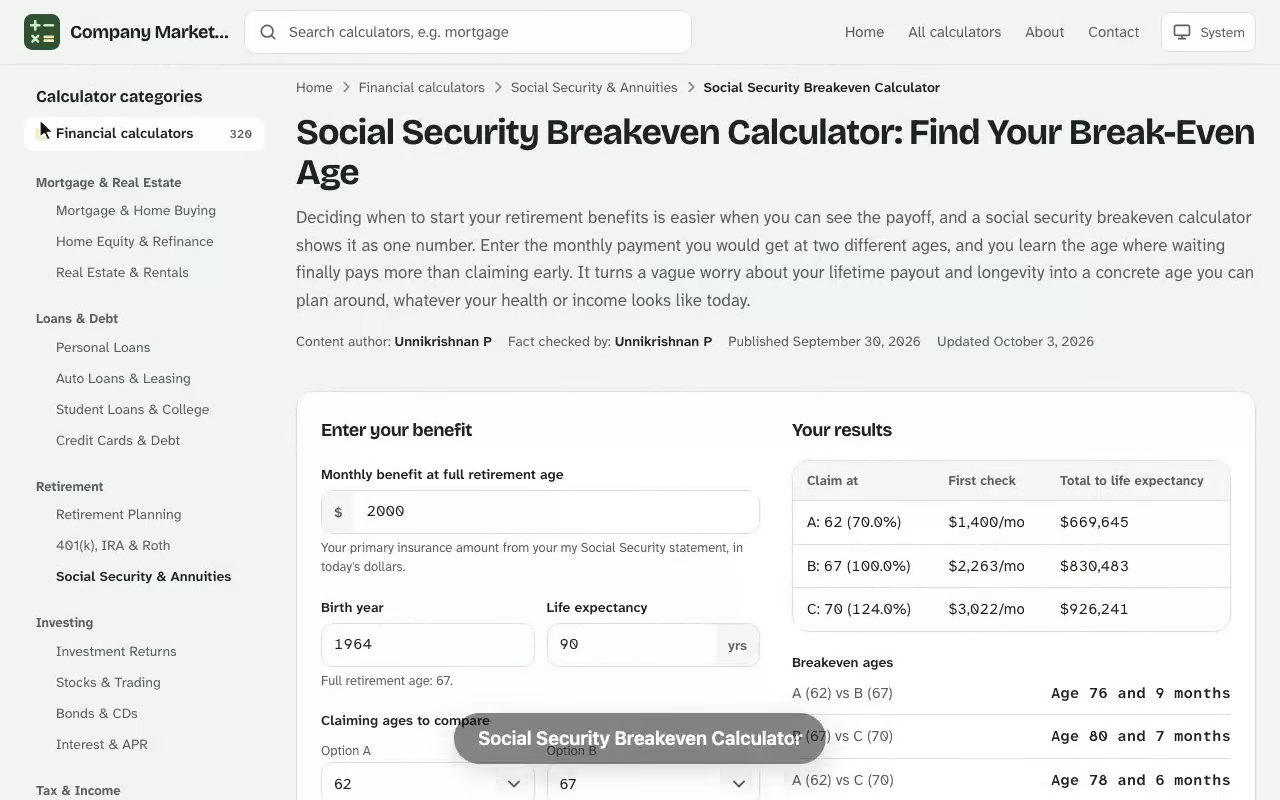
Social Security Breakeven Calculator. Deciding when to start your retirement benefits is easier when you can see the payoff, and a social security breakeven calculator shows it as one number. Enter the monthly payment you would get at two different ages, and you learn the age where waiting finally pays more than claiming early. It turns a vague worry about your lifetime payout and longevity into a concrete age you can plan around, whatever your health or income looks like today. Next, open the free annuity calculator and enter your own details to see an estimate in seconds.
Your results
Claim at
First check
Total to life expectancy
Breakeven ages
A vs B–
B vs C–
A vs C–
Ignores the earnings test, income tax on benefits and spousal or survivor benefits.
Cumulative benefits by age
Total received by the end of each year of age under each claiming option.
Age
Claim at 62
Claim at 67
Claim at 70
Results are estimates for educational purposes and are not financial, tax or legal advice.
How a Social Security Breakeven Calculator Finds Your Break-Even Point
The break-even point is the age at which the cumulative benefits from claiming later pass the cumulative benefits from claiming earlier. Every month you wait past 62 shrinks the number of checks you will collect, but each check is larger. A Social Security break-even calculator compares those two streams of money month by month and tells you when the later, bigger stream catches up. Pair this with the social security importance calculator for a fuller picture before you make a decision.
If you are asking when to claim, a Social Security calculator built around this idea gives a clear first answer. A standard Social Security benefits calculator estimates what you will be paid; a break-even calculator for Social Security goes one step further and prices the wait, so you can see what each extra year of patience costs and what it returns.
The result depends on three things: the benefit amount you are entitled to at each claiming age, the number of months between those ages, and whether you include cost-of-living adjustments. The Social Security Administration (SSA) builds your monthly amount from your earnings history, using your highest 35 years of earnings, then reduces or raises it according to your filing age. That figure is your retirement benefit, and it is the starting point for every comparison below, whether you retire at 62 or keep working into your late 60s. You can read your own estimate by signing in to your my Social Security account, where your earnings record is listed.
Why the Social Security Break-Even Age Matters
Your Social Security break-even point turns an abstract trade-off into a checkpoint, and the break-even age is how you express it in years. If you expect to live well past it, delaying looks attractive; if you doubt you will reach it, claiming early may be the sounder choice. It is a decision aid, not a prediction, and it works best alongside your savings, pension and family situation.
What a Break-Even Calculator Needs From You
You only need a few inputs: your monthly benefit estimate at each age you are comparing, the two ages themselves, and an optional annual increase for inflation. Your date of birth matters indirectly, because it sets your full retirement age and therefore the size of each reduction or credit.
Monthly benefit if you claim at the earlier age
Monthly benefit if you claim at the later age
Both claiming ages, from 62 up to 70
Expected annual increase for cost-of-living adjustments, or 0 percent to ignore it
Your annual income and expected salary increase, only if the tool also estimates the benefit for you
Break-Even Formula: Dividing the Missed Opportunity by the Monthly Benefit Difference
The arithmetic behind any calculator is short. First work out the missed opportunity, which is the money you forgo by not collecting during the months you wait. Then divide it by how much extra each check pays once you do claim. The answer is the number of months after the later claiming age that you need to live to come out ahead. If you want to see how the figures change, the free retirement income calculator gives you an instant result you can adjust as you go.
See how the Social Security Breakeven Calculator works: change the inputs and the a (69) vs b (66) updates instantly. Enter your own numbers in the calculator above.
Add those months, converted to years, to the later claiming age and you have the break-even age. In other words, \(\text{Break-even age} = \text{Later claiming age} + \frac{\text{Break-even months}}{12}\).
Monthly benefit at the earlier and later claiming ages in the worked example.
Total Benefits Received at Each Age
You can also check the answer by adding up total benefits year by year. Whichever claiming age shows the larger running total at a given age is the one that has paid more. The two totals cross exactly at the break-even age, and after that the later claim keeps pulling ahead because its monthly check is higher.
How Inflation and Cost-of-Living Adjustments Change the Answer
Social Security payments rise with annual cost-of-living adjustments, so a larger monthly check grows by more dollars each year than a smaller one. Because the cost of living tends to rise every year, the adjustment is a real feature of the payments you will receive, not a footnote. That means a calculator that includes inflation reaches the break-even age somewhat sooner than a flat calculation does. Setting the annual increase to zero gives you the plain, conservative version, and you can rerun it with a 2 to 3 percent increase to see how much the date moves.
A Hypothetical Example: Break-Even Age at 62, 67 and 70
Suppose your SSA statement shows a primary insurance amount of $2,346 a month (your PIA) at a full retirement age of 67. Claiming at 62, your eligibility age, cuts that to about 70 percent, or $1,642. These are reduced benefits for life, and you collect them for 96 months before 70. Waiting until 70 adds delayed retirement credits that raise it to about 124 percent, or $2,909, which is your maximum benefit. The table runs the formula for each pair of ages with no cost-of-living increase.
Comparison
Monthly difference
Missed opportunity
Months to catch up
Break-even age
Claim at 62 vs 67
$704
$98,520
140 months
78 years 8 months
Claim at 62 vs 70
$1,267
$157,632
124 months
80 years 4 months
Claim at 67 vs 70
$563
$84,456
150 months
82 years 6 months
Take the first row. Between 62 and 67 you collect $1,642 for 60 months, which is $98,520. Waiting pays $704 more per month, so $98,520 ÷ $704 gives about 140 months, or 11 years and 8 months after 67. That lands at 78 years and 8 months.
Where each break-even age falls between the three claiming ages.
Cumulative Benefits by Age
The running totals show who is ahead at each stage of retirement. At 80, claiming at 67 has paid $365,976 against $354,672 for the age-62 claim, while the age-70 claim trails at $349,080. By 85 the order has flipped completely: $523,620 for age 70, $506,736 for age 67 and $453,192 for age 62. By 90 the gap between the earliest and latest claim is $146,448.
Cumulative benefits by claiming age, using the $2,346 example with no cost-of-living increase.
Reading the Result in Months and Years
A calculator may show the answer as months, a decimal age or years and months. They all say the same thing. Convert months to years by dividing by 12, and remember that the break-even age is measured from your birthday, not from the day you start claiming.
Using a Break-Even Calculator to Choose Between 67 and 70
Marisol, a 64-year-old dental hygienist, wants to know whether to stop working at 67 or push on to 70. Her statement shows $2,739 a month at her full retirement age of 67 and $3,396 a month at 70, so she enters both figures, the ages 67 and 70, and an annual increase of 0 percent.
The break-even calculator multiplies $2,739 by the 36 months she would wait, a missed opportunity of $98,604. The extra check is $657 a month, so $98,604 ÷ $657 gives 150 months, and the tool reports a break-even age of 82 years and 6 months.
She then compares that age with the life tables the SSA publishes, which give a 67-year-old woman roughly 19 more years, or about 86. The break-even age sits four years short of that, so the delay is favored on average. Her mother died at 79, though, and that history matters more than an average.
Next she reruns the numbers with the annual increase at 2.5 percent, and the break-even age drops to 80 years and 7 months, nearly two years sooner. Her decision: she will file at 69, her husband's survivor benefit rising with her check, and she will run the tool again once her 2027 statement arrives.
How Full Retirement Age Changes Your Social Security Break-Even Age
Your full retirement age (FRA) is the age at which you are entitled to your full benefit, or 100 percent, and it depends on the year you were born. Because the reduction for claiming early and the credit for claiming late are both measured against FRA, a different FRA shifts every figure in the comparison. Always confirm your FRA before you trust a result.
Birth year
Full retirement age
1943 to 1954
66
1955
66 and 2 months
1956
66 and 4 months
1957
66 and 6 months
1958
66 and 8 months
1959
66 and 10 months
1960 and later
67
Claiming Early Versus Delaying Benefits
Claiming early at 62 permanently reduces your amount, though you collect for the longest stretch; it is the usual form of early retirement. Anyone who decides to claim Social Security at 62 accepts that trade. Delaying benefits past FRA earns an increase for each month, up to age 70, and after 70 there is no extra credit, so there is no reason to wait longer. Your monthly payment is therefore a sliding scale tied to the month you file.
How the SSA Calculates Your Benefit Amount
The SSA indexes your past earnings with the national wage index, averages your top 35 years into your average indexed monthly earnings, and applies three percentages with thresholds called bend points. The result is the monthly estimate you type into the break-even calculator as your early and later amounts. Only wages up to the annual wage base count, and years of noncovered employment can pull an estimate off.
Reading Your Break-Even Calculator Results
A single age is only useful in context. Compare it with how long people in your position tend to live: if your break-even age is 80 and you are in good health with relatives who lived into their 90s, the average life expectancy figure understates your own odds. Use the result as one input into your retirement income plan, not as the whole answer.
If you expect to live past the break-even age, the later claim wins on total dollars.
If you expect a shorter retirement, the earlier, smaller check collects more.
If a spouse relies on your record, a larger check also raises the survivor benefit.
If you still work before FRA, the earnings test may temporarily withhold part of the payments.
Survivor Benefits and Spousal Benefits
Your claiming age affects more than your own check. A surviving spouse steps up to the larger of the two payments, so delaying can raise survivor benefits for the longer-lived partner. Spousal benefits are capped at up to half of a worker's full amount and do not reduce the worker's own check, so couples should run the numbers for both people.
Factors Beyond the Break-Even Age: Health, Spouse and Retirement Income
A break-even age only pays off if you live past it, so your health, your marital status and your other resources decide how much weight the number deserves. Poor health makes reaching the break-even point less likely and favors an earlier claim, while a pension or IRA withdrawals that cover your bills let you wait for the larger check. A fee-only financial adviser, sometimes called a financial advisor, can test a claiming strategy against your own wealth and spending.
Sequence of Returns Risk and Your Savings
If you fund the wait by drawing down an investment portfolio, the age you can afford to delay to depends on markets as well as on the break-even age. This sequence of returns risk is why some retirees claim earlier and preserve their portfolio, and why others use savings to bridge the gap and lock in the larger check.
Taxes and Medicare Move Your Break-Even Point
Up to 85 percent of your benefits can be taxable, and Medicare premiums are set from your reported income. Both shrink the net gain from each extra monthly dollar, so an after-tax comparison pushes the break-even point later than the gross figure the calculator shows. Rerun your retirement calculator inputs with after-tax amounts, as part of your planning, to see the difference.
Social Security Breakeven Calculator questions
What is the Social Security break-even age?
It is the age at which the total benefits from claiming later catch up with the total from claiming earlier. If you live past it, the later claim has paid more in total dollars.
How do I calculate my Social Security break-even point?
Multiply the early monthly benefit by the months you would wait, then divide by the extra monthly benefit the later claim pays. Add the result, in years, to the later claiming age.
What is a typical break-even age?
For claiming at 62 versus waiting until full retirement age or 70, the break-even point usually falls somewhere between the late 70s and early 80s, depending on your amounts and any cost-of-living increase.
Does the calculator include cost-of-living adjustments?
Yes. The Average Annual Increase field raises both benefit streams each year. Set it to 0 percent to see the plain comparison without inflation.
Where do I find my monthly benefit at each age?
Your Social Security Statement in your my Social Security account lists estimated monthly benefits at 62, your full retirement age and 70.
Should I claim early if I expect a shorter lifespan?
If you have health concerns that make reaching the break-even age unlikely, an earlier claim can collect more in total. Weigh that against your other income and any spouse who may rely on your benefit.
Does the break-even age affect survivor benefits?
Indirectly. A surviving spouse steps up to the larger of the two checks, so delaying can raise the survivor benefit even when you would not live past your own break-even age.