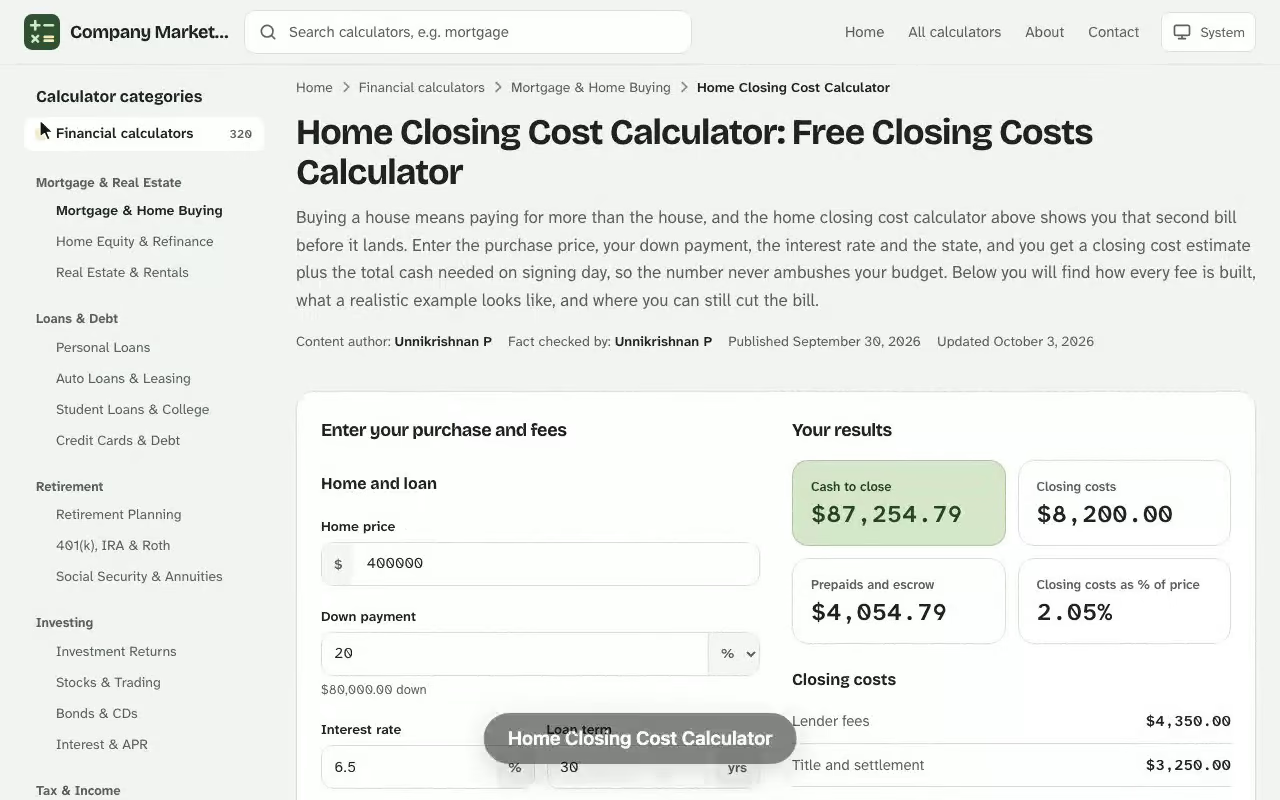
Home Closing Cost Calculator. Buying a house means paying for more than the house, and the home closing cost calculator above shows you that second bill before it lands. Enter the purchase price, your down payment, the interest rate and the state, and you get a closing cost estimate plus the total cash needed on signing day, so the number never ambushes your budget. Below you will find how every fee is built, what a realistic example looks like, and where you can still cut the bill. Next, open the house affordability calculator online and enter your own details to see an estimate in seconds.
Your results
Cash to close
–
Closing costs
–
Prepaids and escrow
–
Closing costs as % of price
–
Closing costs
Lender fees–
Title and settlement–
Government fees–
Other services–
Prepaids and escrow
Prepaid interest–
Homeowners insurance–
Escrow deposit–
Your loan
Down payment–
Earnest money and credits–
Loan amount–
Monthly payment with tax and insurance–
Fees vary by lender, state and title company. Your Loan Estimate and Closing Disclosure show the actual figures.
Itemized closing costs
Every cost you entered that is above $0, grouped as they appear on a closing statement.
Section
Item
Amount
Results are estimates for educational purposes and are not financial, tax or legal advice.
What are closing costs and settlement costs?
Closing costs are the fees you pay to finish a home purchase, on top of the down payment. Lenders, title companies and local governments each take a share, which is why the bill is often called settlement costs, settlement charges or simply closing expenses. They are charged once, at the closing table, and they are separate from your monthly mortgage payment. Next, open the home buyer savings calculator and enter your own details to see an estimate in seconds.
A common rule of thumb puts closing costs at 2% to 5% of the loan amount. That range is wide enough to swing a budget by thousands of dollars, which is the reason a mortgage closing cost calculator beats a guess. Your final figure depends on the home price, the lender you pick, the loan type and where the property sits.
Cash to close versus closing costs
The two terms are not the same. Cash to close equals closing costs plus your down payment, adjusted for any deposit you already paid and any credit from the seller. When you search for a cash needed to close calculator, this is the figure you want: the full amount that must reach the settlement agent by wire transfer or cashier's check.
Why the bill is hard to predict
No two closings look alike. A buyer in a county with a high transfer tax, a lender that charges an origination fee and a title company that quotes a premium policy can pay twice what a neighbor pays for a similar house. Timing matters as well: closing late in the month shortens the prepaid interest period, while closing early in the month lengthens it. The calculator lets you rerun the numbers after every change so you can see which choice moves the total the most.
Who pays the closing costs
Typically the buyer carries most of them. Your real estate agent can negotiate seller concessions into the purchase agreement so the seller covers part of the bill, and some builders and programs offer seller subsidies as well. Concessions are capped by loan type, so ask your lender how much is allowed.
How the home closing cost calculator works
The tool follows the same structure as the official Loan Estimate form, so each result maps to a real line on the paperwork. It adds the fee groups together and then adds your down payment to reach cash to close. Pair this with the mortgage purchase price calculator for a fuller picture before you make a decision.
$$\text{Cash to Close} = \text{Closing Costs} + \text{Down Payment}$$
Here, Loan Costs cover the lender's charges and the services tied to the loan, while Other Costs cover taxes, prepaid items and the initial escrow payment. Percentage-based fees use the formula \(\text{Fee} = \text{Loan Amount} \times \text{Rate}\), and the loan amount is the purchase price minus the down payment.
What you enter
Purchase price of the home you plan to buy
Down payment, as a dollar amount or a percentage of the price
Interest rate you expect from your lender
Discount points and the origination fee your lender charges
The state and county, because recording fees and transfer taxes differ by location
What you get back
You see the loan amount, total loan costs, total other costs, the grand total of closing costs and the cash to close. Treat the output as a budgeting tool: your lender's official Loan Estimate and, three business days before closing, the Closing Disclosure carry the exact figures.
Reading your results step by step
Once the calculator returns your numbers, work through them in the same order the lender will. Start with the loan amount, because every percentage-based fee scales from it. Next look at total loan costs, the part you can still shop. Then check the prepaid and escrow lines, which depend on your insurance quote and your county's tax rate rather than on the lender.
Confirm the purchase price and down payment match your offer.
Check that the interest rate and points match the quote you were given.
Compare total loan costs with the 2%-5% rule of thumb.
Replace the default homeowners insurance and tax figures with your own quotes.
Add the down payment to see the cash you must have ready.
If the cash to close is larger than your savings, change one input at a time. A larger down payment raises cash to close but lowers the loan amount and the percentage fees. Skipping the discount point lowers closing costs but raises the rate. Asking for a seller concession lowers the cash you bring without changing the price. Seeing each trade-off side by side is the reason to use a calculator before you sign anything.
Closing costs by down payment and discount points, with the $18,194 worked example outlined.
Loan costs in a mortgage closing cost estimate
Loan costs sit in sections A, B and C of the Loan Estimate. They are the largest and most negotiable part of any closing costs worksheet, so they deserve the closest look.
Origination charges and discount points
Origination charges pay the lender for creating the loan. They typically bundle an origination fee (often a percentage of the loan), a processing fee and an underwriting fee. Discount points are optional extra charges: each point costs 1% of the loan and buys a lower interest rate. Compare the annual percentage rate, not only the rate, because the APR folds these lender fees into one yearly figure.
Services you cannot shop for
Your lender picks these vendors, and the charges are fairly standard: the appraisal fee, the credit report fee and the flood certification. These lender fees are small compared with origination, but they are due even if the loan later falls through.
Services you can shop for
The Loan Estimate lists services you can shop for, and this is where comparison shopping pays off. The list includes the title search, lender's title insurance, the home inspection, a survey fee, attorney fees to the settlement agent and the document preparation fee. These are third-party fees, so you can pick a provider from your lender's list or choose your own.
Other settlement charges and prepaid closing costs
The second half of the closing costs calculator output covers taxes, prepaid items and escrow. These pre-paid expenses do not pay a vendor for a service; they fund your first months of owning the home.
Recording fees and taxes
The recording fee registers the deed and mortgage with the county, and transfer taxes are levied by the state, county or city when ownership changes. Together these government fees are not negotiable, and they are the reason the calculator asks for your location. The mortgage surcharge some jurisdictions add belongs in this group too.
Prepaid interest and homeowners insurance
Prepaid interest covers the days between closing and the end of that month, so a mid-month closing means more days to prepay. Lenders also require prepaid homeowners insurance, usually a full 12-month premium paid at closing. On an FHA loan you may also owe an upfront mortgage insurance premium.
Escrow and property taxes
The initial escrow payment seeds the account your lender uses to pay bills for you later. It typically holds a couple of months of homeowners insurance and several months of escrow property taxes. Because property taxes depend on the county, the same price can produce a different escrow deposit across two states. Owner's title insurance, an optional policy that protects you, is also listed in this section.
Title search, title insurance, inspection, survey, settlement fees
Yes
E. Taxes and government fees
Recording fees and transfer taxes
No
F. Prepaids
Prepaid interest, 12 months of homeowners insurance
Partly
G. Initial escrow payment
Escrow for insurance and property taxes
No
H. Other
Owner's title insurance
Yes
Seven Loan Estimate fee groups ranked by dollar amount for the $412,500 example.
Worked example: closing expenses on a $412,500 house
Suppose you are buying a $412,500 home with 10% down ($41,250). The loan amount is $371,250, the interest rate is 6.35% on a 30-year loan, and your lender charges a 0.75% origination fee plus one discount point. Property tax runs 1.1% of the price a year.
Fee
How it is figured
Amount
Origination fee
0.75% of $371,250
$2,784.38
Discount point
1% of $371,250
$3,712.50
Processing and underwriting
$495 + $845
$1,340.00
Appraisal, credit report, flood certification
$645 + $52 + $17
$714.00
Title, inspection, survey, settlement, documents
$1,215 + $485 + $410 + $975 + $175
$3,260.00
Total loan costs
$11,810.88
Recording fee and transfer taxes
$187 + 0.2% of price
$1,012.00
Prepaid interest
15 days at 6.35% on $371,250
$968.81
Prepaid homeowners insurance
12 months
$1,584.00
Escrow: insurance and property taxes
2 months + 3 months
$1,398.38
Owner's title insurance
One-time premium
$1,420.00
Total other costs
$6,383.19
Total closing costs
$18,194.07
That is 4.41% of the price and 4.90% of the loan, comfortably inside the 2%-5% range. Adding the $41,250 down payment, your total cash needed is $59,444.07. Without the discount point, the closing costs would fall to $14,481.57, which shows how one lender choice moves the whole bill.
Loan costs and other costs build to $18,194 of closing costs; the down payment lifts cash to close to $59,444.
Estimating settlement costs on a $268,900 condo
Dana has an accepted offer on a $268,900 condo and $21,000 in savings, and wants to know whether that covers everything due at the closing table. Dana opens the calculator and enters a $268,900 purchase price, 5% down ($13,445), a 6.875% rate, a 1% origination fee and zero discount points.
The lender's early quote supplies the third-party fees, which add up to $5,310, and the county's tax rate of 1.35% sets the escrow deposit. After Dana clicks Calculate, the closing cost estimate comes back at $11,657.32. That is 4.56% of the $255,455 loan, inside the 2% to 5% rule of thumb, but the cash to close reads $25,102.32, which is $4,102.32 more than Dana has saved.
The result shows where the gap comes from. The $2,554.55 origination fee and $5,310 of third-party charges make up most of the bill, and neither shrinks with a smaller down payment. With less than 10% down on a conventional loan, Fannie Mae allows the seller to contribute up to 3% of the price, or $8,067, toward the buyer's closing costs.
So Dana reruns the numbers with a 2% seller concession of $5,378 and sends the counteroffer through the real estate agent. The recalculated cash to close falls to $19,724.32, leaving $1,275.68 of the savings as a cushion. The next step is concrete: when the Loan Estimate arrives within three business days, Dana checks that its total closing costs match the $11,657.32 estimate and that the concession appears as a lender credit.
Average closing costs by loan type
The loan program changes which fees you pay, so use the same closing costs calculator but adjust the inputs.
Conventional fixed-rate and adjustable-rate mortgage loans
A fixed-rate mortgage locks the rate for the whole term, so the fees are the standard set above. An adjustable-rate mortgage usually costs about the same to close, so enter the starting rate in the calculator and compare the adjustment caps, not just the fees.
FHA loan, VA loan and USDA loan
An FHA loan adds an upfront mortgage insurance premium. A VA loan replaces it with a funding fee that some borrowers are exempt from, and a USDA loan carries its own guarantee fee. Each program also limits which costs the seller may cover.
First-time buyer programs
State housing agencies and lenders offer assistance programs that put grants or deferred loans toward closing costs. They often come with income limits and a homebuyer education course, so check eligibility early, since the funds must be approved before the closing date and show up as a credit on your Closing Disclosure.
Jumbo loan
A jumbo loan exceeds the conforming limit, so its closing costs grow with the loan amount; enter the full balance into the estimate, because percentage-based fees scale with it. Appraisal and underwriting charges also tend to be higher.
How to estimate closing costs and cut them
To estimate closing costs well, run the calculator twice: once with your expected fees and once with the lowest realistic ones. Then act on the gap.
Shop around and negotiate closing costs
Shop around by requesting a Loan Estimate from at least three lenders for the same loan type.
Ask each lender to waive or reduce the processing fee and the document preparation fee.
Negotiate closing costs by asking for a lender credit in exchange for a slightly higher interest rate.
Choose your own provider for the services you can shop for, such as title and survey.
Ask your real estate agent whether the seller will help with a concession.
Loan Estimate and Closing Disclosure
Within three business days of a completed application, your lender must send a Loan Estimate, the document that replaced the old good faith estimate. Three business days before closing you receive the Closing Disclosure with the final numbers. Compare the two line by line, and use the Consumer Financial Protection Bureau's explainer if a charge looks unfamiliar. Many buyers also get a pre-approval letter first, which makes lender comparisons easier.
Budget for closing costs and cash to close
Treat closing costs as a second savings goal beside the down payment, and set aside a little extra if you plan to buy a home warranty. A buyer who saves only for the down payment often discovers the gap at the last minute.
Use the calculator's cash-to-close figure as your savings target. Open a separate savings account, set a monthly transfer that reaches that amount a month before you sign, and add a buffer of roughly one percent of the price for surprises such as a re-inspection or a rate lock extension, so a few hundred dollars of movement between the estimate and the final statement never stalls the deal.
Write down the total closing costs on each Loan Estimate you collect and compare them in one place, since the lender with the lowest rate is not always the one with the lowest fees.
Checking your estimate on closing day
Verify the wire instructions by phone before you send your cash to close.
Compare the Closing Disclosure with your calculator estimate and your Loan Estimate for changes.
Confirm that the homeowners insurance policy is active on the closing date.
Closing costs when you refinance or pay cash
If you refinance, you pay many of the same loan costs again, and lenders often quote about the same percentage as for a purchase. Even an all-cash buyer owes title, recording and attorney charges, although there is no origination or appraisal for a loan.
See how the Home Closing Cost Calculator works: change the inputs and the cash to close updates instantly. Enter your own numbers in the calculator above.
Compare lenders' closing costs without hurting your credit
Each lender will pull your credit report, but credit checks for the same type of loan within a short window count as one inquiry for your credit score. A loan officer can explain each fee, and a financial advisor can help you decide how much cash to commit to the home purchase. A homebuyer who knows the price ranges for each fee in their state, county and city can spot an inflated charge on any mortgage loan or home loan quote.
Home Closing Cost Calculator questions
How much are closing costs on a home?
Closing costs usually run about 2% to 5% of the loan amount. Your own figure depends on the price, lender, loan type and location, so run the calculator with your real fee quotes.
What is included in closing costs?
Lender charges such as origination and underwriting, appraisal and credit report fees, title and settlement services, recording fees and transfer taxes, prepaid interest and homeowners insurance, and the initial escrow deposit for insurance and property taxes.
What is the difference between closing costs and cash to close?
Closing costs are the fees alone. Cash to close adds your down payment and then subtracts any credits, such as a seller concession or an earnest money deposit you already paid.
Who pays closing costs, the buyer or the seller?
The buyer typically pays most of them, but your agent can negotiate seller concessions into the purchase agreement. Each loan program caps how much the seller may contribute.
Can I negotiate or reduce my closing costs?
Yes. Compare Loan Estimates from several lenders, ask them to trim fees such as processing, choose your own provider for services you can shop for, and consider skipping discount points. Government recording fees and transfer taxes are not negotiable.
When will I know my exact closing costs?
Your lender must send a Loan Estimate within three business days of a completed application and a Closing Disclosure at least three business days before closing. Compare both against this estimate.
Do discount points change my closing costs?
Each discount point costs 1% of the loan amount and is added to your origination charges. In exchange, it can lower your interest rate, so compare the annual percentage rate as well as the total fees.
Do I pay closing costs on a refinance or an all-cash purchase?
A refinance has many of the same loan costs as a purchase. An all-cash buyer skips loan fees but still pays title, recording and attorney charges.