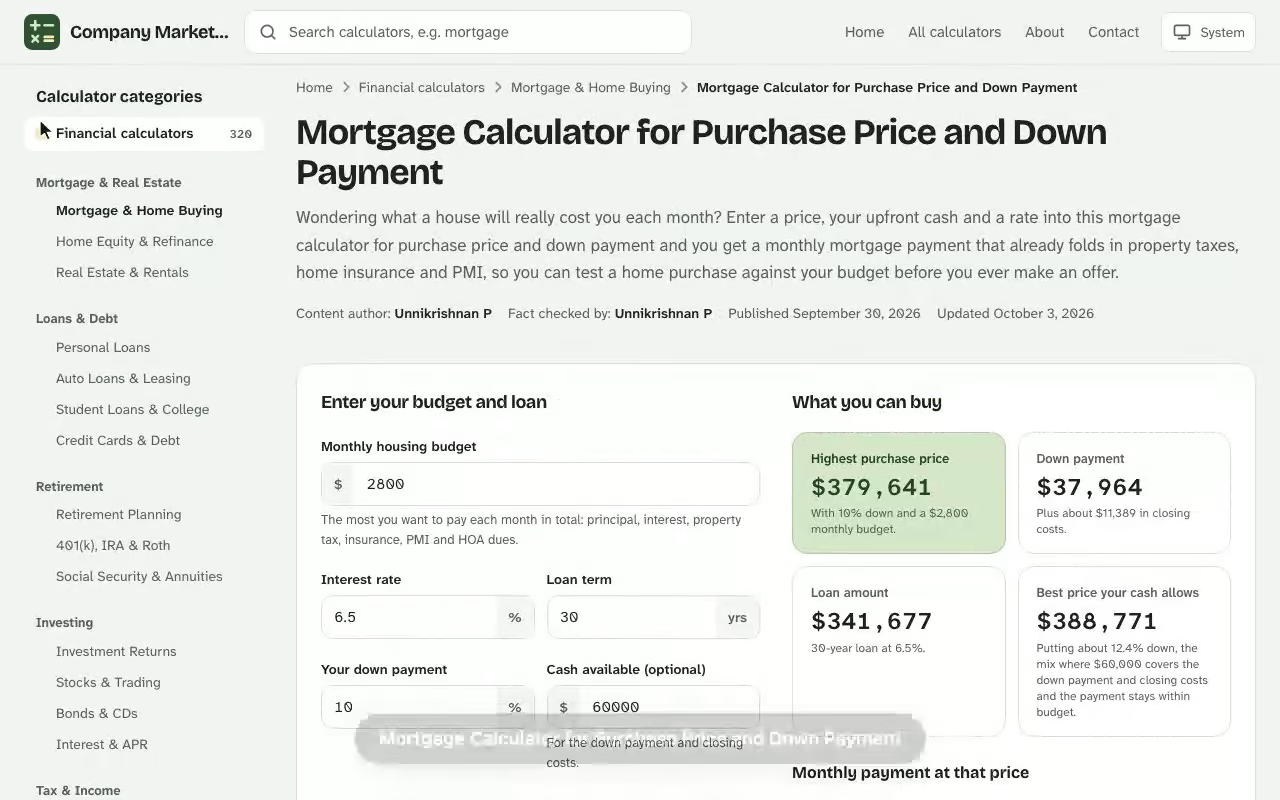
Mortgage Calculator for Purchase Price and Down Payment
Mortgage Calculator for Purchase Price and Down Payment. Wondering what a house will really cost you each month? Enter a price, your upfront cash and a rate into this mortgage calculator for purchase price and down payment and you get a monthly mortgage payment that already folds in property taxes, home insurance and PMI, so you can test a home purchase against your budget before you ever make an offer. Try the house affordability calculator to run your own numbers — everything is calculated in your browser and nothing you enter is stored or sent anywhere.
What you can buy
Highest purchase price
–
Down payment
–
Loan amount
–
Best price your cash allows
–
Monthly payment at that price
Principal and interest–
Property tax–
Home insurance–
PMI–
HOA dues–
Total (your budget)–
Cash to close (down payment + closing costs)–
Not enough cash for this down payment
This works from the payment you choose, not from your income. Lenders will also check your debt-to-income ratio and credit.
Price you can buy at each down payment
The same monthly budget at different down payments. A bigger down payment buys a more expensive home, and 20% or more removes PMI; the last column checks each one against your cash.
Down payment
Home price
Down payment amount
Loan amount
Principal and interest
PMI
Cash to close
Your cash covers it
Results are estimates for educational purposes and are not financial, tax or legal advice.
How the Mortgage Calculator for Purchase Price and Down Payment Works
The tool starts with one subtraction. Whatever you do not pay upfront becomes the loan amount, and that balance is what the lender charges interest on for the whole loan term. Once you have the loan amount, the calculator spreads it across every month of the term, then stacks the recurring costs of ownership on top so the result looks like the bill you will actually receive. If you want to see how the figures change, the free home closing cost calculator gives you an instant result you can adjust as you go.
You fill in a handful of values and click the Calculate button:
Purchase price: the agreed price of the home you are thinking of buying.
Down payment: the cash you put toward the home at closing, entered as a dollar amount or as a percentage of the price.
Interest rate: the yearly rate your lender quotes for a fixed-rate loan.
Loan term: how many years you have to repay, most often 30 years or 15 years.
Property tax and home insurance: yearly amounts that the lender usually collects monthly through an escrow account.
HOA fees and PMI: optional monthly costs that apply to some homes and some borrowers.
Down payment percentage versus dollar amount
Enter either form and the calculator lands on the same loan amount, which drives everything downstream. If you type 12% the tool converts it to dollars, and if you type a dollar figure it shows you the matching down payment percentage. Seeing both side by side makes it easy to tell whether you clear the 20% mark that removes private mortgage insurance.
Interest rate and loan term
Two loans for the same amount can feel completely different depending on these two inputs. A higher interest rate raises every payment, while a longer loan term lowers the monthly bill but multiplies the total interest you hand over by the end.
The Monthly Mortgage Payment Formula
Lenders use the standard amortization formula for a fixed-rate loan. The principal-and-interest portion is: Next, open the fha loan calculator and enter your own details to see an estimate in seconds.
$$M = L \times \frac{i\,(1+i)^{n}}{(1+i)^{n}-1}$$
Here \(L\) is the loan amount, \(i\) is the monthly rate (the yearly rate divided by 12) and \(n\) is the number of monthly payments. The loan amount itself comes from a simple rule:
$$L = \text{Home Price} - \text{Down Payment}$$
The calculator then adds the other recurring pieces to reach your all-in figure:
Remember that the first part, principal and interest, never changes on a fixed-rate loan. Taxes, insurance and HOA dues can all rise over time.
Worked Example: A Home Price of $387,500 With 12% Down
Suppose you are eyeing a $387,500 house and you have saved $46,500, which is exactly 12% of the home price. The loan amount is $341,000. You are quoted a 6.35% fixed rate on a 30-year loan, annual property taxes of $4,450, home insurance of $1,740 a year and no HOA. Because you are below 20% down, the lender adds PMI at 0.62% of the loan per year.
Monthly cost
How it is figured
Amount
Principal and interest
$341,000 at 6.35% over 360 payments
$2,121.82
Property taxes
$4,450 ÷ 12
$370.83
Home insurance
$1,740 ÷ 12
$145.00
PMI
0.62% of $341,000 ÷ 12
$176.18
Total out-of-pocket
All four added together
$2,813.84
The total of 360 payments comes to $763,857 in principal and interest, which means total interest paid reaches $422,857, more than the amount you borrowed. Only $317.37 of the first payment is monthly principal; the rest is interest. With no extra payments, the loan pay-off date lands 30 years after your first payment, so a November 2026 start means a payoff date of October 2056, and the final balance is exactly zero.
See how the Mortgage Calculator for Purchase Price and Down Payment works: change the inputs and the highest purchase price updates instantly. Enter your own numbers in the calculator above.How the four monthly costs build the $2,814 payment in the worked example.
How Your Down Payment Changes the Monthly Payment
Putting more cash down shrinks the loan, trims the interest and can erase PMI entirely. The table keeps the same $387,500 home, 6.35% rate and 30-year loan term, and changes only the down payment.
Down payment
Cash needed
Loan amount
Principal and interest
PMI
Total monthly payment
5%
$19,375
$368,125
$2,290.61
$190.20
$2,996.64
10%
$38,750
$348,750
$2,170.05
$180.19
$2,866.07
12%
$46,500
$341,000
$2,121.82
$176.18
$2,813.84
15%
$58,125
$329,375
$2,049.49
$170.18
$2,735.50
20%
$77,500
$310,000
$1,928.93
$0.00
$2,444.76
The jump from 15% to 20% is the interesting one: PMI disappears, so the monthly bill drops by about $291 even though you only add $19,375 in cash. A buyer short of 20% down should compare that saving against what the same cash could earn elsewhere or cover in reserves.
The monthly payment shrinks as the down payment grows, and PMI vanishes at 20%.
When PMI applies and when it ends
PMI, short for private mortgage insurance, protects the lender if you stop paying. It is normally required when your loan-to-value ratio (LTV) is above 80%, and it can often be cancelled once the balance falls to 80% of the original home price, with automatic termination at 78%. In the worked example that milestone arrives with payment 79, when the balance drops to about $309,975, so the $176.18 charge ends after roughly six and a half years.
Low down payment programs
You do not always need 20% down. FHA loans accept as little as 3.5% down, VA loans and USDA loans can allow no down payment for eligible borrowers, and many conventional programs start at 3%. Each program has its own mortgage insurance rules, so enter the program's down payment percentage and its actual PMI quote rather than assuming none applies, and the calculator shows the resulting bill.
Interest Rate, Loan Term and Today's Mortgage Rates
Mortgage rates move daily, and even a half-point swing changes the bill noticeably. The grid below holds the $341,000 loan constant and varies the rate and term, showing principal and interest only.
Interest rate
15 years
20 years
30 years
5.35%
$2,759
$2,317
$1,904
5.85%
$2,850
$2,414
$2,012
6.35%
$2,942
$2,512
$2,122
6.85%
$3,036
$2,613
$2,234
7.35%
$3,132
$2,716
$2,349
Moving from a 30-year to a 15-year schedule raises the payment by $820.61 a month at 6.35%, yet total interest falls from $422,857 to $188,637. Most buyers pick the conventional 30-year loan for flexibility, then shorten it later with extra payments if their budget allows.
Principal and interest by interest rate and loan term for the $341,000 loan.
Keep in mind that the quoted rate and the annual percentage rate (APR) are not the same number, because APR rolls certain lender fees into the rate. This calculator models fixed-rate mortgages. An adjustable-rate loan starts lower but can reset, so run the tool again with a higher rate to see how far the payment could climb.
A Buyer Tests a $312,400 Purchase Price and a 14% Down Payment
Dana has $52,000 in savings and a household gross income of $7,900 a month. A three-bedroom townhouse is listed at $312,400, and Dana wants to know what the monthly mortgage payment looks like before calling a loan officer. Of the $52,000, $8,264 is earmarked for closing costs and moving, leaving $43,736 for the deposit, which is 14% of the price.
Dana enters these values into the calculator:
Purchase price: $312,400, with a down payment of $43,736, so the loan amount is $268,664
Interest rate 6.58% on a 30-year fixed term
Property taxes of $3,277 a year and home insurance of $1,392 a year
HOA fees of $85 a month and PMI at 0.58% of the loan per year
After the click, the principal-and-interest line reads $1,712.30. Taxes add $273.08, insurance $116.00, HOA $85.00 and PMI $129.85, so the total monthly payment is $2,316.24. Set against $7,900 of gross income, that is 29.3%, just over the 28% front-end guideline many conventional lenders use, and Dana is under 20% down, so PMI is on the bill.
Both flags point to one rerun. Dana changes only the down payment to 20%, or $62,480, which asks for $18,744 more cash. The new total drops to $2,066.92, PMI disappears and the ratio falls to 26.2%, a saving of $249.32 every month. Because the extra $18,744 would take the savings below the three-month reserve Dana wants, the decision becomes a plan: wait about five months, save the difference, and then request the loan quote at 20% down.
Property Taxes, Home Insurance and HOA Fees Beyond the Mortgage
The loan is only part of what you owe each month. Property tax is set by your local government and varies widely, homeowners insurance depends on the age, location and replacement cost of the property, and HOA fees or condo fees cover shared services in a homeowner's association. Lenders typically gather all three into an escrow account and pay the bills when they come due. For a quick estimate of property taxes, multiply the home price by your local effective rate, which averages around 1.1% across the United States; for insurance, ask for a quote on the specific address, since coastal, wildfire and older-roof properties cost more to cover.
Recurring costs such as taxes, insurance, utilities and maintenance tend to grow with inflation.
Non-recurring costs include closing costs, commonly 2% to 5% of the loan amount, plus moving and furnishing expenses.
Reserves for repairs, such as a roof or HVAC replacement, belong in your budget even though no lender asks for them.
The estimate includes taxes, insurance, HOA fees and PMI. Closing costs and repair reserves sit outside the result, so budget for them separately.
Reading the Amortization Schedule and Testing Extra Payments
An amortization schedule shows how each payment splits between interest and principal, and how the loan balance shrinks as a result. Early payments are mostly interest; late payments are mostly principal. These checkpoints come from the worked example:
Payment
Interest paid
Principal
Ending balance
1
$1,804.46
$317.37
$340,682.63
60
$1,688.52
$433.30
$318,657.09
180
$1,305.54
$816.29
$245,899.50
300
$584.05
$1,537.77
$108,833.99
360
$11.17
$2,110.65
$0.00
That slow start is why extra payments matter so much. Adding $200 to each monthly payment retires the loan in 285 payments instead of 360, a gain of six years and three months, and cuts total interest to $319,494, a saving of about $103,363. A biweekly plan or a one-time lump sum toward principal works on the same logic, and a lower rate later through a refinance can do the same job.
Choosing a Down Payment Amount Before You Run the Numbers
Choosing a down payment amount is the biggest lever a first-time homebuyer controls. A larger deposit lowers the monthly bill, but it also drains the savings that protect you after move-in, so the right figure balances both. Run the calculator at several percentages and compare the result each one produces. Every borrower is treated a little differently, yet a few patterns hold across most home loans in the mortgage market.
Match the house price to your savings
Start with the cash you hold, subtract closing costs and a repair cushion, and treat what remains as your deposit. Divide that figure by a target percentage to see the house price it supports: $46,500 at 12% supports a $387,500 house, while the same cash at 20% supports only $232,500. Working backward like this reveals the maximum home price your savings can carry before you fall in love with a listing. Enter that price and deposit into the calculator to see what it costs each month.
Questions a borrower should ask before choosing
Will the borrower still hold three to six months of expenses after paying the down payment?
Does the lender offer a lower rate to a borrower who puts more cash down?
Does the total still fit once the PMI line drops out at 20% down?
Could a gift or an assistance program cover part of the closing costs for a first-time borrower?
Home ownership is a long game, and the costs of homeownership arrive every month, so run the calculator at your chosen deposit and confirm the resulting bill still fits your budget in a bad year. A bigger deposit also builds equity faster, which lowers your risk if prices dip.
Home Affordability: How Much House Can You Handle?
A payment estimate answers "what will this house cost?" while a mortgage affordability calculator or home affordability calculator answers the reverse question, "what can I safely spend?" A common rule-of-thumb keeps housing costs between 25% and 30% of your gross income. Using the worked example, a total of $2,813.84 would need a household income of roughly $112,550 to $135,060 a year to stay in that band.
Lenders also look at your credit, existing debt and savings. Before you commit, list your monthly bills, car and student-loan debt, and your emergency savings, and make sure the budget still works after closing costs and the first year of maintenance. A buyer with a stable income, solid credit and a cushion negotiates from strength with any mortgage lender or bank.
It also helps to know what comes after the result. If the payment looks tight, a HELOC can tap home equity without disturbing a low first-loan rate, and assumable mortgages let some buyers take over a seller's existing loan at its lower rate, which you can model by entering that rate and balance. Unlike a typical mortgage calculator that only asks for a loan amount, this one begins with the home price and your down payment, mirroring how real estate deals are negotiated. Run it for several price points, compare the results and walk into the next showing knowing your number.
Mortgage Calculator for Purchase Price and Down Payment questions
How is a monthly mortgage payment calculated from the purchase price and down payment?
The calculator subtracts your down payment from the purchase price to get the loan amount, applies the standard fixed-rate amortization formula using your interest rate and loan term, then adds monthly property taxes, home insurance, PMI and any HOA fees or other costs.
How much should my down payment be?
Many lenders prefer 20% because it avoids private mortgage insurance, but conventional loans can start near 3%, FHA loans at 3.5%, and VA or USDA loans may require none. Try several percentages and compare the total monthly payment each produces.
When do I have to pay PMI?
PMI is usually required when your down payment is below 20% of the purchase price. It can typically be cancelled once your loan balance falls to 80% of the original home value and ends automatically at 78%. The calculator only adds PMI when the down payment is under 20% and the loan type is not VA.
Does the payment include property taxes and homeowners insurance?
Yes. Enter yearly property taxes and home insurance and the calculator adds one-twelfth of each to your payment. Lenders usually collect these through an escrow account.
Is the interest rate the same as the APR?
No. The interest rate sets your monthly principal and interest, while the APR also folds in certain lender fees. Enter the interest rate quoted by your lender in the rate field.
How do extra payments change my loan?
Extra monthly, yearly or one-time payments go straight to principal, which shortens the loan and cuts total interest. Enter an amount in the extra payment fields to see the new payoff date and the interest and time you save.
What does the biweekly option show?
It shows the result of paying half of your monthly principal and interest every two weeks, which adds up to one extra monthly payment a year, along with the payoff time and interest it saves compared with monthly payments.
Does this tell me how much house I can afford?
It works from a price you choose to the payment you would owe. To work backward from your income, compare the total with the common guideline of keeping housing costs near 25% to 30% of your gross income, or try a home affordability calculator.