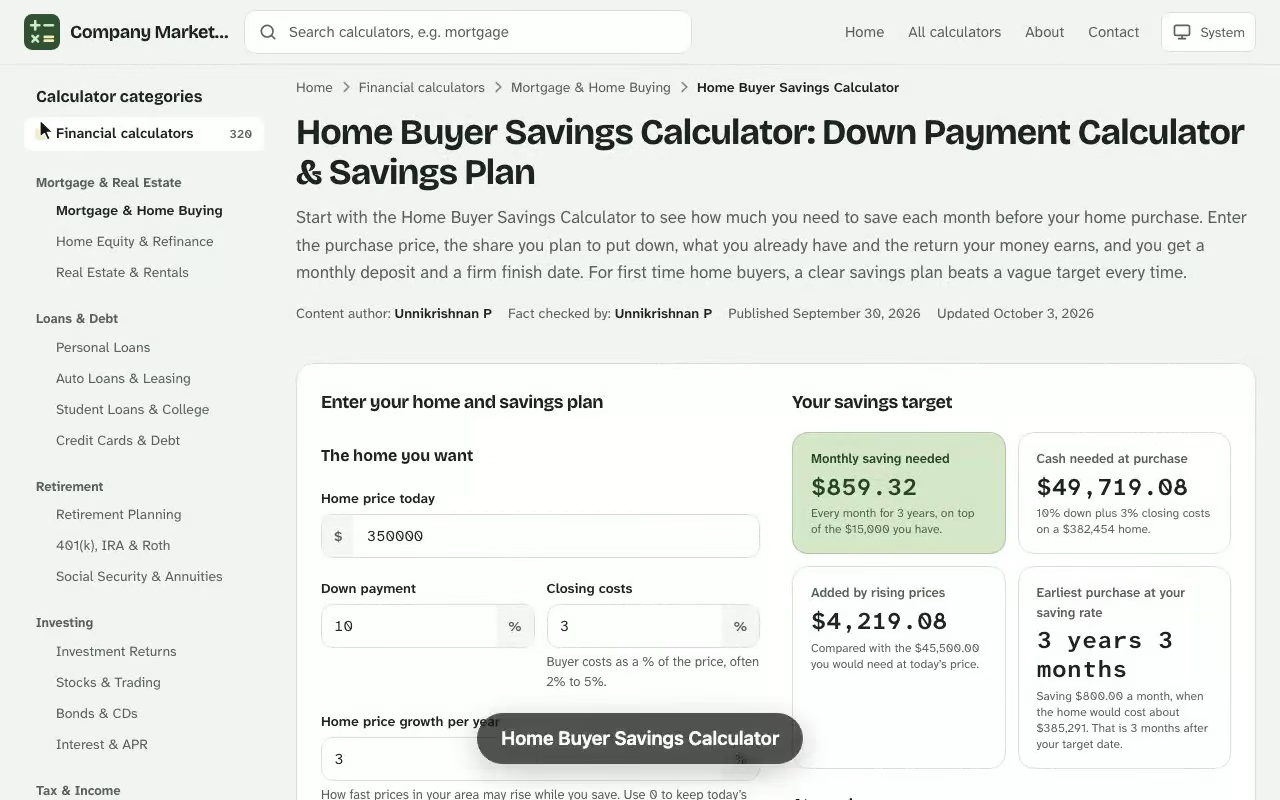
Home Buyer Savings Calculator. Start with the Home Buyer Savings Calculator to see how much you need to save each month before your home purchase. Enter the purchase price, the share you plan to put down, what you already have and the return your money earns, and you get a monthly deposit and a firm finish date. For first time home buyers, a clear savings plan beats a vague target every time. Pair this with the house affordability calculator for a fuller picture before you make a decision.
Your savings target
Monthly saving needed
–
Cash needed at purchase
–
Added by rising prices
–
Earliest purchase at your saving rate
–
At purchase
Home price then–
Down payment–
Closing costs–
What you have saved grows to–
Your monthly deposits add–
Of which interest on savings–
Prices are outrunning your savings
Year-by-year savings vs the target
The cash you would need if you bought at the end of each year, against your savings on the plan that meets your date and at the monthly amount you can save now.
Year
Home price
Cash needed
Savings on the needed plan
Savings at your monthly amount
Short by (your amount)
Results are estimates for educational purposes and are not financial, tax or legal advice.
Home Buyer Savings Calculator: Build Your Down Payment Savings Plan
The tool works backward from your goal. You name the down payment you want for a specific home, and it solves for the deposit that gets you there in the time you allow, counting the interest your balance earns along the way. Each input maps to one piece of that equation, so understanding them explains almost everything that moves your result. Next, open the down payment calculator online and enter your own details to see an estimate in seconds.
Purchase Price and Down Payment Percent
Begin with the purchase price of the house you are aiming for. Multiply it by the down payment percent you intend to pay and you have your target in dollars. Lenders commonly ask for anywhere from 3% to 20% of the price, depending on the loan, so this one input shifts your answer more than any other. A bigger share means a bigger target and a bigger monthly deposit.
Amount Currently Saved and Years to Save
The amount currently saved is your head start, and it earns interest for the entire stretch, so even a modest balance does real work. Years to save is your deadline. A longer window lowers each deposit but pushes your home purchase later, which is why many buyers try three or four timelines before settling on one.
Expected Rate of Return on Your Savings Account
Enter the interest rate your savings account pays. The calculator treats it as compounded monthly, matching how most banks credit interest, and the answer is a before-tax estimate. Money you will need within a few years belongs in an insured account rather than a volatile investment, so use a realistic, guaranteed rate here instead of a market guess.
The Down Payment Savings Formula Behind Your Savings Goal
Under the hood, the calculator solves for the equal monthly deposit that grows, together with your starting balance, to exactly your goal. First, your goal is the price times the share you will pay: Try the home closing cost calculator online to run your own numbers — everything is calculated in your browser and nothing you enter is stored or sent anywhere.
$$G = P \times p$$
Then the monthly deposit that closes the gap, using monthly compounding, is:
the home price and the down payment share, written as a decimal
S
what you have already set aside
r and n
the monthly rate (annual rate \(\div\) 12) and the number of months, which is years \(\times\) 12
D
the deposit you make each month
When your return is 0%, the formula simplifies to \(D = (G - S) \div n\), which makes a handy sanity check: it is the plain division you would do on paper.
Worked Example: A $338,000 Home Purchase
Suppose you are eyeing a $338,000 house and plan to put 15% down, which makes your goal $50,700. You already hold $8,600, your account pays 4.2%, and you want to buy in four years. Run through the formula and the answer is a deposit of $776.90 per month. Over 48 months you contribute $37,291.23, your starting balance grows to $10,170.27, and the account adds $4,808.77 in interest earned.
Input or result
Value
Purchase price
$338,000
Down payment share
15%
Savings goal
$50,700
Amount currently saved
$8,600
Expected rate of return
4.2% per year
Years to save
4
Monthly deposit
$776.90
Total deposits
$37,291.23
Interest earned
$4,808.77
Interest covers about 9.5% of the goal. The rest is your own discipline, which is why the monthly figure matters more than the return you hope for.
A few assumptions sit behind these numbers, and knowing them keeps your expectations honest. The calculation assumes you make every deposit on time, at the end of each month, and that the rate never changes. Real accounts can change their rates, and a missed month pushes the finish line back. Treat the result as a reliable planning figure rather than a guarantee, and build in a little slack by rounding your deposit up to the next convenient amount, such as $800 instead of $776.90. That small rounding habit turns a tight schedule into a comfortable one, and it costs far less than discovering in year three that you are behind. If your pay arrives twice a month, splitting the deposit in half works just as well, since the difference in interest between the two schedules is only a few dollars over the full timeline.
Save Each Month: Your Year-by-Year Deposit Schedule
Seeing the balance build helps you check progress against your plan. In the example, the first year adds only $549.81 in interest, but by year four the account is earning more than $1,900 a year, because the compounded balance keeps getting larger.
Your deposits supply about 90% of the goal in the worked example; interest earned adds the rest.
End of year
Deposits to date
Interest to date
Balance
1
$9,322.81
$549.81
$18,472.62
2
$18,645.62
$1,522.34
$28,767.96
3
$27,968.42
$2,935.71
$39,504.13
4
$37,291.23
$4,808.77
$50,700.00
Stretching the same goal to five years drops the deposit to $601.69, while squeezing it into three years raises it to $1,069.26. Earning 6% instead of 4.2% trims the four-year deposit to $735.22, and earning nothing lifts it to $877.08.
Monthly deposit by years to save and expected return, with the 4-year, 4.2% worked example outlined.
Planning a $284,900 Townhouse Down Payment with a Savings Plan
Dani Okafor, a school librarian, has a $284,900 townhouse in mind and a lender's pre-approval letter that quotes 90% loan-to-value as the sweet spot between cost and cash. That means 10% down, a down payment savings goal of $28,490. Dani has $6,315 in a savings account paying 3.85% and can spare at most $450 a month without touching the emergency fund.
The entries are simple: purchase price $284,900, down payment 10%, amount currently saved $6,315, expected rate of return 3.85%, years to save 3. The calculator returns $561.81 per month, which is $111.81 beyond the $450 ceiling. Over 36 months that plan would mean $20,225.17 in deposits and the $6,315 balance growing to $7,086.86.
Rather than abandon the goal, Dani changes one input and re-runs it. Four years drops the deposit to $407.80, which fits the budget with $42.20 to spare. The same four years also leaves room to round up to a clean $410 each month, so the plan finishes slightly ahead of schedule.
Years to save
Monthly deposit
Fits a $450 budget?
3
$561.81
No, $111.81 over
4
$407.80
Yes, $42.20 under
The result also settles one more question. At 10% down, the loan-to-value ratio is 90%, above the 80% line where conventional lenders require PMI, so Dani adds mortgage insurance to the future monthly budget instead of treating it as a surprise. Closing costs at roughly 3% of the price come to about $8,547, so Dani opens a second savings account for them and sets a $230 monthly transfer. That figure is the answer to the next question, not a guess: how long until the cash for closing is ready too.
How Much Down Payment Do You Need? Why 20% Down Still Matters
Traditionally, 20% down was the benchmark, and it remains the cleanest number to chase. Today a typical buyer puts down far less, and the average often lands between 5% and 10%. Your down payment amount decides your loan amount, your monthly cost and whether you pay extra insurance, so choose it before you set the deposit.
PMI, Mortgage Insurance and Loan-to-Value
Put down at least 20% down and you usually avoid private mortgage insurance. Put down less and your lender measures risk with the loan-to-value ratio, or LTV, which compares your loan amount with the home's value. Above 80% LTV on a conventional mortgage, PMI is normally required. Annual PMI commonly runs from about 0.3% to 1.5% of the loan, and your lender splits that annual premium into a monthly premium added to your payment.
Take the $338,000 house with only 5% down. Your loan amount is $321,100 and your LTV is 95%. At an illustrative 0.6% rate, PMI costs $1,926.60 a year, or $160.55 each month, until your equity reaches the point where the lender drops it. Each extra dollar of equity pushes that day closer, and the insurance protects the lender, not you.
Low Down Payment Loan Programs for Home Buyers
If 20% is out of reach, several home loan options exist, and many were built for buyers with limited savings:
An FHA loan allows as little as 3.5% down for borrowers with a qualifying credit score.
A VA loan can require nothing down for eligible veterans and service members.
A conventional mortgage usually starts at 3% to 5% down, with PMI until your equity builds.
HomeReady and Home Possible are Fannie Mae and Freddie Mac programs designed for lower down payments and moderate income.
A piggyback mortgage splits the borrowing, with a second loan covering part of the down payment so you can skip PMI, usually at a higher rate.
Government programs and local assistance grants can add to your savings, so ask lenders which ones apply in your area.
A smaller down payment gets you in sooner, but it raises your loan, your insurance and the interest you pay for years. Weigh that tradeoff against the shorter savings timeline before you commit. The program you choose changes what you type into the calculator: entering 3.5% instead of 15% on the $338,000 house cuts the savings goal from $50,700 to $11,830, and your four-year deposit drops from $776.90 to $31.81 a month because your $8,600 head start covers most of it.
What a Down Payment Calculator Leaves Out: Closing Costs, Fees and Price Growth
Any single number for your goal is a floor, not a full cash requirement. Two things sit outside the formula yet change what you must save: the costs of closing and the movement of the market while you wait.
Closing Costs, Origination Points and Hidden Costs
Closing costs typically run 2% to 5% of the price, which on a $338,000 house means $6,760 to $16,900 on top of your down payment. They bundle appraisal, title work, prepaid property taxes and lender fees, including origination points. Optional discount points lower your rate in exchange for cash at closing. Ask for a loan estimate early, because the hidden costs of buying a home are the ones that surprise people at the table, and compare fees across several lenders.
Home Price Appreciation and Inflation
Home prices rarely stand still. If the rate of appreciation in your area is 3% a year, the $338,000 house costs $380,422 in four years, and 15% down becomes $57,063. That is $6,363 more than your original goal, and it lifts the monthly deposit from $776.90 to $898.88. Inflation, a tight local supply and your chosen location all feed that climb, and each region of the country moves at a different pace.
The national median home price is a useful anchor when you are not yet sure where to buy, but real estate is local, so check the median home price in the exact area you want. If prices in your area move faster than your savings account, build a margin into your plan or shorten the timeline.
Down Payment Amounts by Home Price and Region
Home prices vary enormously, so the same percentage produces very different goals from one region to the next. The table applies four common down payment percentages to four price points, so you can see where your target falls before you open the calculator.
Home price
3% down
5% down
10% down
20% down
$250,000
$7,500
$12,500
$25,000
$50,000
$338,000
$10,140
$16,900
$33,800
$67,600
$450,000
$13,500
$22,500
$45,000
$90,000
$600,000
$18,000
$30,000
$60,000
$120,000
Median prices in the Northeast and along the West Coast sit well above those in the Midwest and much of the South, so a buyer in one region may need twice the savings of a buyer in another. Check recent real estate listings and sale records near you rather than a national average, and let a few of them set the purchase price you enter. A local real estate agent or housing agency can usually share recent sales for free.
Look at the gap between 3% and 20%: on the $338,000 house it is $10,140 versus $67,600, a difference of $57,460. That gap is the heart of the tradeoff. A lower down payment lets you enter the mortgage market sooner, but you borrow more, pay PMI and often accept a higher interest rate. Because mortgage lenders price risk by the size of your equity stake, even a jump from 5% to 10% down can improve your interest rate and shrink your monthly insurance, so compare quotes at each level before you pick a target. Each step in the percentage also resets your savings goal and your monthly deposit for the same timeline, which is why this is the first input to settle.
The gap between 5% and 20% down grows with every step up in home price.
Down Payment Help for a Veteran or a First-Time Buyer
Homebuyers who are new to the market have more help available than most expect. An eligible veteran or active service member may qualify for a VA-backed mortgage with no money down, which means you can enter 0% as your down payment percent, and many states run first-time programs that offer grants or forgivable second loans below certain income limits. A grant or forgivable second loan works the other way: you add it to the amount currently saved, which lowers the monthly deposit or shortens your years to save. Government-backed programs come with credit and income rules, so confirm your eligibility before you build a plan around one. Even a veteran who qualifies for zero down can benefit from saving something, because a modest down payment lowers the VA funding fee and the balance you carry.
Do not count on a windfall such as a bonus or company stock options. If one arrives, add it to your starting balance once it clears, which shortens the years to save, rather than treating it as the plan itself, since stock can lose value and vesting dates and taxes shrink what you actually keep. Homeownership is a long commitment, and when you are ready to buy a home, a cushion beyond the down payment covers repairs, moving costs and the first months of ownership. Aim to keep three to six months of expenses in reserve, separate from your down payment fund, before you sign. Buyers who skip that reserve often find that one broken furnace undoes years of discipline.
Ways to Shorten Your Down-Payment Savings Timeline
Once you know your number, three levers help you reach it sooner: a bigger deposit, a better return and a lower target. A fourth, more income, is the hardest to control but the most powerful.
Estimate Your Monthly Mortgage Payment Before You Save
Your down payment also sets the monthly mortgage you will carry afterward. A larger amount down lowers your mortgage payment, and a stronger credit score earns better mortgage rates. Lenders also check your debt-to-income ratio, commonly capped near 43%, so your future payment, property taxes and other debts should fit inside that limit. Get pre-approved before you start house hunting, so you know the price range that fits your income.
Rent Versus Buy While You Are Saving
Many people rent while they save, and that is a perfectly sound choice. If you can cut your rent by even a modest amount and redirect it into the account, the calculator shows how many months it removes from your plan. The question to ask is when it makes sense to buy a home, not whether to rush, because buying too early with thin reserves can cost more than renting a little longer.
Where to Keep Your Down Payment Money
Use an insured savings account, certificate of deposit or money market account for money you plan to spend within a few years. A stock or other market investment might grow faster, but it can also fall right before your closing date, and a drop of that kind would erase months of effort. Pick one place, automate a deposit each payday and treat it like a bill.
Reading Your Results and Adjusting the Plan
If the monthly figure looks too high for your budget, change one input at a time and watch what moves. Depositing $700 instead of $776.90 in the worked example stretches the timeline to 53 months, about five months past your target date. Depositing $850 instead finishes in 45 months, nearly three months early. Small, steady changes add up because every extra dollar also earns interest for the rest of the timeline.
Confirm the target by entering a realistic purchase price and the down payment percent your loan requires.
Enter your true balance and the rate your account actually pays.
Pick the shortest timeline your budget can carry, then automate the deposit.
Re-run the numbers after any raise, rate change or price shift.
See how the Home Buyer Savings Calculator works: change the inputs and the monthly saving needed updates instantly. Enter your own numbers in the calculator above.
A home buyer down payment calculator gives you the deposit, but a financial advisor can look at your full budget, refinance plans and other goals. Revisit the result every few months as rates, fees and prices change, and run your down payment savings goal calculator again after each raise, because higher income shortens the timeline. Some lenders spell it downpayment, but the math is identical, and so is the goal: a home down payment ready by closing day.
Home Buyer Savings Calculator questions
How much should I save for a down payment?
Lenders commonly ask for between 3% and 20% of the purchase price, and 20% lets you avoid private mortgage insurance on a conventional loan. Enter the percentage your loan requires as the down payment goal, then add closing costs, which often run 2% to 5% of the price.
How long will it take me to save for a house?
It depends on your goal, your starting balance, how much you deposit and the interest your account pays. Enter your deposit amount and frequency and the calculator shows the date you reach your goal, or use the years to save field to see the monthly savings needed for a deadline.
Does home price appreciation change my savings goal?
Yes. If prices rise while you save, the same percentage down costs more. The calculator grows the home price at your appreciation rate with every deposit, so the goal it shows when you finish reflects the higher price.
Do I need 20% down to buy a home?
No. FHA loans can require as little as 3.5% down, VA loans may need no down payment for eligible veterans, and some conventional programs accept 3% to 5%. A smaller down payment usually means a larger loan and private mortgage insurance.
What is private mortgage insurance (PMI)?
PMI protects the lender when you put down less than 20% on a conventional loan. It is commonly priced at roughly 0.3% to 1.5% of the loan per year and is added to your monthly payment until your equity reaches the lender's threshold.
Are closing costs part of the down payment?
No. Closing costs are a separate cash requirement covering fees such as appraisal, title work and lender charges. The closing costs field adds them to the amount you need to save so your plan covers both.
Where should I keep my down payment savings?
Money you plan to use within a few years is usually safest in an insured savings account, certificate of deposit or money market account, where the balance cannot drop right before closing. Enter the rate your account actually pays as the annual return.