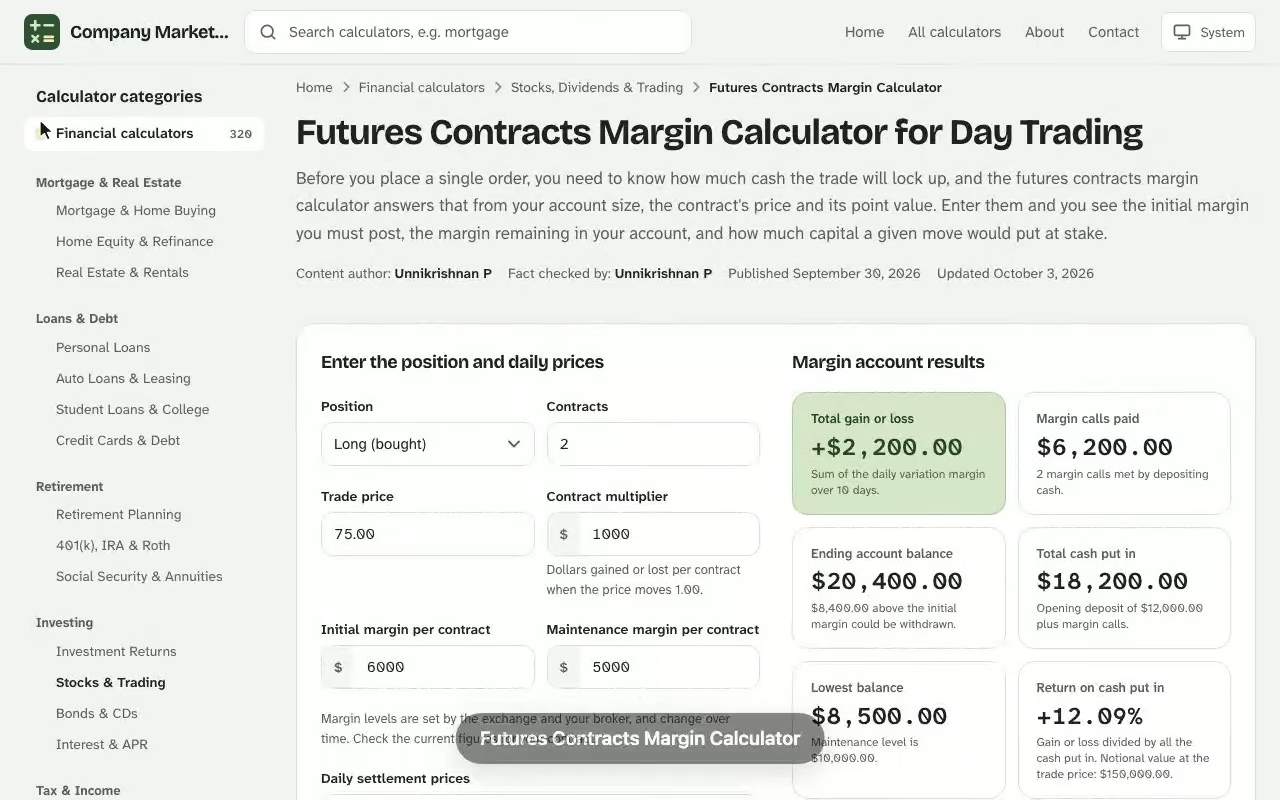
Futures Contracts Margin Calculator. Before you place a single order, you need to know how much cash the trade will lock up, and the futures contracts margin calculator answers that from your account size, the contract's price and its point value. Enter them and you see the initial margin you must post, the margin remaining in your account, and how much capital a given move would put at stake. Pair this with the pivot point calculator for a fuller picture before you make a decision.
Margin account results
Total gain or loss
–
Margin calls paid
–
Ending account balance
–
Total cash put in
–
Lowest balance
–
Return on cash put in
–
Position closed out
Daily mark-to-market
Each day the position is settled at that day’s price: the change is paid into or out of the margin account as variation margin.
Day
Settlement price
Price change
Variation margin
Cumulative gain or loss
Balance
Margin call
Balance after deposit
Results are estimates for educational purposes and are not financial, tax or legal advice.
Using the Futures Contracts Margin Calculator Step by Step
This futures margin calculator follows the same order a trader thinks in: pick the market, describe the trade, then check whether the account can carry it. Every figure it returns is plain arithmetic on the contract's published specifications, so you can verify any line by hand. The free futures and commodities profit calculator uses the same plain-English approach, so you can compare results side by side.
Choose the market and read its contract size, tick size and point value from the exchange specification.
Choose long or short, then type your entry price, your take profit level and your stop loss.
Enter your account size and the number of contracts you want to hold.
Enter the broker's margin per contract, then click the Calculate button to see margin used, margin remaining and the dollar result at each price level.
The Hypothetical Order Inputs
Think of the entries as a hypothetical order: nothing is sent to a market, so you can change the number of contracts or the stop and watch every result move. Futures prices follow each market's own format, so check the example price format before you type, because 2,684.30 for gold and 21,480.25 for an index are not entered the same way.
The Results You Get Back
The calculator reports margin used, margin remaining, notional exposure, leverage, potential profit at your target and potential loss at your stop. It also returns the risk-reward ratio, which is simply the distance to your target divided by the distance to your stop.
Futures Margin Requirements: Initial Margin vs. Maintenance Margin
Every exchange publishes margin requirements in two layers. The initial margin is the deposit needed to open a position, and the maintenance margin is the lower balance you must keep while it is open. Once the equity in your account falls below maintenance, the broker issues a margin call asking you to restore the balance to the initial level. Each margin requirement is set per contract, so doubling your contracts doubles the deposit. Next, open the annual stock option grants calculator and enter your own details to see an estimate in seconds.
A Performance Bond, Not a Loan
The deposit is called a performance bond or good-faith deposit because it shows each side can meet the contract, and it is not a loan. In margin trading on stocks you borrow up to half the purchase price under Regulation T (often written Reg T), and you pay interest on it. A futures trader borrows nothing: the money stays in the account, is held with the clearinghouse through a futures commission merchant (an FCM), and is marked to the market daily. The exchange sets the minimum, but your broker may ask for more. That is why the calculator treats the per-contract figure as money posted, not borrowed, when it works out margin remaining.
Day Trade Margin vs. Overnight Margin
Many brokers offer a reduced day trade margin for intraday positions and charge the full exchange figure if you hold overnight. These day trade margins let a small account open positions it could not otherwise carry, but the discount ends when the session does. If the balance cannot cover the full requirement, the broker will square off the position for you, and a penalty or fee can follow, so enter the figure your broker actually applies.
Futures Margin Formulas: Notional Value, Leverage and Margin Utilization
Three formulas sit behind the futures margin result. The first is the notional value, the total value of the asset a single contract controls:
The second turns that exposure into leverage, the ratio of what you control to what you deposit:
See how the Futures Contracts Margin Calculator works: change the inputs and the total gain or loss updates instantly. Enter your own numbers in the calculator above.
Your margin capacity is the total your account can post, and margin remaining is what is left after the margin used. Cautious traders keep utilization low so a few bad days cannot force a liquidation, because leftover cash is what absorbs drawdowns. The maximum contracts you can open is your capacity divided by one contract's margin, rounded down, but the sensible count of contracts to trade is almost always smaller.
Tick Value and Point Value
The minimum tick is the smallest price step a market allows, and tick value is what one such step is worth in dollars. The point value is the dollar worth of a full one-point move, equal to the tick value divided by the tick size. Micro gold moves in 0.10 steps worth $1, so one point is $10.
Worked Example: Futures Margin for Five Micro Gold Contracts
Suppose your account holds $14,600 and you want to buy micro gold at 2,684.30. One micro contract covers 10 troy ounces, so each point is worth $10. Assume your broker's illustrative initial margin is $990 per contract and the maintenance level is $900 (the real figures change often, so always take them from your broker).
For five contracts, the notional value is 2,684.30 × $10 × 5 = $134,215. The margin used is 5 × $990 = $4,950, which leaves $9,650 as margin remaining, so utilization is 33.9% and leverage is about 27x the money posted. That figure is the headline risk number: a 1% move in gold is a 27% swing against the margin you posted.
Contracts
Initial margin used
Margin remaining
Margin utilization
Notional value
1
$990
$13,610
6.8%
$26,843
2
$1,980
$12,620
13.6%
$53,686
3
$2,970
$11,630
20.3%
$80,529
4
$3,960
$10,640
27.1%
$107,372
5
$4,950
$9,650
33.9%
$134,215
6
$5,940
$8,660
40.7%
$161,058
8
$7,920
$6,680
54.2%
$214,744
Five contracts post $4,950 of initial margin and leave $9,650 of the $14,600 account free.
Reading Profit, Loss and Risk-Reward with a Futures Calculator
Margin tells you what the position costs to hold, but a futures calculator is only useful when it also shows profit and loss. In the example above, a move of 45 points (450 ticks) is worth 5 × $10 × 45 = $2,250, or 15.4% of the account. Up at 2,729.30 that is a gain; down at 2,639.30 it is a loss of the same size.
A stop 12 points below your entry caps the dollar risk at 5 × $10 × 12 = $600, or 4.1% of the account. With a target 45 points above, your risk-reward ratio is 45 ÷ 12 = 3.75. A risk calculator view like this tells you whether a trade is worth taking before the market decides for you, which is the core of risk management.
A 45-point move on five contracts is worth $2,250 at $10 per point.
Potential profit: targets above a long entry, or below a short one, multiplied by the point value and the contracts.
Stop loss: the price that ends the trade, which fixes the loss you accept.
Risk-reward ratio: reward distance divided by risk distance, kept above 1 for most plans.
Commissions and trading fees: subtract them per contract so the net result is honest.
Sizing an MNQ Trade with a Futures Calculator
A trader with $9,320 in the account wants to buy Micro E-mini Nasdaq-100 futures at 21,934.50 and has already decided that no single trade may risk more than 2% of the account, which is $186.40. Before touching the order ticket, the trader opens the futures calculator and types in the account size, the entry price, the $2 point value and the broker's initial margin of $2,140 per contract.
Three contracts come back first. The margin used is $6,420, which is 68.9% of the account and leaves $2,900 in margin remaining, over the 50% ceiling the trader set. Leverage reads 20.5x on a notional value of $131,607. The trader also enters a 38-point stop, and the loss at that stop for three contracts is 3 × $2 × 38 = $228, or 2.4% of the account, so the 2% rule fails as well.
The trader drops to two contracts and clicks the Calculate button again. Now the initial margin is $4,280 (45.9% utilization), the margin remaining is $5,040, and the notional value is $87,738. The same stop risks 2 × $2 × 38 = $152, which is 1.6% of the account and under the $186.40 limit. A target 76 points above entry, at 22,010.50, is worth $304, so the risk-reward ratio is 2.0.
Entry: 21,934.50, long, two contracts.
Stop: 21,896.50, a $152 loss.
Target: 22,010.50, a $304 gain.
That is a futures margin check that took a minute and moved the decision from three contracts to two. The result is the order the trader places, with the stop attached.
Margin Call Risk: When Leverage Turns Against Your Account
A margin call is triggered by adverse price movement, not by the original margin deposit. With five contracts, maintenance is 5 × $900 = $4,500, so your equity can lose $14,600 − $4,500 = $10,100 before the call. That is 202 points, a drop to 2,482.30, or 7.5% below your entry. Most traders should never get near that, which is why a tight stop matters more than the margin itself. Leverage cuts both ways: it magnifies gains and losses alike, and in a fast session the price volatility can gap through a stop.
Written down, the plan is short. Decide your maximum dollar loss per trade before the session opens, keep the margin used well under half of your capital, and size the position from the stop distance rather than from how much margin is available. Many traders who blow up skip that order and size by what the broker allows. Futures trading rewards that discipline, and a repeatable trading plan treats each trade as one of many, so a single stop-out is a small cost of trading, not a crisis, and the calculator is where the plan gets written down. Size contracts from the dollar risk the calculator returns for your stop, keep margin used under about half of your account size, and review your losses weekly against what it predicted, and adjust your day trading size if the actual figures run larger than the stop implied.
The margin call level sits 202 points below the 2,684.30 entry, far beyond the stop.
Margin Requirements by Futures Contracts: ES, NQ, Gold and Crude Oil
Futures contracts are standardized agreements to buy or sell an asset at a set price on a future date, so every market has a fixed size and tick. The E-mini and micro index products are the most common starting point, and each micro is a tenth of its larger sibling: MES versus ES on the S&P 500, and MNQ versus NQ on the Nasdaq-100. The same ratio applies to gold and to crude oil.
Market
Contract size
Tick value
Point value
ES (E-mini S&P 500)
$50 × index
$12.50
$50
MES (Micro E-mini S&P 500)
$5 × index
$1.25
$5
NQ (E-mini Nasdaq-100)
$20 × index
$5.00
$20
MNQ (Micro E-mini Nasdaq-100)
$2 × index
$0.50
$2
MGC (Micro Gold)
10 troy ounces
$1.00
$10
CL (Crude Oil)
1,000 barrels
$10.00
$1,000
The contract's trading hours, delivery months and expiration date matter as well. Contracts end by cash settlement (index futures) or physical delivery (many commodities), and most traders close out well before either happens. Margin can change near expiration, so check the current figure before you enter it.
Who Uses a Margin Calculator and Why
People trade futures for two reasons. A producer, farmer or fund will hedge, using hedging to lock in a price on a commodity such as corn or oil, or on a currency or stockindex. Others speculate, and speculation only needs a small deposit to control a large exposure. Hedgers use the calculator to size exposure against a physical position, and day traders use it to check margin remaining before each entry. Both groups face commodities and stock indexes under the oversight of the CFTC, and the regulation of the market is what keeps contract terms uniform.
Traders in India meet a similar idea as F&O margin, where the broker adds exposure margin on top of the exchange requirement and credits a spread benefit when two legs offset each other. Buying options needs the full premium rather than margin, so only sold options and futures carry a margin line.
Whatever the route, a small tradingaccount rewards planning: your trading platforms show live margin, but a calculator lets you test the plan first, in advance, using the capital you really have, and check that your deposit covers a rough position without leaving you short of equity when volatility spikes.
Futures Contracts Margin Calculator questions
What is futures margin?
Futures margin is a good-faith deposit, also called a performance bond, that you post to open and hold a futures position. It is not a loan, and it is a small fraction of the contract's full notional value.
What is the difference between initial margin and maintenance margin?
Initial margin is the deposit needed to open a position. Maintenance margin is the lower balance you must keep while it is open. If your account equity falls below maintenance, your broker issues a margin call to bring it back up to the initial level.
How many futures contracts can I trade with my account?
Divide your account size by the margin per contract and round down to get the maximum. Most traders use only part of that capacity, so also check the contracts allowed by your risk limit, which is based on your stop loss and the share of your account you are willing to lose.
Why is day trade margin lower than overnight margin?
Many brokers cut the margin for positions that are closed within the same session because the exposure is shorter. If you hold past the cutoff, the full exchange margin applies, so enter the figure that matches how you plan to trade.
How much of my account should I use as margin?
There is no single rule, but a lower margin utilization leaves more room to absorb drawdowns. As a rough guide, under 25% is conservative, 25% to 50% is moderate, 50% to 75% is high, and above 75% leaves little room before a margin call.
What is the difference between ES and MES margin?
MES is a micro contract one-tenth the size of ES, so its point value is $5 instead of $50 and its margin is proportionally smaller. Micros let smaller accounts size positions more precisely.
How is notional value different from margin?
Notional value is the full value of the asset the contract controls, calculated as price times point value times contracts. Margin is only the deposit. Dividing notional value by margin used gives your leverage.
Do margin requirements change?
Yes. Exchanges and brokers adjust margin requirements when volatility rises or falls, so always use the current figure from your broker rather than a fixed number.