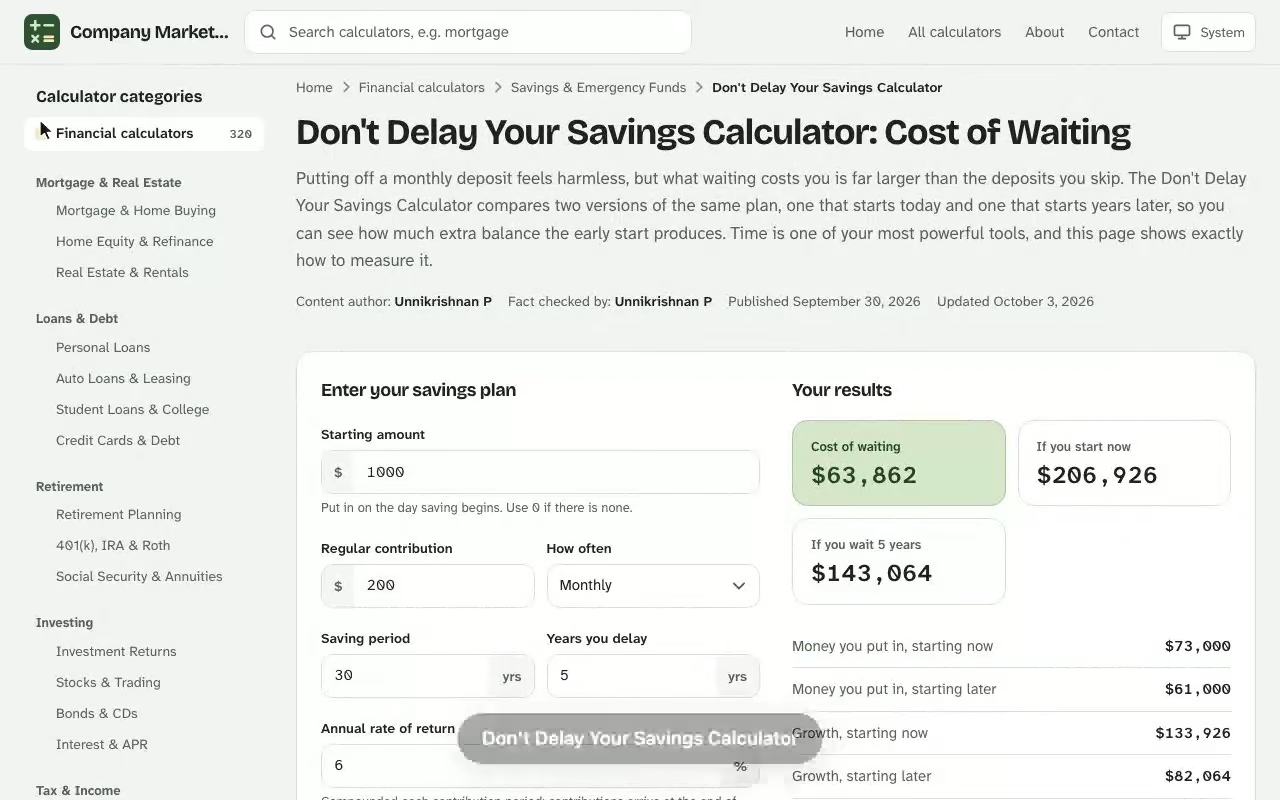
Don't Delay Your Savings Calculator. Putting off a monthly deposit feels harmless, but what waiting costs you is far larger than the deposits you skip. The Don't Delay Your Savings Calculator compares two versions of the same plan, one that starts today and one that starts years later, so you can see how much extra balance the early start produces. Time is one of your most powerful tools, and this page shows exactly how to measure it. Pair this with the savings calculator for a fuller picture before you make a decision.
Your results
Cost of waiting
–
If you start now
–
If you wait 5 years
–
Money you put in, starting now–
Money you put in, starting later–
Growth, starting now–
Growth, starting later–
Cost from contributions you skipped–
Cost from growth you missed–
To catch up after waiting, contribute per month–
Both savers stop on the same date. The one who waits starts with the same starting amount and contribution.
Start now vs start later
Year-end balances for both savers and the gap between them.
Year
Start now
Start later
Gap
Results are estimates for educational purposes and are not financial, tax or legal advice.
How the Don't Delay Your Savings Calculator Works
You enter six values, press the calculate button, and receive the delayed and non-delayed balances plus the gap between them, which is the money you earn or lose by timing alone. Every input matters, and each one is defined below so you know what to type before you run your own numbers. The compare savings rates calculator is free to use with no sign-up, and works on desktop and mobile.
Starting amount and starting balance
The starting amount is the money you already hold today. Think of it as your starting balance: it earns the same return in both scenarios, whether or not you delay new deposits. If you never add anything, the delayed and on-time results come out identical, which is a useful sanity check.
Additional contributions and contribution amount
The additional contributions field is the recurring deposit you plan to add. Your contribution amount is assumed to land at the beginning of each period, so every deposit starts working immediately; the calculator treats all contributions at the beginning of each period the same way. Choose a figure you can keep up through the lean months, because consistency beats a large amount that stops after a year.
Annual interest rate and rate of return
Your annual interest rate is the yearly growth you expect. For a bank product this is the quoted rate; for an investment it is the rate of return you assume. Over long periods stock-heavy portfolios have produced an annual compounded rate of return well above what a bank pays, but that return is hypothetical and never guaranteed. A cautious planner tries several rates and keeps the lower result as the working figure.
Years to postpone saving
The years to postpone saving field sets how long you wait before the first new deposit. Your time to grow, the total number of years, stays fixed, so a longer wait means fewer total deposits and fewer compounding periods for each of them.
See how the Don't Delay Your Savings Calculator works: change the inputs and the cost of waiting updates instantly. Enter your own numbers in the calculator above.
Frequency of contributions and compound frequency
The frequency of contributions can be monthly, quarterly or annually. Pay frequency often decides it: a salaried worker usually deposits monthly, while a freelancer may prefer a quarterly lump after invoices clear. How often interest is added, the compound frequency, shifts the final balance slightly, and in this tool interest is added monthly.
Enter your starting amount, the deposit, the number of years and the annual rate.
Set how many years you would wait and how often you deposit.
Read the delayed balance, the on-time balance and the gap between them.
How the Cost of Waiting Is Calculated
The result rests on the standard future value of a lump sum plus a stream of deposits. With a monthly rate \(i = r \div 12\), a total of \(n\) months and \(k\) months of actual deposits, the final total balance is: Next, open the free benefit of spending less calculator and enter your own details to see an estimate in seconds.
Here \(P\) is the starting amount and \(C\) is the monthly deposit. For the on-time plan \(k = n\); for the delayed plan \(k = n - 12 \times d\), where \(d\) is the number of years you wait. The cost of waiting is simply the difference:
Because the first term is the same in both plans, the entire gap comes from deposits that never got the chance to compound. All figures are before tax, and they ignore fees and inflation, which later sections cover.
Savings Goal Calculator Example: Eight Years of Waiting
Consider a saver with a $4,200 starting amount who can deposit $275 a month for 30 years at an assumed 6.5% annual rate. Run on time, the plan grows to $335,212. Wait 8 years before the first deposit and the same plan ends at $190,798, a gap of $144,414.
Measure
Start now
Wait 8 years
Deposits made
$99,000
$72,600
Interest earned
$232,012
$113,998
Final total savings
$335,212
$190,798
The delay skips only $26,400 of deposits (96 payments of $275), yet it removes $144,414 from the final balance, roughly 5.5 times the money not saved. The deposits you skip are the ones that would have compounded the longest.
The $144,414 cost of waiting on a $275 monthly plan at 6.5% over 30 years.
How Each Extra Year Changes the Result of a Bank Interest Calculator
Any bank interest calculator that supports recurring deposits shows the same pattern, and this tool simply puts the delay up front. Using the example above, here is what each additional year of waiting removes from the 30-year balance:
Years you wait
Final balance
Cost of waiting
0
$335,212
$0
1
$312,811
$22,401
3
$272,138
$63,074
5
$236,411
$98,801
8
$190,798
$144,414
10
$164,962
$170,250
15
$113,293
$221,920
The first year of waiting costs about $22,000, but the cost per year grows as the horizon shortens: waiting from year 10 to year 15 removes another $51,670. After a 10-year wait the loss exceeds half of the on-time balance, which is why the best moment to start is almost always the present one.
Final balance after 30 years for each length of delay.
Testing a Three-Year Wait with a Savings Calculator
Marisol Okafor, a 43-year-old middle-school teacher earning $62,000, plans to hold off on extra retirement saving until a car loan ends in three years. Before agreeing with that plan, Marisol opens the calculator and enters the real figures: a $11,850 balance already set aside, $410 a month, 22 years to age 65, a 5.8% assumed return, and 3 years to postpone saving, with monthly deposits.
The result comes back in a second. Starting now ends at $261,490; waiting three years ends at $212,982. The difference, $48,508, is the cost of waiting, and it dwarfs the $14,760 of deposits (36 payments of $410) that the delay would skip.
Two numbers give that result context. First, $410 a month is $4,920 a year, about 7.9% of Marisol's salary, half of the 15% of income that Fidelity's widely cited retirement guideline suggests, so the plan is already below the benchmark before any delay. Second, the gap equals more than 3.2 times the skipped deposits, so the car loan's relief is small next to what it removes later.
Marisol reruns the calculation with one input changed, setting the wait to 1 year. The cost drops to $17,113. That is the decision point: the car loan has 12 payments left on the fastest payoff schedule, so Marisol sets up an automatic $410 transfer to begin in 12 months, not 36, and writes the date on the calendar.
Why Compound Interest Punishes a Late Start
Interest earned in one period is added to the balance and earns interest of its own in the next. That feedback loop is the power of compound interest, and it needs time rather than large deposits.
Compounding and annual percentage yield (APY)
The annual percentage yield, or APY, expresses the real yearly growth once compounding is included. A 6.5% rate compounded monthly produces an APY near 6.7%, slightly more than the headline number. When comparing accounts, compare APY to APY.
Simple interest versus compound growth
Simple interest pays only on the original principal, so $4,200 at 6.5% earns $273 a year forever. With compounding, the second year earns on $4,473 and each later year earns on a larger base. The growth over time curve bends upward, and the long-term impact of a late start shows up in the final decade, when most of the interest earned arrives.
In the example, the on-time balance passes $54,593 at year 10 while the delayed plan sits at $15,097. By year 30 the delayed plan has caught up in deposits per year but never in interest, because the early dollars are gone.
Most of the on-time balance is interest earned, not deposits.
Keeping Your Savings Goal Calculator Plan Free of Delays
A projection only closes the gap if the plan survives real life. Three checks keep the deposits starting on time and the result honest: how much you deposit, what keeps you from pausing, and which assumptions could change the gap.
How much should I save each month?
There is no universal answer, but a steady savings rate of about 20% of take-home pay is a common benchmark, and a smaller amount made every month beats a bigger one made sporadically. Build a savings plan around your budget, then use the calculator to see what a $50 increase in the monthly deposit would add.
Emergency fund first, then retirement
An emergency fund of three to six months of expenses, held in a savings account, is what lets you keep depositing without interruption: without it, one car repair or job gap becomes an unplanned delay, and the earlier tables show what each year of delay costs. A savings account carries little risk of loss of principal, and a high yield savings account pays more than a standard one, so fund that reserve before you commit extra cash to retirement accounts. A second savings account can hold a short-term goal so it never raids the long-term plan.
Risk, fees and inflation
The rate you enter decides how large the gap looks, so test it. Higher assumed returns come with volatility: the S&P 500 has had years of double-digit gains and years of steep losses. Try the example again at 4.5% instead of 6.5% and the gap from an 8-year wait shrinks along with both balances, which shows the delay hurts at any rate, only by different amounts. You cannot buy an index directly, so any investment fund adds fees that lower what you keep, and inflation reduces what a future dollar buys. The calculator models neither, so treat its output as a hypothetical estimate.
Don't Delay Your Savings Calculator questions
What does the cost of waiting mean?
It is the difference between the balance you would have by starting your contributions now and the balance you would have by starting after a delay, with every other input the same. All figures are before tax.
Why does a delay cost more than the deposits I skip?
Early deposits have the most time to earn interest on interest. Skipping them removes both the deposits and the compounding they would have produced over the remaining years.
What happens to my starting amount if I postpone saving?
Nothing changes for it. The calculator assumes your current balance earns the same rate of return in both the delayed and non-delayed plans, so only the new contributions are postponed.
When are contributions assumed to be made?
At the beginning of each period. You can choose monthly, quarterly or annual contributions, and your first deposit is made when the postponement period ends.
What rate of return should I use?
Use a rate you consider realistic for the account. A savings account pays less but carries little risk to principal, while a stock-heavy investment may earn more over long periods but can lose value. Try a few rates, since future returns cannot be predicted.
How much should I save each month?
Focus on an amount you can keep up consistently. A common target is about 20% of take-home pay, but a smaller regular deposit still helps. Compare amounts with this calculator to see the difference.
Does this calculator include taxes, fees or inflation?
No. Results are before tax and ignore account fees and inflation, so treat them as estimates and test a lower rate to be conservative.