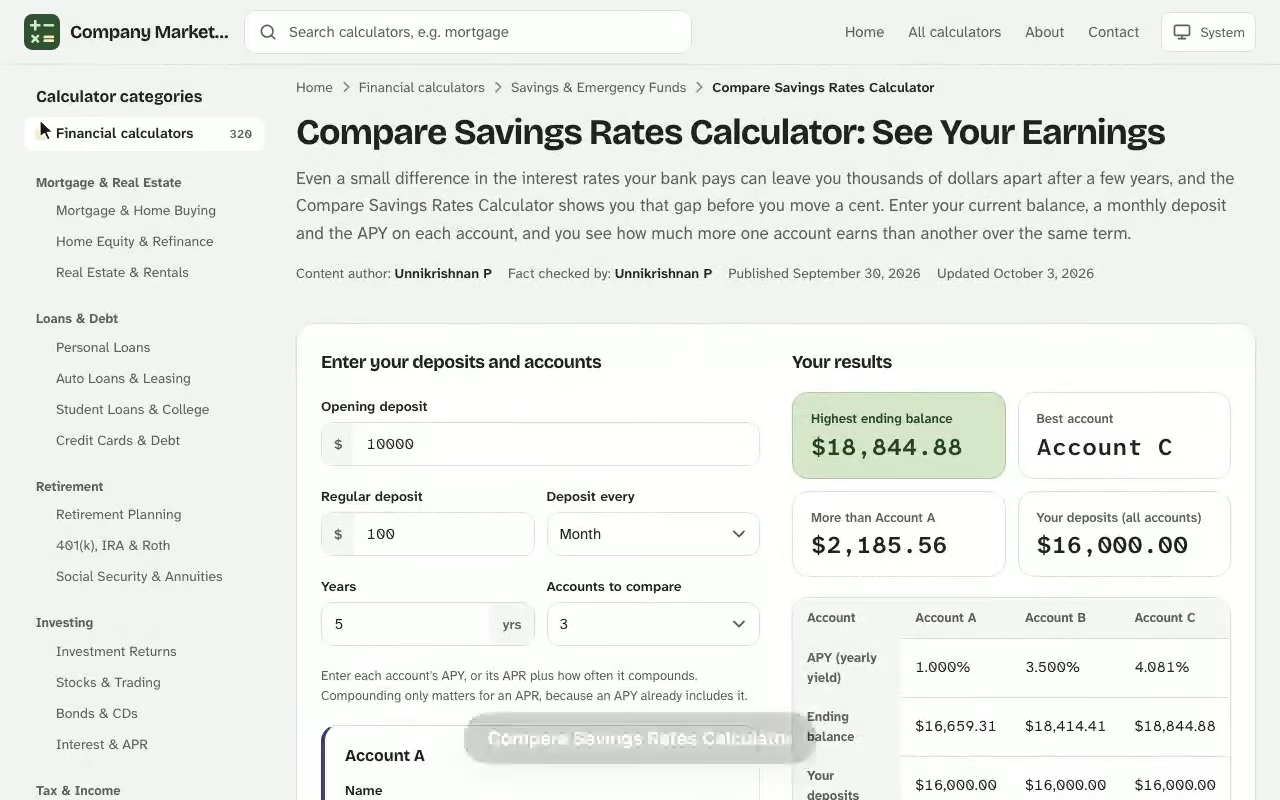
Compare Savings Rates Calculator. Even a small difference in the interest rates your bank pays can leave you thousands of dollars apart after a few years, and the Compare Savings Rates Calculator shows you that gap before you move a cent. Enter your current balance, a monthly deposit and the APY on each account, and you see how much more one account earns than another over the same term. The free savings calculator uses the same plain-English approach, so you can compare results side by side.
Your results
Highest ending balance
–
Best account
–
More than the lowest
–
Your deposits (all accounts)
–
Interest is credited monthly at a rate that earns exactly the APY over a full year. Fees come out at the end of each month; deposits arrive at month end.
Year-end balance by account
How far apart the accounts drift each year on the same deposits.
Results are estimates for educational purposes and are not financial, tax or legal advice.
Compare Savings Rates Calculator: What It Measures
Every savings account quotes a yield, but a yield on its own tells you little about your own money. This calculator turns the rate into dollars by projecting your savings balance forward under different savings rates, so you can place two or three accounts side by side and read the interest earned on each one. It is a quick way to size up the earnings potential of any interest-bearing account before you commit, and to see which offer lets you earn more from the same deposits. If you want to see how the figures change, the savings goal calculator gives you an instant result you can adjust as you go.
You supply the same handful of inputs for every account you want to test:
Initial deposit: the money you already hold or plan to move.
Monthly deposits: the amount you add each month, which can be $0.
Interest rate (APY): the annual percentage yield each bank advertises.
Term: how many years the money stays put, with no withdrawals.
Deposit timing: whether each deposit lands at the start or the end of the month.
The result is a projected ending balance and the total earnings for every rate, so the best offer for your situation stands out at a glance.
How a Savings Rate Calculator Works
A savings rate calculator converts the APY into a monthly rate, then applies it to the running balance one month at a time. Because the balance includes interest from earlier months, your savings growth speeds up the longer the money stays in the account. The don't delay your savings calculator is free to use with no sign-up, and works on desktop and mobile.
See how the Compare Savings Rates Calculator works: change the inputs and the highest ending balance updates instantly. Enter your own numbers in the calculator above.
$$r = (1 + \text{APY})^{\frac{1}{12}} - 1$$
$$B_{n} = (B_{n-1} + D) \times (1 + r)$$
Here \(r\) is the monthly rate, \(B_{n}\) is the balance after month \(n\), and \(D\) is your monthly deposit. For deposits made at the start of the month, the deposit is added before the rate is applied, as in the formula above; for deposits made at the period's close, it is added afterward.
Why APY and compounding matter
The annual percentage yield already includes compounding, so it is the right figure to compare between banks. A plain interest rate can look similar across two accounts while the effective annual return differs, because one pays compound interest daily and another only quarterly. Each compounding period adds a little more to the balance, which is why daily payers win a close race. When a bank compounds daily, it applies a tiny rate to the daily balance every day, so interest is earned on the original principal and on the interest already credited.
Compound interest takes a larger share of the balance each year.
Deposits at the start of each month vs the end of the month
Timing is a smaller lever than rate, but it is not zero. A deposit made at the start of each month earns a full month of interest before the next deposit arrives, while one made at the end of the month earns nothing until the following cycle. Over many years that single month of earnings repeats on every deposit.
Worked Example With a Savings Interest Rates Comparison Calculator
Suppose you hold $13,640 today, add $215 a month and leave everything alone for 6 years. A savings interest rates comparison calculator checks three accounts: a large bank paying 0.41% APY, a credit union paying 3.85% APY, and an online bank paying 4.30% APY. In every case you deposit $29,120 of your own money: the $13,640 opening balance plus 72 monthly deposits of $215.
Account
APY
Ending balance
Interest earned
Large bank
0.41%
$29,648
$528
Credit union
3.85%
$34,458
$5,338
Online bank
4.30%
$35,140
$6,020
Same deposits, three savings rates: the interest earned ranges from $528 to $6,020.
What the gap tells you
Moving from the large bank to the online bank adds $5,492 to your balance without a single extra deposit. The difference between the credit union and the online bank is only $682, so a branch you value or a smoother app could reasonably outweigh it. If you switch your deposits to the start of each month at 4.30%, the ending balance rises to $35,201, which is $61 more than end-of-month deposits.
How the 4.30% APY account reaches a $35,140 savings balance.
Comparing Savings Account Rates for a Closing-Cost Fund
A freelance photographer has a lender's loan estimate in hand that puts closing costs at $15,000, and the closing date is three years away. The money in question is $8,925.40 sitting in an old account at 0.45% APY. A new online account advertises 4.05% APY. Is it worth the trouble of moving?
The photographer opens the calculator and enters $8,925.40 as the starting balance, $140 as the monthly deposit and 3 years as the term. The first account goes in at 0.45% and the second at 4.05%, with deposits at the end of each month for both. Before reading the results, the photographer notes the deposits: $8,925.40 plus 36 payments of $140 is $13,965.40 of the photographer's own money.
Account
Ending balance
Interest earned
Against $15,000
0.45% APY
$14,121.48
$156.08
$878.52 short
4.05% APY
$15,415.63
$1,450.23
$415.63 over
The result settles the question. At 0.45%, the plan misses the lender's figure by $878.52, which means either a bigger deposit or a later closing date. At 4.05%, the same deposits clear it with $415.63 to spare, a gap of $1,294.15 between the two outcomes that comes entirely from the rate. The next step is concrete: open the 4.05% account, schedule the $140 transfer for the first of each month, and rerun the figures every time the bank changes its APY.
Choosing Between a High-Yield and a Traditional Savings Account
A high-yieldsavings account usually pays several times the national average because it runs with lower overhead. A traditional account at a branch network often pays a fraction of that, in exchange for in-person service. Run both rates through the calculator and you know exactly what that convenience costs you each year.
What to check in an online savings account
An online savings account can look identical to another on rate alone, so check the details that change what you actually keep:
Maintenance fees: a monthly charge can erase a lot of the interest on a small balance.
Minimum balance: some banks pay the top rate only above a set amount, or use tiered interest that drops for lower balances.
Minimum deposit: needed to open the account, and sometimes to earn the advertised rate.
FDIC insurance: deposits are covered up to $250,000 per depositor, per ownership category, at each insured bank.
Rate changes: variable rates can fall at any time, unlike a fixed interest rate on a CD.
A money market account or a CD can beat a standard account when you are happy to lock the money in, so test those yields with the same inputs before you decide.
Using a Comparison Calculator to Plan Your Savings Goals
A comparison calculator works best when you start from a target and work backward, which keeps the exercise tied to a real outcome instead of a rate chase. Set the term to your deadline, enter each account's APY, and compare the ending balances against your target to see which rate gets you there sooner. Decide what the money is for, such as a down payment, an emergency fund or a trip, and set the term to match that deadline. Then see whether a higher yield shortens the time it takes to reach the number. Note the interest earned beside each ending balance so the options are easy to rank, and rerun the comparison whenever your target or deadline changes.
Setting a budget around your monthly deposit
Your monthly deposit is the lever you control most directly. Try raising it by a modest amount and compare the annual earnings against the same change in rate. Often a better account and a slightly larger deposit together move your savings strategy further than either does alone. If you follow a budget such as the 50/30/20 split, enter that savings slice as the monthly deposit for every account you compare.
Savings Interest Calculator Limits to Keep in Mind
A savings interest calculator projects a steady rate over the whole term, but real rates move. Treat the output as a hypothetical estimate, a planning aid for your wider financial picture rather than an investment forecast, and rerun it when your bank changes its APY. It also assumes no withdrawals and no changes to fees; pulling money out lowers your current balance and the interest that balance would have earned, so a plan with planned spending needs a lower deposit assumption.
Interest is also taxable income, so your net worth gain after taxes will be slightly smaller than the on-screen earnings. The calculator measures the rate of return from the account itself, not your inflation-adjusted purchasing power, and a credit union or bank over the insured limit leaves part of the balance uncovered.
With those limits in mind, the rule of thumb holds: a higher APY, steady deposits, and a long term do the heavy lifting, and the calculator lets you see how much before you open an account.
Compare Savings Rates Calculator questions
How do I compare savings rates?
Compare the APY, not the plain interest rate, because APY already includes compounding. Enter the same balance, deposits and term for each account so the only thing that changes is the rate, then compare the ending balances.
What is APY and why does it matter?
APY, or annual percentage yield, is the total return an account pays in one year including compound interest. Two accounts with the same stated rate can have different APYs if one compounds daily and the other less often.
Does it matter if I deposit at the start or end of the month?
Slightly. A deposit made at the start of a period earns a full period of interest, while one made at the end earns nothing until the next period. The gap grows with larger deposits, higher rates and longer terms.
Are the results guaranteed?
No. Savings rates are usually variable and can change at any time, so the calculator assumes the APY stays the same for the whole term. Treat the figures as a hypothetical estimate and rerun them when your bank changes its rate.
How often is savings interest compounded?
It depends on the bank. Many online banks compound daily and credit interest monthly, while others compound monthly or quarterly. The APY you enter should already reflect that schedule.
Is the interest I earn taxable?
Interest on a savings account is generally taxable income in the year it is paid, so your after-tax gain will be smaller than the interest shown here.
Is my money safe in a high-yield savings account?
Deposits at an FDIC-insured bank are covered up to $250,000 per depositor, per ownership category, per bank. Check that the account you are considering is insured.