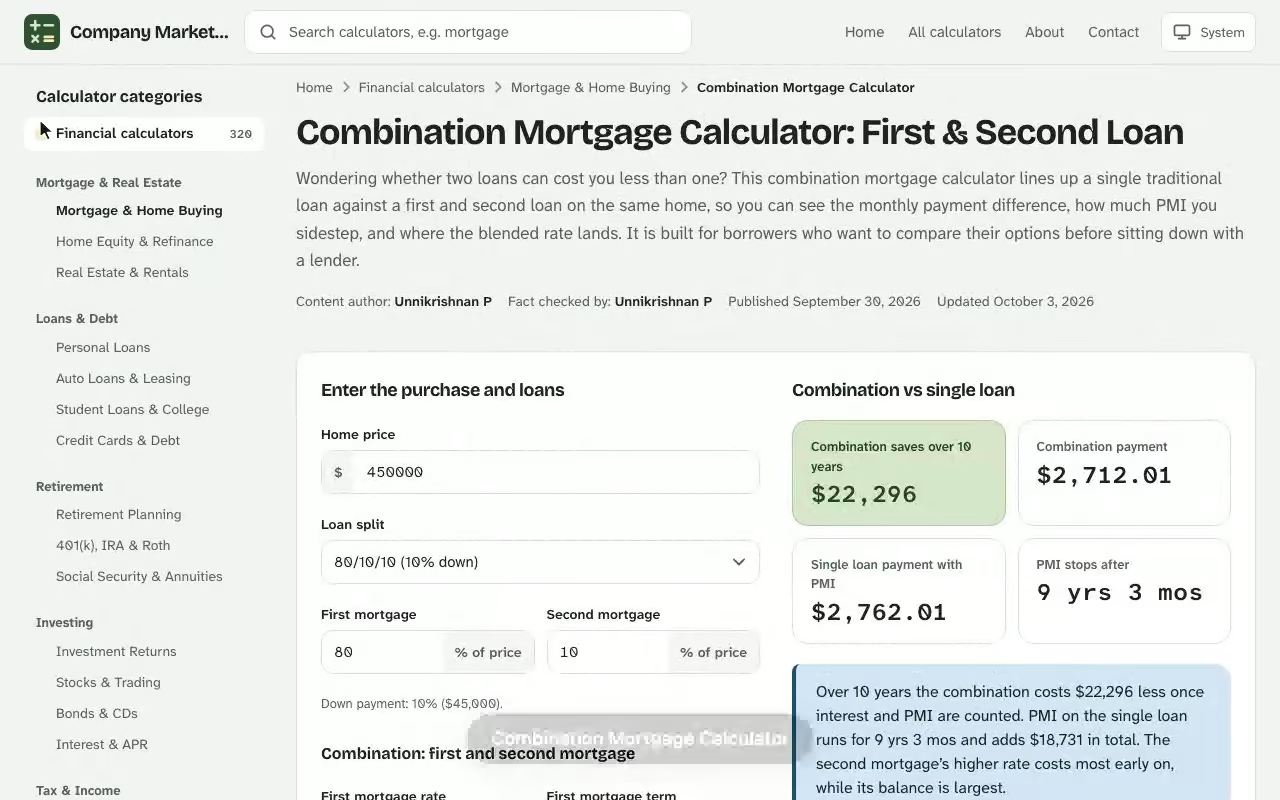
Combination Mortgage Calculator. Wondering whether two loans can cost you less than one? This combination mortgage calculator lines up a single traditional loan against a first and second loan on the same home, so you can see the monthly payment difference, how much PMI you sidestep, and where the blended rate lands. It is built for borrowers who want to compare their options before sitting down with a lender. Pair this with the free amortization calculator for a fuller picture before you make a decision.
Combination vs single loan
Difference over 10 years
–
Combination payment
–
Single loan payment with PMI
–
PMI stops after
–
–
Combination
Single loan
Year-by-year comparison
Payments include PMI on the single loan. Cost is interest plus PMI and second-mortgage fees, to the end of each year.
Year
Combination: paid in year
Combination: owed
Single: paid in year
Single: owed
Single loan costs more by
Results are estimates for educational purposes and are not financial, tax or legal advice.
How a Combination Mortgage Calculator Compares One Loan With Two
A combination structure splits your amount to finance into a first loan sized to reach an 80% loan to equity position, plus a smaller loan that covers whatever is left. Because the first loan stops at 80% of the purchase price, you can avoid PMI on it entirely, and the smaller loan carries its own rate and term. The calculator then prices a single traditional fixed rate mortgage against that pair, side by side, using the same home value, so any difference you see comes from the structure and not from different assumptions. The arm vs fixed rate mortgage calculator is free to use with no sign-up, and works on desktop and mobile.
Lenders also call this setup combination financing. The appeal is simple: a larger down payment is not always available, and private mortgage insurance on a single high-ratio loan can add a few hundred dollars every month. Splitting the debt trades that insurance premium for a second interest charge, and the math decides which one is cheaper for you.
Single loan versus split loans at a glance
Single mortgage: one loan, one interest rate, one payment, and PMI until your balance falls far enough.
Two-loan structure: an 80% first loan with no PMI, plus a smaller second loan that is usually priced at a higher rate.
What you compare: the combined monthly payment now, and the total payments across the full repayment period.
Combination Financing Inputs and What Each Field Means
Every field in the form maps to one number the payment formula needs. Fill in the purchase price and the amount you need to borrow first, then describe each loan. The definitions below walk through them in the order you will meet them. Try the free option arm calculator to run your own numbers — everything is calculated in your browser and nothing you enter is stored or sent anywhere.
Purchase price
The full price of the home you are buying. The tool uses it to work out your loan to equity ratio, which decides where the first loan stops and whether PMI applies to the single loan.
Amount to finance
The total you need to borrow after your down payment. The single loan is assumed to cover this entire figure, while the split structure sizes the first loan at 80% of the purchase price and lets the second loan absorb the remainder of the total financed amount.
Product type
Each loan can be a different product, which is the main reason to run a comparison rather than a rule of thumb. The sections below cover each choice in turn.
Fixed rate mortgage
A fixed rate mortgage keeps the same interest rate and payment from the first month to the last. The payment is set so the balance reaches zero at the end of the term. The most common choices are a 15 year or 30 years schedule.
Fully amortizing ARM
The fully amortizing ARM is the most common adjustable type. After the fixed window ends, the rate resets based on an index plus a margin, with caps limiting each change and the lifetime maximum. Because future index values are unknown, the form assumes a maximum interest rate that you can adjust to match your own forecast.
Interest only payments
With interest only payments, you pay just the monthly charge for borrowing and the principal stays untouched. That produces the lowest starting payment, but once the interest only period ends the loan converts to full amortization over a shorter remaining schedule, and the payment can jump noticeably.
Balloon mortgage
A balloon mortgage usually runs three to five years, with payments calculated as if the loan lasted thirty. With a balloon loan, the leftover balance is due in one lump at the end, so you would need to sell or go through refinancing. Use it only if you are confident about your exit plan.
Line of credit
A line of credit lets you borrow against home equity as needed. The required payment shrinks as the balance shrinks, and the rate is typically variable, which makes it a flexible but less predictable second loan.
Interest rate and term in years
Enter the annual interest rate for each loan, then the term in years over which you will repay it. A shorter term raises the monthly payment but cuts the total interest dramatically, which is why a second loan on a 15 year schedule often costs less overall than one stretched across thirty.
PMI percent
This is the yearly premium for private mortgage insurance, expressed as a percentage of the single loan balance. It applies only when the single loan starts above 80% of the home value, and it is the cost the split structure is designed to remove.
Interest only period
If you tick the interest only box, this field sets how many years the loan stays interest only. When it ends, the balance amortizes over the remaining years, so expect the payment to reset higher.
Months rate initially fixed
For an adjustable loan, this is how long the opening rate holds. A 5/1 loan, for example, is fixed for 60 months before it begins to adjust.
Interest rate cap
The interest rate cap is the ceiling that the adjustable rate cannot exceed over the life of the loan. Set it at the contractual maximum so the worst-case payment shows up in your comparison.
Months between adjustments
How often the rate resets after the fixed window. Annual resets are common, while some products reset every six months.
Expected adjustment
Your guess of how far the rate will move at each reset, as a percentage. A positive number models rising rates and a negative number models falling rates.
Worked Example: Single Mortgage vs. First and Second Mortgage
Suppose you are buying a home for $437,500 and putting 10% down, which is $43,750. That leaves $393,750 to finance. A single traditional loan would start at 90% of the home value, so lenders would require PMI. Here are the inputs for each route.
Item
Single mortgage
First loan
Second loan
Loan amount
$393,750
$350,000
$43,750
Interest rate
7.00%
6.75%
8.50%
Loan term
30 years
30 years
15 years
Principal and interest
$2,619.63
$2,270.09
$430.82
PMI at 0.65% a year
$213.28
None
None
Total monthly payment
$2,832.91
$2,700.92
The payment formula behind each loan
Each loan uses the standard amortization formula, where \(M\) is the monthly payment, \(P\) is the loan amount, \(r\) is the monthly rate (annual rate divided by 12) and \(n\) is the number of monthly payments:
$$M = P \times \frac{r(1+r)^{n}}{(1+r)^{n}-1}$$
For the single loan, \(P = 393{,}750\), \(r = 0.07 \div 12\) and \(n = 360\), which gives $2,619.63 before PMI. The PMI charge is \(393{,}750 \times 0.0065 \div 12 = 213.28\).
Monthly payment comparison
The two-loan route costs $2,700.92 a month against $2,832.91 for the single loan, so you keep $131.99 every month while both loans are running. After the 15 year second loan is paid off, your monthly mortgage payment drops to $2,270.09, a gap of $562.82 compared with the single loan plus PMI.
Monthly payment for the worked example: one loan plus PMI versus a first and second loan.
Total payments comparison
Over the full schedule, the single loan costs $943,066 in principal and interest. PMI on that loan runs for about 115 months, until the mortgage balance drops below 78% of the home value, adding roughly $24,527, for a total of $967,594. The pair of loans costs $894,782, which is $72,812 less. The saving comes from skipping the premium and from the 15 year second loan clearing its higher rate early.
Total payments over the full schedule, split into PMI avoided and rate and term savings.
Blended Rate Calculator Math: Weighting Two Interest Rates
When you hold two loans on one home, a single average makes them easier to judge. A blended rate is the average interest rate across both balances, weighted by how large each one is, so the bigger loan counts for more. The calculation is the sum of each balance multiplied by its rate, divided by the sum of the outstanding balances.
That 6.94% sits below the single loan's 7.00%, even though the second loan carries 8.50%. Keep in mind that this consolidated rate describes the day you close. Because the second loan is repaid sooner, your real effective rate changes as the balances shift, and a blended rate calculator alone does not capture the PMI you avoid.
Loan to equity and the 80% line
The first loan is capped at 80% of the purchase price: $437,500 × 0.80 = $350,000. That cap is why there is no insurance on it. Whatever remains, $43,750 here, goes onto the second loan. If your down payment is larger than 20%, there is nothing to split and a single loan is already insurance-free.
Testing Combination Financing on a $286,400 Condo Purchase
Dana has a signed contract on a $286,400 condo and $28,640 saved for the 10% down payment, which leaves $257,760 to borrow. The household budget caps principal, interest and insurance at $1,750 a month, so Dana opens the form to see whether one loan or two fits under that line.
For the single route, Dana enters a 30 year fixed loan at 6.875% and a PMI percent of 0.58%. The results show $1,693.30 in principal and interest plus $124.58 of PMI, a total of $1,817.88, which is $67.88 over budget. Because the loan starts at 90% of the price, PMI is unavoidable until the balance reaches 78% of the original value, the point at which federal law requires the lender to cancel it automatically.
See how the Combination Mortgage Calculator works: change the inputs and the single loan saves over 10 years updates instantly. Enter your own numbers in the calculator above.
Next, Dana splits the loan: a first loan of $229,120 (exactly 80% of the price) at 6.625% over 30 years, and a $28,640 second loan at 8.25% over 20 years. The comparison now reads $1,467.08 plus $244.03, or $1,711.11 a month with no PMI. That is $38.89 under budget and $106.77 less than the single loan, and the blended rate comes out at 6.81%.
Before accepting it, Dana changes one input, shortening the second loan to 10 years. The payment on that loan jumps to $351.28 and the total reaches $1,818.36, which is actually higher than the single loan, so the 20 year schedule stays. The next step is concrete: Dana asks the lender for a written quote on both loans, including closing costs for each, and sets the 20 year second loan as the figure to hold them to.
Adjustable Rate Mortgage Options for Each Loan
Either loan can be an adjustable rate mortgage, and lenders label them by the fixed period and the reset schedule. The table summarizes the most common choices so you know what to type into the months-fixed and months-between-adjustments fields.
ARM type
Months fixed
What happens next
10/1 ARM
120
Fixed for 120 months, then adjusts annually for the remaining term
7/1 ARM
84
Fixed for 84 months, then adjusts annually for the remaining term
5/1 ARM
60
Fixed for 60 months, then adjusts annually for the remaining term
3/1 ARM
36
Fixed for 36 months, then adjusts annually for the remaining term
When an adjustable second loan makes sense
An ARM usually starts with a lower rate than a fixed loan, which helps a small second balance. If you plan to pay it down within the fixed period, the adjustment risk never arrives. If you may keep it longer, test a higher expected adjustment so you see the payment under pressure.
How the second loan's rate and term change the combined monthly payment.
What the first and second loan comparison excludes
The result you get from the form covers principal, interest and PMI only. Real homeownership adds recurring bills that are identical under the single loan and the first and second loan, so they never change which route wins, but they do change the monthly budget you compare it against:
Property taxes: a yearly bill set by the local government.
Homeowners insurance: required by every lender to cover damage to the house.
HOA dues: monthly fees if the home is in a condo or managed community.
Interest only for the second loan
Choosing interest only on a $43,750 balance lowers that payment, but the principal never falls during the interest only period. Compare the total payments result before accepting the lower monthly figure.
Is a Combination Mortgage Worth It? Costs and Trade-Offs
A combination mortgage saves money when the second loan's higher rate costs less than the PMI you would otherwise pay, and the example above shows that happening. It does not always work. A second loan with a very high rate, an adjustable rate that resets upward, or extra closing costs for two sets of paperwork can erase the gain. Check each of these before you commit:
Closing costs: two loans often mean two sets of fees, so request both quotes in writing.
PMI removal: a single loan's PMI can be cancelled once equity reaches 20% to 22%, which shortens how long it costs you.
Second loan rate: compare it to the premium, not just to the first loan's rate.
Refinance plans: if you may refinance within a few years, the early payoff of the second loan matters more than its rate.
Who benefits from comparing a first and second loan
The comparison matters most when you have less than 20% down, because that is where the calculator shows whether the second loan's extra interest costs less than the PMI it replaces. Self-employed buyers and real estate investors who want cash free for other deals also run it, since the structure reaches high financing without a large cash outlay. Either way, enter both structures and let the totals decide.
Reading the results
Look first at the monthly payment comparison, then at the total payments comparison. If the split structure wins on both, it is a strong candidate. If it wins only on the monthly figure, ask yourself whether the lower payment is worth the higher lifetime cost. The same mortgage calculator logic applies if you test a 15 year first loan or an interest only second loan, so rerun the form with each scenario you are considering.
Questions to ask your lender
Ask your mortgage loan originator whether the second loan is a closed end loan or a line of credit, whether it carries a prepayment penalty, and how the rate is set. A closed end second mortgage has a fixed balance and schedule, while a line of credit can change with the market. Bring the results along and ask for a written estimate for both structures.
Combination Mortgage Calculator questions
What is a combination mortgage?
A combination mortgage splits your financing into a first loan, usually sized at 80% of the purchase price, and a smaller second loan that covers the rest. The structure can help you avoid private mortgage insurance and may lower your total monthly payment.
How does a combination mortgage help me avoid PMI?
PMI is typically required when a single loan starts above 80% of the home value. Keeping the first loan at or below 80% removes that requirement, and the second loan, which is not charged PMI, covers the remaining amount.
How is the blended rate calculated?
The blended rate is the average interest rate across your loans, weighted by balance: multiply each loan amount by its rate, add the results, and divide by the total of the outstanding balances.
Is a combination mortgage always cheaper than one loan?
No. The second loan usually carries a higher rate, and two loans can mean two sets of closing costs. Compare both the monthly payment and the total payments, and check how long PMI would last on the single loan.
What do the adjustable rate fields do?
For an ARM, months rate initially fixed sets how long the opening rate holds, months between adjustments sets how often it resets, expected adjustment is the change applied at each reset, and the interest rate cap is the highest rate the loan can reach.
What happens with an interest only loan?
During the interest only period your payment covers just the interest and the balance does not fall. Afterward the balance is repaid over the remaining years, so the payment is higher.
What is a balloon mortgage?
A balloon mortgage has a short term, often three to five years, but its payments are calculated as if the loan lasted 30 years. The remaining balance is due as one lump sum at the end, so you would need to refinance or pay it off.
Does the calculator include taxes and insurance?
Only if you enter them. Property taxes, homeowners insurance and HOA dues are optional monthly amounts that are added to both options equally, so they change your budget but not which structure is cheaper.